Mastodon Climate Citizen --> Mastodon
Showing posts with label Victoria. Show all posts

Thursday, November 28, 2024

Victoria releases latest (2022) Greenhouse gas emissions report showing year on year 4.3 megatonnes increase


The latest Victorian Greenhouse gas emissions report is for 2022 and contains the headline details for Victoria's emissions profile. It was tabled in Parliament by Climate and Energy Minister Lily D'Ambrosio.

The report is 16 pages long, and contains considerably less detail than reports from previous years which broke down data more finely and were often over 6o pages in length. So only headline details are shown, which is very disappointing and may hide particular problems in some sectors.

This is also a Net zero emissions which takes into account Land Use, Land Use Change and Forestry (LULUCF) carbon sequestration. This is notoriously difficult to estimate accurately. 

While the long term trend is decreasing emissions, in 2022 emissions actually increased. This is most likely a rebound effect with regard to recovering from the Pandemic.

Total net emissions in 2019 were  86.8 MT CO2e, in 2020 86.2MT, in 2021 80.4MT,  and in 2022 84.7MT. So between 2021 and 2022 net greenhouse gas emissions (CO2e) increased by 4.3 megatonnes.

Wednesday, January 10, 2024

Victorian Premier Jacinta Allan acknowledges climate change a factor in extreme rain and flood events

Premier Jacinta Allan has acknowledged that climate change is a factor in extreme rain and flood events, and that more needs to be done in planning to mitigate extreme weather and flood events as part of climate adaptation, along with reducing greenhouse gas emissions.

The Bureau of Meteorology has identified the first nine days of 2024 were Victoria’s wettest since records began in 1900, with an average of 62mm falling across the state since 1 January. The area-average of 62mm of rain from 1 January to 9 January beat the previous opening nine-day record of 50mm set in 1970. Using an area average for daily rainfall to 9am 8 January, the Bureau of Meteorology estimated 5.4% of Victoria was at Highest on record for rainfall for that day, with several site specific all time rainfall records surpassed. 

Interviewed by Richard Willingham on ABC Melbourne, Premier Jacinta Allan said; 

"There is clearly a change in our climate. Growing up in this part of the world, these summer storm events, it is troubling that it is becoming more common and the ferocity of these events. It does speak to the fact we need to recognise that the climate is changing. It does go to those broader measures we need to take as a government, as a community, as a society for action to transition to renewable energy, transition to how we can take stronger climate action."

"Separate to that, what also needs to be considered obviously as we plan for new houses, new communities, or how we build projects, these weather events and the impact of these weather events do need to be factored in. Indeed, legislation that went through the Victorian Parliament last year, our climate legislation, did require that the impact of the climate be factored into the planning initiatives at the earliest Opportunity."

".... What used to be a 1 in 100 year event for communities like Rochester have had 3 big flooding events in 10-11 years. The impact of climate does need to be considered in terms of future planning and decisions."

Wednesday, October 25, 2023

Victoria’s renewable energy generation reached 37.8 per cent of Victoria’s electricity generation in 2022/23


A Progress report tabled in the Victorian parliament highlights that Victoria has doubled its renewable electricity generation in the last five years to supply 37.8 percent of the electricity grid. The state is well on target for over-achieving its 2025 target of 40 percent renewables.

But we need to be aware the International Energy Agency (IEA) in its 2023 World Energy Outlook report, has called for a tripling of renewables generation based on 2022 data.

Earlier this year Victoria formerly announced its 2035 climate targets that included a VRET of 95 per cent renewable generation by 2035 (The 2035 targets were an implementation of an election promise announced in October 2022). The legislated VRET 2030 target has also been increased from 50 per cent to 65 per cent. The state also set new Victorian energy storage targets for at least 2.6 gigawatts (GW) of energy storage capacity by 2030 and at least 6.3 GW by 2035 to support an accelerated renewable energy transition in Victoria. 

As at 30 June 2023, there were 17 renewable energy generation projects under construction or undergoing commissioning in Victoria. These projects have a combined capacity of 1,734 MW. There was also one utility-scale storage project – the 150 MW Hazelwood battery – undergoing commissioning. These projects generated around 662 jobs in these renewables projects in 2022/23, many of them in regional areas of the state.

Saturday, August 19, 2023

Is Australia prepared for a wildfire emergency in 2023 summer?

Queensland Fire incidents map Sat 19 August 11am

Early Fire season started this weekend in SE Queensland. Warmer temperatures with climate change is driving earlier fire seasons, more intense fire weather.

This fire season in Queensland is one month earlier start than the 2019-2020 bushfire season.

Key Points:
🔥 BOM says conditions ripe for high fire danger
🔥 Meteorologists warn people must take precautions
🔥 Australia's worst recorded bushfire season of 2019-2020 sparked on Queensland's Granite Belt in Sep 2019, burnt for months.

According to the Buraeu of Meteorology fire danger for the following regions were rated high on Friday: Capricornia, Central Highlands and Coalfields, Darling Downs and Granite Belt, Wide Bay and Burnett, Southeast Coast. All other regions were rated as moderate fire danger.

Tuesday, May 23, 2023

Logging Native Forests in Victoria to end by 1 January 2024, saving 14 million tonnes of carbon by 2030


Cudos to Premier Dan Andrews and the State Labor Government who took the giant step of announcing the end to native forest logging in Victoria by 1st January 2024. The State Government announced an extra $200 million in funding for transition of affected workers and communities in the 2023/24 budget.

In October 2022 the Victorian Forest Alliance and The Tree Projects published a report which found that an immediate end to native forest logging could prevent 14 million tonnes of carbon emission by 2030. 

 Key facts from the report:

  • Native forest logging in Victoria emitted around 3 million tonnes of carbon in 2021.
  • Emissions from native forest logging are equivalent to the annual emissions of 700,000 cars.
  • Regrowing forests on average only ever hold up to 50% of the carbon of the original forests before they are logged again.
  • Close to 90% of Australia’s wood now comes from Australian plantations.
  • Logging plantations produces 60% less carbon dioxide emissions than the logging of native forests.
Transition is always difficult process, but it can bring new opportunities in Land management and conservation of the forests, and for recreational and tourist opportunities. It also helps guarantee the purity of Melbourne's water supply. It opens up roles for indigenous knowledge in land management, conservation and for managing bushfire threat.

We are likely to see the creation of a Great Forests National Park that many conservationists and scientists have called to be established.

Thursday, October 20, 2022

Victoria sets 75-80% emissions reduction target for 2035, Net zero by 2045, New Renewables Targets VRET of 65% by 2030, 95% by 2035.

The Victorian Labor Premier, Dan Andrews, and Climate Change Minister Lily D'Ambrosio, have announced the State's 2035 emissions reduction target, new renewable energy targets and re-establishment of a  government Owned electricity supplier for the market.. 

The new 2035 emissions reduction target is set at 75-80% reductions on 2005 levels, and net zero by 2045. It places Victoria as globally ambitious in climate targets.

Victoria new renewable energy targets are 95% renewables by 2035, 65% by 2030.

The Victorian state government will undertake to build 4.5 gigawatts of publicly owned renewables and the reestablishment of a publicly owned electric commission. 

The government has estimated its energy plan will create 60,000 jobs by 2035. 

Friday, October 7, 2022

Nitrogen Fertilizer Urea production Locking in Fossil Fuels greenhouse gas emissions for industrial Food production


A new international report identifies Fossil Fuel fertilisers as an important growth area for coal and gas sectors  as part of the petrochemical industry. Plastics and Nitrogen fertilisers are both products of fossil fuels that continue to lock us in to systemic fossil fuel consumption. 

Fossil fertilisers create greenhouse gas emissions at every stage of production to their use in industrial agriculture. They lock our food system productivity into continued greenhouse gas emissions.

Coal or Gas are major sources for nitrogen fertiliser, turning methane into Ammonia through steam reformation, and then into Urea and water. 

Here in Victoria the recently published Victorian Greenhouse Gas emissions report to 2020 highlighted the increased Urea use, while this detail was buried very deeply in the report and few have commented on the massive expansion of Urea use in Victorian agriculture over the last thirty years. (See lead graph for Victoria Urea application.)

"The total area of crop cultivation almost doubled, from 1.8 to 3.5 million hectares between 1990 and 2020, while the application of fertilisers increased from just under 50,000 to 328,000 tonnes of nitrogen (an increase of 561%) over this period. This also contributed to a significant increase in urea application emissions which grew nearly seven-fold between 1990 and 2020 (Figure 40), with particularly strong growth in the last decade (DCCEEW 2022a)." said the Victoria report.

Thursday, September 29, 2022

AGL Energy brings forward Loy Yang A coal power plant closure from 2045 to 2035

AGL Energy has announced the bringing forward of the closure date for the Loy Yang A coal power station in the LaTrobe Valley from 2045 to 2035. 

Such action was not unexpected given the Victorian Premier's announcement on Tuesday setting Victorian energy storage targets, and with continual growth in grid solar and wind farms and the planned construction of offshore wind. In March this year the Victorian Government set offshore wind targets of 2GW by 2032 and 4 GW by 2035.

But the 2035 closure date is still not ambituous and not in keeping with Paris climate target for phasing out coal. Bronya Lipski from Environment Victoria argues that a 2032 closure is in line with AEMO step change scenario. The Greens in the upcoming state election argue that all Victoria's coal plants should be phased out by 2030 with ramping up the speed of renewables and storage construction.  

Tuesday, September 27, 2022

Victoria sets Energy Storage targets of 2.6 Gigawatts by 2030 and 6.3 GW by 2035 capacity, coal may end in early 2030s

Victorian Premier Daniel Andrews and Minister for Energy Lily D’Ambrosio announced new energy storage targets alongside a $157 million package supporting renewable energy generation and storage projects across the state.

Victoria has set a 2.6 gigawatts (GW) target of renewable energy storage capacity by 2030, with an increased target of 6.3 GW of storage by 2035. This energy storage is essential to firm the growth in renewables generation from solar and wind farms.

The new storage targets include both short and long-duration energy storage systems – which can hold more than eight hours of energy to cover peak demand periods. 

The new energy storage targets, along with advancing renewables may spell the closure of Victoria's brown coal in the early 2030s. It also adds momentum to Victoria's achievements in emissions reduction in future climate targets.

Wednesday, September 21, 2022

Victoria cut emissions by 29.8% on 2005 levels by 2020. There is a pathway to decarbonisation by 2035 to meet 1.5C target.


The Victorian Premier, Dan Andrews, announced on 20 September that Victoria Smashes Emissions Targets. Victoria achieved a 29.8 per cent emissions cut on 2005 levels up to and including 2020. Victoria had set an Emissions Reduction Target of 15 to 20 per cent reduction by 2020.

Last year i reported that Victoria reduced emissions by 24.8%, on track for 45-50% reduction by 2030

The Andrews Government rebuilt Victoria's Climate Act and set a number of interim targets. 

Energy was the top sector that needed to start the decarbonisation transition process, and the Andrews Government has tackled this with growing renewables and energy storage as a proportion of our electricity production.

Victoria’s energy sector is still the state’s largest source of emissions, but continues to see deep cuts made due to the rapid upscaling of renewable energy. The sector saw renewable electricity production increase from 21.7% of total electricity generation in 2019 to 24.8% in 2020.

Friday, March 11, 2022

Victorian Government sets offshore wind targets to kickstart offshore wind industry to meet climate targets


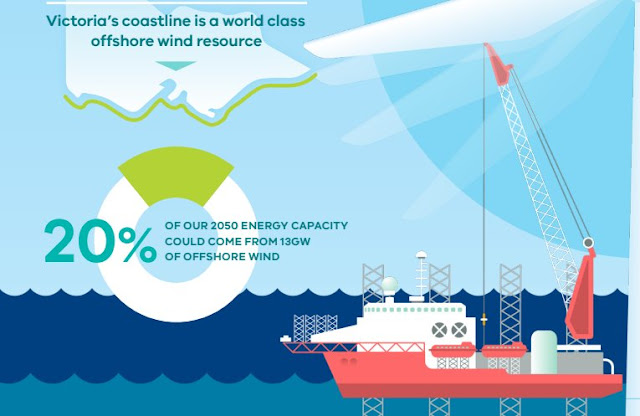
On March 4, 2022 the Victorian Government set new offshore wind farm targets. Currently there are no offshore wind farms operating in the state.

The new offshore wind targets:

  • 2032 - target of 2 GW 
  • 2035 - target of 4 GW 
  • 2040 - target of 9 GW 
  • 2050 - potential capacity of 13 GW

Federal Minister for Emissions Reduction Angus Taylor has been sitting on Federal legislation that has been needed to allow wind farm planning and construction to go ahead. This legislation was finally passed by the Federal Parliament in 2021.

Thursday, February 3, 2022

Sleepless in Melbourne - heat, humidity and rainfall set new January records for Victoria

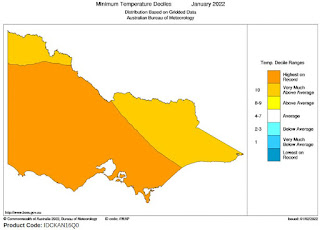
BOM: Average Tmin deciles for January

Sleepless in Melbourne? January was a warm one for Melbourne despite presence of La Nina (ENSO) which usually cools global temperatures marginally. 

The trend was particularly noteable with record mean minimum temperatures for Melbourne and most of Victoria this year. Victoria's January mean minimum temperatures are rising faster than mean maximum temperatures. 

There was also record humidity for January for most of Victoria. Record rainfall was also recorded in north east Victoria.

It seems there will be lots more sleepless January nights in store for us all in Melbourne in future years.

Saturday, October 30, 2021

Victoria reduces emissions by 24.8%, on track for 45-50% reduction by 2030

Victoria achieved a 24.8 per cent emissions reduction between 2005 and 2019 and the state’s annual emissions dropped below 100 megatonnes of carbon dioxide equivalent for the first time since 1994. This are pre-pandemic 2019 figures, and it is likely emissions have further declined during the pandemic. 

The results were contained in a report tabled in the Victorian parliament .

The Andrews government has met its legislated pledge to cut emissions by 20 per cent by 2020 ahead of schedule, and is on track to meet its target of a 28 to 33 per cent reduction below 2005 levels by 2025, and 45-50 per cent by 2030.

Sunday, May 9, 2021

Germany raises climate ambition at Petersburg Dialogue in leadup to COP26

German Finance minister Olaf Scholz and environment minister Svenja Schulze announced new proposed climate targets to press in Berlin on Tuesday 3 May 2021:
  • 65% emissions reduction by 2030,
  • 85-90% by 2040 and
  • net zero emissions by 2045, all compared to 1990 levels.
Previous German goals were 55% by 2030 and climate neutrality by 2050.

Friday, April 9, 2021

Community Panel recommends 21 actions for EV transition for Victoria to reduce Transport Emissions

Community Panel for Infrastructure Victoria on Transport Emissions. I was on this panel which had 211 Victorians (most age groups, Metro and Regional) and met online during late January to mid February 2021.

The 'Tackling Transport Emissions' Community Panel successfully worked together in a virtual environment to deliver 21 recommendations to Infrastructure Victoria using principles of a Just Transition, Equitable Access, and Shared Knowledge.

These recommendations have now been taken forward by Infrastructure Victoria to undertake a detailed technical review. This may include seeking out additional evidence or undertaking further analysis where required.

The reviewed recommendations will inform Infrastructure Victoria’s advice - to support the broader community to take up zero or low emissions vehicles sooner - to government in Victoria’s 30-year infrastructure strategy. This Strategy is planned to be released in mid-2021.

The community panel was titled 'Tackling transport emissions'. Some members felt the need to broaden the remit question's scope to include public and active transport. I was one of those people. Clearly the panel was misnamed and should have been titled 'Tackling the transition to net zero emissions by 2050 through zero emission vehicles' Of course transition to EVs is needed, but we also need to look at mode share change in behaviour for more public and active transport journeys, and urban and transport planning to change transport behaviours. Sadly this wasn't part of the remit.

Friday, September 25, 2020

DELWP fails consumer choice on electricity plans and greenhouse gas emissions

The Victorian Department of Environment Land, Water and Planning provide a website to compare gas and electricity plans. But a problem with this website is it prioritises solely on price. Some people like myself would like the option to compare plans on social and evironmental utility - on the level of greenhouse gas emissions.

Compare electricity in Victoria? DELWP need to do better with this website on comparing energy offers. It fails to empower Victorian consumers in how to maximise reduction of greenhouse gas emissions in their electricity bill plans.

https://compare.energy.vic.gov.au/

Sunday, March 17, 2019

Domestic Aviation emissions are booming while Melbourne Airport plans ignore climate risk management


Growth in domestic transport emissions compared: note aviation emissions growth is well ahead of other transport modes. Source: Charting Transport.com: Update on Australian transport trends (December 2018)


Melbourne Airport Corporation had a drop in session on 13 March at the Hume Global Learning Centre at Broadmeadows. I dropped in to raise that Melbourne airport needs to address aviation emissions growth as part of their business model for airport expansion. This also needs to be dealt with as part of their Risk Management Plan.

My presence sends a signal that Melbourne Airport Corporation need to start to address the issue of airport expansion inducing growth in aviation emissions and non-CO2 climate impact.

Sunday, December 30, 2018

Climate Diary of an extreme heatwave across Australia and climate heat impacts


The Bureau of Meteorology in the lead up to christmas in 2018 showed a heatwave building through the week. The forecast was for severe and extreme heatwave impacts particularly Thursday 27 December to Saturday 29 December.

A blocking high in the Tasman and strong heat from the Pilbara in Western Australia and right through Central Australia, will periodically extend tendrils of sweltering heat to encompass the major population centres of Adelaide, Melbourne and Sydney.

While these cities may get occasional relief from weak cold fronts and coastal sea breezes, inland towns will swelter in the scorthing heat with temperatures in the mid to high 30s and low 40s.

Thursday, October 18, 2018

IPCC 1.5C report needs to inform Moreland's transport strategy


I attended the Brunswick Town Hall, for a special hearing by Moreland Council considering oral presentations to submissions on the Moreland Integrated Transport Strategy and the Moreland Parking Policy.

I was number 19 on the list of presenters as I had made a submission on behalf of Climate Action Moreland (Read it here).

Many of the presenters spoke on the personal circumstances of traffic, parking, cycling and walking in Moreland, and concerns how the strategy and policy might affect employment or business.

Saturday, July 29, 2017

Stop sitting on the fence Bill Shorten on Adani coal


Photo by Julian Meehan Copyright: Creative Commons CC-by-SA

Bill Shorten has been sitting on the fence regarding the Adani Carmichael coal mine. Well, it doesn't stack up according to any social justice morality, or on it's economics or according to environmental and climate criteria.

In April Bill Shorten, interviewed for the ABC 7.30 Report, opposed the NAIF loan while hedging his bets on support for the mine. He said "I support the Adani coal mine so long as it stacks up. I hope it stacks up, by the way. But it's got to stack up commercially. It's got to stack up environmentally."

I attended Bill Shorten's Moonee Ponds office to give him a message to stop sitting on the fence over Adani's Carmichael coal mine. I met with Bill Shorten with other members of civil society during COP21 in Paris, so he knows how serious climate change is, and how important it is to reduce emissions.