Mastodon Climate Citizen --> Mastodon
Showing posts with label flood. Show all posts

Tuesday, March 11, 2025

Prime Minister Albanese says global warming a factor in Tropical Cyclone Alfred and its extreme weather impacts

So on Friday while Category 2 Cyclone Alfred drifted near the Queensland coast, Prime Minister Anthony Albanese fronted up to a media conference in Canberra with questions on whether global warming is making disasters worse, whether the 2035 emissions reduction targets will be released prior to the election (which is a commitment under the UNFCCC and Paris Agreement, not Australian law) and on Peter Dutton choosing to attend an event in Sydney than help constituents in his Brisbane electorate of Dickson prepare for the extreme weather impacts of the cyclone event.

While the Tropical Cyclone stalled over Moreton Bay becoming a tropical Low, it still brought substantial wind damage, and intense rainfall to large parts of SE Queensland and the Northern Rivers of NSW causing extensive flood emergencies. At its peak, more than 450,000 households in SE Queensland and Northern NSW lost power from the grid. Premier Crisafulli described it as the "largest ever loss of power from a natural disaster in Queensland's history". On Sunday several sites around Brisbane set new daily rainfall records.

The Queensland and NSW Governments, along with the Federal Government had been quick to prepare and warn citizens, and set in place emergency services to respond the the extreme weather impacts.

The Climate Council and independent rapid attribution climate researchers identified that global warming is a factor for Tropical Cyclone Alfred as it approached Brisbane.

Wednesday, January 10, 2024

Victorian Premier Jacinta Allan acknowledges climate change a factor in extreme rain and flood events

Premier Jacinta Allan has acknowledged that climate change is a factor in extreme rain and flood events, and that more needs to be done in planning to mitigate extreme weather and flood events as part of climate adaptation, along with reducing greenhouse gas emissions.

The Bureau of Meteorology has identified the first nine days of 2024 were Victoria’s wettest since records began in 1900, with an average of 62mm falling across the state since 1 January. The area-average of 62mm of rain from 1 January to 9 January beat the previous opening nine-day record of 50mm set in 1970. Using an area average for daily rainfall to 9am 8 January, the Bureau of Meteorology estimated 5.4% of Victoria was at Highest on record for rainfall for that day, with several site specific all time rainfall records surpassed. 

Interviewed by Richard Willingham on ABC Melbourne, Premier Jacinta Allan said; 

"There is clearly a change in our climate. Growing up in this part of the world, these summer storm events, it is troubling that it is becoming more common and the ferocity of these events. It does speak to the fact we need to recognise that the climate is changing. It does go to those broader measures we need to take as a government, as a community, as a society for action to transition to renewable energy, transition to how we can take stronger climate action."

"Separate to that, what also needs to be considered obviously as we plan for new houses, new communities, or how we build projects, these weather events and the impact of these weather events do need to be factored in. Indeed, legislation that went through the Victorian Parliament last year, our climate legislation, did require that the impact of the climate be factored into the planning initiatives at the earliest Opportunity."

".... What used to be a 1 in 100 year event for communities like Rochester have had 3 big flooding events in 10-11 years. The impact of climate does need to be considered in terms of future planning and decisions."

Friday, March 18, 2022

The Floods 🌊 | Pre-election Australian Honest Government Ad for #Ausvotes


So much is packed in this Juice Media Honest Government Ad about the Flood Crisis in South East Queensland and North Coast of New South Wales, and the ineffective Federal Government political response.

Of Course it is part of a long history of first denying climate change, then delaying any response to acting on climate change. And doing minimal work in emergency response and recovery, and in developing a national climate risk assessment and developing a national climate adaptation plan.

Rather Australia keeps on approving new coal mines and new gas projects like the Narrabri gas field by Santos in NSW, Beetaloo Basin Gas in the Northern Territory by Origin Energy (70%, operator) and Falcon Oil and Gas (30%) , and the Scarborough Gas project by Woodside Petroleum off the Western Australian Coast.

Wednesday, March 9, 2022

Update on Synthetic turf: risk and impacts associated with floods and bushfires

Mitchelton Football club synthetic turf field damaged by flooding of Kedron Brook (Brisbane)

The Queensland and NSW Flood disasters in February and March 2022 highlighted other risks and impacts that were not included in my Literature Review on Synthetic Turf (2021).

The Guardian reported on a football club in north-west Brisbane seeing its $1.5m synthetic playing field damaged and equipment washed away as flood waters inundated the sports fields beside the creek. (Favazzo 2022)

“In one word, it’s devastating,” said Mitchelton football club technical director Joe Fenech, described the damages. 

I don't think Mr Fenech was thinking of the microplastic pollution the synthetic turf caused due to the floodwaters. Much of the field's rubber infill and any loose plastic fibres would be washed away becoming microplastics pollution, adding to this pollution in the world's oceans.

One of the Football Club shipping containers containing sports equipment was washed down Kedron Brook an estimated seven kilometres from Mitchelton to The Grange, according to a Facebook report by the Club.

My literature review focussed on all the environmental problems, but it also focussed in particular on one proposed natural grass sports field conversion to synthetic turf at Hosken Reserve in North Coburg. It looked only at siting issues within that context. But siting of synthetic turf is a general problem to consider especially with regards to flood and bushfire events.

In terms of extreme weather events, both flooding and bushfire risk should be important determinants for contributing to triple bottom line assessments for Synthetic Field siting.

Sunday, March 6, 2022

Guest Post: ‘One of the most extreme disasters in colonial Australian history’: climate scientists on the floods and our future risk

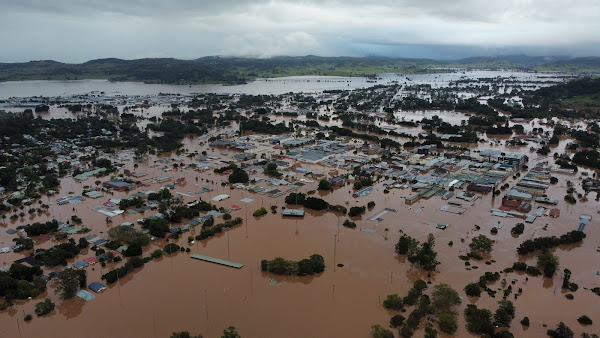
The City of Lismore under floodwaters in Feb 2022
The City of Lismore under floodwaters, February 2022.
Andrew King, The University of Melbourne; Linden Ashcroft, The University of Melbourne, and Sarah Perkins-Kirkpatrick, UNSW Sydney

The deluge dumped on southeast Queensland and northern New South Wales this week has been catastrophic. Floodwaters peaked at around 14.4 metres high in Lismore – two metres higher than the city’s previous record.

So how does this compare to Australia’s previous floods, such as in 2011? And can we expect more frequent floods at this scale under climate change? The answers to questions like these aren’t straightforward.

Climate change doesn’t tell the whole story, as extreme rainfall can occur for a variety of reasons. What’s more, it’s too soon to officially state whether this event is directly linked to climate change, as this would require a formal event attribution study. This can take months or years to produce.

In any case, we do know extreme events like this will occur more frequently in a warmer world. And the rising death toll, ongoing evacuations and destroyed homes make this one of the most extreme natural disasters in colonial Australian history.

Guest Post: Like rivers in the sky: the weather system bringing floods to Queensland will become more likely under climate change

Kimberley Reid, The University of Melbourne and Andrew King, The University of Melbourne

The severe floods in southeast Queensland this week have forced hundreds of residents to flee the town of Gympie and have cut off major roads, after intense rain battered the state for several days. The rain is expected to continue today, and travel south into New South Wales.

We research a weather system called “atmospheric rivers”, which is causing this inundation. Indeed, atmospheric rivers triggered many of the world’s floods in 2021, including the devastating floods across eastern Australia in March which killed two people and saw 24,000 evacuate.

Our recently published research was the first to quantify the impacts these weather systems have in Australia, and another study we published in November looked closely at the floods in March last year

We found while atmospheric rivers bring much-needed rainfall to the agriculturally significant Murray-Darling Basin, their potential to bring devastating floods will become more likely in a warmer world under climate change.

Thursday, June 9, 2016

Storms, floods and avoiding the dots on climate in the Federal election


This article was originally published at nofibs.com.au

During a tour of flood affected areas in Tasmania on Thursday 9 June, the Prime Minister was asked a question (See SMH report) relating to extreme weather events and climate change:

Wednesday, June 8, 2016

Different responses to Extreme rainfall and flooding from France and Australia


Updated: 10 June 2016: Details of climate attribution of French extreme rainfall and flood event

Over the last week we have seen extensive flooding around central France and southern Germany, and the impact of an East coast Low on Australia. They are different weather events but they share a certain commonality in being disastrous intensive rainfall and flood events resulting in death and damage.

The French extreme rain and flood event has recently been attributed to climate change, while the extreme nature of the East Coast Low has not yet been studied for event attribution. Attributing single events to climate change can be statistically difficult due to the range of climate variability. The damage and destruction of both events are consistent with increasing climate trends of greater intensity of rainfall and flood events around the world due to climate change.

While Prime Minister Turnbull and Opposition leader Shorten stayed well clear of mentioning climate change with regards to the extreme rainfall and flooding event in Australia, the French President was far less circumspect, exclaiming (fr) at a press conference that the extreme rainfall and flooding event in France emphasized the importance of the fight against global warming.

"When there are climatic phenomena of this severity, we must all be aware that it is across the world that we must act," he added. "The weather of this magnitude, with people who have been forcibly displaced with emergency relief interventions necessary, is not just a phenomenon that affects only France. It also concerns victims in Germany and Poland," he noted during a press statement with Chilean President Michelle Bachelet.

Thursday, October 10, 2013

Colorado extreme rainfall and flood event of 2013


Like many people around the world I watched and followed the astonishing rainfall and flood events in Colorado in September this year that resulted in at least 10 deaths, damaged some 18,000 homes, caused the evacuation of more than 10,000 people, washing away roads and bridges and isolating communities for a time. The rain and flood event is estimated to have caused $2 billion worth of damage.

The extent of the rainfall was unprecedented in meteorological records that stretch back a little more than 100 years. The extreme rainfall event has been described as a 1 in 1,000 year event. An Extremely rare combination of weather factors combining to produce the event.

Climate change however stacks the dice in several ways in increasing the probability of this event occurring in the future. A primary contribution is the increase in atmospheric capacity to carry water vapour which scientists have worked out to be 6 per cent to 7.5 per cent for each degree Celsius in average global warming. By the end of this century with average global surface temperatures projected to increase by 4 to 5 degrees with current business as usual scenarios, the atmospheric carrying capacity may be an extra 30 per cent, making extreme precipitation events like the Colorado event much more likely to occur.

Wednesday, June 26, 2013

Alberta Floods highlight a more active water cycle with climate change

An intense rainfall and storm event on June 20-21 has caused widespread flooding in the Canadian province of Alberta, encompassing much of the southern portion of the province including Canada's fourth largest city of Calgary. It is the worst flooding event in Alberta's recorded history, highlighting the more active hydrological cycle with climate change.

Over 120,000 people across the region were evacuated, 75,000 in Calgary (7% of the population), many now returning to flood damaged homes and businesses to start the clean up.

I am not going to say climate change caused the flooding. Clearly natural weather variability still plays a significant part in extreme weather events. But the reality is we have warmed the atmosphere and changed the base climate from which all extreme weather events are generated from. We are now living with weather in a more active hydrological cycle resulting in more frequent and intense storm events with a capacity to cause greater flooding.

Monday, January 28, 2013

Queensland 2013 bigwet floods, tornados and climate change

Ex-tropical cyclone Oswald has left a trail of damage and destruction from it's origins in the Gulf of Carpentaria to crossing Cape York and working it's way down the Queensland Coast. The storms brought destructive winds, tornados, rough seas, storm surge and torrential rain, followed by flooding. Quite a few rain records were broken for 24 and 48 hour periods in Rockhampton, Gladstone and Bundaberg with some rain gauges recording well over one metre of rain in 48 hours. Now flood level records are being broken for many river basins and towns like Bunderberg and Gympie.


Although the flood levels in Brisbane city may be lower than the devastating floods in 2011, largely due to better management of water storage in the Wivenhoe Dam, in many regional towns and areas these floods are much much worse and are at record levels.

While the Brisbane CBD may be spared flooding damage, many low lying suburbs around Brisbane will feel the force of the muddy dirty water swirling through their yards and houses. And regional towns are faring much worse in these floods than in 2011.

Thousands of people are being displaced, and hundreds are requiring rooftop emergency rescues from rapidly rising floodwaters especially around Bundaberg. Thousands will utilise emergency disaster assistance provided by State and Federal governments.

Asking whether climate change 'caused' these storms and floods is the wrong question. As climatologist Kevin Trenbeth outlines below, all weather events now have a component of climate change in them. It is now a part of our weather system contributing to all extreme weather events.

Monday, February 13, 2012

Drying trend in Australia still evident despite wettest two year period on record

Back-to-back La Niña events has produced the wettest two year period on record for Australia according to the Bureau of Meteorology (BOM). The two year rainfall total for 2010-2011 of 1409 mm, eclipsed the old record of 1407 mm set during the big wet of 1973-1974. But underlying this wet record is a strong drying trend in the southeast and southwest of the continent with a consistent reduction in Autumn and winter rainfall and streamflow which are important for both agriculture and water storage.

Sunday, December 18, 2011

Extreme Weather: Flash flooding kills over 1000, displaces 100,000 in the Philippines

Heavy rain and flash flooding on Friday night and Saturday in the Philippines associated with tropical cyclone Washi, known locally as Sendong, has killed 521 people, with many still missing and unaccounted for, and displaced over 100,000 people. The cities of Cagayan de Oro and Iligan were particularly hard hit.

Tropical Storm Washi dumped on the island of Mindanao more than a month of average rains in just 12 hours. According to weather forecaster Leny Ruiz the records show that storms that follow Washi's track come only once in about 12 years. Officials claim it was one of the most destructive calamities in southern Philippines in recent years and struck areas not used to severe flooding. River flooding was worsened by the high tide.

Update 23 Dec 2011 - Latest report from AFP say that more than 1,000 people dead and another 1,000 missing, with about half a million people affected and 50,000 in evacuation centres.
Update 29 Dec 2011 - media release Climate Justice Activists Demand Justice for the Victims of Sendong

Wednesday, November 23, 2011

Extreme weather, risk management and adaptation in a warming climate - latest IPCC report

Over the weekend the Intergovernmental Panel on Climate Change (IPCC) released the Special Report on Managing the Risks of Extreme Events and Disasters to Advance Climate Change Adaptation (SREX). There were no surprises for anyone who follows climate science, and the report succinctly integrates a discussion of vulnerability, risk management and adaptation strategies for extreme weather disasters.

The report looks at the evidence for each extreme weather event and gives an assessment of probability and confidence value of each weather event assessment and the future trend. It involved some 220 expert authors from 62 countries and involved more than 18,000 review comments.

Friday, October 7, 2011

Philippines calls for progress in climate talks in Typhoon devastation aftermath


Filipinos are fighting for survival amid worsening climate change according to the Philippine delegation to the United Nations Framework Convention on Climate Change (UNFCCC) round of talks in Panama. The main island of Luzon and the national capital Manila have been blasted and battered in late September and into early October by two consecutive typhoons which have killed at least 76 people and caused at least US$200 million in damage to infrastructure and agriculture.

"Millions of Filipinos are already suffering yet we are only seeing initial climate change impacts. Progress must be made in the climate treaty negotiations," said Commissioner Naderev “Yeb" Saño of the Climate Change Commission (CCC) in a media statement. "We are here in Panama to tell the world that climate change is a matter of life and death for the Philippines," Saño said.

Thursday, July 28, 2011

Impacts of Climate change on the NSW South Coast and Illawarra Regions


A new report by the Climate Commission says the Illawarra region and South Coast of New South Wales highlights the increasing risks of the impacts of climate change. These impacts include an increase in the likelihood of large and intense fires as temperatures increase, rising sea levels causing coastal flooding of buildings and infrastructure, changing rainfall patterns and more intense storms increasing the dangers of severe flooding, and impacts to the regional biodiversity.

Professor Will Steffen, Climate Commissioner and author of the report, said "The evidence for climate change is overwhelming and clear. This report shows that the NSW South Coast and the Illawarra region are particularly vulnerable to the impacts of a changing climate."

Wednesday, June 22, 2011

Climate change blamed in extreme shift from drought to flood in China


An extreme shift in weather in June across much of southern and eastern China has been put down to the effects of global warming and climate change. Usually light rains start in June in the middle and lower Yangtze valley leading in to the summer monsoonal rains and typhoon season, but this year torrential rains and storms struck on June 3 and have continued unleashing devastating floods, the worst in over 50 years.

Chen Zhenghong, senior engineer at the Meteorological Bureau of Central China's Hubei province, said the sharp shift between drought and flood in East and Central China was a result of global warming, according to a Xinhua News Agency report in China Daily on 17 June.

Sunday, June 19, 2011

Missouri River floods endanger nuclear power plants


Large parts of the US midwest are experiencing heavy rainfall and flooding, not unlike what Queenslanders saw in December and January this year when Brisbane was inundated. A major problem with urban infrastructure on flood plains is the risk of innundation during flood events, flood events likely to become more frequent with climate change. In Nebraska two nuclear power Stations are threatened by floodwaters.

Wednesday, April 13, 2011

Queensland climate becoming more extreme according to coral reef record


The Queensland climate is becoming more extreme with more frequent rain and drought events since the nineteenth century according to research on coral reef cores published in the scientific journal, Paleoceanography by Dr Janice Lough from the Australian Institute of Marine Science in April 2011.

Friday, January 14, 2011

La Niña brings torrential rain, floods to Philippines killing 42


The floods in Queensland have been tragic - similar weather and climate factors have brought tragedy to the Philippines. This is the cost of global warming.

Torrential Rains and flooding have battered 25 provinces in the Philippines over the last two weeks. Flooding and mudslides have killed 42 people, with 8 injured and 5 people missing. A damage bill to agriculture, housing and infrastructure has been estimated to be 900 million pesos (about US$23million).

The massive flooding affected over 1.3 million people from 144 towns in the eastern provinces. 101 evacuation centres were set up to temporarily house people. More than 22,000 people remain in government-run temporary shelters while waiting for floodwaters to ebb, with nearly 1,300 houses damaged or destroyed.