Mastodon Climate Citizen --> Mastodon
Showing posts with label NSW. Show all posts

Thursday, November 23, 2023

Coalition and Greens pushing NSW Labor Government for 70% emissions reduction by 2035 target

It seems the NSW Minns Labor government is under pressure to include a more ambitious 2035 emissions reduction target in its climate legislation about to be debated in the NSW Parliament. The legislation as currently written will entrench targets of 50% by 2030 and net zero by 2050.

But Coalition parties and the Greens want a 2035 target included of cutting emissions by 70% on 2005 levels by 30 June 2035.

NSW Liberal Party opposition environment spokesperson, Kellie Sloane, “The Minns government has introduced a climate change bill with less ambitious targets than the Coalition had, they’ve cut electric vehicle subsidies,” she said.

The NSW 2035 target is still less than Victoria's climate action targets put forward before the election in 2022, and legislated in May 2023 in Victoria. 

Victoria's 2035 emissions reduction target is set at 75-80% reductions on 2005 levels, and net zero by 2045. It places Victoria as globally ambitious in climate targets. Victoria new renewable energy targets are 95% renewables by 2035, 65% by 2030. (Climate Citizen)

Read more at The Guardian

Thursday, June 15, 2023

Major Scientific review of Synthetic Turf environmental and health impacts released by NSW Chief Scientist

NSW CSE synthetic turf report a lot to chew over
A major review and report on current scientific assessment of synthetic turf was published by the NSW Office of the Chief Scientist and Engineer. This is of global significance. 

The NSW government released the NSW Office of the Chief Scientist and Engineer Review report on synthetic turf on Friday 9 June 2023. The actual report is 77 pages but includes 19 appendices, bringing the document up to 539 pages. The Review final Report was ready for publication on 13 October 2022, but release was delayed as the document was made Cabinet-in-Confidence and its release delayed due to the NSW election and change of government

The Review’s analysis and insights focussed on four key questions:

  •  What do we know about synthetic turf materials and their use in NSW?

  •  What are the trends and initiatives and their applicability to NSW?

  •  What are the potential health impacts of synthetic turf?

  •  What are the potential environmental and ecological impacts of synthetic turf?


Embedded within the report are 19 appendices containing science based assessments of synthetic turf issues, including: health issues, air pollution and exposure, Odorant monitoring, heat impacts and thermal comfort, heat related health risks, Contaminants and the environment, environmental plastics and microplastics, hydrology, PFAS, soil health, Impact of artificial lights at night, bushfire risk, and Life cycle analysis, and natural turf sporting surfaces.


Much of the report and the science assessments, the key findings and recommendations, have great relevance for Victoria and other states, both for the State Governments and Municipal Councils.


Many of the commissioned experts, from diverse research areas, identified a singular major knowledge gap - that chemical constituents of synthetic turf components, and their associated human and environmental health impacts, are not fully known. (9.1 page 73)


Key insight in the report executive summary questioned the long term sustainability of synthetic turf sporting surfaces given changing climatic conditions due to global warming::


"Overall, it is not clear whether expectations about the longevity and carrying capacity of synthetic fields can be met under Australian climatic conditions, potentially influencing decisions about installation and cost-benefit considerations"


The review also proposed that increased performance of natural turf surfaces may be able to meet the demand for use:

"Best practice guidelines for improving the performance of natural turf have been developed in NSW.  If applied to installation and ongoing management of natural turf sporting fields, these practices may allow increased performance of natural turf fields to meet demand"


Friday, August 26, 2022

Synthetic turf and microplastics under investigation by NSW Chief Scientist

The Office of the Chief Scientist in New South Wales is currently investigating the use of synthetic turf and its environmental impacts, including the generation of microplastics. 

Professor HUGH DURRANT-WHYTE, Commissioner, Natural Resources Commission, and NSW Chief Scientist & Engineer answered questions at the NSW Budget estimates on Tuesday 23 August, 2022.

Durrant-Whyte explained: "It is about suitability for purpose in general, and the Office of the Chief Scientist, in general, doesn't make policy recommendations; it will make science recommendations. There is a lot to do with, as you say, not just microplastics but a whole range of other things, like local temperatures and things like that which impact significantly, but also there is a useability element which is important, so communities actually having access to playing fields and things like that. A lot of things have to be balanced out. Our role in this is to collect the evidence, collect the views, and to genuinely provide the scientific recommendation on which Government can make a policy decision."

The collection of information has been ocurring since the start of 2022 explained Durrant-Whyte. This has included involvement of a number of university groups plus collection of international data.

Friday, March 18, 2022

The Floods 🌊 | Pre-election Australian Honest Government Ad for #Ausvotes


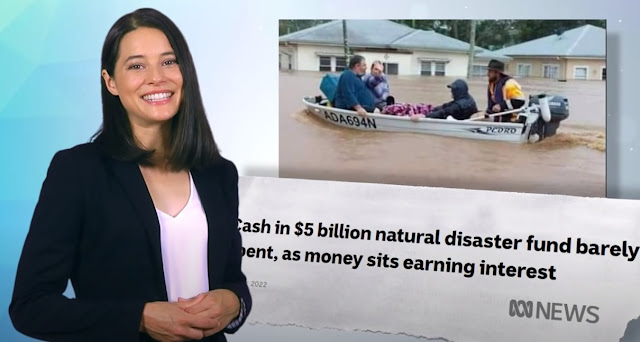
So much is packed in this Juice Media Honest Government Ad about the Flood Crisis in South East Queensland and North Coast of New South Wales, and the ineffective Federal Government political response.

Of Course it is part of a long history of first denying climate change, then delaying any response to acting on climate change. And doing minimal work in emergency response and recovery, and in developing a national climate risk assessment and developing a national climate adaptation plan.

Rather Australia keeps on approving new coal mines and new gas projects like the Narrabri gas field by Santos in NSW, Beetaloo Basin Gas in the Northern Territory by Origin Energy (70%, operator) and Falcon Oil and Gas (30%) , and the Scarborough Gas project by Woodside Petroleum off the Western Australian Coast.

Sunday, March 6, 2022

Guest Post: Like rivers in the sky: the weather system bringing floods to Queensland will become more likely under climate change

Kimberley Reid, The University of Melbourne and Andrew King, The University of Melbourne

The severe floods in southeast Queensland this week have forced hundreds of residents to flee the town of Gympie and have cut off major roads, after intense rain battered the state for several days. The rain is expected to continue today, and travel south into New South Wales.

We research a weather system called “atmospheric rivers”, which is causing this inundation. Indeed, atmospheric rivers triggered many of the world’s floods in 2021, including the devastating floods across eastern Australia in March which killed two people and saw 24,000 evacuate.

Our recently published research was the first to quantify the impacts these weather systems have in Australia, and another study we published in November looked closely at the floods in March last year

We found while atmospheric rivers bring much-needed rainfall to the agriculturally significant Murray-Darling Basin, their potential to bring devastating floods will become more likely in a warmer world under climate change.

Thursday, January 3, 2019

North Queensland Extreme Heatwave impacts koala population

I was scanning for news articles on heatwave impacts and came across this article on Koalas by ABC Capricornia.

It's a well written, but quite an alarming story By Alice Roberts and Jacquie Mackay: Koalas in trouble after Queensland's bushfires and heatwave, expert warns.

According to one CQUniversity academic, extreme heatwave and bushfire conditions could have major long-term impacts on animal numbers in Queensland. Alistair Melzer, a CQUniversity koala researcher, told the ABC that it could be years before the full impact is known.

And we have the iconic image of Chantelle Lowrie in Victoria giving a koala a drink from her water bottle in the 44C late December heat. (See my December 30 entry of Climate Diary of a heatwave)

Sunday, December 30, 2018

Climate Diary of an extreme heatwave across Australia and climate heat impacts


The Bureau of Meteorology in the lead up to christmas in 2018 showed a heatwave building through the week. The forecast was for severe and extreme heatwave impacts particularly Thursday 27 December to Saturday 29 December.

A blocking high in the Tasman and strong heat from the Pilbara in Western Australia and right through Central Australia, will periodically extend tendrils of sweltering heat to encompass the major population centres of Adelaide, Melbourne and Sydney.

While these cities may get occasional relief from weak cold fronts and coastal sea breezes, inland towns will swelter in the scorthing heat with temperatures in the mid to high 30s and low 40s.

Sunday, February 12, 2017

Heatwave makes Australia hottest place on planet with catastrophic bushfire conditions


Australia is currently the hottest place on the planet with the heatwave in SE Australia according to the Climate Reanalyzer site for Saturday 11 February. And last year (2016) was the hottest year on the planet in recorded history, following two previous years which also set the record.

As heat temperature records tumbled in south east Australia in the heatwave, catastrophic fireweather conditions were being experienced on Sunday over a wide region from Port Stephens in the Hunter Region, Tablelands and the Central West region of New South Wales. These conditions are categorized as a greater danger than the Victorian Black Saturday bushfires of 2009 which killed 173 people directly in the bushfires and 374 excess deaths due to the heatwave.

Update: Climate scientists calculate that Climate change doubled the likelihood of the New South Wales heatwave (Feb 16, 2017 The Conversation)

We have an energy crisis with load shedding ocurring in South Australia on Wednesday (that needn't have occurred), and load shedding in NSW on Friday and Saturday with the Tomago Aluminium plant being ordered to curtail production and energy use.

But what you will find largely absent in the media and comments by politicians on the heatwave is any reference to climate change which is an essential driving factor of more intense heatwave conditions and catastrophic fireweather.

The mining and burning of coal is a large contributor to greenhouse gas emissions and needs to be phased out in an orderly way to meet our international commitments on climate change. The only but would be if carbon capture and storage (CCS) was developed at scale and at reasonable cost, and I don't see enough research and investment to make this happen in a realistic timeframe.

So the Liberal Party are causing a clean coal controversy and blaming renewables, when AEMO and the energy market needs a thorough overhaul to re-prioritise production to meet consumer demand and social requirements rather than business profits. Just look at AEMO's governance bias for a start.

The Transition road may be rough at times, but we really do need to move to 100 per cent renewables. Prior changes such as the transition from horse and buggy transport to automobiles - about 13 years - at the start of the twentieth century, shows that transition happens relatively quickly. State renewables targets are realistic and already driving the energy transition we need.

Is it so hard to come up with a bipartisan national energy plan?

Friday, February 10, 2017

"Heatwave is nothing short of horrifying" says climate scientist


First published at nofibs.com.au

"This developing heatwave is nothing short of horrifying" said climate scientist Sarah Perkin-Kirkpatrick.

"Much of eastern Australia has seen heatwave after heatwave this summer, with some seasonal records already broken by the start of February. Night-time temperatures have been too hot for adequate sleep and daytime temperatures have been searing."

Sarah Perkin-Kirkpatrick is a climate scientist who has specialised in studying the causes and dynamics of heatwaves. She is an Australian Research Council DECRA fellow at the Climate Change Research Centre, University of NSW. At the annual Australian Meteorological and Oceanographic Organisation conference meeting in Canberra this week she was awarded the Early Career Researcher (ECR) award.

"What is particularly concerning about the developing event is the intensity, where many regions will see a string of extremely hot days with little relief. Much of NSW, QLD and northern VIC will suffer the most, where temperatures will be the hottest, and follow little reprieve from the previous heatwaves." she said.

Thursday, February 2, 2017

Brisbane and Sydney turn on record heat in January 2017 with record warm nights


Averaged across the state, Queensland had its 6th warmest January on record. Mean minimum temperatures were the second-warmest on record for January. (see above deciles average map for January)

But the City of Brisbane in the south east just experienced it's warmist January on record. Back to back heatwaves have brought persistent heat to south east Australia, and especially to southern Queensland and New South Wales. The town of Moree has had 36 consecutive days of temperatures over 35C, doubling the previous record of 17 days in 1982.

Friday, November 4, 2016

Newcastle residents celebrate ParisAgreement entry into force forming a 2100 sealevelrise high tide mark


On November 4, residents of Newcastle in the Hunter region of New South Wales celebrated the entry into force of the Paris Agreement. Hundreds of people woke up early and formed a high water tide mark line to indicate where sea level rise may reach by 2100.

"Hundreds of people have come together in Newcastle this morning in response to the governments failure to ratify the Paris Climate Agreement, which comes into force today. The group formed a blue line signifying the predicted high tide for Newcastle in 2100 and are calling on the federal government to ratify the agreement and start phasing out fossil fuels as a matter of urgency." said the group in a Facebook posting by the Hunter Community Environment Centre.

Monday, May 9, 2016

Climate protestors close down Newcastle coal port for #Breakfree2016 as Federal election called


When the politics has failed in taking necessary rapid climate action, more people will step up, to protest, to put their bodies on the line in civil disobedient actions. As part of the Global BreakFree mobilisation Australians blockaded Newcastle coal port on Mothers Day, Sunday 8 May 2016. This article is derived from my live blog on Storify of the protest in Newcastle. 350Australia also live blogged the protest

The protest drew more than 2,000 people to Horseshoe Beach, one of the largest climate protests against coal in the NSW regional city of Newcastle. More than 60 people, including a flock of climate angels and Bill Ryan a 94 year old Kokoda veteran from World War II, have been arrested, charged and released for blockading the Kooragang Island rail bridge that is used for transporting coal to the port. Another 4 people were arrested for locking on to coal terminal equipment and banner drop at the coal wharf.

Wednesday, March 30, 2016

Coal train delayed for 6 hours due to #leardblockade civil-disobedience


Photo: Frontline Action on Coal/Twitter

The Leardblockade continues with more coal trains being stopped from transporting coal from Whitehaven and Idemitsu mines to Newcastle port for export in an act of peaceful civil disobedience. Original story published at nofibs.com.au

Environment Officer Anisa Rogers (23), student Linah Winoto (20) and Horticulturalist Jim Kremar (33) occupied a coal train locomotive, stopping all coal trains from reaching the port of Newcastle, shutting down the coal transport line for 6 hours.

Front Line Action on Coal spokesperson, Jason McLean, said of the action that “civil disobedience would not stop until the Government puts the well-­being of its citizens ahead of that of big business.”

Shenhua coal mine doomed by China energy transition


Photo by Kate Ausburn, Creative Commons License.

The proposed Shenhua Watermark coal mine on the Liverpool Plains has been widely opposed by farmers and environmentalists, but it appears the energy transition of China and the economics of coal have ultimately doomed the project. Original article for Nofibs.com.au

The fact is China ‘Is Getting Serious’ About Scaling Back Coal. A rapid transition is taking place in China transitioning to renewable energy and scaling back coal power. Part of this is the concern over chronic air pollution problems.

According to Tim Buckley from IEEFA, "New data shows China’s electricity-sector transformation accelerating in the first two months of 2016. While electricity consumption was up just 0.3% year on year (yoy) to 870TWh for the January-February period, coal imports fell 10.2%i and coal production declined 6.4%."

"China’s absolute use of coal likely peaked in 2013. The subsequent data certainly supports this position. China’s coal consumption declined 2.9% yoy in 2014, with a further decline of 3.7% yoy in 2015 that accelerated in the first two months of 2016. As a guide, production year to date was -6.4% yoy." reported IEEFA

Sunday, March 27, 2016

Balmy Sea Surface Temperatures off south east Australia


It is not only warm temperatures over land that have been abnormally high. Sea Surface Temperatures of eastern and south eastern Australian coast have also been above average for this time of year.

The ENSO wrap up from the BOM for February describes:
"The SST (sea surface temperature) anomaly map for February 2016 shows warm SST anomalies extending across the central and eastern equatorial Pacific. Compared to January, warm anomalies have decreased along the equator, but have increased to the east of Australia and near the South American coast."

For the week ending 13 March 2016 it describes:
"Warm anomalies continue to surround most of the Australian continent, with large regions greater than +1 °C to the north and south. Strong anomalies occur near Tasmania, with values of +2 °C surrounding much of the island. Warm anomalies continue to cover much of the Indian Ocean."

Sunday, February 21, 2016

Storify: Coal train protest ends 1st week of #Leardblockade action on #coal


"Red alert, red alert, keep the coal in the dirt" the protestors chanted at a blockade of coal haul trucks going to Whitehaven's Tarrawonga coal mine while Whitehaven and Idemitsu bulldozers are lining up to devastate the Leard forest to expand coal mining.

Nofibs reporter John Englart reports on the first week of action - titled the Bats Return - at the Leard blockade via social media. The Bats Return is a six week creative action protest at Maules Creek, north-western New South Wales, that started on February 13. It coincides when the miners are allowed, under their permit, to clear the forest.

Tuesday, January 19, 2016

Occupation of #Santos #Pilliga #CSG site by traditional owners, local farmers


Santos plans for a Coal seam gas field in the Pilliga region of western NSW has met stiff opposition from local farmers and traditional owners. A Santos test site was occupied on Sunday by 120 people in a mass civil disobedience action.

Santos want to build a waste water treatment plant at the Leewood site near Narrabri. After that they plan to drill over 850 coal seam gas wells to establish a gasfield in the Pilliga Forest. This is the largest undisturbed inland forest left in Eastern Australia.

Wednesday, December 23, 2015

Hot night in December heatwave across south-eastern Australia


A heatwave encompassing much of south-east Australia to 20 December broke numerous maximum temperature records with the Bureau of Meteorology (BOM) issuing special climate statement No 53 (PDF).

This included an exceptionally hot night on 19–20 December breaking many minimum overnight temperature records.

Friday, November 7, 2014

Locals protest Santos Pillaga CSG expansion


Something is happening in the Pillaga in western NSW. Coal Seam Gas exploration and drilling by Santos is under concerted attack. While the protests are not new, the profiles of those locking on or taking a stand are no longer the regular sterotype.

Yesterday a Coonabarabran mother of three young children, Nicole Hunter, locked on to a bulldozer for several hours. Mrs Hunter attached herself to a bulldozer to stop Santos clearing a patch of the forest for a new coal seam gas drill pad. She had a support crew from Coonabarabran. She was released after several hours without charge.

She is concerned about the industrialisation of the area and the impact on underground water, the mainstay of agriculture and important for recharging the Great Artesian basin. Read the story on CSG is risky business for aquifers.

Saturday, February 22, 2014

Whitehaven coal mine offsets not compatible with threatened ecosystems being destroyed

The Whitehaven coal mine at Maule's Creek near Boggabri in north Western NSW involves the destruction of a substantial part of the Leard Forest. One of the requirements for approval was the provision of environmental offsets to balance 'like for like' against the destruction of high biodiversity habitat. But the latest environmental report by Dr John Hunter advises the offsets for critically endangered ecological communities are "vastly overstated".

This shows that the approval under the EPBC Act by former Environment Minister Tony Burke and the continued support given by current Environment minister Greg Hunt are a travesty and likely a dereliction of duty of care for the environment, threatened species and biodiversity.

Related: Front Line Action on Coal | Leard State Forest | Maule's Creek Community | No Fibs Leard Blockade reports