Mastodon Climate Citizen --> Mastodon
Showing posts with label targets. Show all posts

Saturday, December 16, 2023

Queensland sets 2035 emissions reduction target of 75% below 2005

The new Premier of Queensland Steven Miles has announced for Queensland  a new emissions reduction target of 75% below 2005 levels by 2035. This will be a legislated target.

Queensland already has a commitment to deliver 50% renewable energy by 2030, 70% by 2032, and 80% by 2035.  

The Premier Steven Miles said, “By legislating this target, we will create certainty for industry and bridge the gap between the city and the bush. This announcement is only possible because of the landmark Queensland Energy and Jobs plan, which will see 80 per cent of our energy generated by renewables in 2035."

Update: A first crunch point will come on 22 December when Queensland Labor's Environment Minister Leanne Linard may sign off on Whitehaven’s Winchester South coal mine. The Winchester South coal project is one of over 100 new coal and gas projects in the pipeline in Australia - fuelling catastrophic climate change and leading to more heatwaves, floods and fires.

Thursday, November 23, 2023

Coalition and Greens pushing NSW Labor Government for 70% emissions reduction by 2035 target

It seems the NSW Minns Labor government is under pressure to include a more ambitious 2035 emissions reduction target in its climate legislation about to be debated in the NSW Parliament. The legislation as currently written will entrench targets of 50% by 2030 and net zero by 2050.

But Coalition parties and the Greens want a 2035 target included of cutting emissions by 70% on 2005 levels by 30 June 2035.

NSW Liberal Party opposition environment spokesperson, Kellie Sloane, “The Minns government has introduced a climate change bill with less ambitious targets than the Coalition had, they’ve cut electric vehicle subsidies,” she said.

The NSW 2035 target is still less than Victoria's climate action targets put forward before the election in 2022, and legislated in May 2023 in Victoria. 

Victoria's 2035 emissions reduction target is set at 75-80% reductions on 2005 levels, and net zero by 2045. It places Victoria as globally ambitious in climate targets. Victoria new renewable energy targets are 95% renewables by 2035, 65% by 2030. (Climate Citizen)

Read more at The Guardian

Wednesday, October 25, 2023

Victoria’s renewable energy generation reached 37.8 per cent of Victoria’s electricity generation in 2022/23


A Progress report tabled in the Victorian parliament highlights that Victoria has doubled its renewable electricity generation in the last five years to supply 37.8 percent of the electricity grid. The state is well on target for over-achieving its 2025 target of 40 percent renewables.

But we need to be aware the International Energy Agency (IEA) in its 2023 World Energy Outlook report, has called for a tripling of renewables generation based on 2022 data.

Earlier this year Victoria formerly announced its 2035 climate targets that included a VRET of 95 per cent renewable generation by 2035 (The 2035 targets were an implementation of an election promise announced in October 2022). The legislated VRET 2030 target has also been increased from 50 per cent to 65 per cent. The state also set new Victorian energy storage targets for at least 2.6 gigawatts (GW) of energy storage capacity by 2030 and at least 6.3 GW by 2035 to support an accelerated renewable energy transition in Victoria. 

As at 30 June 2023, there were 17 renewable energy generation projects under construction or undergoing commissioning in Victoria. These projects have a combined capacity of 1,734 MW. There was also one utility-scale storage project – the 150 MW Hazelwood battery – undergoing commissioning. These projects generated around 662 jobs in these renewables projects in 2022/23, many of them in regional areas of the state.

Friday, December 2, 2022

Australian Climate Change Minister Chris Bowen delivers first annual climate statement in 2022

The Annual climate change statement to Federal Parliament was delivered on the 1st December by Chris Bowen, the Minister for Climate change and Energy. It is the first annual statement as mandated under the Climate Act (2022).

The speech outlines the achievements of the Labor Government in the first 6 months in addressing all the issues that were neglected by the previous Liberal National Party Coalition Government.

The last 6 months has been a whirlwind of starting to implement Labor's climate policies taken to the election. However, these policies overwhelmingly focussed on ramping up renewables and restructuring the National Electricity Market (NEM) east-coast electricity grid, with some strategies for encouraging EV transition and Fuel efficiency standards. Policies on Fossil fuel production phasout and addressing the 114 new coal and gas projects in the approvals pipeline were absent. There was also no commitment to phaseout the  $11 billion in yearly tax subsidies to fossil fuel companies.

Australia did commit to the Global Methanne Pledge just before COP27, and made several minor, but important, pledge commitments at the conference. 

The Annual statement highlights that the ‘baseline’ scenario largely reflects already-implemented policies and shows a 32% reduction in emissions on 2005 levels by 2030.

The ‘additional measures’ scenario is based upon two major elements of the Powering Australia plan, achieving the 82% national renewable electricity target by 2030 and the Safeguard Mechanism reforms. Under this scenario, Australia is on track to reduce emissions by 40% on 2005 levels by 2030.

Other Powering Australia and the National Electric Vehicle Strategymeasures have not been included in the scenario. The Government is confident that implementation of these and other measures will result in achieving the 43% emissions reduction by 2030 target. 

The Government is also reforming the Safeguard Mechanism to provide long-term clarity on emissions reduction of the top 200 major carbon polluters. The integrity of carbon credits will be critical for the Mechanism to work effectively. Up to 80% of Australian carbon credits have had their integrity questioned.

Sunday, November 20, 2022

Australia at COP27 Diary

UN climate conference, the 27th Conference of the Parties (COP27) is ocurring in Sharm El-Sheikh in Egypt from Monday November 6 to Friday November 18, 2022 (but may also go overtime into the weekend). 

This is my digital diary of Australia at COP27. I have attended four previous COPs, but I will be following whats going on at COP27 online. Follow with me. I'll be updating this blog post regularly over October-November 2022.

UNFCCC COP27 main website. Civil Society have organised the COP27 Coalition. See the La Ruta del Clima guide to COP27 (English and Spanish). The Australian Pavillion website.

Key Blogs (for tracking issues):. 

20 November - Long past bedtime as La Nina set to intensify cyclone season and flooding

Final hours of negotiations and post assessment: 

  • End game for COP27 - blogging the final hours Closing Plenary scheduled for 12:30-15:30 AEDT
  • The UN Climate conference COP27 may have closed but La Niña is set to intensify Australia’s cyclone season, raising risk of flooding (The Guardian)
  • What are the key outcomes of Cop27 climate summit? (The Guardian)
  • Guest: COP27: one big breakthrough but ultimately an inadequate response to the climate crisis (Blog)
  • The 1.5C climate goal died at Cop27 – but hope must not by Damian Carrington, Environment editor at The Guardian
======

19 November - Overtime, out of time

Prime minister Anthony Albanese says taking climate seriously is key to international diplomacy, is key to Australia’s push to co-host a UN climate conference with the Pacific islands. "Taking climate change seriously is the entry fee to get a seat at the table of international diplomacy and to be taken seriously by those who care about the global economy as well." (The Guardian)

U.S. silent on surprise aid plan (for Loss and Damnage finance) as climate talks stagger (Climatewire) Previous article reported U.S. isolated on loss and damage (Climatewire)

Reuters publishes Analysis-Australia's Climate Policies Don't Match Its Big Talk at COP27 highlighting Australia's addiction to fossil fuel exports and lack of policy to change this so far. (Reuters)

Australian position on Loss and Damage Finance: Australia said it welcomed the EU’s contribution and would “engage constructively with it”. On loss and damage, it was “very attracted to a new fund that benefits from a broad contributor base and focuses on the most vulnerable”. “We want to fully examine how other institutions such as multinational development banks can interact and further develop their interaction with this fund,” said Chris Bowen, the Australian climate change minister. reports the Guardian.

End game for COP27: Will there be backsliding on Fossil fuels or 1.5C target? Will a Loss and Damage finance Facility be established? (Blog)

Highlights and images from Earth Negotians Bulletin highlights Saturday 19 November a real negotiations rollercoaster ride (ENB/IISD)

High Ambition Coalition lists its demands for a successful COP:


Saturday, November 19, 2022

End game for COP27: Will there be backsliding on Fossil fuels or 1.5C target? Will a Loss and Damage finance Facility be established?

COP Presidency Friday 11pm press briefing
The UN climate change conference is approaching its end game.

Will there be backsliding on Fossil fuels or 1.5C target? 

Will a Loss and Damage finance Facility be established?

The negotiations are past Friday closing, well into overtime working through the night.

UNFCCC draft documents can be found here:  https://unfccc.int/document


Thursday, October 20, 2022

Victoria sets 75-80% emissions reduction target for 2035, Net zero by 2045, New Renewables Targets VRET of 65% by 2030, 95% by 2035.

The Victorian Labor Premier, Dan Andrews, and Climate Change Minister Lily D'Ambrosio, have announced the State's 2035 emissions reduction target, new renewable energy targets and re-establishment of a  government Owned electricity supplier for the market.. 

The new 2035 emissions reduction target is set at 75-80% reductions on 2005 levels, and net zero by 2045. It places Victoria as globally ambitious in climate targets.

Victoria new renewable energy targets are 95% renewables by 2035, 65% by 2030.

The Victorian state government will undertake to build 4.5 gigawatts of publicly owned renewables and the reestablishment of a publicly owned electric commission. 

The government has estimated its energy plan will create 60,000 jobs by 2035. 

Wednesday, September 28, 2022

Queensland sets new renewables targets: 70% by 2032, 80% by 2035, coal reliance phaseout by 2035


“We are facing a climate emergency,” Premier Anastacia Palaszczuk said in her State of the State address at a CEDA function. She noted that Queensland is facing dramatic problems from rising sea levels in Torres Strait, record “rain bombs”, bushfires, and a total of 98 natural disasters in the last decade. “Climate change is real …. but we need to do more than talk about it. We need to act, and act in a revolutionary way,” she said.

The Premier launched a $60 billion Queensland Energy and Jobs Plan which will transform Queensland from a coal dependant state for energy to one powered by solar and wind renewables with pumped hydro energy storage, as well as grid batteries, and an upgrade to the transmission grid.

The plan encompasses:

  • At least 25 GW new and existing renewable energy
  • Gladstone grid reinforcement to support heavy industry to switch to renewable energy and decarbonise their operations
  • All publicly owned coal-fired power stations operating as clean energy hubs by 2035, supported by a legislated Job Security Guarantee for energy workers
  • Two new world-class pumped hydro projects that together could deliver up to 7 GW of long duration storage
  • Around 1500km of new high voltage backbone transmission to move more power around the state
  • Up to 3 GW of low to zero emissions gas generation for periods of peak demand and backup security
  • A smarter grid to support over 11 GW of rooftop solar and around 6 GW of batteries in homes and businesses

It should be noted Queensland is a major exporter of both thermal and metallurgical coal and this plan does not cover this coal production for the export market.

Tuesday, September 27, 2022

Victoria sets Energy Storage targets of 2.6 Gigawatts by 2030 and 6.3 GW by 2035 capacity, coal may end in early 2030s

Victorian Premier Daniel Andrews and Minister for Energy Lily D’Ambrosio announced new energy storage targets alongside a $157 million package supporting renewable energy generation and storage projects across the state.

Victoria has set a 2.6 gigawatts (GW) target of renewable energy storage capacity by 2030, with an increased target of 6.3 GW of storage by 2035. This energy storage is essential to firm the growth in renewables generation from solar and wind farms.

The new storage targets include both short and long-duration energy storage systems – which can hold more than eight hours of energy to cover peak demand periods. 

The new energy storage targets, along with advancing renewables may spell the closure of Victoria's brown coal in the early 2030s. It also adds momentum to Victoria's achievements in emissions reduction in future climate targets.

Wednesday, September 21, 2022

Victoria cut emissions by 29.8% on 2005 levels by 2020. There is a pathway to decarbonisation by 2035 to meet 1.5C target.


The Victorian Premier, Dan Andrews, announced on 20 September that Victoria Smashes Emissions Targets. Victoria achieved a 29.8 per cent emissions cut on 2005 levels up to and including 2020. Victoria had set an Emissions Reduction Target of 15 to 20 per cent reduction by 2020.

Last year i reported that Victoria reduced emissions by 24.8%, on track for 45-50% reduction by 2030

The Andrews Government rebuilt Victoria's Climate Act and set a number of interim targets. 

Energy was the top sector that needed to start the decarbonisation transition process, and the Andrews Government has tackled this with growing renewables and energy storage as a proportion of our electricity production.

Victoria’s energy sector is still the state’s largest source of emissions, but continues to see deep cuts made due to the rapid upscaling of renewable energy. The sector saw renewable electricity production increase from 21.7% of total electricity generation in 2019 to 24.8% in 2020.

Wednesday, March 23, 2022

UN Secretary General specifically calls out Australia on climate targets and coal "1.5-degree goal is on life support" | Full Speech


On Monday 21 March the UN Secretary General Antonio Guterres made remarks to the Economist Sustainability Summit in a speech labelled Keeping 1.5 Alive – Delivering on the Fate of our Planet. In the speech he specifically called out Australia for failure to take climate action in increasing 2030 climate targets and phasing out coal and gas.

"
The developed and emerging economies of the G20 account for 80 per cent of all global emissions. A growing number of G20 developed economies have announced meaningful emissions reductions by 2030 – with a handful of holdouts, such as Australia." said  Guterres.

He didn't mince his words on the global catstrophe we are facing, either.

"According to present national commitments, global emissions are set to increase by almost 14 per cent in the 2020s. Last year alone, global energy-related CO2 emissions grew by 6 per cent to their highest levels in history. Coal emissions have surged to record highs. We are sleepwalking to climate catastrophe." 

On a global level he articulated what we need to aim for to avoid catastrophe: "Keeping 1.5 alive requires a 45 per cent reduction in global emissions by 2030 and carbon neutrality by mid-century. That problem was not solved in Glasgow. "

He argues for progressively dismantling coal infrastructure, with full phase-out by 2030 for OECD countries (like Australia), and 2040 for all others. For financing adaptation and mitigation to be pursued with equal force and urgency.

He ends his speech on how do we keep 1.5 alive by calling for positive action and solutions:

  • By accelerating the phase-out of coal and all fossil fuels and implementing a rapid, just and sustainable energy transition -- the only true pathway to energy security. 
  • By honouring the Glasgow pledge to strengthen national climate plans every year until they are aligned with 1.5 degrees. 
  • By delivering concrete outcomes this year on climate coalitions to help emerging economies urgently phase out coal. 
  • By driving a swift and transformative increase in climate finance with multilateral development banks leading on unlocking the trillions that we know are needed. 
  • By speeding up the decarbonization of major sectors such as shipping, aviation, steel and cement. 
  • And by protecting the most vulnerable and ensuring an equal focus on adaptation. 

"That’s how we will move the 1.5 degree goal from life support to the recovery room. "

And Australia is presently not doing our fair share in ambituous 2030 climate targets, in planning for phase out of coal mining in a just transition engaging l;ocal communities in solutions.

Friday, March 11, 2022

Victorian Government sets offshore wind targets to kickstart offshore wind industry to meet climate targets


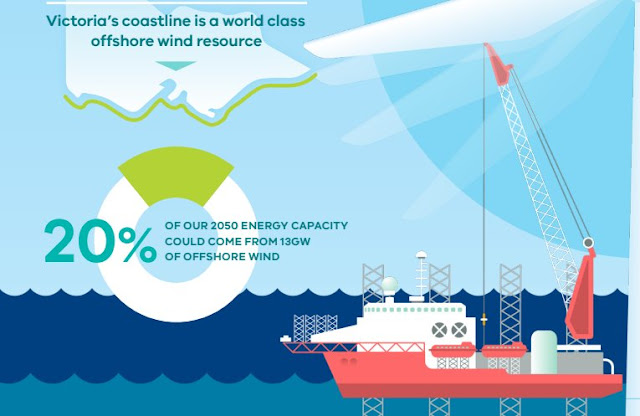
On March 4, 2022 the Victorian Government set new offshore wind farm targets. Currently there are no offshore wind farms operating in the state.

The new offshore wind targets:

  • 2032 - target of 2 GW 
  • 2035 - target of 4 GW 
  • 2040 - target of 9 GW 
  • 2050 - potential capacity of 13 GW

Federal Minister for Emissions Reduction Angus Taylor has been sitting on Federal legislation that has been needed to allow wind farm planning and construction to go ahead. This legislation was finally passed by the Federal Parliament in 2021.

Saturday, October 30, 2021

Victoria reduces emissions by 24.8%, on track for 45-50% reduction by 2030

Victoria achieved a 24.8 per cent emissions reduction between 2005 and 2019 and the state’s annual emissions dropped below 100 megatonnes of carbon dioxide equivalent for the first time since 1994. This are pre-pandemic 2019 figures, and it is likely emissions have further declined during the pandemic. 

The results were contained in a report tabled in the Victorian parliament .

The Andrews government has met its legislated pledge to cut emissions by 20 per cent by 2020 ahead of schedule, and is on track to meet its target of a 28 to 33 per cent reduction below 2005 levels by 2025, and 45-50 per cent by 2030.

Tuesday, October 26, 2021

Morrison Net Zero 2050 Plan a fraud, with plans to double coal exports, new gas expansion

Energy and Emissions Reduction Minister Angus Taylor with 'Net zero Plan' slide

Prime Minister Scott Morrison accompanied by Energy and Emissions Reduction Minister Angus Taylor announced Australia's commitment to Net Zero by 2050. But there will be no change to the 26-28% emissions reduction target by 2030 that was submitted in 2015 to the Paris Agreement.

ABC political analyst Laura Tingle commented "All this time to wait for a 15 page slide set with literally nothing new in it...." and "The plan is based on our existing policies".

Australia is taking a technology not taxes meet and cheat projection to Glasgow, which is another way of climate delay and denial while expanding fossil fuel production

"You will be supported by our data projection that will see us exceed our 2030 target with emissions reduction of up to 35% by 2030. We will keep our commitment, though, when it comes to our pledge that we made, and took to the last election of 26 to 28%, but we will meet it, and we will beat it. And we’ll beat it with emissions reductions we believe about the 35%." said Morrison. 

Yeah the work of all the states will see Australia achieve 37-42% emissions reduction. Federal Government doing SFA according to modelling on 2030 climate targets.

"This is the right plan for Australia – to summarise the outcome from it, which we’ll see in the plan, Australians $2,000 better off on average in 2050 compared with no Australian action." says Angus Taylor. 

But acting fast with renewables with strong 2030 targets showed citizens would be $5000 better off according to Business Council of Australia report. Guardian Australia Politics Live

Find below Ministerial press release, video of the press conference, some twitter commentary, and statements by Opposition Leader Anthony Albanese and shadow Climate spokesperson Chris Bowen.

Monday, October 25, 2021

Australia's 2030 climate targets for COP26

Source: Climate Council: from Paris to Glasgow report, 21 October, 2021

The Nationals have now given in principle support for Net zero by 2050. But 2050 is so far in the distance it is effectively irrelevant to what commitment and ambition Australia takes to the UN Climate Conference in Glasgow, COP26. 

Ratcheting up 2030 ambition and targets is what is really at issue. This was written into the Paris Agreement that countries increase ambition after 5 years. That time is now. Senate estimate questioning on 25 October reveals Australia's 2030 target not being updated (See update at end of post)

While we wait for the Liberal Party to reflect upon the Nationals Party confidential 3 page list of demands on committing Australia to Net Zero by 2050 target, lets reflect a bit more on the 2030 target for Australia. 

According to Climate Works Australia analysis, actions by Australian state governments has already set a de facto emissions target of 37 - 42 percent by 2030 based on a 2005 baseline eclipsing the 26-28 per cent set in 2015 by Prime Minister Abbott that formed part of Australia's initial Nationally Determined Contribution (NDC) and updated NDC this year.

ClimateWorks Australia: defacto national target set by state actions of 37-42%

For Australia to be in the ball park for dealing and to be taken seriously at the UN climate talks it really needs to match the commitments of USA, Europe and UK. The lower end of that range is 46 to 50 per cent emissions reduction by 2030 on 2005 baseline. The Climate Council says a science based target is for Australia to aim to reduce emissions by 75% below 2005 levels by 2030 and reach net zero emissions by 2035.

At the moment Prime Minister Morrison is taking to the G20 and Glasgow COP26 a commitment for net zero by 2050, but no change in 2030 climate targets as submitted in our NDC, no plan to increase our climate finance to our fair share, and no indication we will sign on to the Global Methane Pledge.

Saturday, October 23, 2021

Business, Unions, Environment Organisations outline Australian clean energy transition vital for jobs and new export revenues

There has been a range of reports just published on why Australia should accelerate transition and transformation to a clean economy and phase out Fossil Fuels. The Business Council of Australia On Sunday 10 October The Business Council Of Australia (BCA) released a report, reversing previous stance on a net zero target and upgraded 2030 interim emissions reduction targets.

Four days later a report by global services consultancy Accenture commissioned jointly by the Australian Conservation Foundation (ACF), WWF-Australia, ACTU and BCA was released - Sunshot: Australia’s opportunity to create 395,000 clean export jobs, charting a path for the country through the global transition to net-zero that delivers new jobs and replaces high carbon exports with clean export revenue.

These reports make it clear there are tremendous advantages in moving early with rapid ramp up of renewables, hydrogen, green steel, rare earth minerals, and services and training in the new energy economy. Thousands of jobs would be created, the great majority in regional areas allowing a transition of existing workforces with retraining in related or new skills. The benefits would flow to regional areas and the whole economy.

Sunday, May 9, 2021

Germany raises climate ambition at Petersburg Dialogue in leadup to COP26

German Finance minister Olaf Scholz and environment minister Svenja Schulze announced new proposed climate targets to press in Berlin on Tuesday 3 May 2021:
  • 65% emissions reduction by 2030,
  • 85-90% by 2040 and
  • net zero emissions by 2045, all compared to 1990 levels.
Previous German goals were 55% by 2030 and climate neutrality by 2050.

Thursday, November 7, 2019

New Zealand zero carbon Bill shows bipartisan leadership


Historic moment for New Zealand as the New Zealand Prime Minister Jacinta Ardern calls near unanimous support for a Zero Carbon bill as acting on the biggest challenge of our time.

"I continue to stand by the statement that #ClimateChange is the biggest challenge of our time and for us here in Aotearoa New Zealand that means for this generation, this is our nuclear [free] moment."

Sunday, November 13, 2016

Multilateral assessment of Australia at COP22 for climate action


Australia was under the spotlight at COP22 in Marrakech as part of the SBI multilateral assessment process for climate action. You can read the 31 pages of written questions and responses already on record (PDF).

Each country was allocated 30 minutes of live questioning following a brief statement by the country being questioned.

Europe was up first with their statement and then questions from USA, New Zealand, Australia, Saudi Arabia, Canada, Singapore, China. Europe then responded to these questions.

Then it was Australia's turn with Australia's lead negotiator Ambassador Patrick Suckling saying that the Emissions Reduction Fund (ERF) is delivering real emissions cuts and that Australia is on target for meeting 2020 and 2030 targets.

Friday, November 11, 2016

Strong ambition needed to meet 1.5C #ParisAgreement Target #COP22


According to the latest Climate Action Tracker assessment of national climate plans (NDCs), the Paris Agreement current commitments will lead to a warming of 2.8degC, with a likely chance of holding warming below 3.1degC.

It is clear that more ambition is needed, and the earlier emission reductions happen, the greater the benefit.

I was unable to make this press conference but Dr Cara Augustenborg did a sterling job of tweeting the main points. The Press conference is available as video on demand.

Host country, Morocco, is one of the few countries rated by Climate Action Tracker as 'Sufficient' in their climate targets and climate action. Morocco, along with Nepal are the only countries to update their climate plans (NDCs) since the Paris Agreement was agreed.