Mastodon Climate Citizen --> Mastodon
Showing posts with label science. Show all posts

Saturday, December 7, 2024

Younger people disproportionately represented in climate heat-related mortality trend according to Mexico study

Sorry Kids... latest research shows that increasing temperatures adding to extreme heat due to burning fossil fuels has a disproportionate impact in killing young people under 35 years. While this research is based on Mexico, it is highly likely it applies more widely, although there will be some caveats.

One of the authors of the study, Danny Bressler, said: "The concentration of heat-related mortality among younger people is quite disproportionate compared to other causes of death. Although just 16% of overall deaths from all causes are among under 35 year olds, 75% of heat-related deaths are among under 35 year olds. When we consider lost life years, the age-specific inequality is more extreme: 87% of heat-related lost life years occur among under-35-year-olds."

Meanwhile Australia's Environment Minister is set to approve another 3 coal mines pushing up the temperature and endangering our children's future.

Heat disproportionately kills young people: Evidence from wet-bulb temperature in Mexico (December 2024)

Saturday, October 19, 2024

AMOC collapse: Scientists issue open letter warning on catastrophic risk of Atlantic ocean circulation collapse

Risk of Collapse of Ocean Circulation (AMOC) underestimated: Continued greenhouse gas emissions could trigger a regional cooling around the North Atlantic warned the Icelandic Met Office

An Open Letter by Climate Scientists, including 3 Australian climate scientists, was presented to the Nordic Council of Ministers warning of AMOC collapse "risk has so far been greatly underestimated. Such an ocean circulation change would have devastating and irreversible impacts especially for Nordic countries, but also for other parts of the world."

Global impacts may include "a shift in tropical rainfall belts, reduced oceanic carbon dioxide uptake (and thus faster atmospheric increase) as well as major additional sea-level rise particularly along the American Atlantic coast, and an upheaval of marine ecosystems and fisheries"

Monday, January 29, 2024

IPCC plans 7th assessment cycle reports including Climate Change and Cities, Short-lived Climate Forcers, Carbon Dioxide Removal

The 60th Session of the Intergovernmental Panel on Climate Change (IPCC) met in Istanbul, Turkiye from 16–19 January 2024  (IPCC-60). This session started the planning for the seventh assessment cycle which will run over the next 5-6 years. More than 300 delegates from 120 governments met to determine the work cycle of what reports to produce. 

Outcomes include reports from the three Working Groups, plus a Synthesis Report as in previous assessment cycles. Special reports will include: Special Report on Climate Change and Cities, Methodology Report on Short-lived Climate Forcers, Methodology Report on Carbon Dioxide Removal Technologies, Carbon Capture Utilization and Storage. All three are important foundations for climate policy decision making.

Some climate scientists had previously called for a special report on catastrophic climate change, a blind spot in peer reviewed research and thus in the IPCC assessments. No mention made of this in reports of the IPCC meeting.

Thursday, January 4, 2024

Dr Jennifer Francis on weather whiplash, 2024 and beyond "Expect surprises, destruction, suffering..."

New research has investigated abrupt swings in extreme weather in the Northern Hemisphere. This is being driven by Arctic amplified warming and slowing of the Northern Hemisphere Jet stream.

Changes to the Jet Stream is one of the areas that Dr Jennifer Francis has been focussed on. Francis is Senior Climate Scientist with the Woods Hole Institute in the US. Her recent research has been in weather whiplash, abrupt changes in extreme weather as it applies to North America and Europe.

This interview below is with Nick Breeze and she says for 2024 expect surprises, more broken weather records, and extreme weather will get even worse.

Thursday, June 15, 2023

Major Scientific review of Synthetic Turf environmental and health impacts released by NSW Chief Scientist

NSW CSE synthetic turf report a lot to chew over
A major review and report on current scientific assessment of synthetic turf was published by the NSW Office of the Chief Scientist and Engineer. This is of global significance. 

The NSW government released the NSW Office of the Chief Scientist and Engineer Review report on synthetic turf on Friday 9 June 2023. The actual report is 77 pages but includes 19 appendices, bringing the document up to 539 pages. The Review final Report was ready for publication on 13 October 2022, but release was delayed as the document was made Cabinet-in-Confidence and its release delayed due to the NSW election and change of government

The Review’s analysis and insights focussed on four key questions:

  •  What do we know about synthetic turf materials and their use in NSW?

  •  What are the trends and initiatives and their applicability to NSW?

  •  What are the potential health impacts of synthetic turf?

  •  What are the potential environmental and ecological impacts of synthetic turf?


Embedded within the report are 19 appendices containing science based assessments of synthetic turf issues, including: health issues, air pollution and exposure, Odorant monitoring, heat impacts and thermal comfort, heat related health risks, Contaminants and the environment, environmental plastics and microplastics, hydrology, PFAS, soil health, Impact of artificial lights at night, bushfire risk, and Life cycle analysis, and natural turf sporting surfaces.


Much of the report and the science assessments, the key findings and recommendations, have great relevance for Victoria and other states, both for the State Governments and Municipal Councils.


Many of the commissioned experts, from diverse research areas, identified a singular major knowledge gap - that chemical constituents of synthetic turf components, and their associated human and environmental health impacts, are not fully known. (9.1 page 73)


Key insight in the report executive summary questioned the long term sustainability of synthetic turf sporting surfaces given changing climatic conditions due to global warming::


"Overall, it is not clear whether expectations about the longevity and carrying capacity of synthetic fields can be met under Australian climatic conditions, potentially influencing decisions about installation and cost-benefit considerations"


The review also proposed that increased performance of natural turf surfaces may be able to meet the demand for use:

"Best practice guidelines for improving the performance of natural turf have been developed in NSW.  If applied to installation and ongoing management of natural turf sporting fields, these practices may allow increased performance of natural turf fields to meet demand"


Friday, November 11, 2022

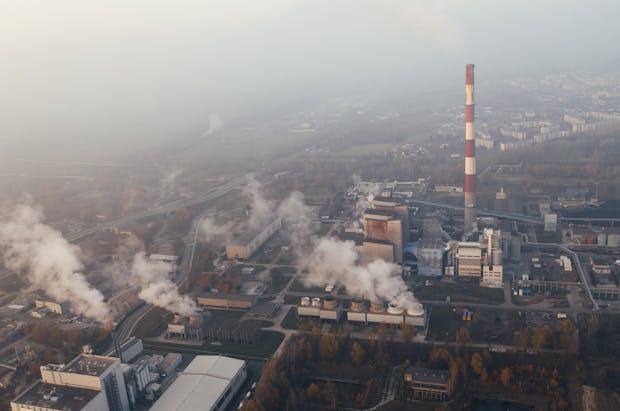
Guest Post: Global carbon emissions at record levels with no signs of shrinking, new data shows. Humanity has a monumental task ahead


Marcin Jozwiak/Unsplash, CC BY
Pep Canadell, CSIRO; Corinne Le Quéré, University of East Anglia; Glen Peters, Center for International Climate and Environment Research - Oslo; Judith Hauck, Universität Bremen; Julia Pongratz, Ludwig Maximilian University of Munich; Philippe Ciais, Commissariat à l’énergie atomique et aux énergies alternatives (CEA); Pierre Friedlingstein, University of Exeter; Robbie Andrew, Center for International Climate and Environment Research - Oslo, and Rob Jackson, Stanford University

Global carbon dioxide emissions from all human activities remain at record highs in 2022, and fossil fuel emissions have risen above pre-pandemic levels, according to a new analysis by an international body of scientists.

The analysis, by the Global Carbon Project, calculates Earth’s “carbon budget”, which is how much CO₂ humans have released, and how much has been removed from the atmosphere by the oceans and land ecosystems. From there, we calculate how much carbon can still be emitted into the atmosphere before Earth exceeds the crucial 1.5℃ global warming threshold.

This year, the world is projected to emit 40.6 billion tonnes of CO₂ from all human activities, leaving 380 billion tonnes of CO₂ as the remaining carbon budget. This amount of emissions is disastrous for the climate – at current levels, there is a 50% chance the planet will reach the 1.5℃ global average temperature rise in just nine years.

Wednesday, September 14, 2022

UN Secretary General highlights climate crisis at WMO United in Science Report 2022 launch

The World Meteorological Organisation (WMO) recently launched the United in Science report (13 September)  The United Nations Secretary General articulated the climate impacts being felt this year, the climate crisis we are facing and the imperative to reduce emissions more rapidly and stop ALL new fossil fuel projects.

The United in Science report highlighted that:

  • Greenhouse gas concentrations continue to rise to record highs. 
  • Fossil fuel emission rates are now above pre-pandemic levels after a temporary drop due to lockdowns.
  • Ambition of new mitigation pledges for 2030 need to be four times higher to limit global warming to 2 °C and seven times higher to get on track to limit global warming to 1.5 °C..
  • 2018–2022 was the fourth warmest 5-year period on record and 2015-2021 were the seven warmest consecutive years on record.
  • Some regions saw greater glacial mass loss than others. For example, Western Canada experienced an exceptionally warm and dry northern hemisphere summer in 2021, which further exacerbated mass loss of glaciers across the region.
  • In 2018-2021 the Arctic sea-ice extent was below average and in the Antarctic, minimum sea-ice extent reached record lows.
  • There is a 48% chance the annual mean global temperature will temporarily exceed 1.5 °C above pre-industrial levels (1850-1900) for at least one of the next five years (2022–2026).
  • there is a 93% probability that at least one year in the next five will be warmer than the warmest year on record (2016).
  • As the climate changes, tipping points, or irreversible physical changes in the climate system, cannot be ruled out. Potential tipping points include the Amazon rainforest, melting of polar ice sheets and changes in major weather systems, such as the monsoon.
  • With 3.3 to 3.6 billion people living in contexts that are highly vulnerable to climate change, adaptation to climate impacts is more important than ever.

Sunday, March 6, 2022

Guest Post: ‘One of the most extreme disasters in colonial Australian history’: climate scientists on the floods and our future risk

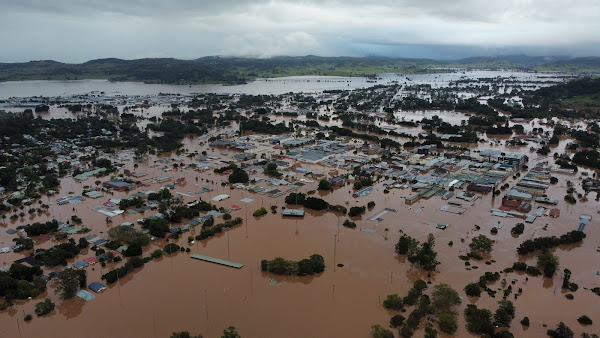
The City of Lismore under floodwaters in Feb 2022
The City of Lismore under floodwaters, February 2022.
Andrew King, The University of Melbourne; Linden Ashcroft, The University of Melbourne, and Sarah Perkins-Kirkpatrick, UNSW Sydney

The deluge dumped on southeast Queensland and northern New South Wales this week has been catastrophic. Floodwaters peaked at around 14.4 metres high in Lismore – two metres higher than the city’s previous record.

So how does this compare to Australia’s previous floods, such as in 2011? And can we expect more frequent floods at this scale under climate change? The answers to questions like these aren’t straightforward.

Climate change doesn’t tell the whole story, as extreme rainfall can occur for a variety of reasons. What’s more, it’s too soon to officially state whether this event is directly linked to climate change, as this would require a formal event attribution study. This can take months or years to produce.

In any case, we do know extreme events like this will occur more frequently in a warmer world. And the rising death toll, ongoing evacuations and destroyed homes make this one of the most extreme natural disasters in colonial Australian history.

Friday, September 24, 2021

IPCC climate science report: code red for humanity says UN Secretary General


"Today’s IPCC Working Group 1 Report is a code red for humanity.  The alarm bells are deafening, and the evidence is irrefutable:  greenhouse gas emissions from fossil fuel burning and deforestation are choking our planet and putting billions of people at immediate risk. Global heating is affecting every region on Earth, with many of the changes becoming irreversible." said Antonio Guiterres, UN Secretary General upon the launch of the Intergovernmental Panel on Climate Change (IPCC) 6th assessment report on the Physical science.

"The internationally agreed threshold of 1.5 degrees Celsius is perilously close. We are at imminent risk of hitting 1.5 degrees in the near term. The only way to prevent exceeding this threshold is by urgently stepping up our efforts, and pursuing the most ambitious path. We must act decisively now to keep 1.5 alive." said Guiterres in an official statement.

Tuesday, April 27, 2021

Sustainable sports fields are natural turf not synthetic in a time of climate emergency

Moreland Council intends rolling out synthetic turf when evidence points to it being a highly problematic environmental and climate issue and at a substantially greater lifecycle cost even when factoring in a higher usage ratio.


So it seems the ratepayers of Moreland are going to be hit with expensive replacement costs of synthetic fields every 7-10 years, an increase in urban heat island which will result in health impacts to residents especially during extreme heat events which are becoming more common, an increase in microplastics pollution to local waterways and Port Philip Bay, 274 tonnes of landfill every 7-10 years, reduced abundance of birdlife, and extra greenhouse gas emissions (lifecycle emissions range from 500-1505 tonnes CO2e for synthetic turf) that will need mitigation. (See the Literature Review: Synthetic Turf carbon footprint, environmental, health, microplastics and biodiversity impacts)

So what is the alternative to Plastic Grass?

Well constructed natural turf field with a carefully chosen grass cultivar to suit the usage and climate.

I have just read a study that was presented at Australian Water Assocation conference last June - Ozwater20 - by Dr Mick Battam (a soil scientist) and Dr Paul Lambie (an irrigation specialist). The study was on building natural turf fields using industrial grade compost. This improves player carrying capacity to about 35-37 hours per week with minimal wear. Their study is titled: Creating Sustainable Open Spaces - Using Compost to Deliver Liveability, Sustainability, Recreation and Economic Outcomes, and is available from Australian Water Assocation website. The study paper concludes:
"Using compost to amend the soils on sports fields has been shown to improve soil fertility. The amendment of soils also reduces irrigation demand, with benefits to the water industry from water savings and increased resilience to drought. A natural turf field built with a wear tolerant turf cultivar and compost amended soil provides for more liveable cities and gives a superior economic outcome to synthetic turf alternatives."

Use of compost for sporting fields to increase their fertility, usage capacity and drought resilience is part of the circular economy. It could provide an outlet for Moreland's green bin food and organic waste collection after it has been through the industrial scale composting process. This is a no-brainer. Moreland Council should embrace this possible reuse of green waste for improving municipal sporting fields.

Friday, April 16, 2021

Literature Review: Synthetic Turf carbon footprint, environmental, health, microplastics and biodiversity impacts


Hosken Reserve: grass oval used for soccer training, informal recreation, off-lead dog exercise
Hosken Reserve: grass oval used for soccer training, informal reacreation, off-lead dog exercise
(Photo by John Englart)

Abstract: 

The conversion of a grass oval to synthetic turf at Hosken Reserve, Coburg North, is about a failure in transparency and consultation with the local community, and poorly framed triple bottom line decision making by Moreland Council. There are questions about the integrity of the triple bottom line decision making embracing the social, environmental and economic impacts, costs and benefits, that was used in the process in the past decade for this site. And there are questions how triple bottom line decision making and weighting of factors will be applied for the current process. 

This literature review provides numerous reasons why conversion of a natural grass oval and open space to a fenced synthetic soccer pitch should not take place. It finds that there are two primary reasons against synthetic turf at Hosken Reserve, and that either reason is significant in itself for the primary project not to go ahead. These two essential reasons are - synthetic turf carbon footprint (up to 1500 CO2e tonnes) in total life cycle greenhouse gas emissions, and synthetic turf increasing waste to landfill contributing to toxic leachates pollution and microplastics pollution. On both these grounds conversion of a shared use natural grass oval to synthetic turf would appear to conflict with existing Council policy and frameworks related to climate change and the climate emergency, and Council’s zero waste to landfill by 2030 target. 

On the triple bottom line factors we found the social factors weighed up with some positive and some negative, the environmental factors were mostly against, and the economics didn’t stack up, even after factoring in 2 to 1 equivalence usage factor for synthetic turf. This review investigated peer reviewed science, grey literature and relevant policy documents to ascertain the following issues with synthetic turf::

  1. Derived from fossil fuel petrochemical industry
  2. Produces greenhouse gas emissions during manufacturing and as it degrades
  3. Increases landfill at end of life
  4. Produces microplastics pollution
  5. Increases urban heat island effect on local residents
  6. Replaces natural grass which allows soil organic carbon sequestration, provides oxygen
  7. Reduces soil biota, grass seeds and insects with a trophic impact on local biodiversity primarily birdlife.
  8. Compacts the soil increasing stormwater runoff
  9. Toxic Chemical leachates from rubber infill pollute waterways
  10. Results in increased lower extremity injuries in elite players
  11. Long term human health impacts uncertain, but vertebrate model confirms toxicity to human health of rubber infill leachates
  12. Enhances infection transmission risk. Encourages a microbial community structure primarily defined by anthropic contamination
  13. Appears to improve water conservation, but the situation is far more complex when life-cycle assessment and irrigation to reduce heat for playability is taken into account
  14. Other issues: increased fire risk, increase in traffic, parking on quiet residential streets
  15. Alternative Solutions

The Climate Action Moreland full submission to Moreland Councillors and Hosken Refresh Consultation can be downloaded in PDF format (27 March 2021). This contained extra information regarding Hosken Reserve and Moreland Couuncil.  The version below has extra references and minor updates but focuses on the science.

This document was researched and prepared by John Englart, Convenor of Climate Action Moreland and was subject to peer review by group members and other active members in the Moreland climate community.

Publication Date: 15 April 2021 

DOI: 10.13140/RG.2.2.28126.56646

Supplementary: Annotated Bibliography on Synthetic Turf and Climate, health, biodiversity and microplastics pollution issues, https://takvera.blogspot.com/2021/04/annotated-bibliography-synthetic-turf.html 


Suggested Citation: Englart, J (2021), Literature Review on environmental and health impacts of synthetic turf., Climate Action Moreland, DOI: 10.13140/RG.2.2.28126.56646

Thursday, September 24, 2020

Letter to Peter Khalil MP on gas lead recovery announcement for Australia

Dear Peter,
I hope you and your family are keeping well during these pandemic times. I am occupying myself with a thousands small jobs from the local to the international on climate advocacy. I appreciate your confidence in speaking up in recent months, and in debating Dave Sharma with Patricia Karvelas on international policy areas.

I am writing to you in your role as my Federal MP for Wills, on the Government gas lead covid recovery announcement by Prime Minister Morrison..

I write as a Victorian voter, a parent and grandfather being very concerned about increasing climate change and as a person who has attended 4 UN Climate Change conferences (COP21, COP22, COP23, and COP25)

I am very concerned about the “gas-fired recovery from COVID-19” as announced by the Prime Minister Scott Morrison today (September 15).

Friday, November 29, 2019

Scientists warn climate tipping points may be close, endorse need for climate emergency action


Two peer reviewed statements by scientists just prior to the UN climate conference COP25 to be held in Madrid, Spain from December 2 to 13, have made clear the existential crsis humanity now faces with climate change and the dire need to ramp up climate action at the climate conference.

The first statement, authored by 5 eminent scientists, but signed by some 11,000 climate scientists, warns "clearly and unequivocally that planet Earth is facing a climate emergency."

The second statement highlights that we may be very close, or perhaps have even initiated, climate tipping points that could push earth into a hothouse state. Our time for action to have some control over future climate may be limited, action now is of the essence, we have a climate emergency. Australian scientist Will Steffen was one of the eminent scientists who authored this statement.

Wednesday, February 8, 2017

Great Forest National Park and Port Philip Bay: communicating conservation research at #vicbiocon17


Sarah Rees and Sheree Maris gave two inspiring presentations on science communication in conservation and biodiversity in an afternoon plenary at the Victorian Biodiversity Conference in Melbourne.

Its always nice to discover new natural wonders in our local area. It enhances our sense of place and pride in nature, and is an important motivation for conservation.

Sarah Rees and Sheree Maris bring us the wonders of the ancient Central Highland forests and the extraordinary ecosystems hiding just under the surface of Port Philip. Both of these environments are just on the edge of Melbourne, yet are largely unknown and unexplored by most Melburnians.

Monday, February 6, 2017

Chief Australian scientist compares Trump to Stalin on science censorship


Alan Finkel, Australia's chief scientist, has compared Donald Trump to Josef Stalin, in the moves to censor environmental data and climate science at the US Environment Protection Agency (EPA) and other US Government agencies.

Soviet dictator Josef Stalin exerted an iron control of science in the USSR.

Finkel's statement was made as part of a speech to the Chief Scientists' roundtable discussion at the Australian National University. Also of note in attendance was New Zealand’s Prime Minister’s Chief Science Advisor Professor Sir Peter Gluckman, and UK’s former Chief Scientist Professor Sir John Beddington.

In his speech Finkel announced he was "going off topic" as "science is literally under attack".

Saturday, January 21, 2017

100 climate impacts on oceans and marine ecosystems


Over my last decade of reading on climate change, I have picked up a fact or two on oceans and the marine environment, and written the odd article.

Oceans and the marine biodiversity they encompass are important. Just take a deep breathe and reflect upon the fact that the oxygen we rely upon, every second breathe we take, comes from ocean marine algae. And that's just the start.

Most of us just dabble at the edge of the marine environment with perhaps a visit to the beach. But the oceans are deeply important for providing much of our food, and as a carbon sink and regulator of weather and climate on our planet. From the mangroves and reef ecosystems that border coasts providing many social benefits to us, to the open ocean, and deep seabed with incredible life forms we are still just discovering.

Who could resist an opportunity to detail the many climate change impacts on the oceans and marine ecosystems from marine ecologist, Dr John Bruno, a Professor at University of North Carolina at Chapel Hill.

His list, tweeted out using the #100impacts hashtag, comes at a time of the inauguration of the new administration of President Trump. One of the first acts of this new administration was to eliminate all mention of climate change from the Whitehouse website.

The list will build over coming days. Revisit to see the latest posts.

Friday, November 11, 2016

Strong ambition needed to meet 1.5C #ParisAgreement Target #COP22


According to the latest Climate Action Tracker assessment of national climate plans (NDCs), the Paris Agreement current commitments will lead to a warming of 2.8degC, with a likely chance of holding warming below 3.1degC.

It is clear that more ambition is needed, and the earlier emission reductions happen, the greater the benefit.

I was unable to make this press conference but Dr Cara Augustenborg did a sterling job of tweeting the main points. The Press conference is available as video on demand.

Host country, Morocco, is one of the few countries rated by Climate Action Tracker as 'Sufficient' in their climate targets and climate action. Morocco, along with Nepal are the only countries to update their climate plans (NDCs) since the Paris Agreement was agreed.

Thursday, October 27, 2016

Warm ocean water melting Antarctica from below adding to sea level rise


Latest observational data from Amundsen Sea embayment (ASE) of West Antarctica confirms the retreat of ice shelf grounding lines caused by warmer water melting the underside of the ice shelves.

Warm ocean waters are melting the junction of the ice shelves where they meet the bedrock, so that the grounding line retreats. This then allows for an acceleration in glacier dischange of ice mass to the sea increasing sea level rise.

Many of the glaciers of the West Antarctic Ice Sheet (WAIS) have topographies where they get deeper as they go further inland.

As the ice shelf grounding line retreats into deeper areas due to basal melting by warmer water, it moves much more rapidly, which then allows more warm water to continue the process of basal melting, and so the ice mass discharge from the glaciers speeds up.

Thursday, August 25, 2016

Saturday, May 28, 2016

Australian Government censors UNESCO report on Great Barrier Reef #ReefGate


A UNESCO report identifies World Heritage sites at risk from climate change, but there is no mention of Australian sites in the report. The Australian Government requested that all mentions be deleted, and this was complied with by UNESCO. This censorship of science should raise many questions.