Why I am being arrested in Melbourne CBD today, 9 December, 2023, with Extinction Rebellion – Statement by John Englart.
I’d like to say a few words why I am disrupting business as usual today, to block the traffic in Melbourne CBD. I am 68 years old and have been concerned about the lack of climate action for 20 years.
I have written letters and emails, I have signed petitions, I have been on delegations to my Federal MP Peter Khalil, and my former MP Kelvin Thomson. Since 2015 I have attended Merri-bek Council meetings each and every month as a witness for their actions on climate. I have decarbonised my personal carbon footprint by increasing cycling, using Solar PV, eliminating gas from my home, composting, and reducing plastics use.
Victorian Racing Club were allowed by the Bracks Labor Government to build a stone flood wall at Flemington Racecourse in 2006 over the objections of local residents and three local Councils.
This racing track is built on the floodplain and should provide mitigation from floodwaters.
Instead those floodwaters from the Maribynong river inundated local residential areas on Friday flooding about 245 homes, and damaging many vehicles.
Prevention of floodwaters spreading across the Flemington racetrack likely exacerbated flood impacts on residential areas that were flooded.
Who will pay for the damage to residential property? The citizens affected, their insurance companies (if they have flood insurance) and it will contribute to all our insurance premiums.
All to prioritise the gambling industry above citizens. And the Melbourne Cup.
Melbourne Airport with 3 runways 2026 Option 1, Night 11pm-6am Flight Paths
Melbourne Airport is planning a third runway.
So I'm doing a science literature dive into reading the air pollution health impacts of aviation emissions...
You know, that coating you find over your car or house if you live under a flight path...this is soot, black carbon (BC), particulate pollution emissions from aircraft landing and taking off. But it's the particles you don't see that are problematic: Ultra Fine Particles (UFP) sometimes referred to as particulate matter with a size designation often classified as PM2.5, but often even smaller which can reach the furthest alveoli of your lungs..
These pollution particulates are not good for your health. UFPs have a high surface area and a capacity to adsorb a substantial amount of toxic organic compounds.
Studies indicate that the "exposure to aircraft emissions induce pulmonary and systemic inflammation, which potentially contributes to cancer, asthma, respiratory and coronary heart disease." (Bendtsen 2021)
In fact it is calculated that aviation emissions on a global basis cause about 16,000 people to die prematurely every year, and of this number about 5,000 people who live within 20 km of airports are estimated to die prematurely each year.
As Steve H L Yim et al (2015) study says: " primary PM2.5 emissions from aviation are a significant contributor to health risk when airport vicinity exposure is captured."
The study also highlights that the health cost of aviation emissions is actually at a magnitude larger than global aviation fatal accident costs, and on par with aviation's climate costs.
I wonder if Melbourne Airport have done their sums on the extra costs to health of people in the 20km radius of the airport with the extra aviation emissions a third runway will induce?
These are all relevant reasons to oppose the airport. The missing piece in this analysis is the aviation pollution impacts on air quality and human health at all scales: local, regional and global.
This article seeks to draw attention to some of the science on aviation exhaust emissions, air quality and human health.
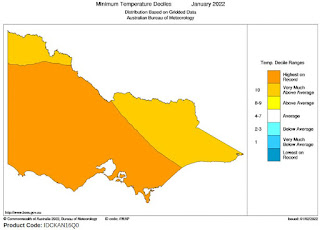
Sleepless in Melbourne? January was a warm one for Melbourne despite presence of La Nina (ENSO) which usually cools global temperatures marginally.
The trend was particularly noteable with record mean minimum temperatures for Melbourne and most of Victoria this year. Victoria's January mean minimum temperatures are rising faster than mean maximum temperatures.
There was also record humidity for January for most of Victoria. Record rainfall was also recorded in north east Victoria.
It seems there will be lots more sleepless January nights in store for us all in Melbourne in future years.
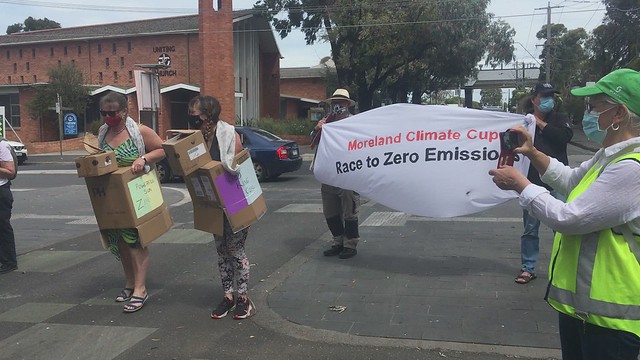
In Melbourne the Moreland Climate Coalition held three covidsafe events in Moreland on Saturday, with other climate protests in the city and at St Kilda, as part of the Global day of action called by the COP26 Coalition in Glasgow.
This included calling the Moreland Climate CUP, the Race to Zero Emissions. Sunlight streaked ahead out of the gates from a slow start. Old King Coal sadly had to retire and be be put down. Of course we'll find a new job for the Old King Coal jockey. That is a matter of Just Transition.
A new website uncovers the aviation emissions associated with 1300 airports globally, covering 99 per cent of passenger flights. Twenty four of those airports are located in Australia producing carbon emissions equivalent to five coal fired power stations.
The aviation sector would have been the sixth-largest emitter of CO₂ in 2018 if it were a country, responsible for 2.5 per cent of global emissions. Up until the pandemic aviation was growing 5 per cent annually since 2013. Despite the disruption caused by the pandemic, the sector remains off-track for limiting global heating to 1.5ºC.
Aviation emissions for the website is based on data from 1300 airports from 2013, 2018, 2019. The website was a joint project by the International Council on Clean Transportation (ICCT), International Think Tank ODI, and Transport and Environment (T&E).
This is the first global attempt to focus on the infrastructure that enables and induces air travel and leads to more CO₂ emissions in future decades.
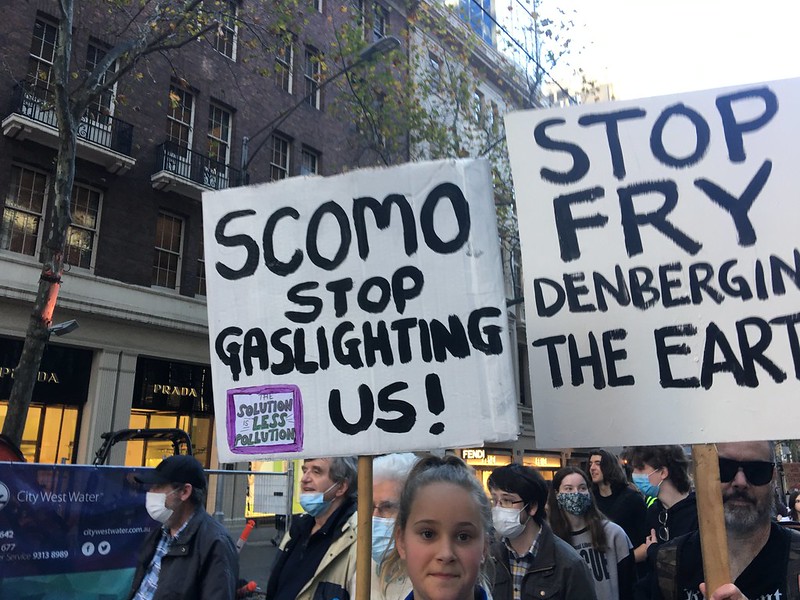
Tens of thousands of students and supporters across Australia engaged in protest calling for an end to fossil fuel projects and to ramp up renewables and increase Australia's weak climate targets.
In over 50 locations across Australia, in all capital cities, and in many regionals centres too, students left school on Friday to demand that the Morrison Government says no to funding dangerous gas and coal projects with Australians’ money and, as an alternative, invests in clean renewable energy, secure jobs and First Nations solutions to protect Country.
John Englart accepting his award from Mayor Cr Natalie Abboud
John Englart, Convenor of Climate Action Moreland, received the annual Moreland Award for Environmental Sustainability at the Moreland Awards on 1st October, 2019 for his advocacy in climate action. More than 200 people attended the awards event at the Coburg Town Hall. Article originally published at Climate Action Moreland website.
Previous to his award, John Englart's name was mentioned during the evening ceremonies as part of three advisory groups: Sustainable Moreland Advisory Group, Moreland Transport Advisory Committee, Community Advisory Reference Group (on level crossing removal).
John has been a resident of Brunswick, Coburg North and Fawkner for 29 years, publishing on climate science and the need for action since 2004, and active in Climate Action Moreland since 2012. He has attended as an NGO Observer for Climate Action Network Australia the United Nations Framework Convention on Climate Change (UNFCCC) Annual conferences in Paris in 2015 (COP21), Marrakech in 2016 (COP22), and Bonn in 2017 (COP23).
A Response from Australia Pacific Airport (Melbourne) to my questions on runway expansion and aviation emissions.
On my first question, regarding factoring in the possibility for development of east coast high speed rail and it's impact on flight projections, they utterly failed to answer my question.
This is a big fail in their risk management and in their corporate business model.
About 150 people attended Extinction Rebellion Day in Melbourne in the Treasury Gardens.
There was no blocking of bridges, no arrests made. It was a pretty tame affair, really. The Climate Guardian angels were present and provided a note of solemnity. Composer and choir master Stephen Taberner was there and gave a quick workshop on street chants.
There was a short march up to Treasury Place where the declaration was read out. A copy of the declaration was also handed to a security officer between the locked bars of the Australian Government offices.
The Is it hot right now? website provides a daily view on daily average temperatures for Australian capital cities, comparing the average temperature to it's history for that day, to see where it sits in the distribution of temperatures typical for the time of year.
The site was developed by climate researchers Mathew Lipson, Steefan Contractor and James Goldie. The data comes from the Bureau of Meteorology's ACORN-SAT.
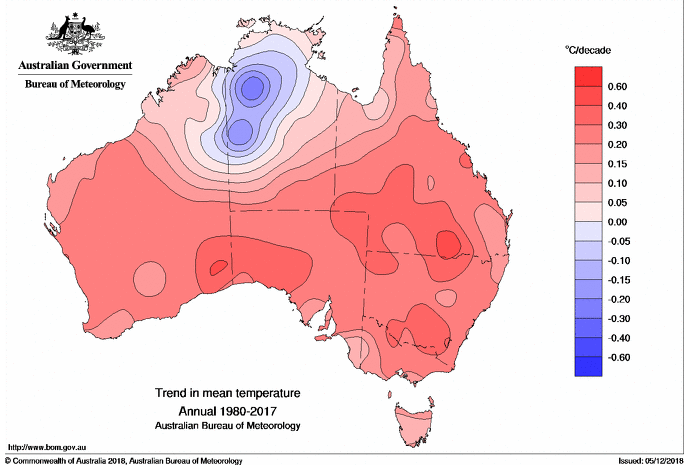
Mat Lipson provided the Yearly average temperature charts and the 2018 heat maps for each city. The trend in rising temperatures is clearly visible in each. I have added details for each city of future projections done by CSIRO in 2015.
In the year heat maps for each city you can still see the fluctuations in temperature due to weather events, but the cold days (blue) are getting rarer, and the hot days (red) are getting more common, a telling sign of the long term climate temperature trend affecting all regions of Australia.
The Powering Past Coal Alliance announced on Friday that Sydney and Melbourne had joined the Alliance at an event: Accelerating the global coal transition. This follows the Australian Capital Territory joining in September 2018. Other states and businesses that joined at COP24 included Israel, Scotland, Senegal, and Scottish Power.
The Alliance, formed in Bonn in 2017 at COP23, now includes 80 members including national governments, state or regional governments, cities, and businesses.
Canada's Environment Minister Catherine McKenna Made the announcement.
Funeral for Our Future - a Service conducted by Stop Adani Melbourne and friends, officiated by Uniting Church Minister Rev Alex Sangster.
Included a Processional march by Riff Raff Marching Band, Songs lead by the Climate Choir, Eulogy for the Reef by Alan Cuthbertson from Stop Adani Melbourne, Eulogy for Nature by Joseph Birckhead and Audrey Cooke, Euology for Children's Future by teenager Marco Bellemo, Call to Action by Rev Alex Sangster and Marco Bellemo.
Melbourne Cup day dawned with rain falling. Storms escalated with torrential rain through the morning. Power outages, train disruptions, flashflooding of stations and many low lying roads across the city eventuated. But the mainstream media failed to add 2 + 2 with the influence of climate change in this extreme weather event.
The previous day racing officials had ordered more racetrack irrigation overnight to reduce the firmness of the track. Perhaps they should have checked the weather forecast.
Intense rain events are becoming more frequent, the science is clear not only from models but also observational data. Part of the reason for this is a Warmer atmosphere that can carry more moisture. For every 1 degrees Celsius of warming the extra atmospheric carrying capacity is increased by an extra 6-7 per cent. So heavier rain. That means more flash flooding.
Last night I attended the last public consultation on the Melbourne Airport Masterplan which involves substantial expansion of the terminals, roads and a future 2nd east-west runway. And complete silence on aviation emissions, except when I pushed the Environment Manger to reluctantly concede this impact.
I have been very concerned about rising temperatures and the urban heat island effect on the people in our cities, particularly Melbourne and the City of Moreland where I live. See Climate change and heatwaves in Melbourne - a Review. Moreland Council have been one of the more pro-active local governments in reducing emissions, ameliorating the urban heat island effect through an urban forest strategy, and in working towards adaptive changes by the population of Moreland in dealing with impacts of extreme heat. Liz Hanna puts this together in the dilemmas we will face in future years as temperatures continue to rise.
The reality of living with 50℃ temperatures in our major cities
Sydney is facing 50℃ summer days by 2040, new research says. Andy/Flickr/Wikimedia Commons, CC BY-SA
Australia is hot. But future extreme hot weather will be worse still, with new research predicting that Sydney and Melbourne are on course for 50℃ summer days by the 2040s if high greenhouse emissions continue. That means that places such as Perth, Adelaide and various regional towns could conceivably hit that mark even sooner.
This trend is worrying, but not particularly surprising given the fact that Australia is setting hot weather records at 12 times the pace of cold ones. But it does call for an urgent response.
Most of us are used to hot weather, but temperatures of 50℃ present unprecedented challenges to our health, work, transport habits, leisure and exercise.
Humans have an upper limit to heat tolerance, beyond which we suffer heat stress and even death. Death rates do climb on extremely cold days, but increase much more steeply on extremely hot ones. While cold weather can be tackled with warm clothes, avoiding heat stress requires access to fans or air conditioning, which is not always available.
The death rate in heat ramps up more rapidly than in cold. Data from Li et al., Sci. Rep. (2016); Baccini et al., Epidemiol. (2008); McMichael et al., Int. J. Epidemiol. (2008), Author provided
Even with air conditioning, simply staying indoors is not necessarily an option. People must venture outside to commute and shop. Many essential services have to be done in the open air, such as essential services and maintaining public infrastructure.
Roughly 80% of the energy produced during muscular activity is heat, which must be dissipated to the environment, largely through perspiration. This process is far less effective in hot and humid conditions, and as a result the body’s core temperature begins to climb.
We can cope with increased temperatures for short periods – up to about half an hour – particularly those people who are fit, well hydrated and used to hot conditions. But if body temperature breaches 40-42℃ for an extended time, heat stress and death are likely. In hot enough weather, even going for a walk can be deadly.
Air conditioning may not save lives
We expect air conditioning to take the strain, but may not realise just how much strain is involved. Shade temperatures of 50℃ mean that direct sunlight can raise the temperature to 60℃ or 70℃. Bringing that back to a comfortable 22℃ or even a warm 27℃ is not always possible and requires a lot of energy – putting serious strain on the electricity grid.
Electricity transmission systems are inherently vulnerable to extreme heat. This means they can potentially fail simply due to the weather, let alone the increased demand on the grid from power consumers.
Power cuts can cause chaos, including the disruption to traffic signals on roads that may already be made less safe as their surfaces soften in the heat. Interruptions to essential services such as power and transport hamper access to lifesaving health care.
Myopic planning
It’s a dangerous game to use past extremes as a benchmark when planning for the future. The new research shows that our climate future will be very different from the past.
Melbourne’s 2014 heatwave triggered a surge in demand for ambulances that greatly exceeded the number available. Many of those in distress waited hours for help, and the death toll was estimated at 203.
The health sector is concerned about Australia’s slow progress and is responding with the launch of a national strategy for climate, health and well-being. Reinstating climate and health research, health workforce training and health promotion are key recommendations.
There is much more to be done, and the prospect of major cities sweltering through 50℃ days escalates the urgency.
Two key messages arise from this. The first is that Australia urgently needs to adapt to the extra warming. Heat-wise communities (or “heat-safe communities” in some states) – where people understand the risks, protect themselves and look after each other – are vital to limit harm from heat exposure. The health sector must have the resources to respond to those who succumb. Research, training and health promotion are central.
About 20 Activists this morning occupied the Melbourne offices of Downer, an infrastructure company, to protest participation in developing the Adani Carmichael coal mine in the Galilee Basin of Queensland, widely seen as a climate carbon bomb with no social license.
The Adani Carmichael coal mine is a climate carbon bomb that would push temperatures well past the 2 degrees C limit that countries set in Paris UN climate Conference in 2015 at COP21. Research shows that Australia needs to leave 95 percent of it's coal in the ground unexploited and unburnt to stand a reasonable chance of not exceeding the 2C target.
In January 2015 it was announced that Downer EDI had won a $2 billion contract for works at Adani’s Carmichael coal mine in Queensland’s Galilee Basin, according to Australian Mining.
Sarah Rees and Sheree Maris gave two inspiring presentations on science communication in conservation and biodiversity in an afternoon plenary at the Victorian Biodiversity Conference in Melbourne.
Its always nice to discover new natural wonders in our local area. It enhances our sense of place and pride in nature, and is an important motivation for conservation.
Sarah Rees and Sheree Maris bring us the wonders of the ancient Central Highland forests and the extraordinary ecosystems hiding just under the surface of Port Philip. Both of these environments are just on the edge of Melbourne, yet are largely unknown and unexplored by most Melburnians.
Lily D'Ambrosio, the Victorian Energy and Environment Minister, stepped forward today to announce that Melbourne's tram network will be powered by 100 per cent Solar. Not directly of course. But the government will issue a tender for a new 75MW capacity large scale solar farm to supply the equivalent power needed for the tram network to the electricity grid.
The Government will voluntarily surrender renewable energy certificates matching the amount of electricity used by all of Melbourne’s trams.
About 35MW from the solar farm will be allocated for powering the tram network. “We’ve got the biggest tram network in the world and we’re powering it with renewables and creating local jobs.” said Transport Minister Jacinta Allan.