Mastodon Climate Citizen --> Mastodon
Showing posts with label heatwave. Show all posts

Friday, August 30, 2024

Australia experiences record breaking winter heatwave; Rapid snow season decline; Global Snapshot of news reveals climate crisis extent

Australia experiencing a late winter season  heatwave breaking temperature recotds.

Australia is in the grip of a late winter season heatwave with temperature records falling across most states. Southern States are experiencing storm fronts with strong winds some times in excess of 100km/hr.

Australia: late Winter #heatwave temperature records broken for Queensland, New South Wales, Northern Territory and South Australia. In Qld, Birdsville’s running maximum temperature at 3:30pm AEST on Friday was 39.6°C. This is roughly 15°C above average for this time of year and Qld’s highest winter temperature on record. (Weatherzone)

Sydney Airport has broken its winter record of 31.1°C this Friday, reaching 31.6°C at 2:48pm. In August 2024 to date, Sydney's running average maximum has been 21°C, some 3.1 above the long-term average. (Weatherzone)

In Queensland, Rental advocates warn heat-related deaths will increase if Queensland regulations aren't tightened. The ABC News report summarises that:

  • Parts of Queensland are predicted to see a record-breaking 36-degree end to winter.
  • Advocates want efficiency regulations to protect renters and public housing tenants.
  • The state government says their reforms have made renting fairer and lifted housing standards.
  • See associated VIDEO: Growing risk of heat-related deaths as Queensland temperatures soar

See climatologist Andrew King explain at the Conversation, published 26 August 2024: 40°C in August? A climate expert explains why Australia is ridiculously hot right now

Thursday, August 3, 2023

Record Extreme heat in Chile, Argentina... in winter.


We are just having a record warm winter in Tasmania, parts of Victoria and Sydney, slightly more pleasant temperatures, but in Chile and Argentina in South America at the moment it is hot...in winter...

Australian climate heatwave expert A/Prof. Sarah Perkins-Kirkpatrick (@sarahinscience) described the South American heat event:
"what the actual F**K. this is totally insane. When I first saw this, I had trouble believing it myself. I'm shocked. Buenos Aires broke a record by over 5C - that's like Sydney experiencing a 30+C day at this time of year. This is bonkers. #climatechange"
https://twitter.com/sarahinscience/status/1686931331350188035

Tuesday, July 11, 2023

Over 61,000 heat related deaths during 2022 European summer

New research estimates over 61,000 heat related deaths in Europe in 2022. And that comes after heat alerts and other climate adaptation measures implemented after the massive death toll of 73,000 from the 2003 heatwave. 

What will the summer bring for Australia? With record temperatures being set around the world (see June climate signals and records), and ElNino formation boosting temperatures.

Meanwhile Australia is approving new thermal coal and gas, and continues fossil fuel subsidiaries to the tune of $11billion per year with no public plan to phase these subsidies out.

Will heat related deaths be at a similar level in 2023 in Europe? 

Will we see a similar number of heat related deaths in the southern hemisphere summer?

What should also be noted is that climate impacts are not gender neutral. Research has found that older women died at higher rates than men.

Thursday, February 3, 2022

Sleepless in Melbourne - heat, humidity and rainfall set new January records for Victoria

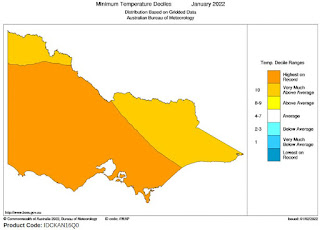
BOM: Average Tmin deciles for January

Sleepless in Melbourne? January was a warm one for Melbourne despite presence of La Nina (ENSO) which usually cools global temperatures marginally. 

The trend was particularly noteable with record mean minimum temperatures for Melbourne and most of Victoria this year. Victoria's January mean minimum temperatures are rising faster than mean maximum temperatures. 

There was also record humidity for January for most of Victoria. Record rainfall was also recorded in north east Victoria.

It seems there will be lots more sleepless January nights in store for us all in Melbourne in future years.

Monday, September 27, 2021

Video: Life at 50C - The families forced to defend their homes from Australian bushfires (BBC)


This short BBC documentary investigates the climate change impacts of extreme heat and bushfires. It articulates climate change is here and now. It will get worse. But there are things we can do to change the direction of global warming.

Friday, April 30, 2021

North Africa and Middle East Warning on heatwaves and extreme temperatures driven by global heating


A few years ago climate scientists announced that in coming decades Melbourne and Sydney will experience 50C days.

Those temperatures are also coming to the Mediterranean with Middle East and North Africa temperatures in heatwaves up to 56 degress Celsius according to the latest research.

This is a media release from the Italian based CMCC Foundation:

Tuesday, February 5, 2019

Extreme Heat withering the trees in Albury


It's been an incredibly hot summer so far if you live in Australia's inland. Record breaking heat is impacting the health of people and roasting the vegetation.

Take the City of Albury- Wodonga as an example.

The towns of Albury-Wodonga straddle the Victoria-New South Wales border, on the Murray river. It is an important regional city with both the Hume Highway and Sydney Melbourne rail passing through.


MEDIA RELEASE – JANUARY 2019: ALBURY’S HOTTEST MONTH EVER – 1/2/19

Record breaking January temperatures coupled with low rainfall have caused significant stress on local plants including death of less established trees, burnt leaves, defoliation of deciduous trees, increased eucalypt limb falls and premature fruit drop.

Albury’s January temperatures were the hottest on record, with an average day time temperature of 37.4 degrees, 5.1 degrees higher than the long term average of 32.3, according to Bureau of Meteorology data.

“These record-breaking January temperatures, including 11 days over 40 degrees, have had widespread impacts on our area” said Lizette Salmon, convener of Wodonga Albury Toward Climate Health (WATCH).

“As well as the blue-green algae problem and many people complaining of listlessness and irritability, we’ve received 60 reports from 30 citizen scientists describing impacts such as fatigued outdoor workers, decimated rhubarb, pumpkin and spinach crops, stressed and dehydrated wildlife and melting wax in bee hives. But the most frequently reported phenomenon has been the number of stressed trees.”

“A local arborist said he’d had double the number of limb fall call-outs from Vic Roads, a council worker said there was more summer leaf litter than any previous year and an orchardist estimated he’d lost 90% of his avocado crop due to premature fruit drop. Just look around our streets and you’ll see lots of stressed trees. Established trees in urban landscapes provide amenity, microclimate and biodiversity, so losses will impact greatly.”

Former curator of the Albury Botanic Gardens, Paul Scannell, said he too had noticed many changes in local plants this summer. “Natives like hakeas are dropping like nine-pins, avenues of ashes and other European and Asian specimens including Japanese maples, planes, conifers and elms are suffering. It’s the extreme temperatures, compounded by lack of water and attack by insects and diseases having an accelerated impact.”

“While defoliation, limb loss and fruit drop are natural responses to extreme conditions, this shutting down for self preservation can only go so far. If the heat and dry persist they’ll need to be well maintained with watering, mulching and, in the case of some street trees, air shattering the ground to open layers, or mechanical aeration to allow moisture to the root zone. Even then, they may not survive long term. If plants are suffering, insects are suffering, birds are suffering and lizards are suffering. It’s all interconnected. I anticipate that in the next 20 years there will be a 30 to 40 percent change of plant species we can use in gardens. We need to take strong action on climate change as well as selecting plants that are more likely to survive a heating planet.”

After advocating for climate action for more than a decade, Mrs Salmon has lost much faith in federal government. “Scientists have been warning us about these heatwaves for years and this January has been an absolute scorcher, yet the Prime Minister and his government are completely ignoring it. Their wilful silence and decades of inaction are disgraceful. Although Mr Morrison says we’ll meet the Paris climate targets he’s using dodgy accounting to ‘carry-over’ credits from Kyoto towards Paris. To pass on a habitable planet to our children we need to replace coal-fired generation with renewables and pumped hydro storage at emergency speed. It will be quicker and cheaper than more fossil fuels.”

Reference:

Monday, February 4, 2019

Politician responses to the record extreme heat for Australia January 2019


I've done some tracking on twitter across the political divide on climate and the heatwave events, going back to 22 December 2018 (the start of Christmas/New Year 1st heatwave event). December and January were record hot for Australia.

Australia's Hottest January on Record as we head into a climate election


Just as climate change has been driving up temperatures in Australia to record levels, the political temperature is also rising for a climate election for May 2019.

Australia has just experienced its hottest December on record, followed by its hottest January. It's already been a very hot summer with record breaking temperatures, and it's not yet over.

Tuesday, January 22, 2019

Heatwave round 3: climate diary of an Australian heat event


Welcome to my third daily diary of an Australian heatwave event. This heat event is marked by persistent heat from the Pilbara and Central Australia from mid December 2018 that sends out waves of heat to impact the south east population centres of Adelaide in South Australia, Melbourne and inland Victoria, western NSW spreading to include Canberra and Sydney.

Read my diary entries for the Christmas New Year heatwave: Climate Diary of an extreme heatwave across Australia and climate heat impacts, covering Dedcember 22 to January 6.

I followed this up with a second blog article documenting the heat event from January 14 - January 19: Take 2: Climate Diary of an Australian heatwave - January 2019
Heat Health alerts issued for Melbourne and Victoria
Over the weekend of 19-20 January the heat retreated to the Pilbara and Central Australia, but the heat event is far from dissipating. Heat Records continue to be broken.

Why am I documenting this? Because climate change is a primary driver of more extreme heat events. Read the Climate Council 2014 Report on Heatwaves: Hotter Longer, More often.

Monday, January 14, 2019

Take 2: Climate Diary of an Australian heatwave - January 2019

Round two for extreme heat roasting of Australia this summer.

The first heatwave round ocurred over the Christmas New Year period for which I did a daily climate blog. I followed this up with some simple analysis of the Maximum temperatures for capital cities and a number of regional towns. A further article looked at Mapping the heat trend in Australia's capital cities for 2018 and future projections.

While Sydney's eastern suburbs temperatures will be in the low 30s in the coming week, residents of Penrith and Richmond in Western #Sydney will swelter through four or five days above 40C says Dean Narramore a meteorologist with the Bureau of Meteorology.

The heatwave will impact large regions of inland Australia with lesser impact of perhaps some extreme heat days for coastal cities and towns. Major international sporting events such as the Australian Tennis Open in Melbourne and the Tour Down Under cycling event in South Australia will see their extreme heat policies implemented.

“Particularly northern South Australia, they’re looking at maybe five days in a row above 45 and normally they might only get five or 10 a year,” meteorologist Dean Narramore said on Sunday, according to The Guardian report.

It is well past time to take rapid action on climate, to reduce emissions and set ambituous targets that are our fair share of the Paris Agreement climate goals to keep global temperatures well below 2 degrees celcius and strive to meet a 1.5C target.

Wednesday, January 9, 2019

Australia's Christmas-New Year heatwave as global warming at 1.1C above pre-industrial


I followed the heatwave over the Christmas - New Year period at the end of 2018 and start of 2019. Read my climate diary of the event.

I did some charting of temperature maximums for capital cities and a few regional observation points for each state. My selection may not be fully representative of regional temperatures.

The heatwave for most areas really commenced from 24 December. It ended at various dates: on 4 January for South Australia, 5th January for Victoria and Northern Territory, 6th January for New South Wales. Temperatures have remained high in Marble Bar in the Pilbara, and although temperatures have dipped a little, remain elevated in the high 30s for Central Australia and Central Queensland.

The heat has retreated from the south east states to again build in the Pilbara and central Australia for the next blast of heat to the south eastern population centres probably from the 14 January.

Thursday, January 3, 2019

North Queensland Extreme Heatwave impacts koala population

I was scanning for news articles on heatwave impacts and came across this article on Koalas by ABC Capricornia.

It's a well written, but quite an alarming story By Alice Roberts and Jacquie Mackay: Koalas in trouble after Queensland's bushfires and heatwave, expert warns.

According to one CQUniversity academic, extreme heatwave and bushfire conditions could have major long-term impacts on animal numbers in Queensland. Alistair Melzer, a CQUniversity koala researcher, told the ABC that it could be years before the full impact is known.

And we have the iconic image of Chantelle Lowrie in Victoria giving a koala a drink from her water bottle in the 44C late December heat. (See my December 30 entry of Climate Diary of a heatwave)

Sunday, December 30, 2018

Climate Diary of an extreme heatwave across Australia and climate heat impacts


The Bureau of Meteorology in the lead up to christmas in 2018 showed a heatwave building through the week. The forecast was for severe and extreme heatwave impacts particularly Thursday 27 December to Saturday 29 December.

A blocking high in the Tasman and strong heat from the Pilbara in Western Australia and right through Central Australia, will periodically extend tendrils of sweltering heat to encompass the major population centres of Adelaide, Melbourne and Sydney.

While these cities may get occasional relief from weak cold fronts and coastal sea breezes, inland towns will swelter in the scorthing heat with temperatures in the mid to high 30s and low 40s.

Thursday, November 29, 2018

Queensland's Catastrophic bushfire, extreme heatwave and climate change


Queensland: Catastrophic fire conditions, a week long extreme heatwave with record breaking temperatures, mass bushfire evacuations at Gracemere near Rochhampton, State and Commonwealth disaster response plans triggered.

But no mention of climate change intensifying heat and bushfires.

Saturday, January 27, 2018

Guest Post: What's your heatwave plan?

Australia's 'deadliest natural hazard': what's your heatwave plan?


Andrew Gissing, Macquarie University and Lucinda Coates, Macquarie University

Heatwaves are Australia’s deadliest natural hazard, but a recent survey has found that many vulnerable people do not have plans to cope with extreme heat.

Working with the Bushfire and Natural Hazards Cooperative Research Centre and the Bureau of Meteorology, my colleagues and I surveyed 250 residents and 60 business managers in Western Sydney and the NSW North Coast.

We found that 45% of those at risk – including the elderly, ill and very young – did not proactively respond to heatwave warnings as they did not think it necessary or did not know what to do.


Read more:
Cities need more than air conditioning to get through heat waves


Few at-risk people reported moving to cooler locations, and more than 20% of people in Western Sydney were concerned about the impacts of energy prices on their ability to use air-conditioning. For most people, extreme heat left them feeling hot and uncomfortable or unable to sleep, though around 15% felt unwell. Few people reported checking on vulnerable family members, friends or family during heatwaves.

Businesses also suffered disruption, and most companies with employees working on machinery or outdoors reported lower than normal productivity.

Many people said that they didn’t need to take any further actions to adjust to future extreme temperatures. However, for some extreme heat is already impacting their living preferences, with around 10% of people indicating that they are considering moving to a cooler town or suburb.


Read more:
Are heatwaves 'worsening' and have 'hot days' doubled in Australia in the last 50 years?


A history of deadly heatwaves

Australia has a long history of deadly heatwaves. The table below shows numbers of deaths and death rates per 100,000 population from episodes of extreme heat in Australia by decade, reaching back to 1844. The information comes from PerilAUS, a database that records the impact of natural hazards reaching back to the early days of Australia’s European settlement

The death rate is the number of deaths per head of population in the country at that time, and was consistently, significantly higher between 1890 and 1939 than for any period before or since.


An extraordinary heatwave occurred between October 1895 to January 1896 that impacted nearly the entire continent but especially the interior. PerilAUS records 435 deaths, 89% of them within New South Wales. Deaths also occurred in South Australia, Western Australia, Victoria and Queensland. Bourke, in NSW, lost 1.6% of its population to the heat: temperatures of 40℃ in the shade were already being recorded in October, mid-spring.

During the disastrous 1939 Black Friday bushfires, 71 people died in Victoria. But at least 420 people died in the heatwaves which preceded the fires, largely in New South Wales. The heatwaves were accompanied by strong northerly winds and followed a very dry six months, increasing the severity of the subsequent fires.

Most will remember the catastrophic bushfires that destroyed several towns in Victoria in 2009 but not many will remember that these fires also followed two heatwave events across Victoria and South Australia, where at least 432 people died.

In 2009, new records of three consecutive days over 43℃ in Melbourne and eight over 40℃ in Adelaide were set. A feature of these heatwaves was the very hot minimum temperatures, with Melbourne’s temperature falling to between 20-25℃ overnight and Adelaide to just 30℃.

We must all plan ahead

There is no reason why a deadly heatwave could not strike Australia again this summer, and there’s at least some evidence that the frequency of heatwaves in Australia is increasing. Sudden peaks in air-conditioning use also creates the risk of overloading electricity grids and prompting blackouts, so it’s important to think about how you can stay cool without power.

Some easy ways to stay safe include tuning into heatwave and emergency warnings by listening to radio broadcasts or searching emergency websites.

Simple measures, like rescheduling outdoor activities to cooler parts of the day, closing curtains and blinds and staying indoors are always sensible. Research suggests that elderly people may be particularly reluctant to use air conditioners, but if your household contains vulnerable people it’s important to use every cooling option available.

It may be possible for some people to use an app or timer to turn on their air conditioners during the afternoon to cool their house, then turn it off after 6pm to avoid contributing to peak demand.


Read more:
High energy costs make vulnerable households reluctant to use air conditioning: study


If you have friends or family who are elderly, sick or very young, make sure to check in on them. Consider selecting a cooler place, like a shopping centre or library, you can visit during peak temperatures.

Make a plan for pets and animals, particularly those who will be left outside during the day while the household is at work or school. Ensure they have shade and access to plenty of water.

On a larger scale, better urban planning and house design – and even planting shade trees near houses – are needed. Unfortunately, deadly heatwaves are part of Australia’s summer, and it’s likely they will worsen under climate change. Planning ahead can literally be a life saver.

Andrew Gissing, Adjunct Fellow, Macquarie University and Lucinda Coates, Risk Scientist, Risk Frontiers Natural Hazards Research Centre, Macquarie University

This article was originally published on The Conversation. Read the original article.

Sunday, October 8, 2017

Guest Post: Liz Hanna on the reality of living with 50℃ temperatures in our major cities

I have been very concerned about rising temperatures and the urban heat island effect on the people in our cities, particularly Melbourne and the City of Moreland where I live. See Climate change and heatwaves in Melbourne - a Review. Moreland Council have been one of the more pro-active local governments in reducing emissions, ameliorating the urban heat island effect through an urban forest strategy, and in working towards adaptive changes by the population of Moreland in dealing with impacts of extreme heat. Liz Hanna puts this together in the dilemmas we will face in future years as temperatures continue to rise.

The reality of living with 50℃ temperatures in our major cities


File 20171006 9753 1kew8yg

Sydney is facing 50℃ summer days by 2040, new research says.
Andy/Flickr/Wikimedia Commons, CC BY-SA


Liz Hanna, Australian National University

Australia is hot. But future extreme hot weather will be worse still, with new research predicting that Sydney and Melbourne are on course for 50℃ summer days by the 2040s if high greenhouse emissions continue. That means that places such as Perth, Adelaide and various regional towns could conceivably hit that mark even sooner.

This trend is worrying, but not particularly surprising given the fact that Australia is setting hot weather records at 12 times the pace of cold ones. But it does call for an urgent response.

Most of us are used to hot weather, but temperatures of 50℃ present unprecedented challenges to our health, work, transport habits, leisure and exercise.


Read more: Health Check: how to exercise safely in the heat


Humans have an upper limit to heat tolerance, beyond which we suffer heat stress and even death. Death rates do climb on extremely cold days, but increase much more steeply on extremely hot ones. While cold weather can be tackled with warm clothes, avoiding heat stress requires access to fans or air conditioning, which is not always available.


The death rate in heat ramps up more rapidly than in cold.
Data from Li et al., Sci. Rep. (2016); Baccini et al., Epidemiol. (2008); McMichael et al., Int. J. Epidemiol. (2008), Author provided


Even with air conditioning, simply staying indoors is not necessarily an option. People must venture outside to commute and shop. Many essential services have to be done in the open air, such as essential services and maintaining public infrastructure.

Roughly 80% of the energy produced during muscular activity is heat, which must be dissipated to the environment, largely through perspiration. This process is far less effective in hot and humid conditions, and as a result the body’s core temperature begins to climb.

We can cope with increased temperatures for short periods – up to about half an hour – particularly those people who are fit, well hydrated and used to hot conditions. But if body temperature breaches 40-42℃ for an extended time, heat stress and death are likely. In hot enough weather, even going for a walk can be deadly.

Air conditioning may not save lives

We expect air conditioning to take the strain, but may not realise just how much strain is involved. Shade temperatures of 50℃ mean that direct sunlight can raise the temperature to 60℃ or 70℃. Bringing that back to a comfortable 22℃ or even a warm 27℃ is not always possible and requires a lot of energy – putting serious strain on the electricity grid.

Electricity transmission systems are inherently vulnerable to extreme heat. This means they can potentially fail simply due to the weather, let alone the increased demand on the grid from power consumers.

Power cuts can cause chaos, including the disruption to traffic signals on roads that may already be made less safe as their surfaces soften in the heat. Interruptions to essential services such as power and transport hamper access to lifesaving health care.

Myopic planning

It’s a dangerous game to use past extremes as a benchmark when planning for the future. The new research shows that our climate future will be very different from the past.

Melbourne’s 2014 heatwave triggered a surge in demand for ambulances that greatly exceeded the number available. Many of those in distress waited hours for help, and the death toll was estimated at 203.

Just last month, parts of New South Wales and Victoria experienced temperatures 16 degrees warmer than the September average, and 2017 is tracking as the world’s second-warmest year on record.

Preparing ourselves

Last year, the Australian Summit on Extreme Heat and Health warned that the health sector is underprepared to face existing heat extremes.

The health sector is concerned about Australia’s slow progress and is responding with the launch of a national strategy for climate, health and well-being. Reinstating climate and health research, health workforce training and health promotion are key recommendations.

There is much more to be done, and the prospect of major cities sweltering through 50℃ days escalates the urgency.


Read more: Climate policy needs a new lens: health and well-being


Two key messages arise from this. The first is that Australia urgently needs to adapt to the extra warming. Heat-wise communities (or “heat-safe communities” in some states) – where people understand the risks, protect themselves and look after each other – are vital to limit harm from heat exposure. The health sector must have the resources to respond to those who succumb. Research, training and health promotion are central.

The second message is that nations across the world need to improve their efforts to reduce greenhouse emissions, so as to meet the Paris climate goal of holding global warming to 1.5℃.

If we can do that, we can stave off some of the worst impacts. We have been warned.

Liz Hanna, Honorary Senior Fellow, Australian National University

This article was originally published on The Conversation. Read the original article.

Wednesday, February 15, 2017

Thermal, wind and demand forecasting failed in South Australian Heatwave: AEMO

AEMO have released their preliminary report into the loadshedding and blackout of 90,000 south Australian residents and businesses during the extreme heatwave on 8 February.

In their summary of the event AEMO outline three main causes for the failure to match generation to demand. They specify that supply was rapidly changing in the period prior to the peak at 18:00, but the problem came down to:

  • Demand was higher than forecast
  • Wind generation was lower than forecast, and
  • Thermal generation capacity was reduced due to forced outages

When you analyse the report it becomes clear there was available capacity (Pelican Point 2) that could have been brought on line to meet the demand, but the market based processes of AEMO failed.

It is important to emphasise here that Adelaide and most of South Australia on Wednesday 8 February was experiencing extreme temperatures in the middle of an exceptional heatwave. Climate scientists have been predicting that heatwaves would get more intense. This sort of extreme heat event is in line with their predictions.

Adding to the extent of the issue, AEMO ordered at the evening peak at 18:03 100MW of load shedding to balance supply versus demand, but it appears SA Power Network shed 300MW, much more than was required.

I reported initially on this event the day after, on February 9: AEMO orders South Australian #heatwave blackout while Gas turbine remains idle.

Sunday, February 12, 2017

Heatwave makes Australia hottest place on planet with catastrophic bushfire conditions


Australia is currently the hottest place on the planet with the heatwave in SE Australia according to the Climate Reanalyzer site for Saturday 11 February. And last year (2016) was the hottest year on the planet in recorded history, following two previous years which also set the record.

As heat temperature records tumbled in south east Australia in the heatwave, catastrophic fireweather conditions were being experienced on Sunday over a wide region from Port Stephens in the Hunter Region, Tablelands and the Central West region of New South Wales. These conditions are categorized as a greater danger than the Victorian Black Saturday bushfires of 2009 which killed 173 people directly in the bushfires and 374 excess deaths due to the heatwave.

Update: Climate scientists calculate that Climate change doubled the likelihood of the New South Wales heatwave (Feb 16, 2017 The Conversation)

We have an energy crisis with load shedding ocurring in South Australia on Wednesday (that needn't have occurred), and load shedding in NSW on Friday and Saturday with the Tomago Aluminium plant being ordered to curtail production and energy use.

But what you will find largely absent in the media and comments by politicians on the heatwave is any reference to climate change which is an essential driving factor of more intense heatwave conditions and catastrophic fireweather.

The mining and burning of coal is a large contributor to greenhouse gas emissions and needs to be phased out in an orderly way to meet our international commitments on climate change. The only but would be if carbon capture and storage (CCS) was developed at scale and at reasonable cost, and I don't see enough research and investment to make this happen in a realistic timeframe.

So the Liberal Party are causing a clean coal controversy and blaming renewables, when AEMO and the energy market needs a thorough overhaul to re-prioritise production to meet consumer demand and social requirements rather than business profits. Just look at AEMO's governance bias for a start.

The Transition road may be rough at times, but we really do need to move to 100 per cent renewables. Prior changes such as the transition from horse and buggy transport to automobiles - about 13 years - at the start of the twentieth century, shows that transition happens relatively quickly. State renewables targets are realistic and already driving the energy transition we need.

Is it so hard to come up with a bipartisan national energy plan?

Saturday, February 11, 2017

Colour scale confusion in Australian heatwave maps


Forecast Map produced by Bureau of Meteorology for 5pm 11 February, 2017. Source


I am reflecting on how easy it is for misleading information to be circulated, even with the best of intentions. A UNFCCC tweet on the Australian extreme heatwave published on 10 February was factually misleading.

Let me explain the details.