Mastodon Climate Citizen --> Mastodon
Showing posts with label South Australia. Show all posts

Sunday, December 30, 2018

Climate Diary of an extreme heatwave across Australia and climate heat impacts


The Bureau of Meteorology in the lead up to christmas in 2018 showed a heatwave building through the week. The forecast was for severe and extreme heatwave impacts particularly Thursday 27 December to Saturday 29 December.

A blocking high in the Tasman and strong heat from the Pilbara in Western Australia and right through Central Australia, will periodically extend tendrils of sweltering heat to encompass the major population centres of Adelaide, Melbourne and Sydney.

While these cities may get occasional relief from weak cold fronts and coastal sea breezes, inland towns will swelter in the scorthing heat with temperatures in the mid to high 30s and low 40s.

Sunday, December 16, 2018

ALP conference acknowledges climate emergency and IPCC 1.5C report, but not the need to Stop Adani and phase out coal


Federal ALP conference has adopted a climate change motion that highlights the IPCC Special Report on 1.5C and that we are in a climate emergency. Labor MP for Batman (being renamed Cooper), Ged Kearney, moved the motion on climate change at the ALP national conference.

The contemporary challenge:

There is no longer any credible or serious scientific doubt that human-induced climate change represents a massive risk to Australia and the world. The recent IPCC report indicates that we are experiencing a climate emergency and, as a result, meaningful action on climate change is urgent, at home and internationally. Labor will take strong action on climate change to mitigate the risks and impacts of climate change on Australian society and economy, and to take advantage of the opportunities transitioning to a low pollution economy represent for workers, businesses and Australia more broadly.

The motion was carried, without a vote from the floor.

Wednesday, February 15, 2017

Thermal, wind and demand forecasting failed in South Australian Heatwave: AEMO

AEMO have released their preliminary report into the loadshedding and blackout of 90,000 south Australian residents and businesses during the extreme heatwave on 8 February.

In their summary of the event AEMO outline three main causes for the failure to match generation to demand. They specify that supply was rapidly changing in the period prior to the peak at 18:00, but the problem came down to:

  • Demand was higher than forecast
  • Wind generation was lower than forecast, and
  • Thermal generation capacity was reduced due to forced outages

When you analyse the report it becomes clear there was available capacity (Pelican Point 2) that could have been brought on line to meet the demand, but the market based processes of AEMO failed.

It is important to emphasise here that Adelaide and most of South Australia on Wednesday 8 February was experiencing extreme temperatures in the middle of an exceptional heatwave. Climate scientists have been predicting that heatwaves would get more intense. This sort of extreme heat event is in line with their predictions.

Adding to the extent of the issue, AEMO ordered at the evening peak at 18:03 100MW of load shedding to balance supply versus demand, but it appears SA Power Network shed 300MW, much more than was required.

I reported initially on this event the day after, on February 9: AEMO orders South Australian #heatwave blackout while Gas turbine remains idle.

Victorian Liberals declare war on renewable targets, jobs, investment


The Liberal party in three states - Victoria, South Australia and Queensland - vowed to drop state based renewable energy targets if elected. This follows Federal Liberal Party war on renewables and climate policy conducted since Abbott took power in 2013, continued under Prime Minister Turnbull.

While climate action at the Federal level has followed a rollercoast ride in the past two decades, states are increasingly taking more action to protect their citizens.

In the latest round of attacks at the Federal level, Manchester University climate change PhD student Marc Hudson argues that what we are seeing is not actually a policy battle, but a politics battle, and one that has been going on since at least 2000.

With reduction of the federal Renewable Energy Target and no plan as yet to extend it, the Labor states of South Australia, Victoria and Queensland, and the ACT, have all set in motion state renewable energy targets.

Friday, February 10, 2017

"Heatwave is nothing short of horrifying" says climate scientist


First published at nofibs.com.au

"This developing heatwave is nothing short of horrifying" said climate scientist Sarah Perkin-Kirkpatrick.

"Much of eastern Australia has seen heatwave after heatwave this summer, with some seasonal records already broken by the start of February. Night-time temperatures have been too hot for adequate sleep and daytime temperatures have been searing."

Sarah Perkin-Kirkpatrick is a climate scientist who has specialised in studying the causes and dynamics of heatwaves. She is an Australian Research Council DECRA fellow at the Climate Change Research Centre, University of NSW. At the annual Australian Meteorological and Oceanographic Organisation conference meeting in Canberra this week she was awarded the Early Career Researcher (ECR) award.

"What is particularly concerning about the developing event is the intensity, where many regions will see a string of extremely hot days with little relief. Much of NSW, QLD and northern VIC will suffer the most, where temperatures will be the hottest, and follow little reprieve from the previous heatwaves." she said.

Thursday, February 9, 2017

AEMO orders South Australian loadshedding blackout while Gas turbine remains idle #SAheat


Over 40,000 South Australian households endured a blackout yesterday evening for about half an hour during an extreme heatwave. AEMO ordered the loadshedding, but questions remain why the Pelican Point 2nd gas turbine wasn't fired up.


Quick Summary Wednesday 8 February SA Heatwave Blackouts


10:31am BOM SA advise an extreme heat warning issued by the SES based on BOM heatwave forecasting

1:30pm Briefing for media on heatwave conditions

2:17pm NEM watch reported the lack of online reserve in South Australia.

5:17pm Actual lack of Reserve (Level 1) , Actual Lack of Reserve (Level 2) at 6:17pm.

6:03pm AEMO ordered 100MW of load shedding to last to 7:30pm.

8:32pm SA Power networks tweeted that it was an "upstream generation issue managed by AEMO the Australian Energy Market Operator, not SA Power Networks".

9:16pm SA Energy Minister Tom Koutsantonis says that "Power shedding tonight was avoidable. There was sufficient local generation to meet our demand tonight, but AEMO didn't instruct it on! Why?"

10:23pm Tom Koutsantonis says to a question "Yes gas, South Australian Gas fired generation that should have been told to be on & wasnt!"

11:27pm SA Energy Minister Tom Koutsantonis says that "AEMO have informed the SA Government they got their demand forecast for SA wrong."

Tuesday, January 17, 2017

Santos Tour Down Under stage shortened due to extreme heat, after riders raise heat health concern


First published at nofibs.com.au

Cyclists in the Santos Tour Down Under UCI Professional cycling race in South Australia today faced the challenge of riding in temperatures over 40 degrees. Local temperatures on the road are likely to be even higher for the cyclists riding on hot road surfaces. Indeed, Jérémy Maison with the FDJ team measured a local temperature of 50C with their Garmin cycling computer, according to a tweet.

The stage was from the Adelaide suburb of Unley, through the Adelaide Hills to Lyndoch, in the Barossa Valley.

The race length was revised down from 145km to 118km, a reduction of 26.5km, with the finishing circuit reduced from two laps to just one, after cyclists in the peloton complained about the searing conditions.

The real irony though, is the fact that the major race sponsor is the South Australian based Gas and fracking company Santos, whose whole business revolves around fossil fuel extraction which causes climate change and more extreme temperatures.

Tuesday, September 13, 2016

Solar thermal for South Australia? Solar Reserve says 6 power stations may be built


Originally published at nofibs.com.au

Solar Reserve has a plan to build a solar thermal power station with 8 hours molten salt storage at Port Augusta which would diversify South Australian electricity generation, bringing jobs and solar innovation to the state.

A report in the Adelaide Advertisor says that once the first power station is built with locked in long term contracts and finances, a further 5 solar thermal power stations of a similar size could be built across the north of the state. Leigh Creek, Woomera, Whyalla, and Roxby Downs have all been identified as possible sites. This would then amount to about 650MW capacity, as much as the expanded interconnector with Victoria.

Friday, April 15, 2016

BP questioned on Pay, #climatechange and Bight project at BP AGM


BP board had a torrid time at their AGM with 59 per cent of shareholders rejecting the executive remuneration package and questions on climate change, and the new project in the Great Australian Bight that has been described as a carbon bomb.

Inside the AGM, BP were grilled by shareholders, including big institutional investors, about their reckless plans to drill in the Bight. Wilderness Society national campaign director Lyndon Schneiders and Catherine Howarth from partner organisation ShareAction were in the meeting and asked pointed questions about the Bight.

It was reported that members of the board appeared to distance themselves from the Bight proposal, pointing the finger at the Australian government for enticing oil companies to drill in the region. The CEO also remarked, quite rightly: "Gosh this investment in Australia is not very popular today."

Oil spill at BP Melbourne a #FightfortheBight


Original story at storify, then posted at nofibs.com.au

Activists from the Wilderness Society, Sea Shepherd, Friends of the Earth and others came together this morning outside BP Australia's headquarters on Bourke Street Melbourne to stage a mock oil spill. They are highlighting the massive risks from BP oil exploration in the Great Australian Bight.

These risks are considerable and multiple including the climate risk of exceeding the 2C temperature limit agreed to at the Paris UN climate talks, and the risk of an oil spill damaging the pristine marine and coastal environment from Western Australia to Victoria and Tasmania.

The mock oil spill provided effective street theatre on Bourke Street outside BP's Melbourne offices. Some people dressed in decontamination suits with 44 gallon drums as props containing the BP insignia. Protestors chanted "BP has no right, no right to risk the bight".

Wednesday, December 23, 2015

Hot night in December heatwave across south-eastern Australia


A heatwave encompassing much of south-east Australia to 20 December broke numerous maximum temperature records with the Bureau of Meteorology (BOM) issuing special climate statement No 53 (PDF).

This included an exceptionally hot night on 19–20 December breaking many minimum overnight temperature records.

Tuesday, April 28, 2015

BP refuses to release #oilspill models for deep sea drilling #SouthAustralia coast


Pristine beaches along Eyre peninsula under potential threat if an oil spill occurs Photo: John Englart This original article was published at nofibs.com.au

The fifth anniversay of British Petroleum's Deepwater Horizon oil spill has just passed. Could such a devastating oil spill happen in Australia? Conservationists with the Wilderness Society and other environmental groups say it is a distinct possibility, off Australia's southern shores in the Great Australian Bight. And it is British Petroleum (BP) again in the hot seat with exploration licences about to do some deep sea exploratory drilling.

On Monday April 20th activists from the Wilderness Society converted the statue of Colonel Light in Adelaide to a sea of black to imitate an oil spill. They were highlighting that BP is refusing to release oil spill modelling or emergency plans for their exploratory drilling in the Bight and the potential for catastrophic environmental damages to pristine ocean ecosystems and beaches on the South Australian coast.

Wilderness Society director, Peter Owen, told the ABC: "The potential of oil all over South Australia's beaches was not Colonel Light's vision for South Australia," he said. "This is high risk. Why are the people of South Australia being asked to carry the risk for these big companies whilst they refuse to disclose their oil spill modelling, their plans to respond to an emergency?"

"In order to get that approval they [BP] have to consult with the community yet they are refusing to disclose any oil spill modelling, they're refusing to disclose any oil spill emergency planning. They are not being transparent with the people of South Australia." said Owen.


"We are confident that when we publish the clear, complete and accessible summary, it will satisfy the needs of our stakeholders and inform discussion," a BP spokesperson told the ABC.

But oil spill modelling and emergency response plans still remain unavailable to the general public to assess.

Monday, April 6, 2015

Port Augusta: Transition from #coal to #solar critical say locals


First published at nofibs.com.au

The Port Augusta community have called for South Australian Premier Jay Weatherill to step up to help fund construction of a solar thermal power station. The call from Repower Port Augusta comes in reponse to an Alinta Energy assessment (Draft Milestone 3 Balance of Study Report March 2015 PDF) that found a solar thermal power station was still uneconomic to build without government support. The proposed 50MW project is estimated to cost $577 million, about $150 million greater than it's commercial viability.

Australia currently does not have any 'baseload' concentrating solar thermal with molten salt energy storage power plants. The Port Augusta proposed power station could be Australia's first using a Concentrating Solar Thermal (CST) power tower with up to 15 hours molten salt energy storage included.

These type of CST plus molten salt energy storage power plants are already producing electricity or under construction at Crescent Dunes in Nevada, USA (110MW), Gemasolar in Andalucía, Spain (20MW), Planta Solar Cerro Dominador at Calama, Chile (110MW under contruction), Rice Solar energy project in California, USA (150MW), and Supcon Solar Project in China (50MW under construction).

Friday, January 9, 2015

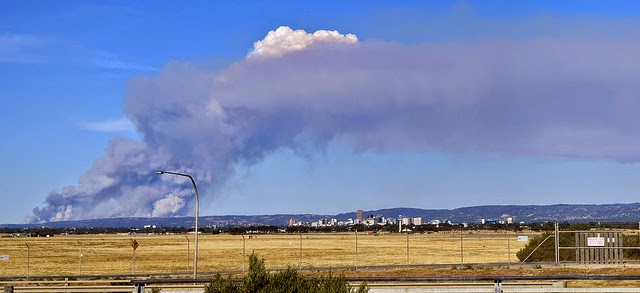
Climate Change not on Abbott’s South Australian #bushfire agenda but should be


Photo: Adelaide bushfires, as seen from the airport. Copyright: eosdude/Flickr (CC BY-ND 2.0)

This article originally appeared at Nofibs.com.au

Prime Minister Tony Abbott has visited the bushfire stricken communities in the Adelaide Hills outlining disaster recovery and short-term income assistance payments to bushfire victims, but refusing to be drawn on whether climate change has influenced bushfires. I investigate some of the recent science into the links between bushfire and climate Change for South Australia and the climate of denial being put forward by the Abbott government.

You can read a report of Abbott's visit to the fire ravaged area by Shalailah Medhora at the Guardian: Adelaide bushfires: PM announces cash payments for people left homeless.

The Adelaide Hills Sampson Flat bushfire has burnt more than 12,000 hectares, with up to 38 houses and numerous sheds, livestock, including destroying the Tea Tree Gully Kennels and Cattery with the loss of life of many family pets.

Sunday, September 28, 2014

South Australia sets 50 per cent renewables target for 2025


Congratulations to South Australian Premier Jay Wetherall who announced this past week that the state was about to reach it's 2020 target of 33 per cent renewables in the electricity sector and had chosen to increase this target to 50 per cent by 2020.

“This new target of half of the States power to be generated by renewable sources will create jobs and drive capital investment and advanced manufacturing industries." he said in a statement. (statement PDF)

The Federal Renewable Energy Target (RET) has been a significant factor in attracting $5.5 billion in investment and was likely to support a further $4.4 billion by 2025, creating much needed jobs in solar installation and advanced manufacturing.

“This new target of half of the States power to be generated by renewable sources will create
jobs and drive capital investment and advanced manufacturing industries." Wetherall said, “But we will only be successful with both of these targets if the Federal Government maintains the current Renewable Energy Target Scheme arrangements."

The Abbott Government Warburton review of the RET has recommended either closing the scheme to new investors or by setting targets based on the growth of electricity demand. Both of these options would throw a spanner in the works of investment in renewable energy in Australia.

Monday, January 13, 2014

Extreme Heatwave hits Southeast Australia

This page may be updated further in coming days
Last week we saw record temperatures in a heatwave in Queensland and Western New South Wales with 34 maximum temperatures broken and mass deaths of flying foxes. The heat has been building over the last week in Western Australia and central Australia with an extreme heatwave across much of south east Australia forecast for this week.

Alasdair Hainsworth, Assistant Director for Weather Services at the Bureau of Meteorology said “What is unusual about this event, which the pilot heatwave forecast shows, is that when high maximum temperatures and above average minimum temperatures are sustained over a number of days, there is a build-up of ‘excess’ heat. Extreme heatwave conditions can be seen in southern NSW, Victoria and Tasmania."

Tess Parker from Monash University explains the dynamics of the heatwave at the Conversation: What’s cranking up the heat across south-eastern Australia?

Saturday, April 27, 2013

Carbon price funding solar PV energy for Adelaide factory puts Tony Abbott on ice

Opposition Leader Tony Abbott made a frosty mistake in visiting the Adelaide Ice Service factory today, arguing the business was a victim of the carbon tax. At the same time Climate Change Minister Greg Combet and local Labor MP Mark Butler announced a grant of nearly $90,000 to the company from the carbon price funded Clean Technology Food and Foundries Program to install a 87.5 kilowatt photovoltaic solar system at its ice manufacturing plant in Regency Park.

The visit continues Abbott's attempt to beat up the carbon price as a negative, but it shows just how shallow and loose with the truth his own campaign is, especially regarding climate change policy. The carbon price hasn't brought economic ruin. Indeed, there are strong arguments by Environment Victoria that the compensation package to carbon intense energy providers is overly generous. Victoria's brown coal generators are being subsidised to continue polluting to maintain healthy profits.

Friday, June 29, 2012

Hot change for Arabunna people of Lake Eyre facing climate change


New research from the University of Adelaide has highlighted the challenges facing the Arabunna people in the north of south Australia who face increased temperatures and a drier climate with global warming that will impact their traditional culture and lifestyle. The traditional Arabunna lands include the Lake Eyre region and also cover the giant Roxby Downs BHP uranium mine.

There will be a doubling of days above 40 degrees celsius by the 2070s with increases of 5 degrees and more. Such change will effect the fragile desert ecosystems and greatly impact the availability of bush tucker and the wellbeing of sacred sites.

Friday, November 20, 2009

Firefighters turn climate heat on Canberra

Sydney IMC: Firefighters demanded action on climate change from politicians in Canberra on November 19 while much of south eastern Australia sweltered and suffered with temperatures well above 30 degrees. Many regions were declared severe, extreme or catastrophic fire danger. The Firefighters carried a banner "Firefighters for climate change action now" demanded that the Government's Carbon Pollution Reduction Scheme be passed by the Senate.

Scientists have reported this week that the Climate Treaty is more urgent with Global carbon emissions still increasing. with Australia the worst emitter on a per capita basis. Scientists have also called for Emissions need to be slashed to save Great Barrier Reef. | Read ACTU media release | Climate Institute Media Release

Wednesday, November 18, 2009

South Australia faces catastrophic fire danger

Catastrophic Fire Danger warning has been issued for two regions in South Australia - Flinders and North-West Pastoral districts - because of predicted extreme temperatures, strong winds and low humidity. This is the first time this top classification fire warning has been used in Australia.

Fire weather warnings have been revamped following the Black Saturday fires in Victoria in February 2009 which killed 173 people. The Fire Danger warning system has been refined with the top classification being a Code Red Catastrophic Fire Danger [100+], followed by Extreme Fire Danger [75-99] and Severe Fire Danger [50-74] .