![]() |
| Australia Institute webinar with Richie Merzian and Chris Barrie |
Wednesday, March 23, 2022
A Climate for Leadership: how Australia should respond to increasing disasters with retired Admiral Chris Barrie | Webinar
Friday, March 18, 2022
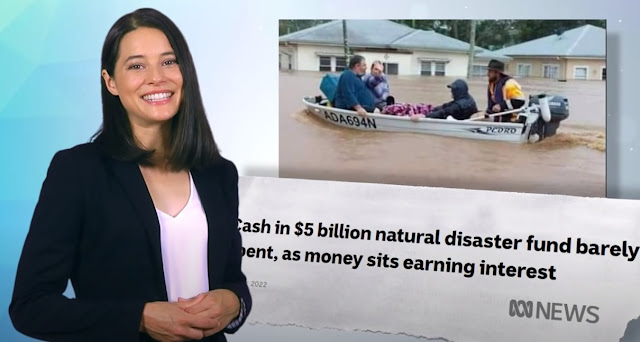
The Floods 🌊 | Pre-election Australian Honest Government Ad for #Ausvotes
So much is packed in this Juice Media Honest Government Ad about the Flood Crisis in South East Queensland and North Coast of New South Wales, and the ineffective Federal Government political response.
Of Course it is part of a long history of first denying climate change, then delaying any response to acting on climate change. And doing minimal work in emergency response and recovery, and in developing a national climate risk assessment and developing a national climate adaptation plan.
Rather Australia keeps on approving new coal mines and new gas projects like the Narrabri gas field by Santos in NSW, Beetaloo Basin Gas in the Northern Territory by Origin Energy (70%, operator) and Falcon Oil and Gas (30%) , and the Scarborough Gas project by Woodside Petroleum off the Western Australian Coast.
Sunday, March 26, 2017
Coral, climate change, storm surges and #CycloneDebbie

Article originally published at nofibs.com.au
Tropical Cyclone Debbie is forecast to cross Central Queensland coast on Tuesday morning as a Category 4 Severe tropical cyclone. It will bring destructive winds greater than 200km per hour plus a storm surge with a king tide innundating low lying coastal properties, and torrential rain causing flooding. It is also cooling sections of the Great Barrier Reef reducing coral bleaching from an extensive and long lasting marine heatwave.
Update: 25,000 people in Mackay ordered to evacuate due to storm surge threat.
Update: Coal mines and coal ports affected.
Tropical Cyclone Debbie draws heat from the unusually warm waters of the Coral Sea. This will help it increase in intensity to achieve possibly Category 4, and an outside chance as a Category 5 severe tropical cyclone before it strikes land.
It is the first tropical cyclone to strike the north Queensland coast since Cyclone Nathan in March 2015. Although it may not be as strong, it is being compared in size and extent to the Category 5 cyclone Yasi from 2011.
Tuesday, August 25, 2015
Reflecting on Hurricane Katrina 10 years on

I wrote this in response to a facebook discussion on whether Hurricane Katrina can be attributed to climate change. It is an argument I put together with limited time and research, but still valuable to answer the question..
Thursday, February 19, 2015
Extreme Weather: Severe Tropical Cyclones Lam and Marcia make Australian landfall
This map from bureau of Meteorology shows Tropical Cyclone Lam hitting the Northern Territory and Tropical Cyclone Marcia about to make landfall between Mackay and Yeppoon on the Queensland coast.
Severe Tropical cyclone Marcia is the 4th recorded category 5 storm to make landfall on the Queensland coast. Previous category 5 storms included Cyclone Yasi in 2011, Cyclone Innisfail in 1918 and Cycline Mahina in 1899. See a list of Australia's worst tropical cyclones at Australian Geographic.
Follow the live reporting at the Brisbane Times or live reporting at the Guardian.
Friday, January 9, 2015
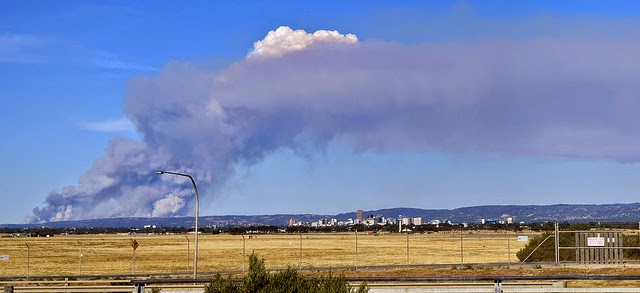
Climate Change not on Abbott’s South Australian #bushfire agenda but should be

Photo: Adelaide bushfires, as seen from the airport. Copyright: eosdude/Flickr (CC BY-ND 2.0)
This article originally appeared at Nofibs.com.au
Prime Minister Tony Abbott has visited the bushfire stricken communities in the Adelaide Hills outlining disaster recovery and short-term income assistance payments to bushfire victims, but refusing to be drawn on whether climate change has influenced bushfires. I investigate some of the recent science into the links between bushfire and climate Change for South Australia and the climate of denial being put forward by the Abbott government.
You can read a report of Abbott's visit to the fire ravaged area by Shalailah Medhora at the Guardian: Adelaide bushfires: PM announces cash payments for people left homeless.
The Adelaide Hills Sampson Flat bushfire has burnt more than 12,000 hectares, with up to 38 houses and numerous sheds, livestock, including destroying the Tea Tree Gully Kennels and Cattery with the loss of life of many family pets.
Saturday, February 4, 2012
Extreme weather: Heavy rain and flooding in Fiji tests climate disaster preparedness
Fiji is experiencing heavy rain and major flooding with a 15-day state of emergency being declared in Fiji’s west coast areas. At least 8 people have died so far in the Fiji January-February 2012 floods with up to 51 reported cases of water-related diseases, thousands in evacuation centres and $30million in damages reported so far.
The Government’s Provincial Development and Multi Ethnic Affairs Ministry Permanent Secretary, Colonel Inia Seruiratu, declared the emergency on January 25 to apply to Ba, Lautoka, Nadi, Nadroga, Ra, and Tavua.
A 2009 publication produced by UNISDR and the UN Development Programme (UNDP) warned that in western Fiji, high-intensity floods would become more frequent. In the Nadi area, for example, these type of floods used to occur every 190 years, but with the influence of climate change by 2100 it is projected that they will occur every 25 years. (Institutional and policy analysis of disaster risk reduction and climate change adaptation in Pacific Island Countries: final report (PDF))
Tuesday, February 1, 2011
Cyclone Yasi spells disaster for flood ravaged Queensland

Tropical Cyclone Yasi may become Queensland's second extreme weather disaster within a month, with the potential to rival the destructive power of Hurricane Katrina that destroyed New Orleans in 2005. Cyclone Yasi is likely to hit the Queensland coast near the regional city of Cairns as a Category 4 storm with winds of 250-260 km per hour and a 4 metre storm surge on late Wednesday or early Thursday.
Thursday, January 27, 2011
Green groups criticize Federal Government for slashing climate programs
Deferring expenditure in the solar flagship program is of major concern for the development of industry scale solar power stations in Australia, necessary for converting our reliance on carbon intensive coal fired power to renewable technologies. A US study has shown the feasibility of converting global power to 100 per cent carbon emission neutral alternative energy technologies in 20 to 40 years, similar to the Australian study by Beyond Zero Emissions with the Zero Carbon Australia 2020 report, launched in July 2010.
Tuesday, January 11, 2011
Floods threaten Brisbane, one third of Queensland declared a disaster area

Over a third of the Australian state of Queensland has been declared a disaster area with the capital Brisbane on flood alert expected to experience it's worst flooding in living memory. Early report: Brisbane flood, from an island in suburbia. Total deaths from Queensland floods now number 27 - 10 from the regional floods in 2010 and 17 from the flooding in Toowoomba, Lockyer valley and Brisbane, with 14 people now listed as missing feared dead (revised down from 55).
This flood event follows widespread flooding across northern and central Queensland over the christmas holiday period that affected over 200,000 people, closing major highways and airports, closing most of the mines in the state, damaging crops, and causing billions of dollars worth of damage.
Friends of the Earth have warned about heavy metals released in flood waters and a Wiradjuri elder has warned of the risk of groundwater poisoning from gold mine at Lake Cowal if floodwaters breach the open cut mine owned by Canadian company Barrick Gold. The Great Barrier Reef is under threat from toxic pollution from floods according to the WWF.
The question that few people are publicly discussing is to what extent is climate change contributing to this disaster presently unfolding in Australia.
While Queensland is suffering disasterous floods, one of the world's largest insurers, Munich Re announced that the number of climate related disasters soared in 2010 killing as many as 295,000 people. "The high number of weather-related natural catastrophes and record temperatures both globally and in different regions of the world provide further indications of advancing climate change." said Munich Re in a press statement. Nine tenths of the disasters in 2010 were severe weather-related events.
Torrential rain drenched Toowoomba on Monday 10 January, a city located at 700 metres altitude high on the Great Dividing Range 125 kms west of Brisbane. Extreme flash flooding occurred in the suburbs and central business district. Reports of 150mm of rain falling in a 40 minute period quickly swamped stormwater drains and creeks and turned roads and suburban streets into raging rivers.
Flood photos | Youtube Video: Toowoomba Flood 2011.01.10 - cars swept away into East Creek near Chalk Drive.
Friday, September 16, 2005
Guest Post: Katrina was environmental and social blowback
What has happened and is happening in New Orleans poses critical questions to our assumptions about the great traditions of western thought and social progress.
The first and most important question that must be answered is, was the cause of the levies breaking simply a lack of investment in old, yet critical infrastructure or is it a fundamental question on the failure of a market economy and the subjugation of civil society to neo-classical economics?
If you believe that the levies broke through a mere lack of engineering and that the solution lies in more engineering, then you may as well not read on. Just ask yourself one question: What assumptions and what ideological fabric underpin the drastic reduction of funds from federal grants for levee maintenance, and their subsequent redirection to war making?
Why did the Bush administration divert $71.2 million from the budget of the New Orleans Corp of Engineers, a 44% cut? With the loss of Federal funds plans to upgrade pumps and fortify levees were mothballed.