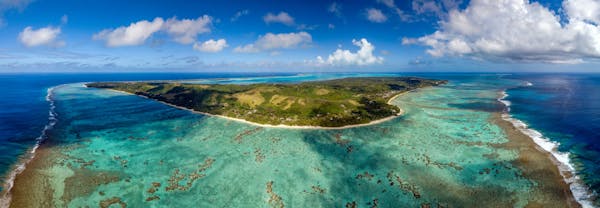
The Pacific Islands Forum is underway in Tonga. The UN Secretary General Antonio Guterres made a speech to the opening of the forum.
He highlighted in his speech (see below) the need for a just transition for the phaseout of fossil fuels and called for all members of the G20 to step up and lead, by phasing out the production and consumption of fossil fuels and stopping their expansion immediately.
While Australia was not explicitly named, we are the only member state of the Forum involved in fossil fuel expansion and export.
"When governments sign new oil and gas licenses, they are signing away our future." said Guterres.
He also called for national climate plans – Nationally Determined Contributions – to be submitted by next year, aligning with the 1.5-degree upper limit of global heating.
Guterres also launched two new reports from Tonga highlighting the acceleration of sea level rise and the impacts already occurring on low lying Pacific Nations.
Australian Prime Minister Anthony Albanese has signed an agreement with the Tuvalu PM, Kausea Natano, to set up “a union” between the two countries.
The arrangement will offer a special visa that offers safe residency to the people of Tuvalu so they can work, live and study in Australia because of the impacts of climate change.
The agreement was made at the Pacific Islands Forum in the Cook Islands. It will see 280 people per year given a "special mobility pathway" to "live, work and study" in Australia. Tuvalu is a low lying Pacific nation with about 11,000 people.
In return, Australia will have effective veto power over Tuvalu's security arrangements with any other country.
The Australia-Tuvalu Falepili Union comprises a bilateral treaty between Tuvalu and Australia, as well as a commitment articulated in a joint leaders' statement (see below) to uplift broader bilateral partnership.
"Falepili" is a Tuvaluan word for the traditional values of good neighbourliness, care and mutual respect.
Hot on the heels of trips to Washington and Beijing, Prime Minister Anthony Albanese is now in the Cook Islands for the Pacific Island Forum. There, he will aim to strengthen relations with Pacific countries and reaffirm Australia’s place as a security partner of choice.
But to do that, he’ll have to repair a historic split from when former prime minister John Howard met with Pacific leaders on the same island, Aitutaki, a quarter of a century ago to defend his choice to expand Australia’s fossil fuel industries.
Pacific leaders see climate change as by far their greatest security threat. Sea level rise, stronger cyclones, marine heatwaves and ocean acidification pose existential threats. They will ask Albanese to support a regional declaration for a phaseout of fossil fuels.
What will happen on the atoll? We could see history repeat – Pacific outrage, Australian intransigence. Or we could see a better outcome, if Albanese signals Australia is at last ready to move away from fossil fuels.
Here is a quick summary in graphic and point form where the main countries line up on climate commitments at the end of the Climate leaders summit organised by USA President Joe Biden in his first 100 days of leadership:
Prime Minister Scott Morrison made:
no change in Australia's low targets.
no commitment to net zero by 2050 target.
produced meaningless statistics that don't stack up
slagged off the work of other countries
talked up hydrogen without explaining much of this will be blue hydrogen from coal and gas
thanked some of Australia's highest emitting companies, part of the problem
tried to carve out emissions from our fossil fuel exports (Australia is 3rd largest carbon exporter)
talked up the hired help: Allan Finkel and his contribution (including to the gas led recovery)
A press conference this morning at the United Nations climate Conference COP25 launched an ambition drive, Mad 4 Survival, spearheaded by the Climate Vulnerable Forum and lead by the Marshall Islands. Apporopriate that this is being launched on Human rights day. Climate change is already having a massive impact on human rights and human rights are fundamental to all parts of the climate negotiations.
Marshall Islands poet Kathy Kijiner was joined on the panel by Philippines Deputy Speaker Loren Legarda, Shanchita Haque, Permanent Mission of Bangladesh to the United Nations. (Source: media release)
See below for headline speech by Loren Legarda from the Philippines.
Australia's Prime Minister Malcolm Turnbull attended the Pacific Leaders' meeting forum, and announced a small increase in climate related aid for the region. But this comes after the Abbott Government slashed Australia's foreign aid budget to extremely low levels in 2014.
The Pacific Islands Forum Leaders’ Meeting has concluded in Pohnpei in the Marshall Islands. A major focus of this meeting was action on climate change following Paris and COP21.
The Statement following 47th Pacific Islands Forum Leaders’ Meeting was released by the Minister for Foreign Affairs of the Republic of the Marshall Islands, The Honorable John Silk:
“Today’s communique is a clarion call to action that even with the Paris Agreement, there remains a lot of work to do to guarantee there will still be 16 seats at the Pacific Islands Forum in a hundred years from now.”
“The Pacific is strongest when we come together and fight as one. Along with our big brothers and sisters in Australia and New Zealand, we have declared that we will continue to push for an ambitious amendment to the Montreal Protocol in October, and to see ambitious climate action across all sectors. This must include reducing aviation and maritime emissions in line with the 1.5°C temperature target we all agreed in Paris.”
“I want to particularly thank President Christian for the Federated States of Micronesia’s tireless leadership in the Montreal Protocol negotiations, beginning with their first submission in 2009. If we succeed in Kigali, it will be one of the best examples of island leadership that we have ever seen and help us avoid up to half a degree of warming – the biggest chunk yet off the ambition gap.”
Tony De Brum with Coalition of High Ambition at Paris COP21. The Marshall Islands helped to galvanise what became an inexorable push towards a 1.5-degree target in Paris Photo: John Englart, CC BY-SA
Australia’s Prime Minister Malcolm Turnbull will have some explaining to do when he attends the Pacific Islands Forum leaders' meeting in Pohnpei, Micronesia, this week.
Australia’s continued determination to dig up coal, while refusing to dig deep to tackle climate change, has put it increasingly at odds with world opinion. Nowhere is this more evident than when Australian politicians meet with their Pacific island counterparts.
It is widely acknowledged that Pacific island states are at the front line of climate change. It is perhaps less well known that, for a quarter of a century, Australia has attempted to undermine their demands in climate negotiations at the United Nations.
Australia's Immigration Minister Peter Dutton has made a joke of Pacific Nations facing rising sea levels due to climate change. The Australian Prime Minister, recently returned from meeting with Pacific Island Nations in Port Moresby, laughed at the joke, before Social Services Minister Scott Morrison pointed out the boom microphone overhead.
Now there are calls for Peter Dutton to resign and Tony Abbott to apologize to the people of the Pacific and the world for the insensitive nature of the comments. The President of Kiribati Anote Tong, Marshall Islands Foreign Minister Tony De Brum and PNG Governor of Oro Province Gary Juffa, among others, have all condemned the comments and called for a public apology.
A lunchtime press conference on Abbott's decision to accept 12,000 Syrian refugees went awry today. As the press conference was running late Immigration Minister Peter Dutton remarked that it was running to "Cape York time". Tony Abbott responded, "we had a bit of that up in Port Moresby".
Dutton then added, "time doesn't mean anything when you're about to have water lapping at your door". to watch the Prime Minister laughed.
Then Social Services Minister Scott Morrison pointed out to both men that there was a microphone overhead. You could see Dutton face change...
It may have been a private conversation but it revealed the disdain that Abbott and Dutton feel for our neighboring countries and their leaders and for the people of the Pacific.
Once the video was published condemnation from all sides was swift.
See: Tony Abbott, Peter Dutton Joke About Flooding Of Small Island Nations
The conversation begins with Peter Dutton insulting Aboriginal people – and ethnic and Muslim leaders who were attending the roundtable summit – about their perceived indifference to punctuality.
DUTTON: It’s Cape York time.
ABBOTT: (laughs) What’s this mate?
DUTTON: It’s Cape York time.
ABBOTT: We had a bit of that up in Port Moresby.
DUTTON: Oh yeah.
ABBOTT: Yeah, yeah.
ABBOTT: Anyway, it was a good meeting. It was a good meeting.
MORRISON: When was… was it in Moresby?
ABBOTT: Yeah, yeah, yeah.
DUTTON: Time doesn’t mean anything when you’re about to be, you know, have water lapping at your door.
ABBOTT: (laughs) Ha ha ha ha ha ha ha ha.
Morrison interrupts with a warning.
MORRISON: There’s a boom (microphone) up there.
ABBOTT: Yeah, yeah.
Former Prime Minister Abbott has labeled climate change ‘crap’, and made Australia the only nation on earth to abolish a price on carbon.
Labor and Green political leaders and Environmental leaders such as Greenpeace's CEO Kumi Naidoo have condemned the comments and called for an apology. Pacific Islanders with 350Pacific have called for Minister Dutton to resign over the offensive climate remarks.
Reaction and condemnation by the Twitterati was swift
@bencubby@joshgnosis These people could not care less about anyone but themselves - recording is an insight into how much they care
The Labor Party responded with both Federal Opposition leader Bill Shorten and Richard Marles, Shadow Minister for Immigration and Border Protection, tweeting derogatory comments on the interaction.
Greens spokeperson on Climate Change Senator Larissa Waters issued the following statement:
“These people are not governing for the good of Australia. They smoke cigars to celebrate their cruel budget, then they laugh about the effect their policies are having on people and our planet,” Senator Waters said.
“It’s disgusting and they know it’s wrong. Why else would they be scared of a boom mic?”
“What else are these clowns saying when the microphones are off? Imagine what Cabinet meetings must be like.
“What we’ve seen today is raw contempt for the survival and safety of our Pacific Island neighbours and our own coastal communities.
“We’re talking about peoples’ lives, and this government is laughing.
“It’s a huge diplomatic blunder that will enrage our Pacific Island neighbours, who have been calling on Australia to save their homes. What an insult for them to now hear the Australian Prime Minister laughing at the prospect of their homes going underwater.
“The mask has absolutely come off today. The government knows what it will cost to deliver for their fossil fuel donors, and they’re intent on doing it anyway.
“It’s now clear to everyone how impossible it will be for Abbott’s Australia to have any credibility at the UN climate talks in Paris later this year.
“This is the man we sent to the UN in Geneva this week to negotiate about refugees’ lives, for goodness sake.
“Abbott and Dutton are clowns, but they’re the only ones laughing,” Senator Waters said.
The small island nation of the Republic of the Marshall Islands submitted it's climate target on 21st July 2015. It is the first small island state to set an emissions reduction target for 2025, and the first developing country to adopt the simpler and more robust absolute economy-wide target that is usually expected of industrialized countries.
The nation's Intended Nationally Determined Contribution (INDC) was submitted to the United Nations as part of it's commitment to the climate summit in Paris in December 2015. It reflects a commitment to reduce emissions by 32% below 2010 levels by 2025, and a further indicative target to reduce emissions to 45% below 2010 levels by 2030. The Marshall Islands longer-term vision is to move towards net zero emissions by 2050, or earlier if possible.
Speaking to The Age newspaper, Foreign Minister Tony De Brum urged Australia to also take a leadership and set ambitious climate targets.
"It is important that Australian people understand we are not just playing footsie politics with the leaders of our big neighbour to the south," Mr de Brum said. "We are really serious about its need to contribute to our safety and future security." Brum told the Age.
The Pacific Declaration for climate Justice signed by several Pacific Nations on June 8, 2015, threatens legal action to recover damages against major climate polluters.
Developed nations and corporations that have contributed substantially to greenhouse gases and carbon pollution enhancing climate change impacts may be subjected to litigation brought by Pacific Island Nations.
Forty representatives of several Pacific Island Nations gathered in early June on the azure waters of Port Vila, Vanuatu, on board the Greenpeace vessel, Rainbow Warrior. They were attending a Human Rights and Climate Justice Workshop.
President of Vanuatu, Baldwin Londsdale, and representatives from Tuvalu, Kiribati, Fiji and Solomon Islands met and signed a declaration seeking "climate justice". They were joined by representatives from the Philippines, including former national climate negotiator Mr. Naderev “Yeb” Saño and the Mayor of Dolores, Samar, Mrs. Emiliana Villacarillo.
"It is now more important than ever before that we stand united as affected communities in the face of climate change, rising sea-levels and changing weather patterns. Let us continue to stand and work together in our fight against the threats of climate change," said Vanuatu President, H.E Baldwin Lonsdale.
The declaration for climate justice declared
"We commit to holding those most responsible for climate change accountable. By doing so, we send a message of hope that the people and not the polluters are in charge of humanity’s destiny. We commit to bring a case that would investigate the human rights implications of climate change and hold the big carbon polluters accountable to appropriate international bodies or processes."
Thirty Pacific warriors are currently touring Australia to share their climate message and ask for our support and solidarity. On Monday they brought their message to Narrabri and the Leard Blockade and saw first hand the destruction wrought by Whitehaven Coal's Maules Creek Project and Idemitsu’s Boggabri Coal.
“We are sending a powerful message: we will not stand idly by as the coal industry sinks the future of the Pacific Islands – we are fighting for our god given right to live”, says Mikaele Maiava, for the Climate Change warriors for Tokelau in a brief statement.
Four of the thirty climate warriors come from Tokelau, which transitioned to 100 per cent renewables in 2012. They are only too well aware of the negative impacts of climate change. Read the Ulu o Tokelau, Aliki Faipule Kuresa Nasau statement from 3 October and understand the motivation of not just the four warriors from Tokelau - Avelio Tumua, Dedles Suega Isaia, Aleki Manuele and Mikaele Maiava - but all the warriors from all the countries of the South Pacific.
Countries that are part of the campaign include: Papua New Guinea, Samoa, American Samoa, Tonga, Solomon Islands, Vanuatu, Tokelau, Niue, Cook Islands, Federated Sates of Micronesia, Marshall Islands, Palau, Tuvalu, Nauru, Kiribati and Fiji.
Island nations are very aware of the threat to their culture and heritage and very lives from the perils of climate change, ocean acidification and sea level rise. Tokelau has chosen to lead by example converting their electricity to 100 per cent renewables in 2012 and now sending climate warriors to Australia to close down the largest coal port in the world for a day.
Although Pacific Island countries only contribute 0.03% of the world's greenhouse gas emissions they will be the first to go under if the business as usual scenarios of the IPCC come to pass.
The leader of tiny Tokelau in the South Pacific knows this too well. The Ulu o Tokelau, Aliki Faipule Kuresa Nasau, made this statement at the 25th South Pacific Regional Environment Programm (SPREP) Meeting in Majuro in the Marshall Islands on 3 October 2014. The meeting called for less talk and more action on climate change financing such as the Green Climate Fund. Other important themes discussed included the importance of building island resilience, developing the blue-green economy and the growing the co-operation for meaningful and durable partnerships to achieve common goals.
By Michael Hopkin, The Conversation, who interviewed Steve Rintoul from CSIRO, Richard Allan Professor of Climate Science at University of Reading, and Mathew England a Climatologist at University of New South Wales.
The “pause” in global warming since 2001 can be explained by the discovery of unusually strong winds in the Pacific, climatologists have found.
Global surface air temperatures have more or less flatlined since the turn of the century, prompting some observers to claim that the planetary warming trend has stopped. But the new research, published in Nature Climate Change, shows how stronger winds have driven the excess heat down into the ocean.
Researchers led by Matthew England, a professor of climatology at the University of New South Wales, began by looking at the differences between the 1990s, when Earth’s surface was strongly warming, and the 2000s, after the hiatus began.
Previous research has already shown that cooler temperatures over the eastern Pacific are linked to a slowdown in worldwide warming, but researchers wanted to know why.
We are currently in a negative phase of the Pacific Decadal Oscillation, a cycle with phases that can last between 15 to 30 years. During a negative phase waters are cooler and heat mixes into deeper levels of the north Pacific ocean. When the next phase change ocurrs to a positive PDO we are likely to see some of the stored ocean heat released spiking atmospheric temperatures.
The Pacific Decadal oscillation was only identified by scientists in the 1990s, and we only have accurate observational data for identifying it going back some 50-60 years. Nathan J Mantua and SR Hare from the University of Washington in Seattle described the operation of the Pacific Decadal Oscillation in the Journal of Oceanography in 2002 (Mantua & Hare 2002 PDF). Read more about the PDO from the Climate Impacts Group from University of Washington.
A study by Australian and US researchers has found robust signs that global warming is having an increasing impact on the El Niño/La Nina (ENSO) cycle which drives a significant amount of changes to global weather. The El Nino cycle has been unusually active and intense in the 30 year period from 1979 to 2009, more than any time in the last 600 years, researchers found.
"Our research suggests in a warming world we are likely to see more extreme El Niño and La Nina events, which over the past decade in Australia have been related to extreme flooding, persistent droughts and dangerous fire seasons,” said lead author Dr Shayne McGregor from the University of NSW ARC Centre of Excellence for Climate System Science.
“Importantly, this study not only tells us how ENSO activity has behaved in the past in relation to global average temperature, it also opens the window for climate models to be able to estimate more accurately how this activity will change in the future." said Dr McGregor.
El Niño is likely to become more intense with climate change, and produce drier conditions for Australia and the Western Pacific, with increases in rainfall in the central and eastern equatorial Pacific in the mid to late twenty first century, according to new research.
It is the first time climate scientists have produced robust results from modelling to conclude that climate change has a substantial impact on the El Niño-Southern Oscillation (ENSO) cycle in the future. But a 2010 study by scientists from NASA and NOAA provided some signs.
So, a stronger El Niño is likely to bring more intense drying which may exacerbate drought and bushfire weather. In the central pacific island nation of Kiribati El Niño will bring more intense rain and floods. More intense Winter rain and floods may be felt in California, northwest Mexico and southwest United States, as well as down the west coast of South America, and even further afield.
A recent study looking into regional tropical cyclone formation conditions in the east and central Pacific has projected that 2 to 3 times more tropical cyclones (Hurricanes) are likely to hit Hawaii in the later part of this century.
While on a global level tropical cyclones are expected to slightly reduce in frequency overall, because of regional conditions some areas will actually experience an increase in tropical cyclone frequency. Hawaii happens to be one of those areas.
At the start of this week Australia's Foreign Minister Bob Carr announced that Australia would fund repairs to 40 kilometres of main road in South Tarawa, Kiribati. The road is heavily damaged and undermined by rising sea levels and coastal erosion from climate change. The irony is that at the same time Bob Carr's colleague, Federal Environment Minister Tony Burke was approving 3 major fossil fuel developments that will exacerbate climate change.
"Kiribati is at the front line of climate change," Senator Carr said. "Its highest point is now just three metres above sea level. Unless action is taken, Kiribati will be uninhabitable by 2030 as a result of coastal erosion, sea level rise and saltwater intrusion into drinking water."
To Kiribati Australia's aid money is an important contribution to a small island state facing obliteration due to rising seas in the next 50 years. The highest point on Kiribati is just 3 metres above sea level, and much of the land is only one to two metres high. Rising seas and storm surges are spoiling land for agriculture, washing away houses, undermining roads and producing salt water incursion into fresh drinking water wells.
Kiribati is unlikely to survive the impacts of climate change this century, but adaptation can be made to increase resilience. "This project will provide more than 40 per cent of the population with better access to health clinics, schools and markets. Coastal roads will be rehabilitated to withstand rising sea levels and storm surges caused by climate change." said Senator Carr.
The tiny self governing territory of Tokelau in the South Pacific has become entirely solar-powered, with the third and final photovoltaic solar farm being turned on at the end of October 2012.
Tokelau consists of 3 small atolls with a population of about 1500 people 450km north from Samoa, and a dependent territory of New Zealand. The atolls are low lying with perhaps the highest points just 2 metres above sea level. Rising seas this century threaten the future of these islands with 1 metre rise in global sea level due to climate change conservatively predicted by the end of the century.