Mastodon Climate Citizen --> Mastodon
Showing posts with label microplastics. Show all posts

Monday, December 2, 2024

INC5: Negotiations for Global Plastics Treaty 5th meeting in Busan, South Korea

Plastic bottles and Styrofoam in Merri Creek
Outcome summary: Negotiations fail to conclude, but some progress made. Still wide divergencies in some areas. A resumed session in 2025 agreed to.

The United Nations Intergovernmental Negotiating Committee for a Global Plastics Treaty is holding its fifth meeting in Busan, South Korea from 25 November to 1 December 2024 to prepare a treaty by the end of 2024. This meeting is it. 

Global Plastics pollution is an escalating Crisis that interlinks with the Biodiversity Crisis and Climate Crisis. The Health and environmental impacts of plastics, microplastics and nanoplastics are of increasing concern as more research is done.

The process for a Global Plastics Treaty was started in March 2022 at the resumed fifth session of the UN Environment Assembly (UNEA-5.2). See my reports of INC1INC2INC3, INC4.

A Zero Draft of the treaty was prepared at INC4 with elements of both common rules for all parties, and a nationally driven policy framework, and many procedural issues still to sort out. As this zero draft contained some 1500 brackets, in the interim the Secretariat has prepared a non-paper  to try to streamline negotiations start.

Australia is a member of the High Ambition Coalition to End Plastics Pollution, which put out this joint Ministerial statement before INC5.

UNEP INC5 website | CIEL INC5 preparatory work | IPEN at INC5
Break Free From Plastic News | Break Free from Plastics POPlite daily summaries
 | Minderoo Foundation | GAIA news updates

December 1 - Day 7

IISD/ENB have a highlights report available with a summary of Final Plenary discussions.

  • They agreed to adjourn INC-5 in Busan, Republic of Korea, and convene a resumed meeting at a later date. Some countries wanted it early in 2025 not to lose momentum, while others like Saudi Arabia called for later - July or August.
  • delegates agreed to use the Chair’s revised Text as a basis for negotiations at the resumed fifth session of the INC (INC-5.2), and also other texts.
  •  INC Chair Vayas resassured delegates that “nothing is agreed until everything is agreed.” 
  • While supporting it as the basis for negotiations at the next meeting, several delegations underlined that the Chair’s Text should remain open to additions and deletions. They noted that the text did not always reflect the discussions held during the week and excluded some countries’ “red lines.”
  • The Arab Group and the Russian Federation noted that the Non-Paper containing the draft text of the Chair of the Committee, circulated on Friday, 29 November 2024, better reflected discussions, but were willing to engage on the basis of the Chair’s Text
  • “We are not leaving Busan discouraged,” shared the EU, encapsulating the mood during the closing plenary. 
  • Several delegations spoke, with Mexico and Rwanda speaking on behalf of 95 and 85 countries, respectively, to call for a strong treaty, which would include articles on production, hazardous plastics, and chemicals of concern.
  • Kuwait, who spoke for the Like-Minded Countries, expressed concern that “at this session, expedient progress was undermining trust and inclusivity,” and noted “attempts to stretch” the UN Environment Assembly (UNEA) resolution mandate beyond its limits.

Watch the final Plenary on UN WebTV here: http://webtv.un.org/en/asset/k1n/k1ngcaixml

After report backs from the 4 contact group co-chairs,  Chair has proposed the latest non-paper as a starting point for further negotiations at a resumed session 5.2 at some time in the future. Various Parties spoke in plenary, including Saudi Arabia, Iran, Kuwait, India, Ghana, Rwanda, Mexico, Uruguay, European Union, Finland. Panama, Russian Federation, Iraq, Canada, Cuba, Grenada, Samoa, Japan, Vanuatu, Jamaica, Armenia, Tonga, UK. Powerful statements by Rwanda on behalf of 85 countries and Mexico for 95 countries for an ambitious legally binding full-life-cycle treaty that addresses chemicals of concern.

2 December - International talks on curbing plastic pollution fail to reach agreement (Guardian)

Chair releases latest text. Some Delegates and Policy Experts  have responded with this press release (GAIA):

Plastics Treaty INC-5: Global South Delegates and Civil Society Speak Out 
Delegates and Policy Experts React to the Chair’s Proposed Treaty Text

Busan, South Korea – Global South delegates and civil society leaders spoke at a press conference at BEXCO Convention Center this afternoon, to share their outlook on the negotiations thus far and what it means for the Global South. In the hour before the press conference, the Chair released his latest paper, which proposes text for the treaty to serve as a basis for the final bout of negotiations. 

Arpita Bhagat, Plastics Lead at GAIA Asia Pacific states: “The Chair’s latest text is unacceptable to the majority of Global South countries and the billions of people they represent: people who are fighting for their lives for a strong treaty. Nor is it acceptable to people harmed by plastics in the Global North, including environmental justice, front and fenceline communities, and Indigenous Peoples who have long been sidelined in the process. It is not a reflection of the will of the vast majority of Member States, who support ambitious measures in a legally-binding, global instrument. Once again, as throughout this process, the Chair has bent to the will of the petrochemical states while dismissing the demands of the majority, in a completely non-transparent, exclusionary process. This is a matter of life and death, especially for Global South communities. Member States will not roll over and play dead. As long as ambitious countries hold on to their principles, civil society will have their backs.” 

Cheikh Ndiaye Sylla, National Focal Point for Senegal, states, “This version of the text is…not acceptable…For life cycle, we have to negotiate this from the polymer, meaning the production. It is legally binding as per the title…No text is better than bad text.”  

Dr Sam Adu-Kumi, Negotiator for Ghana, states, “The whole world is looking up to us…they are expecting something better that will protect the environment, human health, our brothers and sisters, and our young populations….So we are not here to accept anything short of an ambitious treaty.” 

These elements in the new text are particularly problematic:

On core obligations:

  • Plastic production (“Supply”): the Chair’s text does not represent the strong language Panama and more than 100 other countries proposed, including a global target on production reduction; it is full of weak text options, such as referring to a reduction target as  “aspirational.” This critical article must be strengthened with national targets. 
  • Chemicals of concern: The Chair has stripped away systematic controls on toxic chemicals from this article, where we need the strongest measures to address the fundamental threat posed by chemicals of concern. 
  • Waste management: the waste hierarchy has been removed; and “energy recovery” – code for waste-burning technologies– remains.

On means of implementation:

  • Financial mechanism: At least 126 countries support an independent, dedicated fund– the most widely supported provision in the instrument– yet the Chair’s text undermines it with weak, optional language that fails to provide adequate funds, such as through a polymer production fee.

The treaty infrastructure is weak:

  • No right to vote: The Chair’s text fails to give countries the right to vote, ensuring further paralysis of the process. This is not the “start and strengthen” treaty that we were promised. 

The week in Busan started with petrochemical states threatening to derail the process if Member States exercised their right to call for a vote, which brought us to this point. Continuing the work in an INC 5.2  will only be worthwhile with a transparent process where states put an end to the tyranny of the minority.  

As we confront the potential failure of the negotiations, we remind Member States that, as they themselves have stated, no deal is better than a bad deal.

Panama makes an  Impassioned plea  alongside all high ambition countries at the global plastic treaty negotiations in Busan. We can’t be dragged down by those with low ambition. Treaty must reduce plastic production & address chemicals of concern. Its not a waste a management treaty

30 November 2024 - Saudi Arabia Leads Pushback Against Global Plastic Treaty (New York Times) "Saudi Arabia, Russia and other producers of petroleum, which is used to make most of the world’s plastic, have pushed back against measures that would address plastic pollution by placing curbs on excessive plastic production. The Saudis and their allies have also said they oppose any treaty that would start to list and phase out chemicals present in plastic that are thought to be harmful to health."

November 30 - Day 6

According to Break Free from Plastic: "The sixth day of #INC5 negotiations for a  #PlasticsTreaty have been spent in informal closed door meetings that are extending to the late evening." 

Marine Biology Professor Rebecca R Helm reports: "Citizens at the UN plastics negotiation are no longer allowed in rooms. This is, in some ways, abnormal.  But it’s also not unexpected. Rumor has it a key sticking point is on capping plastic production. Now we wait."

IISD/ENB 30 November summary and In the Corridors section.

Will INC-5 deliver a treaty? With only a day left for delegates to negotiate, the answer to this question generated mixed responses. Amidst the “aura of confusion” at the venue, some country delegates felt that the light at the end of the tunnel was “getting brighter.” “There are some articles that we can already agree on,” referring to issues such as information exchange; public information, awareness, education and research; final provisions; and the establishment of the conference of the parties (COP), subsidiary bodies, and the secretariat. Others, however, were more cautious, sharing that the clean articles need to be attached to strong language on production, design, waste management, and finance. “We are not there yet.”

For some “stakeholders,” though, being excluded from the talks at this crucial stage sent a “dark signal.” At a press conference of the International Indigenous Peoples’ Forum on Plastics on Saturday, Indigenous representatives stressed, “We have been silenced and strategically undervalued” in these negotiations. “How can you talk about a just transition, when we are not given a space at the table?”  Another delegate shared, “we are rights holders in this process,” and “this treaty must guarantee not only our participation in the negotiations, but also in the implementation of measures to tackle the onslaught of plastic pollution, which disproportionately affects our communities, relatives, and Mother Earth.”

Will it be a plastics treaty, or a plastic waste treaty? “It is worrying that at this stage in negotiations, we are still unsure,” opined one participant. The text circulated on Friday has elements that, if agreed, “could give us a plastics treaty, with upstream measures related to production and design.” On the other hand, “if we cannot agree on these, we will go home with a plastic waste treaty,” she said, noting that this would be “a real waste.” Another delegate was overheard lamenting, “If after all this, we end up with a plastic waste treaty, which countries can implement domestically if they want, does it even make sense to call this an international treaty? Will it have been worth our efforts?”

One seasoned delegate wondered out loud whether there was still time to change the working modalities of the negotiations. “By now, we have come to the end of the line on contact-group-like negotiations, with every state commenting on every line,” drawing attention to the fact that the informal closed-door negotiations seem like “contact groups, just without the transparency.” He described several formats that could “push negotiations over the finish line,” including the round-table Vienna setting, which would bring the Chair and key coalitions together in face-to-face discussions. He wondered whether, “we may have run out of time” to switch gears in this way.

With the informals going on upstairs, delegation after delegation held bilaterals with the INC Chair downstairs, perhaps in a bid to break the deadlocks on core issues. However, at the end of the evening, it was still unclear whether “we’ll be shedding happy tears on Sunday, or weeping.” In hushed conversations throughout the day, some were heard discussing “plan B options,” in the event that INC-5 does not deliver a treaty. “Who will fund a resumed meeting of the INC, if it comes to that?” queried one delegate. “Should we keep hope alive?” asked one delegate. The jury is still out.

Break Free from Plastics POPlite daily summaries and awards for Day 6:  


CIEL Update on negotiations:

30 November 2024 - Greenpeace challenges petrochemical tanker as Busan plastics treaty talks enter final stage (Greenpeace)

Greenpeace International activists have boarded a tanker that is set to load toxic plastic chemicals from South Korea’s Hanwha TotalEnergies complex. They are urging governments to resist fossil fuel and petrochemical industry interference in the talks and to deliver a treaty that firmly cuts plastic production, which on current trends is set to triple by 2050.

“We are taking direct action here today – stopping this plastic shipment – to urge world leaders to listen to the voices of the millions of people around the world, along with scientists and businesses – who are demanding they cut plastic production to stop plastic pollution,” said Alex Wilson, Greenpeace UK climb team volunteer.

They continued, “As we protest here, petrochemical industry lobbyists are out in force in Busan. They are using their power, money and access to try to ensure that the treaty fails to do what it must – turn off the tap of plastic production.

Thursday, April 25, 2024

Negotiations for Global Plastics Treaty 4th meeting in Ottawa conclude setting intercessional work for a Bridge to Busan.

Photo Credit: Ottawa march for a Plastics Treaty coutesy FoEI via X

The United Nations Intergovernmental Negotiating Committee for a Global Plastics Treaty is holding its fourth meeting in Ottawa, Canada from 23–29 April 2024 to prepare a treaty by the end of 2024. Global Plastics pollution is an escalating Crisis that interlinks with the Biodiversity Crisis and Climate Crisis. The Health and environmental impacts of plastics, microplastics and nanoplastics are of increasing concern as more research is done. (See Background Science).

The process for a Global Plastics Treaty was started in March 2022 at the resumed fifth session of the UN Environment Assembly (UNEA-5.2). See my reports of INC1, INC2, INC3.

A Zero Draft of the treaty has been prepared with elements of both common rules for all parties, and a nationally driven policy framework, and many procedural issues still to sort out. Australia is a member of the High Ambition Coalitionto End Plastics Pollution, which put out this joint Ministerial statement before INC4. 

UNEP INC4 website | CIEL INC4 preparatory work | Break Free From Plastic News | 
IPEN | Minderoo Foundation

INC4 wrapped up with some progess made, decision on intercessional work covering several issues but excluding polymer production and reducing production, and kicking the big decisions on plastics regulation down the road. The failure of the High Ambition Coalition to speak up and push more strongly for more ambition by including more in intercessional work at the last plenary is a lost opportunity that may knobble ambition in the treaty that results.

The next negotiation meeting - INC5 - is due in November in Busan, South Korea.

29 April - Day 7

Media on INC4 outcomes:

The Guardian: Developed countries accused of bowing to lobbyists at plastic pollution talks

AP News: At plastics treaty talks in Canada, sharp disagreements on whether to limit plastic production

Zero Waste Europe: Global Plastics Treaty – another brick in the wall?

UNEP media release: Road to Busan clear as negotiations on a global plastics treaty close in Ottawa

Comments on the final day and hours of negotiations:

Negotiations wrapped up at 3.17 am local time in Ottawa with the call from the dais: “Plastics may last forever, but this INC should not!”.

Miko AliƱo (@mikoalino) commented on X: "The bridge getting to an ambitious #PlasticsTreaty became much more challenging after #INC4 delegates chose to exclude production reduction measures from intersessional work – a compromise that ignores the full plastics life cycle, contrary to the UNEA Resolution 5/14 mandate."

Earth Negotiations Bulletin (@IISD_ENB) commented on X: "Despite a growth of brackets and new text when #INC4 was meant to streamline, there were some signs of #PlasticTreaty progress, such as agreeing to set a legal drafting group to ensure the text of the new instrument on #plasticpollution is legally sound."

Greenpeace Canada summarised the outcome in a statement highlighting the failure in the High Ambition Coalition (that includes Canada, Australia) to push more strongly for "inclusion of any reference to plastic production or polymers in intersessional work, despite strong support by various countries, scientists and civil society groups. While Canada supported in principle a proposal from Rwanda to add a reduction of production in the intersessional work, the country and various other high ambition coalition governments did not push for it  in the final plenary, resulting in a compromised outcome."

Graham Forbes, Greenpeace Head of Delegation to the Global Plastics Treaty negotiations and Global Plastics Campaign Lead at Greenpeace USA, said:

“The world is burning and member states are wasting time and opportunity. We saw some progress, aided by the continued efforts of states such as Rwanda, Peru, and the signatories of the Bridge to Busan declaration in pushing to reduce plastic production. However, compromises were made on the outcome which disregarded plastic production cuts further distancing us from reaching a treaty that science requires and justice demands. People are being harmed by plastic production every day, but states are listening more closely to petrochemical lobbyists than health scientists. Any child can see that we cannot solve the plastic crisis unless we stop making so much plastic. The entire world is watching, and if countries, particularly in the so-called ‘High Ambition Coalition’, don’t act between now and INC5 in Busan, the treaty they are likely to get is one that could have been written by ExxonMobil and their acolytes.

“We are heading towards disaster and with time running out – we need a Global Plastics Treaty that cuts plastic production and ends single-use plastic. There is no time to waste on approaches that will not solve the problem.”

Break Free from Plastics in a statement -  INC-4 negotiating countries fail to respond to the magnitude of the plastics crisis - also highlighted the non-inclusion of plastics production in intercessional work as a lost opportunity making the achievement of an ambitious treaty more difficult:

"Today’s decision to exclude upstream measures from the intersessional work means it will be more daunting to include extraction or production reduction measures under the ambit of the draft plastics treaty. This compromise diminishes the ambition of this process as it ignores the central role of plastics production in fueling the climate, biodiversity and pollution crises. This is not only an utter disappointment, but also a missed opportunity to tackle the root causes comprehensively." 

Indian based NGO Centre for Financial Accountability (@cfa_ind) did a thread summary of outcomes on X:

"The fourth meeting of the INC for a global agreement to end plastic pollution concluded on April 29 after a plenary full of huddles and the regrettable decision to not include discussions on primary plastic polymers in the intersessional work. "

"Countries decided to move forward with intersessional work on the financial mechanism, as well as on plastic products, chemicals of concern in plastic products, product design, reusability, and recyclability."

"Member States agreed to include observers’ participation during this work. They also decided to create a legal drafting group that will conduct a legal review of the text and provide recommendations to the plenary. "

"The exclusion of upstream measures from intersessional work, however, weakens the plastics treaty's scope. Ignoring plastics production's impact on climate, biodiversity, and pollution crises undermines comprehensive solutions."

"This compromise diminishes ambition and highlights the need for holistic solutions. It's not just disappointing; it's a severe setback in our efforts to combat the plastic pollution crisis." 

WWF said in a statement while progress had been made, most of the big decisions that determine how ambitious the treaty will be are still to be made:

“Countries have made important progress in Canada with constructive discussions on what the treaty will actually do, but the big decisions still remain: will we get the strong treaty with common global rules that most of the world is calling for, or will we end up with a voluntary watered-down agreement led by least common denominator values?

"Negotiators need to recognise that plastic pollution is an accelerating global crisis that cannot be solved with fragmented national approaches. Governments must now employ all possible means to step up progress between the meetings on measures that will have the biggest impact on addressing plastic pollution across plastic’s full lifecycle, in particular, global bans on high-risk products and chemicals, global product design requirements and a robust financial package to secure a just transition,” said Eirik Lindebjerg, Global Plastics Policy Lead, WWF International.

IISD/ENB noted the Conference outcomes in Highlights and images for 29 April 2024:

During the closing plenary, INC Chair Luis Vayas Valdivieso (Ecuador) proposed, and delegates agreed to establish a legal drafting group to ensure legal clarity in the text of the future agreement. The Committee also established two intersessional expert groups to:

develop an analysis of potential sources and means that could be mobilized, for implementation of the objectives of the instrument, including options for the establishment of a financial mechanism, alignment of financial flows, and catalyzing finance; and 

identify and analyze criteria and non-criteria based approaches with regards to plastic pollution and chemicals of concern in plastic products and product design, focusing on recyclability and reusability of plastic products and their uses and applications.

During the course of the day, delegates had considered and modified the streamlined parts of the Revised Draft Text (PDF), on issues related to just transition, the preamble, objective, scope, and the principles that will govern the new agreement, as well as the technical issues to be addressed in the future instrument. 

Global Alliance Incinerator Alternatives (GAIA) Global South media conference (Starts 11 mins in):

Europe proposes to adjourn INC4 and hold an INC4.2 to further work

Delphine Levi Alvares (@delphinelevialv) comments on X At 2.16 am, "EU proposes to adjourn rather than close #INC4 and hold an INC4.2 to continue the work. GCC countries are obviously saying no. The group of 'like-minded countries' is brought up again and still has not disclosed who is part of it... Are they ashamed of working together?"

Earth Negotiations Bulletin (@IISD_ENB) on X: "Delegates at #INC4 discuss a European Union, proposal calling for additional time for negotiations before INC-5, calling to adjourn INC-4 and resume the work to identify common areas and landing spots before November 2024. "

Rwanda and Peru propose 40% by 2040 plastics production reduction target

Rwanda and Peru submitted a conference room paper calling for a compilation report of scientific and technical information on sustainable levels of consumption and production of primary plastic polymers, and an open-ended working group to consider options for primary plastic polymers including the implication of no option.

"The science tells us that current and projected levels of plastic consumption and production are unsustainable and far exceed our waste management and recycling capacities. Moreover, these levels of production are also inconsistent with the goal of ending plastic pollution and limiting global warming to 1.5 degrees." said a Rwanda statement on intercessional work.

A motion submitted by Rwanda and Peru sets out a global reduction target, ambitiously termed a “north star”, to cut the production of primary plastic polymers across the world by 40% by 2040, from a 2025 baseline. 

It says: “The effectiveness of both supply and demand-side measures will be assessed, in whole or in part, on their success in reducing the production of primary plastic polymers to sustainable levels.” (Guardian

The motion was supported by 29 countries including Australia, Denmark, Nigeria, Portugal, the Netherlands and Nigeria, who signed a declaration, “the Bridge to Busan”, calling on all delegates to ensure plastic production was addressed.

Final Plenary Video: https://www.youtube.com/watch?v=yIOE0h7cCrA 

28 April - Day 6

The IISD/ENB In the Corridors informal summary of Sunday's negotiation report:

Delegates arriving for the penultimate day of official negotiating time for INC-4 hunkered down, with some Subgroups spending considerable time validating streamlined texts, while others proceeded with line-by-line negotiations. Discussions had become heated in one group late Saturday evening, with some delegations noting that their considerations did not appear in the streamlined text. “Any discussions on polymers goes beyond the mandate of the INC,” charged one delegation, noting that they had made strong calls to delete that part of the text, and were concerned that it was still reflected in the Co-Facilitators’ streamlined text. In response, another delegate stated that “we must be able to discuss polymers in order to consider the full lifecycle of plastic.”

As delegates worked through the text, it was sometimes difficult to see the shape the future instrument will eventually take. “There are so many no-text options, the final document may just be one page,” joked one delegate. Others were encouraged by the proposals for intersessional work, although how to fit all the potential issues to consider into the six months before INC-5 will be challenging.

The heavy sighs among participants were palpable in the hallways and contact group rooms as many realized the sheer amount of work they will need to get through before the end of 2024. What will the output of INC-4 be? How useful will it be for their deliberations at INC-5? Will a foundation of convergence on key concerns among delegations be possible to advance an agenda leading to a robust ILBI on plastic pollution? While the somber mood spoke volumes, the path towards candid textual negotiations offered a glimmer of hope.

27 April - Day 5

The IISD/ENB In the Corridors informal summary of Saturday's negotiation report:

As the energy waned in the halls of the Shaw Center in Ottawa, delegates slogged through the Revised Zero Draft to make headway on narrowing down the options, thereby streamlining the text.

Spending a considerable amount of time during the day addressing issues of finance, the testy discussion about breaking the traditional approach to financing, that developed countries should pay, has reared its head over the past few days. If all countries are responsible for plastic pollution in the environment, all countries pay to clean it up, correct? And what about historical responsibility? Should we compel the plastics industry to pay for plastic waste generated further down the plastics value chain? Delegations grappled with these questions, as one delegate reminded others that to effectively implement the new treaty, every cent, from every source, will count.

In the corridors, and behind closed doors, many participants were involved in fevered conversations about the status of the Draft and the nature and magnitude of intersessional work ahead. “They’ve spent so much time streamlining the text that we really may not get to the heart of the textual negotiations at this meeting,” lamented one worried observer. One participant said that “at this stage, we don’t know if we are taking one step forward and two steps back, or two steps forward and one step back.” On intersessional work, one delegate was overheard saying, “this cannot be a repeat of Nairobi… the earlier we hear what is planned, the sooner we can agree.” One seasoned delegate, commenting on the sheer volume of work remaining, wondered if INC-4 would benefit from “one additional day of negotiations.” A plenary scheduled for Sunday may give additional guidance.

26 April - Day 4

The IISD/ENB In the Corridors informal summary of Friday's negotiation report:

On a Friday that felt like a Wednesday, delegates continued streamlining the Revised Draft Text. Many were excited to discuss the issue related to fishing gear in a joint Subgroup, with some being reminded that the issue of marine litter was what kickstarted the global discussions on marine plastic which grew into these negotiations towards a plastic pollution treaty. A seasoned delegate expressed optimism that “consensus was likely achievable,” hoping that an “easy win” could infuse the rest of the process with much needed energy. But what initially appeared to be a low-hanging fruit proved to be rather more complex, with developing countries wondering who would pay for the artisanal fishing industries to obtain alternative, biodegradable fishing gear.

In the morning, some were surprised to see the daily program showing three contact groups meeting in parallel. The schedule remained fluid, with some delegates arriving in the right rooms at the wrong time, and others missing out on short sessions altogether. “My delegation cannot be in three different places at the same time, didn’t we agree we wouldn’t do that?” complained one delegate.

Meanwhile, rumors were circulating about the possibility of a resumed INC-4 (INC-4.2) that could be convened prior to INC-5. In hushed conversations, some delegations shared that convening a “jamboree” would not be as effective as holding structured intersessional talks, targeted at the most contentious issues that remain on the agenda. Unfortunately, the late-night plenary did not shed more light on the status of intersessional work.

What is abundantly clear is that delegates will have their hands full for the rest of the meeting, with three meetings running in parallel to get through another reading of the text.

26 April - Plenary Video: https://www.youtube.com/watch?v=vlQDSTkbwwo
Debate on whether to proceed with 3 sub-groups running in parallel to speed work in the limited time at INC4. Australia spoke in favour of this. Many small countries have small delegations and would be unable to attend 3 groups in parallel. Chair decides to proceed with two meetings in parallel.with a third stream when exceptional circumstances dictate.

26 April 2024 - Canada's First Nation declares emergency due to excessive chemicals emission (Yahoo News)

26 April 2024, Greenpeace ramps up pressure on UN delegates to cut plastic production, by delivering a “Global Plastics Factory” outside the Shaw Centre (Greenpeace)


26 April 2024, Plastics Offsetting project by Danone in Bali called into question 

A plastic offsetting project backed by the food and drink giant Danone has been suspended, following allegations that a recycling facility was built illegally close to a Balinese community and without proper consultation, an Unearthed investigation has found. Danone’s project was set up as an attempt by the French multinational to offset its enormous plastic footprint in Indonesia, and part of its promise to recover more plastic than it uses in the country by 2025. (Greenpeace Unearthed)

Monday, November 20, 2023

Global Plastics Treaty INC3 in Nairobi starts from a Zero Draft, ends with Petro States blocking and delaying progress


The United Nations  Intergovernmental Negotiationg Committee for a Global Plastics Treaty is meeting in Nairobi, Kenya from 13-19 November 2023. Global Plastics pollution is an escalating Crisis that interlinks with the Biodiversity Crisis and Climate Crisis. The process for a Global Plastics Treaty was started in March 2022 at the resumed fifth session of the UN Environment Assembly (UNEA-5.2).

A Zero Draft of the treaty has been prepared with elements of both common rules for all parties, and a nationally driven policy framework, and many procedural issues still to sort out.

UNEP third session INC3 website } CIEL preparatory work | Break Free From Plastic | IPEN

Australia is a member of the High Ambition Coalition to End Plastics Pollution

19 November - Day 7 

INC3 concludes with no intersessional work approved, petro states blocking consensus, negotiating in what some call in bad faith. New revised zero draft authorised to be prepared by the Secretariat by 31 December 2023 for INC4 in Ottawa in April 2024

Plenary suspended and delegates
continued deliberations in informal groups.

Photo: by IISD/ENB | Anastasia Rodopoulou
Read IISD/ENB report on Sunday negotiations

Magnus LĆøvold (@magnuslovold) from Norwegian Academy of International Law, tweeted:

The third round of the #PlasticsTreaty #INC3 negotiations just concluded in Nairobi with no plan for how to move the process forward. This is a deeply disappointing, but not unexpected, outcome. For too long, ambitious countries have failed to face up to the reality that a meaningful treaty on plastic pollution cannot be achieved as long as the least ambitious countries are allowed to control the pace of the process.

The Nairobi round will go down in history as an unqualified failure of multilateral environmental diplomacy. It did nothing but record in elaborate detail the magnitude of the committee’s disunity. The week’s proceedings have swept away all doubt that some of the countries involved in this process — notably Iran   Saudi Arabia  and Russia — are negotiating in bad faith. It is impossible to develop a treaty on plastic pollution under such circumstances.

As they prepare for the next negotiation round in Ottawa, @HACplastic  and other ambitious countries must muster the courage to move ahead, even if those least willing to join stay behind. 

We cannot afford to let a small minority of countries continue to hold this process hostage. It is time to overrule their spoiler tactics, and take future substantive decisions to a vote #ConsensusKillsDemocracy

Centre for International Environmental Law: Ambition Meets Inertia in Third Session of Global Plastic Treaty Talks. Argues that Absent a Major Course Correction, Ottawa will host a “Polite but Massive Failure.”

“This week made clear that an overwhelming majority of countries demand an ambitious treaty that covers the full lifecycle of plastics,” said CIEL President Carroll Muffett. “That treaty is still achievable in these talks, but only if negotiators acknowledge and confront the coordinated campaign by fossil fuel and petrochemical exporters to prevent real progress of any kind.”

Alongside exporting countries themselves, INC-3 saw a massive presence in the industries that make plastics and plastic feedstocks. A CIEL analysis revealed that 143 fossil fuel and chemical industry lobbyists registered for the negotiations – including on country delegations.

“The results this week are no accident,” said David Azoulay, Program Director for Environmental Health at CIEL. “Progress on plastics will be impossible if Member States do not confront and address the fundamental reality of industry influence in this process.” 

There was also criticism of the High Ambition Coalition in the CIEL statement. Australia is a member of the High Ambition Coalition.

a troubling number of wealthier countries, including members of the 60+ member “High Ambition Coalition to End Plastic Pollution,” suggested a willingness to prioritize short-term consensus over long-term success.

“‘High Ambition’ is not a brand — it’s a commitment,” Azoulay said. “High Ambition countries in the Global North must follow the lead of Rwanda, Uruguay, and Pacific Island states in fighting to ensure ambition is reflected not just in empty political commitments but in the final treaty text.”

Break Free From Plastic (@brkfreeplastic) tweeted:

The #INC3 missed a vital chance for ambitious action on plastic reduction. A few loud voices held sway, blocking advances in setting targets, baselines & schedules.

We need a strong #ConflictofInterest policy to overcome deliberate obstruction.

In a statement they called for a strong conflict of interest policy and reassess how to deal with the countries deliberately blocking the ambition of the negotiation process. 

Despite a mandate for a revised draft, Member States failed to reach an agreement on priorities for intersessional work ahead of INC-4, despite an 11th-hour attempt, jeopardizing significant advancements for the treaty process. 

With the petrochemical influence in the treaty negotiations, including the ‘low ambition’ of a group of ‘like-minded’ plastic-producing countries, and the lack of ambition by the so-called ‘high ambition’ countries, the INC-3 concluded without concrete headway towards the mandate adopted at the fifth United Nations Environment Assembly (UNEA 5.2) to negotiate a comprehensive and legally binding treaty that will cover measures along the entire life cycle of plastic.

Greenpeace Canada responded: UN INC3 ends in frustration as governments allow low ambition countries to derail Global Plastics Treaty

“This round of Global Plastics Treaty talks proves once again the toxic influence the petrochemical industry has on global governments and our future. Between now and the next round of negotiations, high ambition countries have their work cut out for them to counter the damage done by the problematic low ambition countries. Unless the Treaty dramatically reduces plastic production, we cannot make gains on the worsening climate, pollution and biodiversity crises and their associated harms to people worldwide.

“The Global Plastics Treaty must reduce plastic production by at least 75% by 2040 to stay within the 1.5 degree threshold."

GAIA statement - Plastics Treaty Negotiations held Hostage by small handful of Oil Producing Countries -  excerpt:

At the start of INC-3 the Zero Draft was a balanced document representing a range of views to provide Member States a basis for negotiating; by Sunday afternoon the draft more than tripled in size. A minority of Member States–particularly oil-producing nations in the newly formed informal “group of like-minded countries” including Iran, the Russian Federation, and Saudi Arabia– undermined the previously agreed upon mandate for a plastics treaty, seeking to include low-ambition language and trying to run out the clock. 

Such interventions include inserting language on “national priorities,” “national circumstances,” and a “bottom-up approach,” which could lead to voluntary measures overpowering legally-binding measures – a thus far failed approach to international environmental policy, as evidenced by the Paris Climate Agreement. 

The same Member States, and some others, worked hard to undermine the mandate for a treaty covering the “full lifecycle of plastic, including its production, design, and disposal” (Res. 5/14), to focus solely on waste management approaches, claiming that the problem is not plastic itself, but its disposal. 

“There is no difference between plastic and plastic pollution– plastic is pollution,” says Rafael Eudes, AlianƧa Reziduo Cero, Brazil. Plastic pollutes from the moment fossil fuels are extracted from the earth, to when the waste is thrown away.”

Thursday, June 15, 2023

Major Scientific review of Synthetic Turf environmental and health impacts released by NSW Chief Scientist

NSW CSE synthetic turf report a lot to chew over
A major review and report on current scientific assessment of synthetic turf was published by the NSW Office of the Chief Scientist and Engineer. This is of global significance. 

The NSW government released the NSW Office of the Chief Scientist and Engineer Review report on synthetic turf on Friday 9 June 2023. The actual report is 77 pages but includes 19 appendices, bringing the document up to 539 pages. The Review final Report was ready for publication on 13 October 2022, but release was delayed as the document was made Cabinet-in-Confidence and its release delayed due to the NSW election and change of government

The Review’s analysis and insights focussed on four key questions:

  •  What do we know about synthetic turf materials and their use in NSW?

  •  What are the trends and initiatives and their applicability to NSW?

  •  What are the potential health impacts of synthetic turf?

  •  What are the potential environmental and ecological impacts of synthetic turf?


Embedded within the report are 19 appendices containing science based assessments of synthetic turf issues, including: health issues, air pollution and exposure, Odorant monitoring, heat impacts and thermal comfort, heat related health risks, Contaminants and the environment, environmental plastics and microplastics, hydrology, PFAS, soil health, Impact of artificial lights at night, bushfire risk, and Life cycle analysis, and natural turf sporting surfaces.


Much of the report and the science assessments, the key findings and recommendations, have great relevance for Victoria and other states, both for the State Governments and Municipal Councils.


Many of the commissioned experts, from diverse research areas, identified a singular major knowledge gap - that chemical constituents of synthetic turf components, and their associated human and environmental health impacts, are not fully known. (9.1 page 73)


Key insight in the report executive summary questioned the long term sustainability of synthetic turf sporting surfaces given changing climatic conditions due to global warming::


"Overall, it is not clear whether expectations about the longevity and carrying capacity of synthetic fields can be met under Australian climatic conditions, potentially influencing decisions about installation and cost-benefit considerations"


The review also proposed that increased performance of natural turf surfaces may be able to meet the demand for use:

"Best practice guidelines for improving the performance of natural turf have been developed in NSW.  If applied to installation and ongoing management of natural turf sporting fields, these practices may allow increased performance of natural turf fields to meet demand"


Tuesday, May 30, 2023

Australia at Global Plastics Treaty negotiations in Paris #INC2

The second meeting of the Intergovernmental Negotiating Committee (INC) of the Plastics Treaty ocurred from 29 May – 2 June 2023 in Paris, France. Referred to with the hashtag #INC2. The first meeting convened 28 November - 2 December 2022 at Punta del Este, Uruguay, which I reported on. The aim is to complete negotiations by the end of 2024 and create a global, legally binding plastics treaty. 

Katherine Lynch (Australia) at the final Plenary

Australia's Environment Minister Tanya Plibersek attended the first day of the conference, then returned to Australia. Australian official Katherine Lynch played a key role in co-facilitating Contact Group 2.

In 2022 Australia joined the High Ambition Coalition of 20 nations including the UK, Canada, France, and Germany that aims to end plastic pollution by 2040, including a legally binding target to phase out plastic waste products by 2025. But some countries, including the United States, Saudi Arabia and China, want to make targets voluntary. Read more at Sydney Morning Herald (28 May): Australia steps in to stop countries watering down plastics pact.

Outcomes:  

  • Delegates mandated the INC Secretariat to prepare a zero-draft of the treaty in advance of INC-3.
  • INC3 scheduled for Nairobi, Kenya in November 2023, to work on a Zero draft. 
  • Committee welcomed offers to host INC-4 by Canada (Ottawa April 2024) and INC-5 by the Republic of Korea towards the end of 2024.
The options paper from INC2 will inform the ‘zero draft’, the text with legal language that will form the blueprint of the final treaty. 

An important decision will be what kind of treaty: a treaty focused on global obligations, where every country needs to comply with an international set of standards (like the Montreal Protocol or Minamata Convention)? Or should it be a treaty that relies on nationally determined measures, where countries set their own goals and targets (like the Paris Agreement)?

This blogpost was updated frequently over the week.

Tuesday, May 23, 2023

Submission on Synthetic Turf to Moonee Valley Council for JH Allan Reserve


The following submission to Moonee Valley Council was made 22 March 2023 regarding a plan to redevelop JH Allan Reserve, including a proposal to turn open space natural grass sports field to a synthetic turf soccer pitch. 

I followed my original submission with an addendum on 4th April due to new information before the consultation closed.

Even during that short time period a new scientific review and new research had become known regarding the threat of airborne microplastics, with synthetic turf implicated as one source for airborne microplastics. 

The redevelopment of JH Allan Reserve in Keilor East  was identified in the Moonee Valley Soccer Strategy presented to Council meeting in September 2022. The strategy identified opportunities to improve sports infrastructure at J H Allan Reserve. 

Upgrade to lighting using new energy efficient LED sports lights to the eastern sports field is under consideration to improve evening use and minimise light spill and glare.

Repurposing of the western sports field natural grass currently used as a cricket oval and open space to a synthetic turf soccer pitch is under active consideration. 

Once again we see Soccer driving the push for synthetic turf, without a consideration of possible alternatives, including new research on improved natural turf surfaces providing increased capacity.

"At this stage, no scoping or design work in relation to this potential development has commenced." said Moonee Valley Council. "initial estimates based on similar recent projects indicate this development would cost between $4-$5 million."

After 7-10 years the synthetic turf matting and infill will need to be replaced. Current cost for a soccer pitch synthetic surface replacement is $750,000 (Estimate for Clifton Park 2023/24 Merribek Council Capital Works Budget)

In Mid-2023 there will be a Report back to Moonee Valley Council following the completion of the community consultation process.

Having Milleara Gardens Kindergarten located next to the Western oval where the Synthetic turf conversion is proposed should also raise concerns in particular about possible urban heat impacts on learning and airborne microplastics pollution and childrens health. This was not included in my submission or addendum.

Friday, September 16, 2022

Microplastics pollution threat fails to be included in Hockey Feasibility study for Moreland Council

On Wednesday night I made a statement to Moreland Council meeting on Agenda item 7.9 Hockey Feasibility Study for a second Field Hockey pitch in Moreland.

My concerns were that Council needs to consider all the information on health and environmental impacts of synthetic turf, as well as the well argued social benefits, as part of good governance for making an informed  decision. This includes assessing carbon footprint, greenhouse gas emissions climate impact, urban heat, microplastics pollution and reduction in biodiversity, and disposal at end-of-life.

The Feasibility Report had a number of errors which I tried to highlight in my statement, the major one being the complete absence of the microplastics pollution threat. 

A Swiss/German study published October 2021 found that between 50 kilograms to over 1 metric ton per year was the average fibre loss from a synthetic pitch. (Bertling et al 2021) This is separate from infill loss assessed at 2.98 tonnes average per year from the same study (which would mainly apply to soccer artificial turf rather than hockey). 

There are several more errors in the Feasibility study I did not go into.

The health and environmental impacts that were mentioned, were not adequately detailed or quantified which was in sharp comparison to data provided to justify the social benefits. 

My Literature Review: Synthetic Turf carbon footprint, environmental, health, microplastics and biodiversity impacts, published April 2021, highlighted numerous impacts including in the areas of urban heat, microplastics and carbon footprint. The Literature review also explored how use of synthetic turf is an aspect of the Plastics crisis, is concurrent with and related to the climate crisis.

Wednesday, September 7, 2022

PFAS, synthetic turf and a new planetary boundary proposed and being exceeded


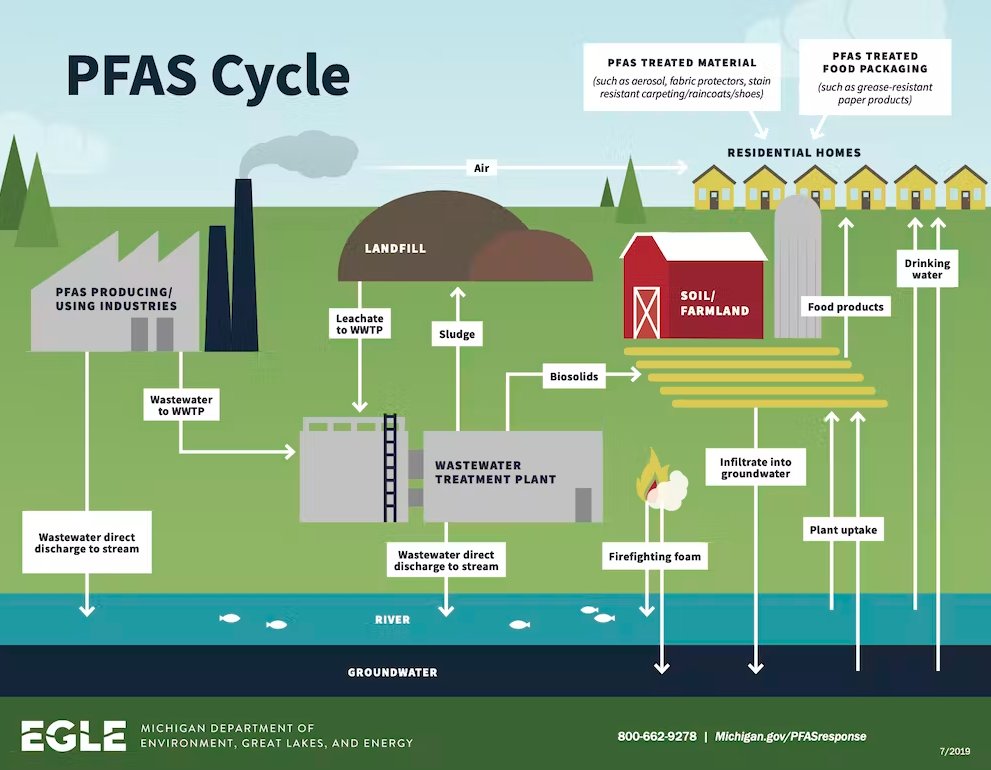
Very concerning. Increasing production and use of Forever chemicals, that is, the thousands of chemicals in the PFAS class: Per- and Polyfluoroalkyl Substances. These are not natural chemicals, and they do not break down in the environment. The chemicals are widely used. According to the Department of Health they are not manufactured in Australia, although plenty of products that use PFAS are imported.

PFAS is spread widely through water pollution and oceans and as aerosols in the atmosphere contaminating soils. PFAS chemicals are found very widely across the earth in rainfall. So, our water resources  are now contaminated.

My attention was drawn to this Euronews article. It sums up the recent scientific findings and outlines the issues: Rainwater everywhere on Earth unsafe to drink due to ‘forever chemicals’, study finds

Fluorine signatures and PFAS chemicals have been found in synthetic turf matting and fibers in the USA and in Sweden. With the study in Sweden the researchers say the presence of PFAS chemicals "we believe these results to be broadly translatable to Artificial turfs globally".

Friday, August 26, 2022

Synthetic turf and microplastics under investigation by NSW Chief Scientist

The Office of the Chief Scientist in New South Wales is currently investigating the use of synthetic turf and its environmental impacts, including the generation of microplastics. 

Professor HUGH DURRANT-WHYTE, Commissioner, Natural Resources Commission, and NSW Chief Scientist & Engineer answered questions at the NSW Budget estimates on Tuesday 23 August, 2022.

Durrant-Whyte explained: "It is about suitability for purpose in general, and the Office of the Chief Scientist, in general, doesn't make policy recommendations; it will make science recommendations. There is a lot to do with, as you say, not just microplastics but a whole range of other things, like local temperatures and things like that which impact significantly, but also there is a useability element which is important, so communities actually having access to playing fields and things like that. A lot of things have to be balanced out. Our role in this is to collect the evidence, collect the views, and to genuinely provide the scientific recommendation on which Government can make a policy decision."

The collection of information has been ocurring since the start of 2022 explained Durrant-Whyte. This has included involvement of a number of university groups plus collection of international data.

Wednesday, March 9, 2022

Update on Synthetic turf: risk and impacts associated with floods and bushfires

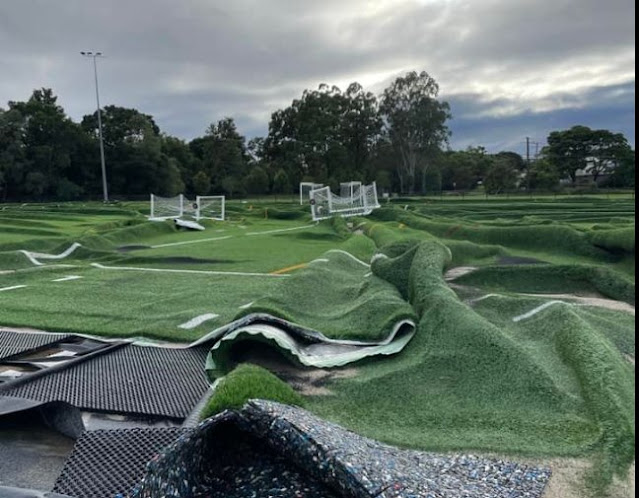
Mitchelton Football club synthetic turf field damaged by flooding of Kedron Brook (Brisbane)

The Queensland and NSW Flood disasters in February and March 2022 highlighted other risks and impacts that were not included in my Literature Review on Synthetic Turf (2021).

The Guardian reported on a football club in north-west Brisbane seeing its $1.5m synthetic playing field damaged and equipment washed away as flood waters inundated the sports fields beside the creek. (Favazzo 2022)

“In one word, it’s devastating,” said Mitchelton football club technical director Joe Fenech, described the damages. 

I don't think Mr Fenech was thinking of the microplastic pollution the synthetic turf caused due to the floodwaters. Much of the field's rubber infill and any loose plastic fibres would be washed away becoming microplastics pollution, adding to this pollution in the world's oceans.

One of the Football Club shipping containers containing sports equipment was washed down Kedron Brook an estimated seven kilometres from Mitchelton to The Grange, according to a Facebook report by the Club.

My literature review focussed on all the environmental problems, but it also focussed in particular on one proposed natural grass sports field conversion to synthetic turf at Hosken Reserve in North Coburg. It looked only at siting issues within that context. But siting of synthetic turf is a general problem to consider especially with regards to flood and bushfire events.

In terms of extreme weather events, both flooding and bushfire risk should be important determinants for contributing to triple bottom line assessments for Synthetic Field siting.

Friday, April 16, 2021

Literature Review: Synthetic Turf carbon footprint, environmental, health, microplastics and biodiversity impacts


Hosken Reserve: grass oval used for soccer training, informal recreation, off-lead dog exercise
Hosken Reserve: grass oval used for soccer training, informal reacreation, off-lead dog exercise
(Photo by John Englart)

Abstract: 

The conversion of a grass oval to synthetic turf at Hosken Reserve, Coburg North, is about a failure in transparency and consultation with the local community, and poorly framed triple bottom line decision making by Moreland Council. There are questions about the integrity of the triple bottom line decision making embracing the social, environmental and economic impacts, costs and benefits, that was used in the process in the past decade for this site. And there are questions how triple bottom line decision making and weighting of factors will be applied for the current process. 

This literature review provides numerous reasons why conversion of a natural grass oval and open space to a fenced synthetic soccer pitch should not take place. It finds that there are two primary reasons against synthetic turf at Hosken Reserve, and that either reason is significant in itself for the primary project not to go ahead. These two essential reasons are - synthetic turf carbon footprint (up to 1500 CO2e tonnes) in total life cycle greenhouse gas emissions, and synthetic turf increasing waste to landfill contributing to toxic leachates pollution and microplastics pollution. On both these grounds conversion of a shared use natural grass oval to synthetic turf would appear to conflict with existing Council policy and frameworks related to climate change and the climate emergency, and Council’s zero waste to landfill by 2030 target. 

On the triple bottom line factors we found the social factors weighed up with some positive and some negative, the environmental factors were mostly against, and the economics didn’t stack up, even after factoring in 2 to 1 equivalence usage factor for synthetic turf. This review investigated peer reviewed science, grey literature and relevant policy documents to ascertain the following issues with synthetic turf::

  1. Derived from fossil fuel petrochemical industry
  2. Produces greenhouse gas emissions during manufacturing and as it degrades
  3. Increases landfill at end of life
  4. Produces microplastics pollution
  5. Increases urban heat island effect on local residents
  6. Replaces natural grass which allows soil organic carbon sequestration, provides oxygen
  7. Reduces soil biota, grass seeds and insects with a trophic impact on local biodiversity primarily birdlife.
  8. Compacts the soil increasing stormwater runoff
  9. Toxic Chemical leachates from rubber infill pollute waterways
  10. Results in increased lower extremity injuries in elite players
  11. Long term human health impacts uncertain, but vertebrate model confirms toxicity to human health of rubber infill leachates
  12. Enhances infection transmission risk. Encourages a microbial community structure primarily defined by anthropic contamination
  13. Appears to improve water conservation, but the situation is far more complex when life-cycle assessment and irrigation to reduce heat for playability is taken into account
  14. Other issues: increased fire risk, increase in traffic, parking on quiet residential streets
  15. Alternative Solutions

The Climate Action Moreland full submission to Moreland Councillors and Hosken Refresh Consultation can be downloaded in PDF format (27 March 2021). This contained extra information regarding Hosken Reserve and Moreland Couuncil.  The version below has extra references and minor updates but focuses on the science.

This document was researched and prepared by John Englart, Convenor of Climate Action Moreland and was subject to peer review by group members and other active members in the Moreland climate community.

Publication Date: 15 April 2021 

DOI: 10.13140/RG.2.2.28126.56646

Supplementary: Annotated Bibliography on Synthetic Turf and Climate, health, biodiversity and microplastics pollution issues, https://takvera.blogspot.com/2021/04/annotated-bibliography-synthetic-turf.html 


Suggested Citation: Englart, J (2021), Literature Review on environmental and health impacts of synthetic turf., Climate Action Moreland, DOI: 10.13140/RG.2.2.28126.56646