Mastodon Climate Citizen --> Mastodon
Showing posts with label Tanya Plibersek. Show all posts

Friday, October 18, 2024

Inaugural Global Nature Positive Summit more financial greenwash than tackling decline in nature and biodiversity

Australia committed two years ago in 2022 at the landmark Convention on Biodiversity COP15 meeting in Montreal to hold an inaugural Global Nature Positive Summit. This occurred in Sydney 8-10 October. 

Unlike the Kunming-Montreal Global Biodiversity Framework adopted at Biodiversity COP15,  the Nature Positive Summit proved to have substantial  greenwash from the Australian and NSW state Governments, as they continue to approve and subsidise new coal and gas or logging of native forests.

The Federal Labor Government had been elected in May 2022 with a commitment to take strong climate action and to revamp and overhaul Australia's ineffective national environment laws. 

A report on State of the Australian Environment had its publication delayed by the previous Coalition Government. This report showed most ecosystems are declining or in a dire state which needs to be addressed, and is already impacting human society and economics. This expert report summaried at The Conversation, argued that:

  • Australia’s environment is generally deteriorating
  • Climate change threatens every ecosystem
  • The importance of Indigenous knowledge and management to deliver on-ground change
  • Environmental management isn’t well coordinated
  • Environmental decline and destruction is harming our well-being

Since Labor came to power in May 2022 we have seen some changes made such as a Water Trigger and Nature Repair Market, further changes to establish an Environment Protection Agency and Data Information Agency at a standstill in the Senate with the Government unwilling to compromise with the Greens and crossbench. Most substantive changes to the Environment Protection and Biodiversity Conservation (EPBC) Act have now been pushed out to beyond the next election. A fundamental fail by this Labor Government.

The Coalition has refused to bargain on a bipartisan basis and has signaled its support for business as usual regarding land clearing, forestry and mining. They too refused to act on the Samuel Review to upgrade ther EPBC Act. Ambition to address biodiversity crisis and species extinction is failing from both major parties.

The Nature Positive Summit seems to be more talkfest as Government policy ambition fails to address the nature negative policies already in place and driving biodiversity loss. The conference was held a week after three new thermal coal mine projects approved by the Federal Government that will result in up to 1.5 billion tonnes of lifecycle greenhouse gas emissions. 

The Labor NSW government can't stand high either as Forests NSW is about to log native forests 400km north of Sydney in the Bulga State Forest, which includes habitat for ther endangered Greater Glider. The Federal Government Regional Forestry Agreements with the states exclude application of the present ineffective national environment laws to protect endangered species.

Monday, October 2, 2023

Submission on BHP Caval Ridge Mine Horse Pit Coal Extension in the Bowen Basin: an additional lifetime 440 megatonnes of CO2

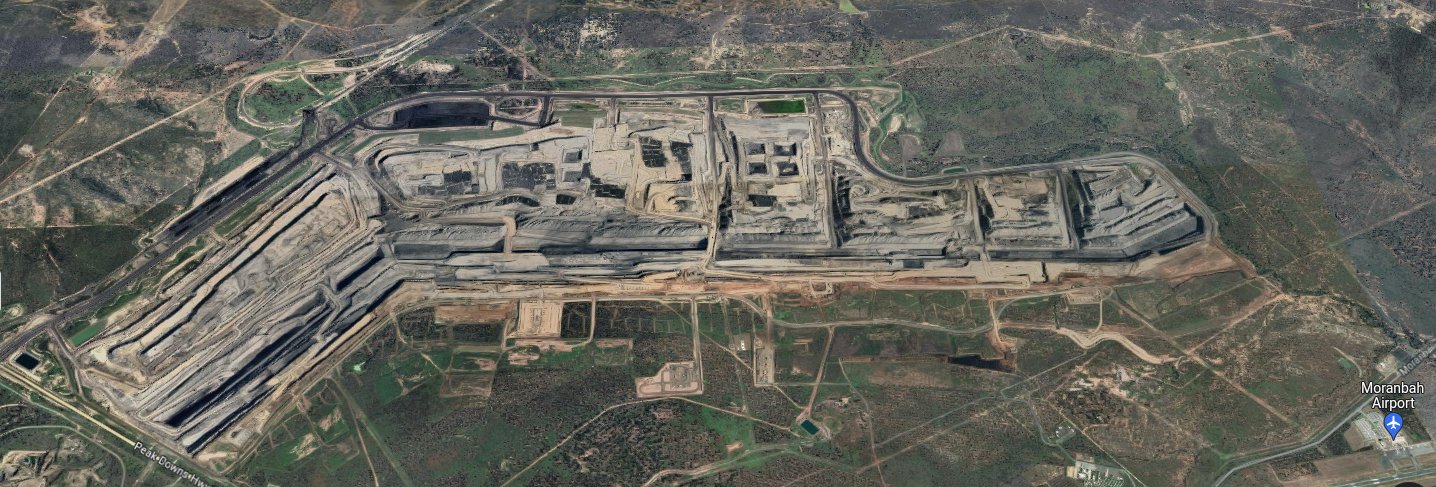
Aerial view: existing Caval Ridge mine in the Bowen Basin, Queensland


Submissions for this coal mine extension closed 29 September 2023. The Labor Federal government has already approved 10 new coal or gas projects since coming to power in May 2022. The BHP Caval Ridge Mine Horse Pit Coal Extension is in the approval queue with about 100 other coal and gas projects. 

The Labor Government has promised a refresh of Australia's environmental laws in the Environment Protection and Biodiversity Conservation Act (EPBC), but those reforms continue  to be deferred. During the Howard government in 2005 Anthony Albanese proposed a Climate Trigger be inserted in the EPBC Act. It failed of course. Labor did not revisit a Climate Trigger amnedment in 2007-2013 when in power with the Rudd and Gillard governments, and has not raised it as a priority in the current term of the Albanese Government.

BHP Mitsubishi Alliance’s proposes to extend the Caval Ridge Coal Mine and operate it for more than three decades, to 2056. The mine is located  approximately 5 km south west of Moranbah in the Bowen Basin, Queensland. It is an open cut mining operation that supplies hard coking coal product for the export market.

The Proposed Project will extend one of the two pits and will involve extraction and combustion of approximately 15 million tonnes per annum (Mtpa) of coal.

The proposal aims to commence in 2025 and extend to 2055. The mining schedule indicates extraction of approximately 158.3 million tonnes of coal over the life of the Proposed Project. The total combustion CO2 emissions for the product coal of the Proposed Project is estimated to be 440.64 million tonnes of CO2 added to the atmosphere that will exacerbate global warming.

My submission was one of 147 submissions co-ordinated by the Mackay Conservation Group.

Minister Plibersek and her department are now reviewing public comments about this proposal, alongside the large volume of scientific evidence that  Environment Council of Central Queensland Inc (ECoCeQ)  submitted with its reconsideration request


Tuesday, May 30, 2023

Australia at Global Plastics Treaty negotiations in Paris #INC2

The second meeting of the Intergovernmental Negotiating Committee (INC) of the Plastics Treaty ocurred from 29 May – 2 June 2023 in Paris, France. Referred to with the hashtag #INC2. The first meeting convened 28 November - 2 December 2022 at Punta del Este, Uruguay, which I reported on. The aim is to complete negotiations by the end of 2024 and create a global, legally binding plastics treaty. 

Katherine Lynch (Australia) at the final Plenary

Australia's Environment Minister Tanya Plibersek attended the first day of the conference, then returned to Australia. Australian official Katherine Lynch played a key role in co-facilitating Contact Group 2.

In 2022 Australia joined the High Ambition Coalition of 20 nations including the UK, Canada, France, and Germany that aims to end plastic pollution by 2040, including a legally binding target to phase out plastic waste products by 2025. But some countries, including the United States, Saudi Arabia and China, want to make targets voluntary. Read more at Sydney Morning Herald (28 May): Australia steps in to stop countries watering down plastics pact.

Outcomes:  

  • Delegates mandated the INC Secretariat to prepare a zero-draft of the treaty in advance of INC-3.
  • INC3 scheduled for Nairobi, Kenya in November 2023, to work on a Zero draft. 
  • Committee welcomed offers to host INC-4 by Canada (Ottawa April 2024) and INC-5 by the Republic of Korea towards the end of 2024.
The options paper from INC2 will inform the ‘zero draft’, the text with legal language that will form the blueprint of the final treaty. 

An important decision will be what kind of treaty: a treaty focused on global obligations, where every country needs to comply with an international set of standards (like the Montreal Protocol or Minamata Convention)? Or should it be a treaty that relies on nationally determined measures, where countries set their own goals and targets (like the Paris Agreement)?

This blogpost was updated frequently over the week.

Thursday, December 8, 2022

Minister outlines major update to Australian environmental laws and the EPBC Act by end of 2023

Photo: Tanya Plibesek speech
Australia: Environment Minister Tanya Plibersek announces formal response to the Independent Review of Australia’s Environment Protection and Biodiversity Conservation Act.
 
"At the heart of our reform is a conceptual shift. When we reform our environmental laws, we will take them from being nature negative, where we just manage an overall decline in our environment, to nature positive, where we protect our land and leave it in a better state than we found it." said Plibersek at a Queensland Conservation Council event. 

Major Reforms include: 
  • introduction of National Environmental Standards, 
  • new system of regional planning, 
  • overhaul of environmental offsets, and 
  • establishment of an independent Environment Protection Agency. 

New National Environmental Standards will apply to Regional Forestry Agreements, which were previously exempt from EPBC Act regulation. This means threatened species and ecosystems will come back under Federal government regulation.

Climate will be a consideration, but no climate trigger for the amended legislation: 
"proponents of large projects be required to publish their lifetime, domestic carbon dioxide emissions. Proponents will also be required to disclose what they will do to manage or offset their emissions, in line with Australia’s climate targets."