Mastodon Climate Citizen --> Mastodon
Showing posts with label IPCC. Show all posts

Monday, January 29, 2024

IPCC plans 7th assessment cycle reports including Climate Change and Cities, Short-lived Climate Forcers, Carbon Dioxide Removal

The 60th Session of the Intergovernmental Panel on Climate Change (IPCC) met in Istanbul, Turkiye from 16–19 January 2024  (IPCC-60). This session started the planning for the seventh assessment cycle which will run over the next 5-6 years. More than 300 delegates from 120 governments met to determine the work cycle of what reports to produce. 

Outcomes include reports from the three Working Groups, plus a Synthesis Report as in previous assessment cycles. Special reports will include: Special Report on Climate Change and Cities, Methodology Report on Short-lived Climate Forcers, Methodology Report on Carbon Dioxide Removal Technologies, Carbon Capture Utilization and Storage. All three are important foundations for climate policy decision making.

Some climate scientists had previously called for a special report on catastrophic climate change, a blind spot in peer reviewed research and thus in the IPCC assessments. No mention made of this in reports of the IPCC meeting.

Thursday, April 7, 2022

UN Secretary General calls out Australia: "the truly dangerous radicals increasing the production of fossil fuels" in launching IPCC WGIII report on climate solutions


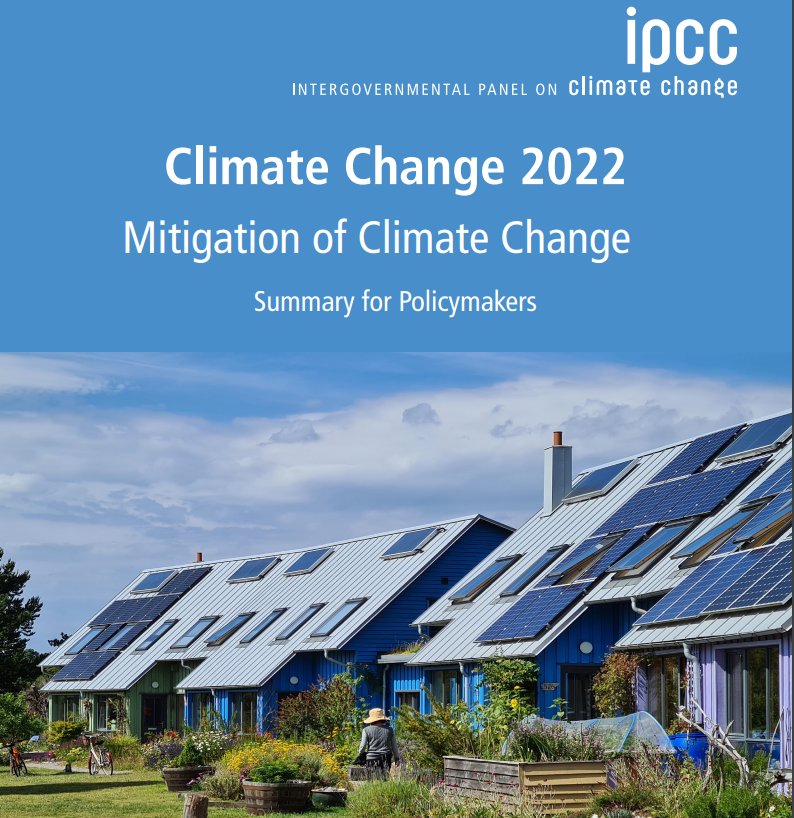
The Intergovernmental Panel on Climate Change (IPCC) has published it's third report of the present cycle. This one is on Climate Change 2022: Mitigation of Climate Change and contains possible solution pathways. 

This is the sixth IPCC Assessment cycle undertaking the collation of the science, impacts and solutions. Working Group I focussed on the Physical Science of climate Change. Working Group II focussed on climate impacts and vulnerability assessment. The Working Group III report is on how to mitigate climate change, the solutions and transition pathways for deep decarbonisation.

Antonio Guterres, the United Nations Secretary General, again stepped up to launch this report. He didn't mince any words. 

He called it a "damming" verdict that outlines a "litany of broken promises", highlighting that "we are on a fast track to climate disaster". He does not hesitate in saying "This is a climate emergency".

He doen't mention any nations by name, but Australia is clearly in his sights  when he calls out the truly dangerous radicals increasing the production of fossil fuels.

"Investing in new fossil fuels infrastructure is moral and economic madness. Such investments will soon be stranded assets – a blot on the landscape, and a blight on investment portfolios."

Tuesday, March 1, 2022

UN Secretary General launches IPCC climate report: "abdication of leadership is criminal...World's biggest polluters are guilty of arson of our only home."


Very powerful speech by Antonio Guterres, UN Secretary General  at launch of the Intergovernmental Panel on Climate Change (IPCC) 6th assessment report Working Group II report on Impacts, Adaptation and Vulnerability. He highlights the climate emergency we are in.

Australia as a member of the G20 and the OECD needs to phase out Australian coal use by 2030, and phase out coal export by 2040. Australia should be increasing our 2030 climate emissions reduction targets to 50% or more. I am well aware that every second of delay means death.. Australia needs to honour the Glasgow pledge at COP26 to strengthen national climate plans every year until they are aligned with 1.5C.

The last paragraph item in the Summary for policymakers of this report reads:

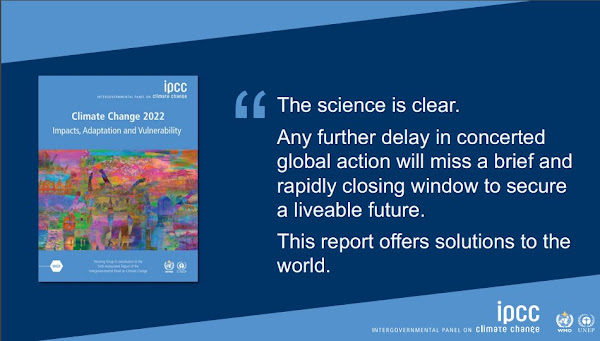
SPM.D.5.3 The cumulative scientific evidence is unequivocal: Climate change is a threat to human well-being and planetary health. Any further delay in concerted anticipatory global action on adaptation and mitigation will miss a brief and rapidly closing window of opportunity to secure a liveable and sustainable future for all. (very high confidence) 

Friday, September 24, 2021

IPCC climate science report: code red for humanity says UN Secretary General


"Today’s IPCC Working Group 1 Report is a code red for humanity.  The alarm bells are deafening, and the evidence is irrefutable:  greenhouse gas emissions from fossil fuel burning and deforestation are choking our planet and putting billions of people at immediate risk. Global heating is affecting every region on Earth, with many of the changes becoming irreversible." said Antonio Guiterres, UN Secretary General upon the launch of the Intergovernmental Panel on Climate Change (IPCC) 6th assessment report on the Physical science.

"The internationally agreed threshold of 1.5 degrees Celsius is perilously close. We are at imminent risk of hitting 1.5 degrees in the near term. The only way to prevent exceeding this threshold is by urgently stepping up our efforts, and pursuing the most ambitious path. We must act decisively now to keep 1.5 alive." said Guiterres in an official statement.

Sunday, September 12, 2021

IPCC report, Labor climate policy and targets: Email to Peter Khalil MP for Wills


The following email was sent to Labor MP for Wills, Peter Khalil on 16 August 2021. As of 12 September 2021 there has been no response or acknowledgement of this email. 

Thursday, December 12, 2019

Fossil Awards to Japan, Brazil and a Ray of the Year to the IPCC


Wednesday Fossil of the Day ceremony was a tough one to organise. Half the Fossil of the Day Team had been locked out of the conference centre by the heavy handed tactics of UN Security. First prize went to Japan for continuing to shun ambition and lock in coal addiction. @nd Fossil award to Brazil for land grabbing and deforestation of the Amazon. We also had a ray of light - a Ray of the Year presented to Youba Sokona, the IPCC Vice-Chair, who presnted two copies of one of the IPCC reports as a gift in return.

A civil society protest action at 2.45pm had occurred outside the Baker Plenary hall, but resulted in between 200-300 people being pushed and shoved out a side door outside the hall and locked out. Read more: UNFCCC closes the door literally on civil society demanding climate justice at COP25.

Friday, September 27, 2019

New IPCC report on Oceans and Cryosphere


The IPCC has released a new scientific report reviewing scientific research on global warming and how it impacts oceans and cryosphere, and knock on effects on marine ecosystems, fisheries, coastal systems and sea level rise, and water systems.

Kristina Dahl, senior climate scientist, Union of Concerned Scientists, said:
“Our oceans have absorbed the vast majority of extra heat added to the planet by heat-trapping gases emitted by humans. As the latest IPCC report shows, the consequences for the health of our oceans and the safety of coastal communities are already grave and will worsen as the planet continues to heat up.

“The report details how glaciers and ice sheets around the world are rapidly shrinking in response to human-caused warming. This loss of land-based ice will further accelerate rising seas levels, which will have stark implications for communities whose cultures, livelihoods or water supplies are glacier-dependent, as well for coastal communities across the globe more broadly.

Monday, December 10, 2018

What is in a word? Lots when it comes to welcoming the IPCC special report on 1.5C to #COP24


During negotiations on Saturday at the UN climate change conference fossil fuel major countries blocked welcoming the IPCC Special report on 1.5C target for informing the negotiations. Blocking countries were Saudi Arabia, USA, Kuwait, and Russia.

The Intergovernmental Panel on Climate Change (IPCC) special report on 1.5C was initiated by the Conference of the Parties as part of the Paris Agreement in 2015.

The report was based on over 6000 peer reviewed papers. The Summary for Policy makers document of the report was approved by a meeting of government representatives on the IPCC.

Thursday, October 18, 2018

IPCC 1.5C report needs to inform Moreland's transport strategy


I attended the Brunswick Town Hall, for a special hearing by Moreland Council considering oral presentations to submissions on the Moreland Integrated Transport Strategy and the Moreland Parking Policy.

I was number 19 on the list of presenters as I had made a submission on behalf of Climate Action Moreland (Read it here).

Many of the presenters spoke on the personal circumstances of traffic, parking, cycling and walking in Moreland, and concerns how the strategy and policy might affect employment or business.

Wednesday, February 1, 2017

US Congress considers bill to abolish funding to IPCC, UNFCCC, Green Climate Fund


Abolition of Funding for IPCC, UNFCCC, Green Climate Fund is the target of Bill HR 673 introduced into U.S. Congress on January 24, 2017. Currently the bill is referred to the House Committee on Foreign Affairs.

Transition advisor Myron Ebell, at a talk of the Global Warming Policy Foundation in the UK, was adamant that Trump wants to withdraw from the Paris Agreement, despite Secretary of State Rex Tillerson saying it would be advantageous to have a place at the negotiating table.

Strangley, Ebell has never spoken to President Trump, and now seems to be out of the loop altogether.

He outlined three major ways Trump might withdraw US participation from the Paris climate agreement.

Ebell argued that in the first instance, the president can simply stop any US financial contributions to the UN Framework Convention on Climate Change (UNFCCC), and that all US funding to the UNFCCC, including to the Green Climate Fund, represents a violation of US law ever since Palestine was accepted as a UNFCCC member. Secondly, Trump might request the US Congress to reject the Paris agreement on the basis that legally it is a treaty and does not qualify as an executive presidential order. Thirdly, Trump could withdraw the US from the UNFCCC altogether.

Sunday, October 6, 2013

IPCC report: Climate Council Q & A with Professor Will Steffen

While the AMOS event was occurring Professor Will Steffen and Amanda MacKenzie from the Climate Council conducted a live Q and A via twitter, facebook and youtube on the IPCC report.

The Climate Council was established two weeks ago after the Climate Commission was abolished as one of the first acts of the new Federal Government lead by Tony Abbott. The public reaction to the axing of the Climate Commission was an outpouring of donations to the new non-government Climate Council to continue it's valuable work. More than $1 million has been raised from 20,000 people, mostly in small donations.

IPCC: Climate change is unequivocal with rapid and substantive emissions reduction required

The original of this article was published on the Climate Action Moreland website.


A packed hall last thursday night (3 October) in Melbourne heard from Australian climate scientists on the latest science report from the Intergovernmental Panel on Climate Change (IPCC). I was one of four members of Climate Action Moreland who attended.

The Australian Meteorological and Oceanographic Society (AMOS) organised the free public event in Melbourne to explore the findings and significance of the latest comprehensive report on the science of climate change. It was so popular that 700 people registered to attend - the capacity of the hall, and a further 200 people enquiring had to be turned away or put on a waiting list.

Tuesday, January 15, 2013

Australian Heatwave part of global warming trend says IPCC head Pachauri

The IPCC chairperson is visiting Australia and commented that the Extreme heatwave and catastrophic bushfires that Australia is experiencing is an 'unmistakeable' part of a global trend of an increase in the frequency and intensity of heatwaves and other extreme weather events. Indeed, researchers from the Potsdam Institute for Climate Impact Research (PIK) have just released a new study - Global increase in record-breaking monthly-mean temperatures - which clearly shows the present Australian heatwave records being broken and the US recording it's hottest year in 2012, are both part of this global trend.

Wednesday, November 28, 2012

Sea Level rising 60% faster than IPCC projections

Sea Level is rising 60% faster than IPCC projections according to a new climate change related study comparing the actual rise in CO2 concentration, global temperature and sea level with past projections done by the IPCC.

Rising Global temperatures are consistent with past projections made by the IPCC fourth assessment report. But Projections for sea level rise amounted to 2 mm a year, while sea-levels are actually rising at a rate of 3.2 mm a year.

Lead author of the study, Stefan Rahmstorf, said: "This study shows once again that the IPCC is far from alarmist, but in fact has under-estimated the problem of climate change. That applies not just for sea-level rise, but also to extreme events and the Arctic sea-ice loss."

Figure 2: Sea level measured by satellite altimeter (red with linear trend line; AVISO data from (Centre National d'Etudes Spatiales) and reconstructed from tide gauges (orange, monthly data from Church and White (2011)). Tide gauge data were aligned to give the same mean during 1993–2010 as the altimeter data. The scenarios of the IPCC are again shown in blue (third assessment) and green (fourth assessment); the former have been published starting in the year 1990 and the latter from 2000. From Comparing climate projections to observations up to 2011 Stefan Rahmstorf et al 2012 Environ. Res. Lett. 7 044035 doi:10.1088/1748-9326/7/4/044035

Wednesday, November 23, 2011

Extreme weather, risk management and adaptation in a warming climate - latest IPCC report

Over the weekend the Intergovernmental Panel on Climate Change (IPCC) released the Special Report on Managing the Risks of Extreme Events and Disasters to Advance Climate Change Adaptation (SREX). There were no surprises for anyone who follows climate science, and the report succinctly integrates a discussion of vulnerability, risk management and adaptation strategies for extreme weather disasters.

The report looks at the evidence for each extreme weather event and gives an assessment of probability and confidence value of each weather event assessment and the future trend. It involved some 220 expert authors from 62 countries and involved more than 18,000 review comments.

Tuesday, May 17, 2011

Carbon price needed for climate mitigation says UN Climate Head Pachauri

Rajendra Pachauri, head of the UN Intergovernmental Panel on Climate Change (IPCC), has weighed into the Australian debate on a carbon price by telling the ABC PM radio program he agreed with Australia setting a carbon price.

"A price on carbon is by far the most effective means globally to bring about mitigation of emissions of greenhouse gases because you know then you are providing a price signal by which new technologies will be developed, consumer actions would be influenced and producers would move towards low carbon technologies and processes and products." he told ABC reporter Sarah Clarke, "So I think a carbon price is an important part of actions to mitigate emissions of greenhouse gases."

Friday, July 2, 2010

IPCC scientist: Action on climate change urged by scientists since 1990

IPCC Scientist Dr Jean-Pascal van Ypersele, Vice Chair, IPCC takes Penny Wong to task about when the scientific message on climate change and the need for action become clear. He spoke shortly after Penny Wong's keynote speech at the opening plenary 2010 International Climate Change Adaptation Conference on the Gold Coast.

1.1 Opening Plenary: Jean-Pascal van Ypersele & Martin Parry from NCCARF on Vimeo. Jean-Pascal van Ypersele started with a quote which called for immediate action to stabilize carbon emissions and to reduce carbon emissions by 60 per cent by 2050. Dr van Ypersele then apologised to the audience - that he had prepared his speech in a hurry and the quote he had given was actually from the first IPCC assessment report done in 1990. He then stated to the audience and the Minister he had to slightly disagree with the Minister that scientists up until recently had not been clear with their message. He then briefly summarised the importance of both mitigation and adaptation measures. "Adaptation is clearly needed if we want to avoid some of the unavoidable impacts" said Jean-Pascal van Ypersele "the IPCC has as a whole the message that mitigation and adaptation are complementary". The small number of errors found in the last report will generate a review of the processes in the IPCC and of writing the next IPCC report to be published in 2013. Listen to the rest of his speech, or find other videos of plenary speakers at NCCARF's videos at Vimeo. PDF presentations of many of the speakers are available for download at the Conference program website

Friday, November 6, 2009

Industrialised World Intransigence on CO2 emissions dooms Climate Negotiations

Africa abandons Barcelona's pre COP15 climate talks - Anger in the streets at rich nations inaction. Copenhagen Climate Treaty appears doomed - delays likely. Delay is not an option, delay kills.

This week (Nov 2 - 6) the Barcelona International Climate Change Talks are happening, five days of formal negotiations, in the lead up to COP 15 in Copenhagen in December 2009. Already Barcelona has seen a Manifestation in Barcelona streets - "The climate is not for sale" (Youtube vid | report), Outdoor film screening in city streets of Age of Stupid, TckTckTck wake up call for climate talks, Greenpeace banner drop (Youtube), Anarchist night greeting, Africa boycott U.N. climate talks (Grist report), Evening Water Lobby group targeted, and the Main entrance shut down by activists.

Conservation organisations have warned that the Copenhagen climate treaty threatens to subsidise the destruction of the world's remaining rainforests instead of financing their protection. In Indonesia Greenpeace established a Climate Defenders Camp to preserve Rainforest peatlands (Youtube Video). On October 24, 2009 people in 181 countries came together through 350.org calling for carbon emissions to be capped at 350ppm. It was the most widespread day of environmental action in the planet's history, at over 5200 events around the world, many of them reported on the Indymedia Network. (Photos)

See also: Barcelona IMC | Indymedia Ireland | Climate IMC
Climate Code Red: the Case for a Sustainability Emergency | Carbon Equity

Friday, October 12, 2007

Arctic Sea Ice heading for Rapid Disintegration: Greenland Ice Sheet melting

Arctic summer sea ice is headed towards rapid disintegration as early as 2013, a century ahead of the International Panel on Climate Change (IPCC) projections, according to 'the Big Melt' (PDF), a new review of recent scientific literature on climate change produced by www.carbonequity.info. We have gone past the tipping point for Arctic sea ice and now we watch the disintegration of the Greenland and the West Antarctic ice sheets which will result in catastrophic changes in sea level of 5 metres or more in the next 100 years.

Saturday, March 17, 2007

NASA Climatologist Predicts Disastrous Sea Level Rise

In an interview on Australian ABC Television program, The 7.30 Report, James Hansen, a prominent NASA climatologist, predicted the likelihood that the earth will pass a tipping point resulting in Sea Level Rise of up to a metre every 20 years. The trigger for this is an extra degree of global warming resulting in the runaway melting of the Greenland and West Antarctic Ice sheets.

According to Hansen "the problem is that the climate system in general has a lot of inertia and that means that it takes time for the changes to begin to occur but then, once they do get under way, it becomes very difficult to stop them and that is true in spades for the ice sheets. If we once begin to disintegrate it will become very difficult, if not impossible, to stop them and we are beginning to see now on both Greenland and west Antarctica disintegration of those ice sheets. They're both losing ice at a rate of about 150 cubic kilometres per year and that's still not a huge sea level rise."