Mastodon Climate Citizen --> Mastodon
Showing posts with label mitigation. Show all posts

Thursday, April 7, 2022

UN Secretary General calls out Australia: "the truly dangerous radicals increasing the production of fossil fuels" in launching IPCC WGIII report on climate solutions


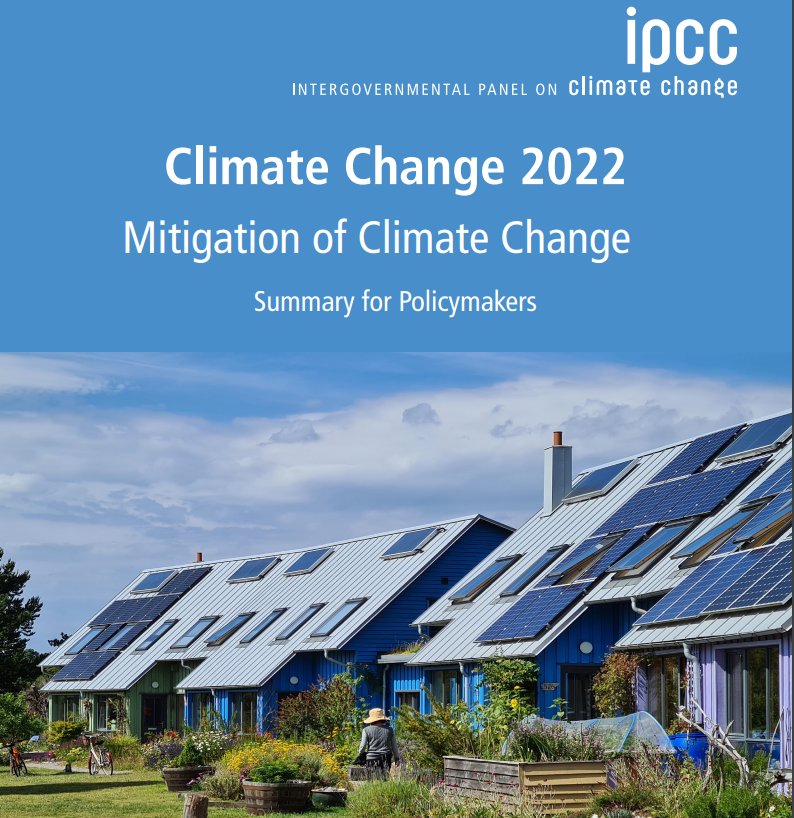
The Intergovernmental Panel on Climate Change (IPCC) has published it's third report of the present cycle. This one is on Climate Change 2022: Mitigation of Climate Change and contains possible solution pathways. 

This is the sixth IPCC Assessment cycle undertaking the collation of the science, impacts and solutions. Working Group I focussed on the Physical Science of climate Change. Working Group II focussed on climate impacts and vulnerability assessment. The Working Group III report is on how to mitigate climate change, the solutions and transition pathways for deep decarbonisation.

Antonio Guterres, the United Nations Secretary General, again stepped up to launch this report. He didn't mince any words. 

He called it a "damming" verdict that outlines a "litany of broken promises", highlighting that "we are on a fast track to climate disaster". He does not hesitate in saying "This is a climate emergency".

He doen't mention any nations by name, but Australia is clearly in his sights  when he calls out the truly dangerous radicals increasing the production of fossil fuels.

"Investing in new fossil fuels infrastructure is moral and economic madness. Such investments will soon be stranded assets – a blot on the landscape, and a blight on investment portfolios."

Thursday, February 12, 2015

Climate change and heatwaves in Melbourne - a Review

Abstract: The impacts of Climate change are now being felt at a regional level in cities like Melbourne. The impact of rising temperatures and increasing frequency, duration and intensity of hotspells and heatwaves on Melbourne and its urban heat island poses challenges in how to respond and adapt. There are multiple risks to human health, maintaining urban infrastructure and urban biodiversity. Countering heatwaves and climate change is a major social and political challenge and will require both rapid mitigation of carbon emissions for the long term and widespread adoption of urban climate adaptation strategies and behaviour at personal, business and government levels.

John Englart 10 February 2015.
Download as a PDF

DOI: 10.13140/RG.2.1.3050.7688

This article started during my single subject study in Academic Research at NMIT (now Melbourne Polytechnic) during Semester 1 of 2014. The focus was selected in negotiation with my lecturer. A slightly abbreviated version was handed in as my major assessment for the subject. The other two assessments of the subject were an annotated bibliography and a formal classroom presentation, which was also published at slideshare. I received a high distinction for the subject overall.

This literature review is structured in two parts: the first on Melbourne temperature and heatwave impacts from climate change, and the second on risk management, mitigation and adaptation to rising temperatures, heatwaves, and the urban heat island effect in Melbourne.

I thought limiting my focus to one climate impact - temperature and heatwaves - and one location - Melbourne - would narrow the field substantially, but as I dug deeper and read more widely I found a wealth of relevant literature either relevant to heatwave impact or directly to my regional focus. The bulk of the references are peer reviewed academic studies, but some are academic working papers and presentations, reports to Government, and news articles including several by myself published on this blog, Sustainable Fawkner or Climate Action Moreland.

Contents

Tuesday, December 20, 2011

Climate Change: Going Beyond Dangerous - a frank presentation by Professor Kevin Anderson

Listen to this 55 minute webinar (voice presentation with slideshow) by Professor Kevin Anderson, on Climate Change: Going Beyond Dangerous. Professor Anderson is Deputy Director of the Tyndall Centre for Climate Change Research and holds a chair in Energy and Climate Change at Manchester University, and is an advisor to the British Government on climate change (see Wikipedia).

Kevin Anderson explains in simple language what we are facing in our climate future - a four degree world perhaps as soon as 2060 and a 6 to 8 degree world by the end of the century. He is brutally honest and straight forward in his assessments of where we are at with mitigation and the options open for humanity. Climate negotiations have dithered since 1992, and have left no easy options for us. The longer we delay, the more difficult it will be to respond to climate change.
It is only through knowing the dire extent of the situation that we can take the actions necessary to possibly avoid the worst climate impacts.


Friday, July 2, 2010

IPCC scientist: Action on climate change urged by scientists since 1990

IPCC Scientist Dr Jean-Pascal van Ypersele, Vice Chair, IPCC takes Penny Wong to task about when the scientific message on climate change and the need for action become clear. He spoke shortly after Penny Wong's keynote speech at the opening plenary 2010 International Climate Change Adaptation Conference on the Gold Coast.

1.1 Opening Plenary: Jean-Pascal van Ypersele & Martin Parry from NCCARF on Vimeo. Jean-Pascal van Ypersele started with a quote which called for immediate action to stabilize carbon emissions and to reduce carbon emissions by 60 per cent by 2050. Dr van Ypersele then apologised to the audience - that he had prepared his speech in a hurry and the quote he had given was actually from the first IPCC assessment report done in 1990. He then stated to the audience and the Minister he had to slightly disagree with the Minister that scientists up until recently had not been clear with their message. He then briefly summarised the importance of both mitigation and adaptation measures. "Adaptation is clearly needed if we want to avoid some of the unavoidable impacts" said Jean-Pascal van Ypersele "the IPCC has as a whole the message that mitigation and adaptation are complementary". The small number of errors found in the last report will generate a review of the processes in the IPCC and of writing the next IPCC report to be published in 2013. Listen to the rest of his speech, or find other videos of plenary speakers at NCCARF's videos at Vimeo. PDF presentations of many of the speakers are available for download at the Conference program website