Mastodon Climate Citizen --> Mastodon
Showing posts with label China. Show all posts

Tuesday, November 21, 2023

APEC 2023 and the Sunnylands statement for US-China cooperation to address the Climate Crisis in leadup to COP28

APEC 2023 San Fransisco

Last week on the 16-17 November Pacific Nation leaders met under the Asia Pacific Economic Co-operation Forum and and issued the 2023 APEC Leaders’ Golden Gate Declaration. President Biden (USA), President Xi (China), Prime Minister Anthony Albanese (Australia) were all there.

Of greater importance has been the ongoing dialogue between US Special Presidential Envoy for Climate John Kerry and China Special Envoy for Climate Change Xie Zhenhua who met in early November in California, following by bilateral discussion by Presidents Biden and Xi before APEC. 

Dialogue and actions by USA and China are key for setting ambition at the United Nations Climate conference COP28 in Dubai.

China's emissions are likely to fall in 2024, according to analysis published at Carbon Brief.

Wednesday, November 16, 2022

G20 in Bali provides impetus for negotiations at COP27: $20 billion to phase out Indonesian coal, Europe-Australia bilateral affirms Paris goals

G20 Leaders Plant Mangroves In Bali Photo via PM Albanese via twitter

So what did the G20 meeting say on climate and how will it affect the UN Climate Change conference COP27 in Sharm El-Sheikh, Egypt?

"Mindful of our leadership role, we reaffirm our steadfast commitments, in pursuit of the objective of UNFCCC (United Nations Framework Convention on Climate Change) to tackle climate change by strengthening the full and effective implementation of the Paris Agreement and its temperature goal," a declaration issued at the end of the meeting said.

The declaration maintains the 1.5C temperature goal. 

There was also an important bilateral meeting between Biden and Xi that cleared blockages for climate co-operation. 

And a $20 billion financing package for Indonesia to phase out coal and increase renewables as part of it's energy transition and reduction in greenhouse gas emissions.

Australia -Europe joint statement which in point 9 affirmed "deeply committed to full implementation of the Paris Agreement, noting the urgency to limit global warming to 1.5 degrees through rapid, deep and sustained reductions in greenhouse gas emissions in this decade and to achieve net zero emissions by 2050, and will spare no effort to bring about ambitious action by all members of the international community."

Thursday, November 11, 2021

USA-China Glasgow Declaration at COP26 maintains ambition on CO2 and methane

China and US Climate Envoys take the stage at COP26 announcing Joint Declaration


There has been a lot of pressure on China, with the lack of presence of President Xi Jingping at the Leaders summit last week. The US called out China for the lack of this presence. 

But today Chinese climate envoy Xie Zhenhua and his US counterpart John Kerry stunned observers by announcing the China-US Joint Glasgow Declaration on Enhancing Climate Action in the 2020s. 

This adds to the feeling that although the outcome of COP26 may be mixed, lacking in ambition in some areas according to the Draft cover text, and still not resolving the Emissions Gap or Production Gap, there is still substantial movement going forward.

As background, China only offered a very minor update to it's NDC commitment at COP26. 

But this was after it had increased ambition at the Biden summit in April which included commitment to  join the Kigali Amendment, strengthen control of non-CO2 greenhouse gases, strictly control coal-fired power generation projects, and phase down coal consumption.

In September China committed to stop funding overseas coal projects at the UN General Assembly. September. 

Even though President Xi did not attend COP26, China does have a substantial delegation at the UN Climate Change Conference in Glasgow, COP26. 

On Wednesday the USA and China announced their declaration, and outlined what actions both countries would be taking together into the 2020s. This will give a boost to those negotiators arguing for more ambition in the draft textxs for the final COP decision on mitigation, adaptation, Common timeframes and finance.

Friday, December 7, 2018

Arab group wins (again) #FossiloftheDay at COP24 for being not okay with IPCC 1.5C report


Well the Arab Group is off to a great start this Conference of the Parties (COP) in Poland with a second fossil award.

This time it was for Kuwait wanting to delete specific references to findings in the IPCC 1.5°C Special Report in negotiations in the Warsaw International Mechanism (WIM) for Loss and Damage.

Saudi Arabia and the Arab Group scored a Fossil award yesterday for trying to kill ambition and prevent more transparency. Looks like we have a first candidate in this years race for the Colossal Fossil

Here is the official media release by Climate Action Network:

Sunday, September 4, 2016

Deciphering the US-China bilateral climate change outcomes


This article first appeared at indybay.org.

The nine point statement on the U.S.-China Climate Change Outcomes in Hangzhou China negotiated between Presidents Xi Jinping and Barack Obama outlined the growing bilateral cooperation between the US and China on climate policy in a number of meetings since 2013. (First outcome).

These bilateral negotiations should be widely welcomed. They proved to be an important stage setter for the Paris Agreement at COP21 in Paris which set in place for the first time a true international framework for reducing greenhouse gas emissions and dealing with climate change.

Read the U.S.-China Climate Change Outcomes (Whitehouse.gov) in full.

United States and China ratify Paris Agreement

The formal occasion in Hangzhou China was used to lodge instruments of ratification of the Paris Agreement with UN Secretary General Ban Ki-Moon, and call for all other UNFCCC signatory countries to ratify the agreement this year. (Second Outcome)

Read more on this by me: China and the United States Ratify Paris Agreement on climate

China and the United States Ratify Paris Agreement on climate while Australia fumbles on policy


On Saturday China agreed to ratify the Paris Agreement according to the Guardian, with members of China's National People's Congress Standing Committee adopting "the proposal to review and ratify the Paris Agreement" on Saturday morning.

China is the world's largest greenhouse gas emitter with about 24 percent of total global emissions. The USA is second on about 12 percent of global emissions.

The report comes on the eve of the G20 summit in Hangzhou China over the weekend, where China, US set to release review of each other’s fossil fuel subsidies in historic move at G20 summit according to the South China Morning Post.

The announcement comes as Xi Jinping and Barack Obama met ahead of the start of the G20 on Sunday to make a joint statement on climate change and submit their country instruments of ratification to UN Secretary-General Ban Ki-moon.

Wednesday, March 30, 2016

Shenhua coal mine doomed by China energy transition


Photo by Kate Ausburn, Creative Commons License.

The proposed Shenhua Watermark coal mine on the Liverpool Plains has been widely opposed by farmers and environmentalists, but it appears the energy transition of China and the economics of coal have ultimately doomed the project. Original article for Nofibs.com.au

The fact is China ‘Is Getting Serious’ About Scaling Back Coal. A rapid transition is taking place in China transitioning to renewable energy and scaling back coal power. Part of this is the concern over chronic air pollution problems.

According to Tim Buckley from IEEFA, "New data shows China’s electricity-sector transformation accelerating in the first two months of 2016. While electricity consumption was up just 0.3% year on year (yoy) to 870TWh for the January-February period, coal imports fell 10.2%i and coal production declined 6.4%."

"China’s absolute use of coal likely peaked in 2013. The subsequent data certainly supports this position. China’s coal consumption declined 2.9% yoy in 2014, with a further decline of 3.7% yoy in 2015 that accelerated in the first two months of 2016. As a guide, production year to date was -6.4% yoy." reported IEEFA

Saturday, January 30, 2016

Coal on the skids - China, India, USA, Great Britain, and Australia


Coal production and the seaborne coal market are all suffering as renewables ramp up and coal-fired power is reassessed due to pollution, health and greenhouse gas emission concerns.

Coal prices for Newcastle thermal coal is just above US$56 per metric ton. Major coal markets in India and China are drying up. Vietnam has just announced a review of coal power citing the need to implement all international commitments in reducing greenhouse gas emissions.

There is increasing closure of coal power stations driven by health impacts from pollution as well as growing concern to reduce emissions after the historic UN climate conference Paris Agreement.

Coal is in structural decline. And it needs to be.

A study by Ekin and McGlade published January 2015 into fossil fuel resources and the 2 degree limit found that, without any Carbon Capture and Storage, 88 per cent of coal needs to stay in the ground, unburnt.

So here is a list of recent heartening news on the coal front.

Sunday, April 19, 2015

Obama: climate change can no longer be denied or ignored


With Earth Day coming up this Wednesday on April 22 President Barack Obama has released a video saying that climate change can no longer be denied or ignored. He will deliver a speech at the Florida Everglades on Wednesday that will reinforce this message of the threat that climate change poses to the economy and to the world, in one of the most vulnerable habitats in the United States.

United States submits INDC to United Nations


The United States joined 32 other countries submitting their Intended Nationally Determined Contribution (INDC) by 31 March, 2015. The USA set its climate target at 28 per cent emissions reduction on 2005 levels by 2025.

According to the UNFCCC nations, all countries "have agreed that there will be no back-tracking in these national climate plans, meaning that the level of ambition to reduce emissions will increase over time."

The United States commitment is for "an economy-wide target of reducing its greenhouse gas emissions by 26-28 per cent below its 2005 level in 2025 and to make best efforts to reduce its emissions by 28%."

The current United States climate policy and regulatory action places it firmly on the path of reducing emissions in the range of 17 percent below the 2005 level by 2020.

"Achieving the 2025 target will require a further emission reduction of 9-11% beyond our 2020 target compared to the 2005 baseline and a substantial acceleration of the 2005-2020 annual pace of reduction, to 2.3-2.8 percent per year, or an approximate doubling." says the INDC note.

Wednesday, September 24, 2014

UN Climate summit advances pledges while Australia, Canada noticeably reticent


The UN climate summit has resulted in an extensive range of promises and commitments on climate action. But noticeably absent is any mention of commitments from Canada and Australia. These two countries both have high carbon fossil fuel mining industries with governments in denial on taking effective climate action on a national level to reign in emissions and the mining and export of fossil fuels.

Friday, September 19, 2014

PwC report: World still on track for dangerous warming this century


The latest Pricewaterhousecoopers (PwC) Low Carbon Economy Index (LCEI) shows that the world is still on track for 3.7 to 4.8°C of warming by the end of the century, rather than the 2 degrees limit committed to at Copenhagen in 2009 and at subsequent climate talks. But there are small glimers of climate hope from the continued growth in renewables and in the reduction in carbon intensity reported by some countries. Australia in particular was a surprise showing a 7.2 per cent reduction in carbon intensity in 2013, more than any other major nation.

However, even if all current policies on the table were fully implemented at their highest ambition range, the planet would still be on a trajectory of at least 3 degrees warming by the end of the century.

Friday, December 27, 2013

Australia's coal expansion risks stranded assets

Australia's headlong expansion of coal mining for export carries substantial investment risks of stranding assets says a new report from Oxford University. Previous warnings regarding potential risks of a carbon bubble have been made by Carbon Tracker, PriceWaterhouseCoopers (PwC) and International Energy Agency (IEA).

During December 2013 the Abbott Federal Government gave approval for massive coal port expansion in Queensland at Abbot Point and expansion of coal seam gas (CSG) facilities in Gladstone. It also approved the third coal mine to operate in the Galilee basin 450km from the coast. Environmental approval processes were also passed to the authority of State Governments to streamline further mining approvals, as well as Federal funding immediately cut to Environmental Defenders Offices in each state.

In the conclusion of the report on the risk of stranded assets, Ben Caldecott, James Tilbury and Yuge Ma state:

"It is clear that China’s coal demand patterns are changing as a result of environment-related factors and consequently less coal will be consumed than is currently expected by many owners and operators of coal assets. Given China’s growing role as the price setter in global and regional coal markets; falling demand will, all things being equal, reduce coal prices. This would result in coal assets under development becoming stranded, or operating mines only covering their marginal costs and subsequently failing to provide a sufficient return on investment."

Sunday, September 22, 2013

Super Typhoon Usagi drawing energy from record warm waters

Super Typhoon Usagi is the strongest tropical cyclone storm on a global level this year, bringing destruction to the Northern Philippines, Taiwan, Hong Kong and southern China.

Warmer surface waters contribute energy for much stronger, more intense storms. Parts of the Western Pacific have experienced record and much warmer than average sea surface temperatures in August, part of record global sea surface temperatures.

A NASA analysis of the storm remarked on it's super rapid intensification, identifying warm ocean waters as a contributor to the storm's rapid growth and strength.

Tuesday, March 5, 2013

Repost: China Takes a Leading Role in Solving Climate Change

China Takes a Leading Role in Solving Climate Change (via Skeptical Science)

Posted on 4 March 2013 by dana1981 A few months ago we looked at some hopeful climate news, including Mexico passing comprehensive climate legislation nearly unanimously, and many other efforts from a variety of countries to reduce their carbon emissions. Ultimately the biggest emitters need to get…

Friday, December 28, 2012

China's coral reef ecosystems suffer devastating 80 per cent decline

In the last 30 years the coral reef ecosystems off the coast of mainland China and Hainan Island have suffered an 80 per cent decline largely due to unrestrained economic development driving coastal development, pollution and overfishing.

The study, published in the journal Conservation Biology - The Wicked Problem of China's Disappearing Coral Reefs - was conducted jointly by scientists from the Australian Research Council Centre of Excellence for Coral Reef Studies and James Cook University, and from the South China Sea Institute of Oceanology, Chinese Academy of Sciences.

"A wicked problem is one that is very hard to solve without having a whole lot of other foreseen and unforeseen consequences to people, industries and to the environment itself," said lead author Professor Terry Hughes.

Saturday, February 4, 2012

Climate change predicted to escalate Tropical Cyclone damage costs for US and China

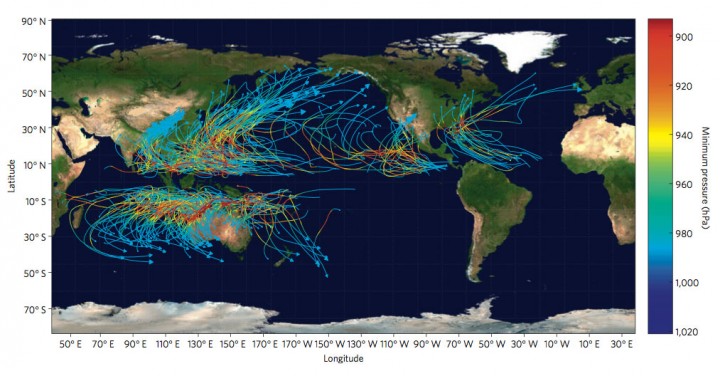
A new study looking at the economic costs of tropical cyclone damage taking into account climate change, forecasts that tropical cyclones will cause $109 billion in damages by 2100. Increased vulnerability of populations and growing economic wealth is expected to double the costs from $26 billion per year to $56 billion by 2100. Climate change is predicted to add some $53 Billion in damages. Two countries are responsible for incurring 75% of the extra damage from climate change associated with tropical cyclones: the United States and China. But tropical island nations will incurr the highest damage per GDP - up to 37%.

The study - The impact of climate change on global tropical cyclone damage - is by Robert Mendelsohn, Kerry Emanuel, Shun Chonabayashi & Laura Bakkensen from Yale and MIT and was published in Nature Climate Change on January 15, 2012.

Caption: Storm tracks and minimum pressure for a sample of synthetic storms. The tracks show that storms are more frequent in the western Pacific. The minimum pressure (hpa) or storm intensity is measured by their color. Storm intensity is higher over the warm waters near the Equator and lower over the cooler waters towards the poles.

Wednesday, June 22, 2011

Climate change blamed in extreme shift from drought to flood in China


An extreme shift in weather in June across much of southern and eastern China has been put down to the effects of global warming and climate change. Usually light rains start in June in the middle and lower Yangtze valley leading in to the summer monsoonal rains and typhoon season, but this year torrential rains and storms struck on June 3 and have continued unleashing devastating floods, the worst in over 50 years.

Chen Zhenghong, senior engineer at the Meteorological Bureau of Central China's Hubei province, said the sharp shift between drought and flood in East and Central China was a result of global warming, according to a Xinhua News Agency report in China Daily on 17 June.

Wednesday, October 20, 2010

Climate study: Australia falling behind in indirect carbon pricing


A report commissioned by the Climate Institute has analysed the indirect carbon price in the electricity generation sectors of six countries: Australia, UK, USA, China, Japan and South Korea, with Australia languishing at the bottom just ahead of South Korea.

"A direct and broad based price tag on pollution is required if Australia is to meet its targets at lowest short and long-term cost. However, it is also critical to ensure that our international competitiveness is not lost to other countries gaining early mover advantages in clean energy investment and reducing their economies' dependence on pollution," said Mr Erwin Jackson, Deputy CEO of the Climate Institute.

"Countries such as India are already taxing imports of pollution intensive products like coal. Putting a price tag on pollution is also insurance against possible trade measures aimed at highly polluting exports." said Mr Jackson.