The European Copernicus Agency early this week identified that Sunday, Monday and Tuesday set new global daily average temperature records. This Thursday UN Secretary General highlighted Extreme Heat with a call to action, including an end to new fossil fuel extraction. He highlighted a new International Labor Organisation report on extreme heat safety and health for workers.
22 July 2024 was confirmed as warmest day globally in recent history. July 23 and July 21 also broke the record set in July 2023.
Yet Australia is still approving new coal and gas projects, allowing offshore #Fossilfuel exploration exacerbating the #ClimateCrisis. We need a #ClimateTrigger in National Environment laws
Sunday Monday and Tuesday this week all exceeded Global Daily Average Temperature Record set in July 2023. Welcome to the Anthropocene.
We are just having a record warm winter in Tasmania, parts of Victoria and Sydney, slightly more pleasant temperatures, but in Chile and Argentina in South America at the moment it is hot...in winter...Australian climate heatwave expert A/Prof. Sarah Perkins-Kirkpatrick (@sarahinscience) described the South American heat event:
"what the actual F**K. this is totally insane. When I first saw this, I had trouble believing it myself. I'm shocked. Buenos Aires broke a record by over 5C - that's like Sydney experiencing a 30+C day at this time of year. This is bonkers. #climatechange" https://twitter.com/sarahinscience/status/1686931331350188035
Welcome to my third daily diary of an Australian heatwave event. This heat event is marked by persistent heat from the Pilbara and Central Australia from mid December 2018 that sends out waves of heat to impact the south east population centres of Adelaide in South Australia, Melbourne and inland Victoria, western NSW spreading to include Canberra and Sydney.
I followed this up with a second blog article documenting the heat event from January 14 - January 19: Take 2: Climate Diary of an Australian heatwave - January 2019
Heat Health alerts issued for Melbourne and Victoria
Over the weekend of 19-20 January the heat retreated to the Pilbara and Central Australia, but the heat event is far from dissipating. Heat Records continue to be broken.
Why am I documenting this? Because climate change is a primary driver of more extreme heat events. Read the Climate Council 2014 Report on Heatwaves: Hotter Longer, More often.
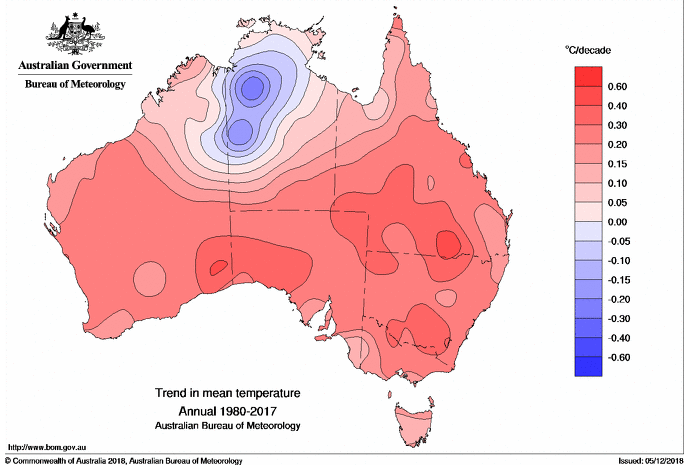
Australia's average temperature in 2018 was 1.14 °C above the 1961–1990 average, making it slightly warmer than 2017 said the Bureau of Meteorology in the 2018 Annual climate statement.
"When we look across all of Australia in 2018, we can see that every single state and territory had above-average day and night-time temperatures," Dr Bettio said.
"The average maximum temperature for the country as a whole was particularly warm, sitting 1.55 °C above the 1961–1990 average, making 2018 Australia's second warmest year on record for daily high temperatures.
"Average minimum temperatures for 2018 were 0.73 °C above average, the eleventh-warmest on record.
"The only part of the country to buck the trend for above average temperatures was the Kimberley region, which had cooler than average nights for the year."
On temperatures 2018 was Australia's third-warmest year on record; a year of protracted drought and persistent warmth.
Meanwhile, Australia still has no effective climate or energy policy, no consistent plan to phase out coal or gas fossil fuels, no plan to reduce transport emissions, a problem with increased vegetation clearing in Queensland and New South Wales. Australia's emissions are rising over the last 4 years and Environment department Data shows that Australia is unlikely to meet it's low 26 percent emissions reduction target by 2030.
The Is it hot right now? website provides a daily view on daily average temperatures for Australian capital cities, comparing the average temperature to it's history for that day, to see where it sits in the distribution of temperatures typical for the time of year.
The site was developed by climate researchers Mathew Lipson, Steefan Contractor and James Goldie. The data comes from the Bureau of Meteorology's ACORN-SAT.
Mat Lipson provided the Yearly average temperature charts and the 2018 heat maps for each city. The trend in rising temperatures is clearly visible in each. I have added details for each city of future projections done by CSIRO in 2015.
In the year heat maps for each city you can still see the fluctuations in temperature due to weather events, but the cold days (blue) are getting rarer, and the hot days (red) are getting more common, a telling sign of the long term climate temperature trend affecting all regions of Australia.
The Bureau of Meteorology in the lead up to christmas in 2018 showed a heatwave building through the week. The forecast was for severe and extreme heatwave impacts particularly Thursday 27 December to Saturday 29 December.
A blocking high in the Tasman and strong heat from the Pilbara in Western Australia and right through Central Australia, will periodically extend tendrils of sweltering heat to encompass the major population centres of Adelaide, Melbourne and Sydney.
While these cities may get occasional relief from weak cold fronts and coastal sea breezes, inland towns will swelter in the scorthing heat with temperatures in the mid to high 30s and low 40s.
I have been very concerned about rising temperatures and the urban heat island effect on the people in our cities, particularly Melbourne and the City of Moreland where I live. See Climate change and heatwaves in Melbourne - a Review. Moreland Council have been one of the more pro-active local governments in reducing emissions, ameliorating the urban heat island effect through an urban forest strategy, and in working towards adaptive changes by the population of Moreland in dealing with impacts of extreme heat. Liz Hanna puts this together in the dilemmas we will face in future years as temperatures continue to rise.
The reality of living with 50℃ temperatures in our major cities
Sydney is facing 50℃ summer days by 2040, new research says. Andy/Flickr/Wikimedia Commons, CC BY-SA
Australia is hot. But future extreme hot weather will be worse still, with new research predicting that Sydney and Melbourne are on course for 50℃ summer days by the 2040s if high greenhouse emissions continue. That means that places such as Perth, Adelaide and various regional towns could conceivably hit that mark even sooner.
This trend is worrying, but not particularly surprising given the fact that Australia is setting hot weather records at 12 times the pace of cold ones. But it does call for an urgent response.
Most of us are used to hot weather, but temperatures of 50℃ present unprecedented challenges to our health, work, transport habits, leisure and exercise.
Humans have an upper limit to heat tolerance, beyond which we suffer heat stress and even death. Death rates do climb on extremely cold days, but increase much more steeply on extremely hot ones. While cold weather can be tackled with warm clothes, avoiding heat stress requires access to fans or air conditioning, which is not always available.
The death rate in heat ramps up more rapidly than in cold. Data from Li et al., Sci. Rep. (2016); Baccini et al., Epidemiol. (2008); McMichael et al., Int. J. Epidemiol. (2008), Author provided
Even with air conditioning, simply staying indoors is not necessarily an option. People must venture outside to commute and shop. Many essential services have to be done in the open air, such as essential services and maintaining public infrastructure.
Roughly 80% of the energy produced during muscular activity is heat, which must be dissipated to the environment, largely through perspiration. This process is far less effective in hot and humid conditions, and as a result the body’s core temperature begins to climb.
We can cope with increased temperatures for short periods – up to about half an hour – particularly those people who are fit, well hydrated and used to hot conditions. But if body temperature breaches 40-42℃ for an extended time, heat stress and death are likely. In hot enough weather, even going for a walk can be deadly.
Air conditioning may not save lives
We expect air conditioning to take the strain, but may not realise just how much strain is involved. Shade temperatures of 50℃ mean that direct sunlight can raise the temperature to 60℃ or 70℃. Bringing that back to a comfortable 22℃ or even a warm 27℃ is not always possible and requires a lot of energy – putting serious strain on the electricity grid.
Electricity transmission systems are inherently vulnerable to extreme heat. This means they can potentially fail simply due to the weather, let alone the increased demand on the grid from power consumers.
Power cuts can cause chaos, including the disruption to traffic signals on roads that may already be made less safe as their surfaces soften in the heat. Interruptions to essential services such as power and transport hamper access to lifesaving health care.
Myopic planning
It’s a dangerous game to use past extremes as a benchmark when planning for the future. The new research shows that our climate future will be very different from the past.
Melbourne’s 2014 heatwave triggered a surge in demand for ambulances that greatly exceeded the number available. Many of those in distress waited hours for help, and the death toll was estimated at 203.
The health sector is concerned about Australia’s slow progress and is responding with the launch of a national strategy for climate, health and well-being. Reinstating climate and health research, health workforce training and health promotion are key recommendations.
There is much more to be done, and the prospect of major cities sweltering through 50℃ days escalates the urgency.
Two key messages arise from this. The first is that Australia urgently needs to adapt to the extra warming. Heat-wise communities (or “heat-safe communities” in some states) – where people understand the risks, protect themselves and look after each other – are vital to limit harm from heat exposure. The health sector must have the resources to respond to those who succumb. Research, training and health promotion are central.
Averaged across the state, Queensland had its 6th warmest January on record. Mean minimum temperatures were the second-warmest on record for January. (see above deciles average map for January)
But the City of Brisbane in the south east just experienced it's warmist January on record. Back to back heatwaves have brought persistent heat to south east Australia, and especially to southern Queensland and New South Wales. The town of Moree has had 36 consecutive days of temperatures over 35C, doubling the previous record of 17 days in 1982.
Is there a funding bias with the National Health and Medical Research Council (NHMRC) when it comes to climate change and health? and particularly extreme heat and population health?
Some climate and health researchers say there is a definite bias, over a number of years, against funding health and climate change related research projects. One result of this wide-spread perception, is that researchers self-censor their funding proposals to avoid mentioning climate change to stand a much better chance of grant approval.
The Climate Council released it's new report on climate change and heat health, on the impacts of extreme heat on public health. Nofibs reporter and climate activist John Englart was there at the Melbourne Royal Children's Hospital to document the occasion.
Key findings of the report include that:
1. Climate change is a serious health threat for many Australians.
2. As extreme heat events worsen, the risk of adverse human health impacts is increasing.
3. Heatwaves can put intense pressure on health services.
4. While the health sector has made significant steps in improving resilience to heatwave events, more needs to be done.
5. Reducing greenhouse gas emissions rapidly and deeply is the best way to protect Australians from worsening extreme heat events.
Follow the presentations on twitter in my Storify curation of the launch of the report by public health researcher Dr Elizabeth Hanna, Climate Councillor Professor Lesley Hughes, Australian epidemiologist and public health researcher Professor Fiona Stanley, and Dr Stephen Parnis, an emergency medical doctor and Vice President of the AMA.
At a press conference this afternoon people across Victoria were warned of the extreme bushfire threat, and equally, the health threat from extreme heat. Temperatures across the state are forecast to exceed 40 degrees C.
The Victorian Health Department, Vic Health, have issued a heat health alerts for north Central and North East regions with Central region, which includes Melbourne, on the threshold.
Total Fire bans have been issued for eight of the nine regions, with East Gippsland being the exception.
"One of the most important things about tomorrow is it is hot across most parts of Victoria. It will reach 40 degrees in most districts and it will be extremely hot all day with very strong winds." said Emergency Services Commissioner Craig Lapsley.
This article appeared originally at nofibs.com.au.
I have been travelling in England and Europe for 6 weeks now. It is supposed to be Autumn going into Winter, yet there is still plenty of warmth despite the shorter days. Other than a few days of rain, it has been remarkably fine: T-shirt and shorts weather, although a jacket is sometimes needed for chilly evenings.
Even in Switzerland I was wearing T-shirts and shorts, only pulling on a warm jacket for the journey to the top of Mount Titlis at over 3000 metres altitude in the European Alps.
I realize with my full bag I have probably brought far too many warm weather clothes expecting much cooler Autumn and Winter temperatures. Or maybe it is that bottle of Limoncello from Sorrento weighting my bag down.
Flying Foxes are dropping to earth and dying in their thousands from heat exhaustion. The extreme heat in Queensland from the 29 December to 5 January has taken a massive toll of flying fox colonies, warns a wildlife conservation organisation. It is estimated that perhaps hundreds of thousands of native flying foxes have died as a direct result of the record setting high temperatures in the heatwave event across Queensland and north western NSW.
A wildlife conservation organisation, the Bat Conservation and Rescue Queensland Ltd, said that "many colonies across South-East Queensland have been severely affected including those at Camira, Mt. Ommaney, Pan Pacific Gardens, Regents Park, Boonah, Bellmere, Pine Rivers and Palmwoods. Reports indicate all Western Suburbs colonies and inland, and colonies from Gympie down to Yamanto have been devastated."
We tend to think of our own comfort and safety in extreme weather events, but animals and plants can also suffer. Heat related stress is a major cause of increased human mortality during heatwaves. But these events also impact populations of many species such as flying foxes and birds. They can't seek shelter in air-conditioned lounge rooms or shopping centres (except maybe the odd few sparrows). Instead, they fall from their tree roosts suffering heat exhaustion and dehydration.
Australia's Bureau of Meteorology (BOM) confirmed on 3 January 2014 in the annual climate statement that 2013 was the hottest year on record for Australia. This was all the more concerning considering the neutral ENSO conditions. 2013 also ranks as the sixth-warmest year since global records commenced in 1880, according to the WMO.
The residents of Manhattan and New York are already feeling the effects of global warming after experiencing Hurricanes Irene and Superstorm Sandy. But more is in store with more frequent large storms, rising sea levels, and higher temperatures and heatwaves in summer. The latest scientific study identifies that rising temperatures and heatwaves are likely to substantially increase temperature related deaths in the city.
The study by public health and climate reserachers at Columbia University in New York projects that in the 2020s there will be a mean increase of about 20 percent in deaths due to heat, set against a mean decrease of about 12 percent in deaths due to cold, with a net result of a 5 or 6 percent increase in overall temperature-related deaths. Heat related mortality is expected to rise steeply in projections for the 2050s and 2080s, despite alternate emissions scenarios. The worst case scenario is projected to cause over 1,000 annual heat related deaths by rising temperatures and heatwaves.
Climate change will result in hotter and more humid environment for the tropics and mid latitudes resulting in increasing economic costs of reduced work capacity due to heat stress. The study by NOAA scientists said work capacity has already reduced by 10 percent during extreme heat in summer months. This is likely to double to 20 per cent by 2050.
One of the physical properties of warmer air is that it can hold more moisture. So in hot weather atmospheric humdity can be more extreme. But there are physiological limits of human health in coping with temperature extremes. In 2010 Scientists outlined health limits of heat stress with Climate Change. The scientific paper by Steven Sherwood from the University of NSW and Professor Matthew Huber from Purdue University - 'An Adaptability Limit to Climate Change Due to Heat Stress' outlined the health adaptation limits of the human body.
Humans and most mammals maintain a core body temperature around 37 °C that may vary slightly among individuals but does not adapt to the local climate. To allow transfer and regulation of metabolic heat human skin is strongly regulated at 35 °C or below, a couple of degrees colder than core body temperature. This allows the body to dissipate heat through the skin at wet-bulb temperatures below 35 °C.
In this latest study, the researchers looked at military and industrial guidelines already in place for those who work in hot and humid conditions outside, and set those guidelines against climate projections for how hot and humid it's likely to get over the next century, using Wet Bulb temperatures scale which take account of humidity and wind speed. Using a middle of the road modelling projection they estimated that reduced work capacity due to heat stress is likely to double to 20 per cent by 2050.
A Stanfoord University Professor of civil and environmental engineering has suggested that installing solar photo-voltaic panels on your house would be a better contribution to reducing global temperatures than the geo-engineering solution of painting vast numbers of urban roofs white to combat the urban heat island contribution to global warming. "There does not seem to be a benefit from investing in white roofs," said Professor Jacobson. "The most important thing is to reduce emissions of the pollutants that contribute to global warming."
Cities and urban areas release more heat to the atmosphere than rural areas - this is known as the Urban Heat Island effect. Climate skeptics have used this to argue that surface temperature data is contaminated by the location of data collection in urban areas. A new scientific study by Stanford University researchers has quantified the contribution of the heat islands on a global basis for the first time, showing that the contribution to global warming from urban heat islands is modest compared with what greenhouse gas emissions contribute.
New scientific research on the livable limits with regard to temperature mean over half the earth may be too hot for habitation in 300 years, if there is no appreciable reduction in greenhouse emissions from business as usual. The scientific research paper published published by the National Academy of Sciences (PNAS) in the US says that while central estimates of business-as-usual warming by 2100 are 3-4 °C, eventual warmings of 10 °C are quite feasible and even 20 °C is theoretically possible. Temperatures will continue to increase past 2100 unless strong mitigation action is taken now. Human health will suffer due to heat stress once the wet-bulb temperature reaches 35 °C for extended periods.
The research focuses on the limits of human health in coping with temperature extremes. It is often assumed that humans would be able to adapt to any possible warming so the researchers focused on what the limits of livable conditions and heat stress are. They calculated the highest tolerable "wet-bulb" temperature and found that this temperature could be exceeded for the first time in human history in future climate scenarios if greenhouse gas emissions continue unabated.
The research was conducted by Professor Steven Sherwood from the University of NSW and Professor Matthew Huber from Purdue University and published as 'An Adaptability Limit to Climate Change Due to Heat Stress' in the Proceedings of the National Academy of Sciences (PNAS).
Wet-bulb temperature is used as it includes temperature and atmospheric humidity and is equivalent to what is felt when wet skin is exposed to moving air. Humans and most mammals maintain a core body temperature around 37 °C that may vary slightly among individuals but does not adapt to the local climate. To allow transfer and regulation of metabolic heat human skin is strongly regulated at 35 °C or below, a couple of degrees colder than core body temperature. This allows the body to dissipate heat through the skin at wet-bulb temperatures below 35 °C.
"Any exceedence of 35 °C for extended periods should induce hyperthermia in humans and other mammals, as dissipation of metabolic heat becomes impossible. While this never happens now, it would begin to occur with global-mean warming of about 7 °C, calling the habitability of some regions into question. With 11-12 °C warming, such regions would spread to encompass the majority of the human population as currently distributed. Eventual warmings of 12 °C are possible from fossil fuel burning."
At wet-bulb temperatures above 35 °C heat stress and hyperthermia starts - the inability of the body to dissipate excess heat. Heat stroke may occurr which is an acute condition of hyperthermia that is caused by prolonged exposure to excessive heat and/or humidity. The heat-regulating mechanisms of the body eventually become overwhelmed and unable to effectively deal with the heat, causing the body temperature to climb uncontrollably. At wet bulb temperatures of 37-38 °C lethal conditions are reached, even for acclimated and fit individuals.
At the moment the highest instantaneous wet-bulb temperature anywhere on Earth is about 30 °C, with the most common range at 26-27 °C. While maximum temperature may reach 50 °C in tropical desert areas, these areas mostly have very low humidity, thus allowing perspiration to work in cooling the skin and thus core body temperature. Thus, peak potential heat stress is surprisingly similar across many regions on Earth.
"Although areas of the world regularly see temperatures above 100 degrees (F), really high wet-bulb temperatures are rare," Huber said. "This is because the hottest areas normally have low humidity, like the 'dry heat' referred to in Arizona. When it is dry, we are able to cool our bodies through perspiration and can remain fairly comfortable. The highest wet-bulb temperatures ever recorded were in places like Saudi Arabia near the coast where winds occasionally bring extremely hot, humid ocean air over hot land leading to unbearably stifling conditions, which fortunately are short-lived today."
Matthew Huber did the necessary climate modelling on supercomputers operated at Purdue University while Steven Sherwood completed the wet-bulb calculations. In comparing the peak wet-bulb temperatures to the global temperatures for various climate simulations they found that the peak wet-bulb temperature rises approximately 1 degree Centigrade for every degree Centigrade increase in tropical mean temperature.
The research paper says:
"The simplest prediction of global warming's effect on TwMax is to assume a uniform upward shift of the Tw distribution. A 4 °C increase in Tw would then subject over half the world's population annually to unprecedented values and cut the "safety buffer" that now exists between the highest maximum Tw and 35 °C to roughly a quarter. A shift of 5 °C would allow maximum Tw to exceed 35 °C in some locations, and a shift of 8.5 °C would bring the most-common value to 35 °C. It has been similarly pointed out that a few degrees of warming will produce unprecedented temperature and agricultural stresses in the tropics"
"These temperatures haven't been seen during the existence of hominids, but they did occur about 50 million years ago, and it is a legitimate possibility that the Earth could see such temperatures again," Huber said. "If we consider these worst-case scenarios early enough, perhaps we can do something to address the risk through mitigation or new technological advancements that will allow us to adapt."
In an accompanying comentary article in PNAS Professor Tony McMichael and Dr Keith Dear from the National Centre for Epidemiology and Population Health at ANU provided additional comments on the health risks and the research.
"Much of the climate change debate has been about whether the world will succeed in keeping global warming to the relatively safe level of only two degrees Celcius by 2100", Professor McMichael said. "But climate change will not stop in 2100, and under realistic scenarios out to 2300, we may be faced with temperature increases of 12 degrees or even more. If this happens, our current worries about sea level rise, occasional heatwaves and bushfires, biodiversity loss and agricultural difficulties will pale into insignificance beside a major threat - as much as half the currently inhabited globe may simply become too hot for people to live there."
Dr Dear warned the UN's Intergovernmental Panel on Climate Change (IPCC) have tended to strike a cautious tone in forecasting future temperature rise and associated impacts. "In presenting its warnings about the future, the IPCC is very careful to be conservative, using mild language and low estimates of impacts," Associate Professor Dear said. "This is appropriate for a scientific body, but world governments - including our own - should be honest with us about the full range of potential dangers posed by uncontrolled emissions and the extremes of climate change that would inevitably result."
Both Professor McMichael and Dr Dear warned that projected environmental impacts of climate change will ultimately impact on human health and wellbeing, posing a considerable threat to the survival of our species.
Can someone please tell our Prime Minister, Kevin Rudd, that tackling climate change and setting a carbon price are important health reforms for our species (let alone other species we share the earth with) that needs his urgent attention?
Image courtesy Purdue University - "A high-CO2 model run that produces a global-mean T 12 °C warmer; accounting for GCM bias, the maximum T(wet) distributions are roughly what would be expected with 10 °C of global-mean warming relative to the last decade."