Mastodon Climate Citizen --> Mastodon
Showing posts with label Brisbane. Show all posts

Tuesday, March 11, 2025

Prime Minister Albanese says global warming a factor in Tropical Cyclone Alfred and its extreme weather impacts

So on Friday while Category 2 Cyclone Alfred drifted near the Queensland coast, Prime Minister Anthony Albanese fronted up to a media conference in Canberra with questions on whether global warming is making disasters worse, whether the 2035 emissions reduction targets will be released prior to the election (which is a commitment under the UNFCCC and Paris Agreement, not Australian law) and on Peter Dutton choosing to attend an event in Sydney than help constituents in his Brisbane electorate of Dickson prepare for the extreme weather impacts of the cyclone event.

While the Tropical Cyclone stalled over Moreton Bay becoming a tropical Low, it still brought substantial wind damage, and intense rainfall to large parts of SE Queensland and the Northern Rivers of NSW causing extensive flood emergencies. At its peak, more than 450,000 households in SE Queensland and Northern NSW lost power from the grid. Premier Crisafulli described it as the "largest ever loss of power from a natural disaster in Queensland's history". On Sunday several sites around Brisbane set new daily rainfall records.

The Queensland and NSW Governments, along with the Federal Government had been quick to prepare and warn citizens, and set in place emergency services to respond the the extreme weather impacts.

The Climate Council and independent rapid attribution climate researchers identified that global warming is a factor for Tropical Cyclone Alfred as it approached Brisbane.

Wednesday, March 9, 2022

Update on Synthetic turf: risk and impacts associated with floods and bushfires

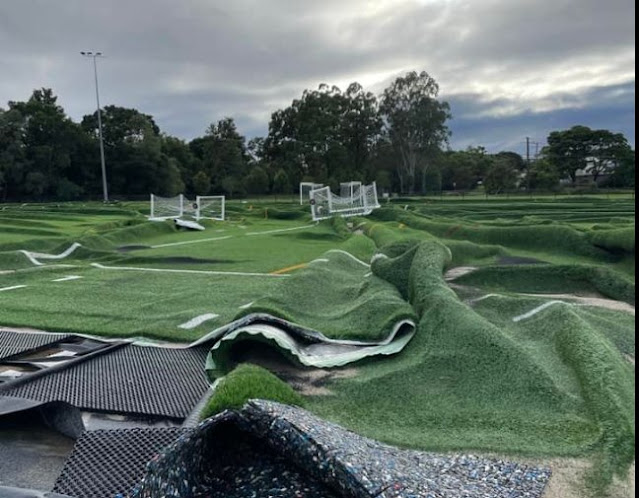
Mitchelton Football club synthetic turf field damaged by flooding of Kedron Brook (Brisbane)

The Queensland and NSW Flood disasters in February and March 2022 highlighted other risks and impacts that were not included in my Literature Review on Synthetic Turf (2021).

The Guardian reported on a football club in north-west Brisbane seeing its $1.5m synthetic playing field damaged and equipment washed away as flood waters inundated the sports fields beside the creek. (Favazzo 2022)

“In one word, it’s devastating,” said Mitchelton football club technical director Joe Fenech, described the damages. 

I don't think Mr Fenech was thinking of the microplastic pollution the synthetic turf caused due to the floodwaters. Much of the field's rubber infill and any loose plastic fibres would be washed away becoming microplastics pollution, adding to this pollution in the world's oceans.

One of the Football Club shipping containers containing sports equipment was washed down Kedron Brook an estimated seven kilometres from Mitchelton to The Grange, according to a Facebook report by the Club.

My literature review focussed on all the environmental problems, but it also focussed in particular on one proposed natural grass sports field conversion to synthetic turf at Hosken Reserve in North Coburg. It looked only at siting issues within that context. But siting of synthetic turf is a general problem to consider especially with regards to flood and bushfire events.

In terms of extreme weather events, both flooding and bushfire risk should be important determinants for contributing to triple bottom line assessments for Synthetic Field siting.

Friday, October 8, 2021

Australian Aviation CO2 emissions equivalent to 5 coal power stations


A new website uncovers the aviation emissions associated with 1300 airports globally, covering 99 per cent of passenger flights. Twenty four of those airports are located in Australia producing carbon emissions equivalent to five coal fired power stations.

The aviation sector would have been the sixth-largest emitter of CO₂ in 2018 if it were a country, responsible for 2.5 per cent of global emissions. Up until the pandemic aviation was growing 5 per cent annually since 2013. Despite the disruption caused by the pandemic, the sector remains off-track for limiting global heating to 1.5ÂșC.

Aviation emissions for the website is based on data from 1300 airports from 2013, 2018, 2019. The website was a joint project by the International Council on Clean Transportation (ICCT), International Think Tank ODI, and Transport and Environment (T&E).

This is the first global attempt to focus on the infrastructure that enables and induces air travel and leads to more CO₂ emissions in future decades.

Wednesday, January 9, 2019

Mapping the heat trend in Australia's capital cities for 2018 and future projections


The Is it hot right now? website provides a daily view on daily average temperatures for Australian capital cities, comparing the average temperature to it's history for that day, to see where it sits in the distribution of temperatures typical for the time of year.

The site was developed by climate researchers Mathew Lipson, Steefan Contractor and James Goldie. The data comes from the Bureau of Meteorology's ACORN-SAT.

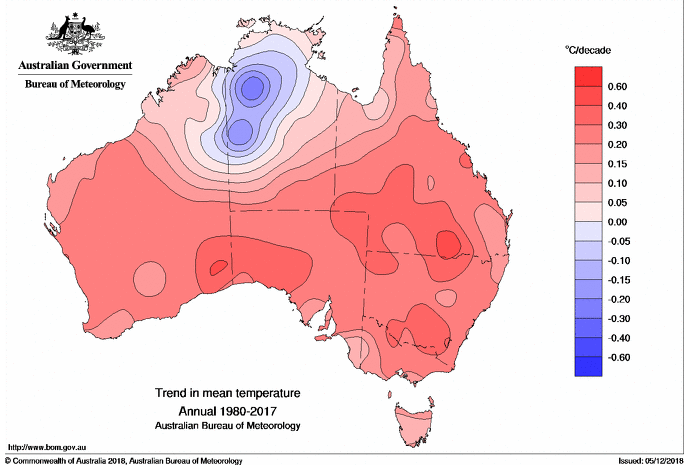
Mat Lipson provided the Yearly average temperature charts and the 2018 heat maps for each city. The trend in rising temperatures is clearly visible in each. I have added details for each city of future projections done by CSIRO in 2015.

In the year heat maps for each city you can still see the fluctuations in temperature due to weather events, but the cold days (blue) are getting rarer, and the hot days (red) are getting more common, a telling sign of the long term climate temperature trend affecting all regions of Australia.

Thursday, February 2, 2017

Brisbane and Sydney turn on record heat in January 2017 with record warm nights


Averaged across the state, Queensland had its 6th warmest January on record. Mean minimum temperatures were the second-warmest on record for January. (see above deciles average map for January)

But the City of Brisbane in the south east just experienced it's warmist January on record. Back to back heatwaves have brought persistent heat to south east Australia, and especially to southern Queensland and New South Wales. The town of Moree has had 36 consecutive days of temperatures over 35C, doubling the previous record of 17 days in 1982.

Thursday, November 6, 2014

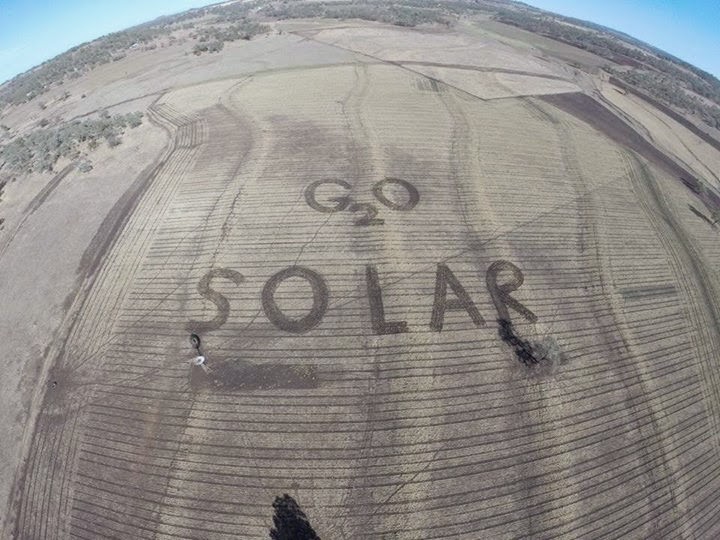
Farmer puts climate #onmyagenda at Brisbane #G20


A farmer at Felton on the Darling Downs has found a novel way to communicate to the G20 leaders expected in Brisbane: a ploughed sign in his field that says 'GO 2 Solar',

Rob McCreath said in a statement, "Australia is one of the richest per capita countries in the world, with the highest per capita greenhouse gas emissions in the developed world. We have huge reserves of sunshine, so making use of it is simply a matter of common sense. Our government’s reluctance to do so is an international embarrassment.

"Unlike coal, solar power really is good for humanity, because it can provide the clean energy needed to lift people out of poverty across the world, without stuffing up the climate even more."

He identified that 2013 was Australia's hottest year on record with 2014 shaping up to likely be the warmest year on record. "we’ve got a raging drought over a vast area. In spite of the overwhelming scientific evidence, our idiotic politicians are hooked on coal and gas, which is the cause of the problem." he said.

McCreath added "I hope Angela Merkel shirtfronts Tony Abbott and asks him, if Germany can go solar then why on earth can’t Australia?"

Tuesday, May 21, 2013

Global Warming to exacerbate Heat related deaths, more storms for New York


The residents of Manhattan and New York are already feeling the effects of global warming after experiencing Hurricanes Irene and Superstorm Sandy. But more is in store with more frequent large storms, rising sea levels, and higher temperatures and heatwaves in summer. The latest scientific study identifies that rising temperatures and heatwaves are likely to substantially increase temperature related deaths in the city.

The study by public health and climate reserachers at Columbia University in New York projects that in the 2020s there will be a mean increase of about 20 percent in deaths due to heat, set against a mean decrease of about 12 percent in deaths due to cold, with a net result of a 5 or 6 percent increase in overall temperature-related deaths. Heat related mortality is expected to rise steeply in projections for the 2050s and 2080s, despite alternate emissions scenarios. The worst case scenario is projected to cause over 1,000 annual heat related deaths by rising temperatures and heatwaves.

Sunday, June 5, 2011

Thousands rally to price carbon on World Environment Day


An estimated 10,000 people packed the lawns of the State Library on Swanston street Melbourne on World Environment Day to Say yes to a safe climate and support the introduction of a carbon price by the Gillard Federal Labor Government. About 8000 people also gathered in Sydney, 5000 people rallied in Adelaide's Victoria Square, 5000 in Brisbane, 3000 in Perth, 3000 in Hobart, and 2000 in Canberra. Organisors estimate up to 45000 may have attended rallies across Australia today to support climate action and pricing carbon.

Flickr photos: Melbourne | Adelaide | Canberra | Sydney

Sunday, April 10, 2011

Climate rally in Brisbane for a price on pollution

Share photos on twitter with TwitpicPeople gathered in King George Square in Brisbane's CBD on Saturday calling for a price on pollution and in support of the Gillard Government's proposed carbon tax. The protest was organised by Getup! and follows similar protests in Melbourne and Sydney. The rally featured face painting and music for children and was advertised as a family friendly event.

Photos: Skeptical Science - Brisbane Rally for Climate Action

Tuesday, January 11, 2011

Floods threaten Brisbane, one third of Queensland declared a disaster area


Over a third of the Australian state of Queensland has been declared a disaster area with the capital Brisbane on flood alert expected to experience it's worst flooding in living memory. Early report: Brisbane flood, from an island in suburbia. Total deaths from Queensland floods now number 27 - 10 from the regional floods in 2010 and 17 from the flooding in Toowoomba, Lockyer valley and Brisbane, with 14 people now listed as missing feared dead (revised down from 55).

This flood event follows widespread flooding across northern and central Queensland over the christmas holiday period that affected over 200,000 people, closing major highways and airports, closing most of the mines in the state, damaging crops, and causing billions of dollars worth of damage.

Friends of the Earth have warned about heavy metals released in flood waters and a Wiradjuri elder has warned of the risk of groundwater poisoning from gold mine at Lake Cowal if floodwaters breach the open cut mine owned by Canadian company Barrick Gold. The Great Barrier Reef is under threat from toxic pollution from floods according to the WWF.

The question that few people are publicly discussing is to what extent is climate change contributing to this disaster presently unfolding in Australia.

While Queensland is suffering disasterous floods, one of the world's largest insurers, Munich Re announced that the number of climate related disasters soared in 2010 killing as many as 295,000 people. "The high number of weather-related natural catastrophes and record temperatures both globally and in different regions of the world provide further indications of advancing climate change." said Munich Re in a press statement. Nine tenths of the disasters in 2010 were severe weather-related events.

Torrential rain drenched Toowoomba on Monday 10 January, a city located at 700 metres altitude high on the Great Dividing Range 125 kms west of Brisbane. Extreme flash flooding occurred in the suburbs and central business district. Reports of 150mm of rain falling in a 40 minute period quickly swamped stormwater drains and creeks and turned roads and suburban streets into raging rivers.

Flood photos | Youtube Video: Toowoomba Flood 2011.01.10 - cars swept away into East Creek near Chalk Drive.

Monday, December 28, 2009

Queensland Climate Change Minister spins Climate Destruction of Great Barrier Reef

Queensland Minister for Climate Change, Kate Jones speaking at the Climate Leaders Summit organised by the Climate Group In December Kate Jones, the Queensland Climate Change Minister, stated "Queenslanders are by per capita the highest emitters of carbon in the world." and said the Queensland Government was "committed to world action on climate change." Spoken at the Copenhagen climate talks on December 15, they illuminate the greenwashing, spin and hypocrisy that our politicians are engaging in.

"We as a State are already taking action. We are home to the world's largest reef, the Great Barrier Reef, and that is why we are committing here today to reduce runoff into the reef by 50% in four years." she stated to the crowd of climate bureaucrats and fellow politicians.

Bradley Smith from Friends of the Earth Brisbane said that "If the Queensland government were serious about protecting the Great Barrier reef, they wouldn't be expanding the coal industry. Without deep and urgent emissions reductions, reducing runoff to the Great Barrier Reef is like rearranging deck chairs on the Titanic."

Sunday, December 20, 2009

Brisbane: Coal 1, Planet 0 - time to take action on climate

Friends of the Earth Brisbane have taken action to highlight the climate failure in Copenhagen with banner drops in Shopping Malls and on bridges along the Brisbane River on Saturday 19 December, and imploring community members to take action.


Banners were hung from Victoria, Goodwill and Kurilpa Bridges, inside Queens Plaza shopping centre, in Indrooroopilly and in Ashgrove.

Friends of the Earth spokesperson Bradley Smith said "Politicians in Copenhagen have let us down and our let children down. This outcome is effectively a death sentence for our Pacific Island neighbours," said Mr Smith.

"This is not a proud moment for Australia. Our representatives were complicit in the failure of these talks. Back room deals, attempting to undermine previous agreements and the bullying of small and vulnerable nations were all appalling."

"Fortunately there is still hope and a lot that Queensland can do, for example by breaking our addiction to the coal industry. We now know that it will take very different political system to get meaningful international action on climate change," said Mr Smith.

View full report with photos and video at sixdegrees.org.au - Copenhagen Failure: Brisbane Demands Action