Mastodon Climate Citizen --> Mastodon
Showing posts with label bushfire. Show all posts

Saturday, August 19, 2023

Is Australia prepared for a wildfire emergency in 2023 summer?

Queensland Fire incidents map Sat 19 August 11am

Early Fire season started this weekend in SE Queensland. Warmer temperatures with climate change is driving earlier fire seasons, more intense fire weather.

This fire season in Queensland is one month earlier start than the 2019-2020 bushfire season.

Key Points:
🔥 BOM says conditions ripe for high fire danger
🔥 Meteorologists warn people must take precautions
🔥 Australia's worst recorded bushfire season of 2019-2020 sparked on Queensland's Granite Belt in Sep 2019, burnt for months.

According to the Buraeu of Meteorology fire danger for the following regions were rated high on Friday: Capricornia, Central Highlands and Coalfields, Darling Downs and Granite Belt, Wide Bay and Burnett, Southeast Coast. All other regions were rated as moderate fire danger.

Wednesday, November 30, 2022

After all the flooding rains we still face elevated bushfire risk for Summer 2022


You might think after the deluge of rain and flood events his year that fire risk would be low this summer.

You would be wrong.

All the rains and floods have contributed to vegetation growth adding to fuel load. When this fuel dries out with summer heat, it makes it susceptible to wildfire.

We are more likely to see grassfires this season than forest fires. But they can be equally deadly.

Wednesday, March 9, 2022

Update on Synthetic turf: risk and impacts associated with floods and bushfires

Mitchelton Football club synthetic turf field damaged by flooding of Kedron Brook (Brisbane)

The Queensland and NSW Flood disasters in February and March 2022 highlighted other risks and impacts that were not included in my Literature Review on Synthetic Turf (2021).

The Guardian reported on a football club in north-west Brisbane seeing its $1.5m synthetic playing field damaged and equipment washed away as flood waters inundated the sports fields beside the creek. (Favazzo 2022)

“In one word, it’s devastating,” said Mitchelton football club technical director Joe Fenech, described the damages. 

I don't think Mr Fenech was thinking of the microplastic pollution the synthetic turf caused due to the floodwaters. Much of the field's rubber infill and any loose plastic fibres would be washed away becoming microplastics pollution, adding to this pollution in the world's oceans.

One of the Football Club shipping containers containing sports equipment was washed down Kedron Brook an estimated seven kilometres from Mitchelton to The Grange, according to a Facebook report by the Club.

My literature review focussed on all the environmental problems, but it also focussed in particular on one proposed natural grass sports field conversion to synthetic turf at Hosken Reserve in North Coburg. It looked only at siting issues within that context. But siting of synthetic turf is a general problem to consider especially with regards to flood and bushfire events.

In terms of extreme weather events, both flooding and bushfire risk should be important determinants for contributing to triple bottom line assessments for Synthetic Field siting.

Tuesday, November 9, 2021

Survivors tell stories of Climate driven mega-fires at COP26 and call for urgent climate action

Wildfire survivors press conference

The fires are growing more intense, burning far greater areas than we have previously experienced. Climate change factors are pushing widfires to become mega-fires. Fires that are near impossible to effectively control. Forest systems that have rarely if ever, seen fire, are now burning.

Bushfires sirvivors from Australia, Canada, USA and Turkey held a press conference outside the Australian Pavilion at #COP26 on Monday, where they shared their stories of heartbreak and loss.

Those who lost everything in the 2019-2020 Black Summer bushfires in Australia, and then the fires that followed in California, Turkey and Canada, know exactly what’s at stake. 

The Climate Council pulled together these people to share their stories outside the Australian Pavillion.  All the participants called for world leaders and decision makers at COP26 to commit to strong emission reductions this decade.

Otherwise, we risk experiencing Black Summer, after Black Summer, after Black Summer.

Monday, September 27, 2021

Video: Life at 50C - The families forced to defend their homes from Australian bushfires (BBC)


This short BBC documentary investigates the climate change impacts of extreme heat and bushfires. It articulates climate change is here and now. It will get worse. But there are things we can do to change the direction of global warming.

Wednesday, January 8, 2020

Climate change and the Victorian bushfire crisis


The science and warnings for this Bushfire crisis were well known and ignored. This was criminal negligence by our political leaders of the highest order.

See my twitter thread on #bushfires to Darren Chester MP interview on BBC on 30/12 #climateemergency

Nationals @DarrenChesterMP (Gippsland) on BBC on #bushfire emergency "Whether they are worse in years to come is a debateable point I suppose. One of the challenges we have is trying to reduce fuel loads in the months leading up to the summer period"

I call bullshit #Auspol 1/10

Wednesday, December 18, 2019

Angus Taylor addresses international community at COP25 without mentioning bushfire climate crisis


On Tuesday 10 December Australian Energy Minister delivered Australia's national statement to the United Nations climate conference COP25 in Madrid. While bushfires raged in the state of New Soutrh Wales and across Australia, and even in Angus's own southern Tablands electorate of Hume, there was not a mention of the bushfirers in his address to the international community.

Lots of hype about meeting and beating climate targets, but the reality is the Morrison Government advocated strongly for using Kyoto Prorocol carryover credits to meet Australia's already too low Paris Agreement climate targets.

The advicacy for this met pushback. But it was one of the destabilising factors in the conference that provided distraction and prevented the conference reaching more ambiituos outcomes.

Wednesday, December 4, 2019

Australia receives first Fossil Award at COP25 for bushfire response by Prime Minister


Australia, Brazil and Japan all shared equally the first Fossil of the Day award of the United Nations Climate Conference COP25 in Madrid. A very moving statement was read out by one of the Australian Fridays For Future students in acceptance of the award for Australia.

With massive bushfires in late Spring comprising a 6,000 kilometre fire front, 1.65 million hectares burnt, the East Coast of Australia was on fire, with the smoke plume travelling over the Pacific, South America to the South Atlantic Ocean. An estimate of 1000 koalas killed along with other wildlife and their native habitats.

Clearly The Prime Minister Scott Morrison trivialising the bushfires, and not accepting the link between climate change driving early and more intense bushfires has struck a very raw nerve in the Australian public. We have a climate crisis and the Prime Minister is refusing to put the safety of the Australian public above ideology.

Friday, November 22, 2019

Bushfires and climate change: Australian Prime Minister denies the evidence


With highest per capita emissions, Australia needs to reduce emissions faster for reducing extreme event risk including Bushfires. Source: The Australia Institute


The Australian Prime Minister Scott Morrison says no evidence links Australia's carbon emissions to bushfires, yet he has been strongly contradicted on link between emissions and bushfires.

The scientific evidence is clear that Climate change is driving catastrophic mega fires.

Australia is not prepared - fire authorities and scientists have been warning governments for years and they haven't acted to reduce bushfire risk by implementing a strong climate and energy policy.

Governments have failed to properly equip and resource our firefighters to deal with a longer fire weather period, much hotter and more intense bushfires.

As part of it's duty of protection of public safety, the Federal Government should be honest with the community about their role.

Australian bushfires so intense smoke crosses the Pacific to South America


The extent of Australia's November Bushfires are massive, and the smoke cloud has gone global.

NASA have tracked the smoke cloud lofted 12-13 kilometres into the atmosphere from the hundreds of fires along the east coast of Australia. This smoke has drifted across the Pacific and South America, and even been detected over the southern Atlantic.

The fires are all the more concerning given this is in Spring season in November, long before the major bushfire season expected during January-February. This is very far from normal.

Saturday, November 9, 2019

East Coast of Australia literally on fire, #bushfires driven by global heating


The east coast of Australia is literally on fire, in early November, with bushfires spread up and down the east coast of Australia, particularly New South Wales. This is not normal for early November.

Fire conditions are exacerbated by the rising temperatures of global heating and change in rainfall patterns, and higher evaporation rates.

Professor David Bowman, a bushfire expert, commented "As a society we are running out of time to adapt to climate change driven bushfires, and policy failure will lead to escalating disasters that have the capacity to eclipse the worst disasters we have experienced."

Thursday, November 29, 2018

Queensland's Catastrophic bushfire, extreme heatwave and climate change


Queensland: Catastrophic fire conditions, a week long extreme heatwave with record breaking temperatures, mass bushfire evacuations at Gracemere near Rochhampton, State and Commonwealth disaster response plans triggered.

But no mention of climate change intensifying heat and bushfires.

Sunday, February 12, 2017

Heatwave makes Australia hottest place on planet with catastrophic bushfire conditions


Australia is currently the hottest place on the planet with the heatwave in SE Australia according to the Climate Reanalyzer site for Saturday 11 February. And last year (2016) was the hottest year on the planet in recorded history, following two previous years which also set the record.

As heat temperature records tumbled in south east Australia in the heatwave, catastrophic fireweather conditions were being experienced on Sunday over a wide region from Port Stephens in the Hunter Region, Tablelands and the Central West region of New South Wales. These conditions are categorized as a greater danger than the Victorian Black Saturday bushfires of 2009 which killed 173 people directly in the bushfires and 374 excess deaths due to the heatwave.

Update: Climate scientists calculate that Climate change doubled the likelihood of the New South Wales heatwave (Feb 16, 2017 The Conversation)

We have an energy crisis with load shedding ocurring in South Australia on Wednesday (that needn't have occurred), and load shedding in NSW on Friday and Saturday with the Tomago Aluminium plant being ordered to curtail production and energy use.

But what you will find largely absent in the media and comments by politicians on the heatwave is any reference to climate change which is an essential driving factor of more intense heatwave conditions and catastrophic fireweather.

The mining and burning of coal is a large contributor to greenhouse gas emissions and needs to be phased out in an orderly way to meet our international commitments on climate change. The only but would be if carbon capture and storage (CCS) was developed at scale and at reasonable cost, and I don't see enough research and investment to make this happen in a realistic timeframe.

So the Liberal Party are causing a clean coal controversy and blaming renewables, when AEMO and the energy market needs a thorough overhaul to re-prioritise production to meet consumer demand and social requirements rather than business profits. Just look at AEMO's governance bias for a start.

The Transition road may be rough at times, but we really do need to move to 100 per cent renewables. Prior changes such as the transition from horse and buggy transport to automobiles - about 13 years - at the start of the twentieth century, shows that transition happens relatively quickly. State renewables targets are realistic and already driving the energy transition we need.

Is it so hard to come up with a bipartisan national energy plan?

Sunday, January 10, 2016

Town of Yarloop destroyed in #Waroonafire #bushfire maelstrom


The Waroona bushfire South of Perth was started by lightning strike last Wednesday. It rapidly grew to be an uncontained uncontrollable fire of such size, ferocity and intensity that it produced pyrocumulus clouds creating it's own local convective weather.

Saturday, December 26, 2015

Intense Bushfire hits Surf Coast on Christmas Day forcing evacuations


We are already getting a taste of the future with climate change with record temperatures in December, extreme bushfire alerts, and intense bushfires like the Separation Creek and Wye River fire causing town evacuations on the Surf Coast near Melbourne.

On Christmas day BOM Tasmania reported in a tweet "A sweltering 36 degrees in #Hobart today - the hottest Christmas Day on record! Cool change early tomorrow". Temperatures in Adelaide reached 37 degrees, the hottest Christmas Day in 29 years, just short of the temperature of 37.3°C reached in 1986.

In Victoria along the Great Ocean Road there was a major bushfire out of control on Christmas Day along Separation Creek and Wye Valley causing the Great Ocean Road to be closed and town evacuations. Wye River, Allenvale, Kennett River, Grey River were all affected. Most of the houses destroyed were at Wye River and Separation Creek.

A cool change with rain moved through overnight. Initially houses in Lorne were thought to be in danger as the wind changed direction with the cool change, that might push the fire towards the town. Evacuation warnings were issued for the small coastal settlements and for Lorne.

Thursday, October 8, 2015

Storify: Australia setting new early Spring heat and bushfire records


The early spring heatwave has brought a taste of summer extreme heat and bushfires across the continent setting new early season temperature records with temperatures anomolies of 12 degrees C and more over much of southern Australia, particularly Victoria.

This comes as a powerful El Nino is taking place in the Pacific which acts to boost temperatures and drought conditions in Australia. And all this takes place in a hotter environment with Australia having warmed by 0.9 degrees from 1910.

In September the Climate Council warned that Australia faces increased bushfire risk, with bushfire seasons extending for longer due to the impact of climate change.

The Bureau of Meteorology have issued a statement on October 7 which advises that the Indian Ocean Dipole has turned positive which will reinforce the El Nino impact on Australia.

Wednesday, September 2, 2015

Longer bushfire seasons driven by climate change warns Climate Council


Original article published at nofibs.com.au.

The Climate Council has warned that Australia faces increased bushfire risk, with bushfire seasons extending for longer due to the impact of climate change.

The warning comes after the United States and Canada have suffered one of their worst wildfire seasons on record. More than 8 million acres was burnt this year with seven of the top years having occurred since 2000.

The extension and overlapping of fire seasons in the northern and southern hemisphere poses problems as fire fighting resources and people are often shared and moved to accommodate the greatest risk.

But with seasons extending resources will be retained to fight fires locally. Australia has sent dozens of experienced firefighters to help combat more than 70 fires in the United States, but Australia's fire season is now starting earlier in October and extending later into March.

Wednesday, February 25, 2015

Impact of climate change science on Regional Forest Agreement stumps bureacrat


This article was originally published at Nofibs.com.au

At Senate estimate hearings on Monday Senator Janet Rice, the Greens spokesperson for forests, asked a number of probing questions on Regional Forest Agreements. One question in particular asked about how climate change science was included in the review of these agreements. The bureaucrats looked like stunned mullets, until one volunteered that the question would have to be taken on notice.

Really? They haven't considered some sort of cost benefit analysis of carbon sequestration? Not even as an opportunity to bid under the Emmissions Reduction Fund for the carbon sequestration potential involved in protection of old growth forests?

Senator RICE: I have one more question on climate, particularly on how climate science has progressed significantly in the years since the first RFAs were struck and climate has not been considered in the reviews so far. I want to know how it is intended that the impacts of climate change and the value of forests for carbon sequestration are going to be taken into account in the review and progress reports to come.

Mr McNamara: We will have to take the question on notice.

Friday, January 9, 2015

Climate Change not on Abbott’s South Australian #bushfire agenda but should be


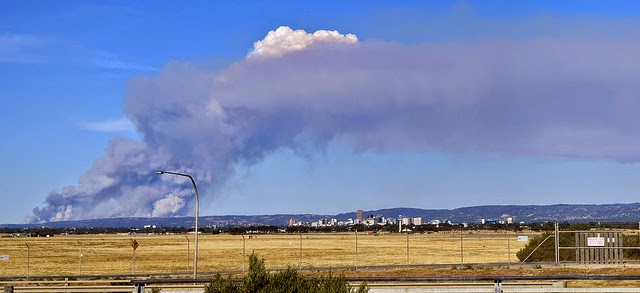
Photo: Adelaide bushfires, as seen from the airport. Copyright: eosdude/Flickr (CC BY-ND 2.0)

This article originally appeared at Nofibs.com.au

Prime Minister Tony Abbott has visited the bushfire stricken communities in the Adelaide Hills outlining disaster recovery and short-term income assistance payments to bushfire victims, but refusing to be drawn on whether climate change has influenced bushfires. I investigate some of the recent science into the links between bushfire and climate Change for South Australia and the climate of denial being put forward by the Abbott government.

You can read a report of Abbott's visit to the fire ravaged area by Shalailah Medhora at the Guardian: Adelaide bushfires: PM announces cash payments for people left homeless.

The Adelaide Hills Sampson Flat bushfire has burnt more than 12,000 hectares, with up to 38 houses and numerous sheds, livestock, including destroying the Tea Tree Gully Kennels and Cattery with the loss of life of many family pets.

Friday, June 13, 2014

Indian Ocean Dipole set to triple frequency of floods, bushfires and droughts


Climate change and extreme weather is likely to hit the Indian Ocean rim countries much harder over the coming century. That is the conclusion of a new study lead by CSIRO climate scientist Wenju Cai.

The research lead by Wenju Cai from CSIRO's Marine and Atmosphere Division outlines that an increase in greenhouse gases and climate change is likely to cause more extreme positive Indian Ocean Dipole (IOD) events to occur and that this will likely triple the frequency of bushfires, floods and drought in Australia, Africa and India from one event every 17 years to one every 6 years.

The interaction between ENSO and IOD still needs much more research and study to understand. IOD events are often triggered by El Nino, but can also sometimes occur during La Nina years as well.

Dr Wenju Cai told the ABC:

"Most of our severe bushfires were preconditioned by the Indian Ocean Dipole... When a summer season is preceded by an [extreme positive] Indian Ocean Dipole our bushfires tend to be much more severe.

"Now this is in Australia, but it has global impact. [For example] in Indonesia, a positive Indian Ocean Dipole tends to cause drought. You may recall in 1997 we had a wild bushfire in Indonesia... emitting a lot of pollutants and smoke that caused health problems to many millions of people in the region and also cost lost economic activity because people couldn't go out because of the visibility problem.

"In the meantime, in eastern African countries, they experienced devastating floods, causing thousands to die... and displacement of many hundreds of thousands."