Mastodon Climate Citizen --> Mastodon
Showing posts with label queensland. Show all posts

Saturday, December 16, 2023

Queensland sets 2035 emissions reduction target of 75% below 2005

The new Premier of Queensland Steven Miles has announced for Queensland  a new emissions reduction target of 75% below 2005 levels by 2035. This will be a legislated target.

Queensland already has a commitment to deliver 50% renewable energy by 2030, 70% by 2032, and 80% by 2035.  

The Premier Steven Miles said, “By legislating this target, we will create certainty for industry and bridge the gap between the city and the bush. This announcement is only possible because of the landmark Queensland Energy and Jobs plan, which will see 80 per cent of our energy generated by renewables in 2035."

Update: A first crunch point will come on 22 December when Queensland Labor's Environment Minister Leanne Linard may sign off on Whitehaven’s Winchester South coal mine. The Winchester South coal project is one of over 100 new coal and gas projects in the pipeline in Australia - fuelling catastrophic climate change and leading to more heatwaves, floods and fires.

Friday, November 10, 2023

Queensland announces cash grants for new gas exploration, new coal mine extension, to ramp up ocean warming destruction of Great Barrier Reef

Cash grants for gas exploration in Queensland announced by the Queensland Labor Government, Treasurer and Minister for Trade and Investment Cameron Dick, and Minister for Resources Scott Stewart.

"$21 million in funding is available through the Frontier Gas grants program for companies looking to explore and unlock new reserves in the Bowen and Galilee basins and bring Queensland gas to market sooner." said the media statement.

At the same time the Queensland Government granted a mining lease for Anglo American to expand its Lake Lindsay coal mine operation near Middlemount in the Bowen Basin. It will extend the life of the mine producing 5.6 million tonnes of coal and affects 500 jobs. But the loss of tens of thousands of Tourism and hospitality jobs oon the Great Barrier Reef? They are going.

New fossil fuel projects are at odds with climate science for meeting the Paris Climate Temperature Targets. The Queensland Government incentivising fossil fuel exploration and granting extended mining leases is adding to global warming that is cooking the planet, and warming oceans destroying the Great Barrier Reef. It is destroying long term jobs and biodiverrsity.

Monday, October 2, 2023

Submission on BHP Caval Ridge Mine Horse Pit Coal Extension in the Bowen Basin: an additional lifetime 440 megatonnes of CO2

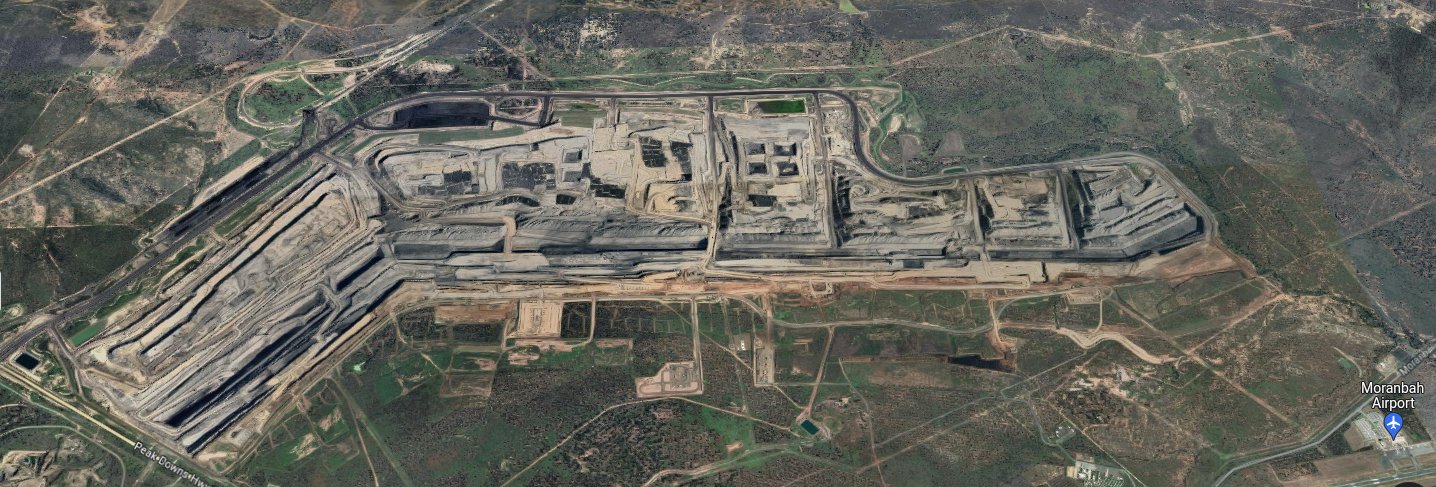
Aerial view: existing Caval Ridge mine in the Bowen Basin, Queensland


Submissions for this coal mine extension closed 29 September 2023. The Labor Federal government has already approved 10 new coal or gas projects since coming to power in May 2022. The BHP Caval Ridge Mine Horse Pit Coal Extension is in the approval queue with about 100 other coal and gas projects. 

The Labor Government has promised a refresh of Australia's environmental laws in the Environment Protection and Biodiversity Conservation Act (EPBC), but those reforms continue  to be deferred. During the Howard government in 2005 Anthony Albanese proposed a Climate Trigger be inserted in the EPBC Act. It failed of course. Labor did not revisit a Climate Trigger amnedment in 2007-2013 when in power with the Rudd and Gillard governments, and has not raised it as a priority in the current term of the Albanese Government.

BHP Mitsubishi Alliance’s proposes to extend the Caval Ridge Coal Mine and operate it for more than three decades, to 2056. The mine is located  approximately 5 km south west of Moranbah in the Bowen Basin, Queensland. It is an open cut mining operation that supplies hard coking coal product for the export market.

The Proposed Project will extend one of the two pits and will involve extraction and combustion of approximately 15 million tonnes per annum (Mtpa) of coal.

The proposal aims to commence in 2025 and extend to 2055. The mining schedule indicates extraction of approximately 158.3 million tonnes of coal over the life of the Proposed Project. The total combustion CO2 emissions for the product coal of the Proposed Project is estimated to be 440.64 million tonnes of CO2 added to the atmosphere that will exacerbate global warming.

My submission was one of 147 submissions co-ordinated by the Mackay Conservation Group.

Minister Plibersek and her department are now reviewing public comments about this proposal, alongside the large volume of scientific evidence that  Environment Council of Central Queensland Inc (ECoCeQ)  submitted with its reconsideration request


Saturday, August 19, 2023

Is Australia prepared for a wildfire emergency in 2023 summer?

Queensland Fire incidents map Sat 19 August 11am

Early Fire season started this weekend in SE Queensland. Warmer temperatures with climate change is driving earlier fire seasons, more intense fire weather.

This fire season in Queensland is one month earlier start than the 2019-2020 bushfire season.

Key Points:
🔥 BOM says conditions ripe for high fire danger
🔥 Meteorologists warn people must take precautions
🔥 Australia's worst recorded bushfire season of 2019-2020 sparked on Queensland's Granite Belt in Sep 2019, burnt for months.

According to the Buraeu of Meteorology fire danger for the following regions were rated high on Friday: Capricornia, Central Highlands and Coalfields, Darling Downs and Granite Belt, Wide Bay and Burnett, Southeast Coast. All other regions were rated as moderate fire danger.

Wednesday, September 28, 2022

Queensland sets new renewables targets: 70% by 2032, 80% by 2035, coal reliance phaseout by 2035


“We are facing a climate emergency,” Premier Anastacia Palaszczuk said in her State of the State address at a CEDA function. She noted that Queensland is facing dramatic problems from rising sea levels in Torres Strait, record “rain bombs”, bushfires, and a total of 98 natural disasters in the last decade. “Climate change is real …. but we need to do more than talk about it. We need to act, and act in a revolutionary way,” she said.

The Premier launched a $60 billion Queensland Energy and Jobs Plan which will transform Queensland from a coal dependant state for energy to one powered by solar and wind renewables with pumped hydro energy storage, as well as grid batteries, and an upgrade to the transmission grid.

The plan encompasses:

  • At least 25 GW new and existing renewable energy
  • Gladstone grid reinforcement to support heavy industry to switch to renewable energy and decarbonise their operations
  • All publicly owned coal-fired power stations operating as clean energy hubs by 2035, supported by a legislated Job Security Guarantee for energy workers
  • Two new world-class pumped hydro projects that together could deliver up to 7 GW of long duration storage
  • Around 1500km of new high voltage backbone transmission to move more power around the state
  • Up to 3 GW of low to zero emissions gas generation for periods of peak demand and backup security
  • A smarter grid to support over 11 GW of rooftop solar and around 6 GW of batteries in homes and businesses

It should be noted Queensland is a major exporter of both thermal and metallurgical coal and this plan does not cover this coal production for the export market.

Wednesday, March 9, 2022

Update on Synthetic turf: risk and impacts associated with floods and bushfires

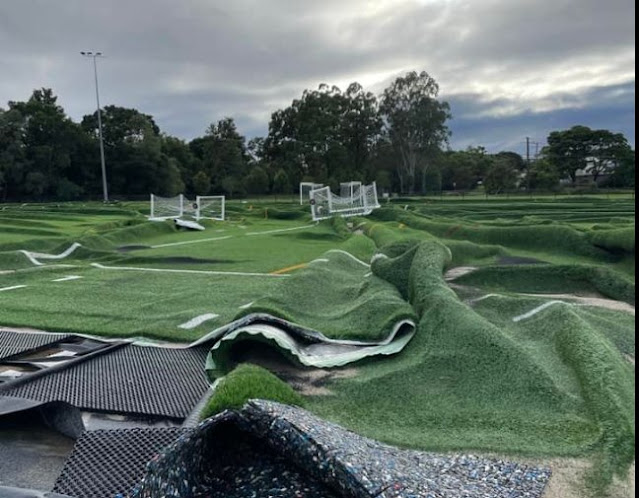
Mitchelton Football club synthetic turf field damaged by flooding of Kedron Brook (Brisbane)

The Queensland and NSW Flood disasters in February and March 2022 highlighted other risks and impacts that were not included in my Literature Review on Synthetic Turf (2021).

The Guardian reported on a football club in north-west Brisbane seeing its $1.5m synthetic playing field damaged and equipment washed away as flood waters inundated the sports fields beside the creek. (Favazzo 2022)

“In one word, it’s devastating,” said Mitchelton football club technical director Joe Fenech, described the damages. 

I don't think Mr Fenech was thinking of the microplastic pollution the synthetic turf caused due to the floodwaters. Much of the field's rubber infill and any loose plastic fibres would be washed away becoming microplastics pollution, adding to this pollution in the world's oceans.

One of the Football Club shipping containers containing sports equipment was washed down Kedron Brook an estimated seven kilometres from Mitchelton to The Grange, according to a Facebook report by the Club.

My literature review focussed on all the environmental problems, but it also focussed in particular on one proposed natural grass sports field conversion to synthetic turf at Hosken Reserve in North Coburg. It looked only at siting issues within that context. But siting of synthetic turf is a general problem to consider especially with regards to flood and bushfire events.

In terms of extreme weather events, both flooding and bushfire risk should be important determinants for contributing to triple bottom line assessments for Synthetic Field siting.

Friday, October 15, 2021

Carmichael coal mine threatens irreversible damage to Doongmabulla Springs and local ecology says new study

Doongmabulla Springs threatened by Carmichael mine

New hydrology research from Flinders and Darwin Universities highlights the Bravus (formerly Adani) Carmichael Coal mine being develeped in the Galilee Basin of Central Queensland may permanently damage the Doongmabulla Springs and the acquifer water it depends upon, and with it local ecosystems.

The natural springs are environmentally significant and are also of great spiritual and cultural significance to the Wangan and Jagalingou Indigenous nation.

Groundwater scientists warn more research is needed to measure and fully understand the aquifer sources that feed the springs.

“Even if the springs’ source aquifer is partially dewatered for mining operations, there is a serious threat of permanent damage,” says Flinders University PhD candidate Mr Robin Keegan-Treloar, the lead author of a new paper in the international Journal of Hydrology.

Thursday, January 3, 2019

North Queensland Extreme Heatwave impacts koala population

I was scanning for news articles on heatwave impacts and came across this article on Koalas by ABC Capricornia.

It's a well written, but quite an alarming story By Alice Roberts and Jacquie Mackay: Koalas in trouble after Queensland's bushfires and heatwave, expert warns.

According to one CQUniversity academic, extreme heatwave and bushfire conditions could have major long-term impacts on animal numbers in Queensland. Alistair Melzer, a CQUniversity koala researcher, told the ABC that it could be years before the full impact is known.

And we have the iconic image of Chantelle Lowrie in Victoria giving a koala a drink from her water bottle in the 44C late December heat. (See my December 30 entry of Climate Diary of a heatwave)

Thursday, November 29, 2018

Queensland's Catastrophic bushfire, extreme heatwave and climate change


Queensland: Catastrophic fire conditions, a week long extreme heatwave with record breaking temperatures, mass bushfire evacuations at Gracemere near Rochhampton, State and Commonwealth disaster response plans triggered.

But no mention of climate change intensifying heat and bushfires.

Saturday, July 29, 2017

Large and vocal protest to Stop Adani outside Queensland Labor conference in Townsville


Photo by StopAdani

Queensland Premier Annastacia Palaszczuk and Federal Opposition Leader Bill Shorten talk about addressing inequality inside the Queensland State Conference of the Labor Party in Townsville. Yet one of the greatest drivers of inequality is climate change driven by fossil fuels and coal mining.

Outside the state convention about 200 people turned up on Saturday morning to press the point that developing more fossil fuels, especially the Adani Carmichael coal mine, will further drive climate change. Climate change is a driver of political destabilisation, food insecurity, and inequality at a global level.

Queensland's commitment to 50 percent renewables by 2030 and zero emissions by 2050 mean little if coal and gas is continued to be exploited and exported overseas. Politicians often say that if we don't export it , then some other country will. But this is an immoral defence, with this justification known as the Drug Pusher's defence. That's what Premier Palaszczuk is arguing: an immoral case that if Queensland doesn't drive climate change by exporting coal, then some other nation will do so.

But even the Drug Pusher's defence for developing the Adani mine falls flat when you take into account there is a global energy transition occurring, and the global coal market is in structural decline. Developing any new coal mine risks becoming a stranded asset, failing at plain economics.

Wednesday, May 3, 2017

Reports Adani's Abbot Point coal terminal exceeded pollution limits 8 fold


Remember that story on Adani's Abbot Point export coal terminal contaminating the Caley Valley wetlands next door? And the ruckus of denial from Adani, Deputy PM Barnaby Joyce and Queensland Resources Council CEO Ian MacFarlane?


The latest update is a news report on the ABC that reveals that at one monitoring point the contaminated liquids and sediment from Abbot Point were at 8 times the legal limit.

Adani had applied and was issued an authority to release contaminated water, but with a limit of total suspended solids up to 100 milligrams per litre. The report provided by Adani Abbot Point Bulkcoal on the water release advised that the water discharged on 30 March from a licensed point on the northern side of the terminal contained 806mg/L of sediment.

Sunday, April 30, 2017

Mark Butler endorses Westpac's policy assessment that excludes Adani Project while ALP policy remains mute on export coal


Shadow minister for Energy and Climate Mark Butler was on ABC Insiders program on Sunday and was critical of the Government criticising Westpac over a business policy decision, when the Government has refused to implement a Banking Royal Commission to look at financial practices that hurt lots of ordinary Australians and small businesses.

It was a very competent interview and attack on the Government, while adroitly not answering the question of opposing the mine if Adani does manage to get the financial investment required sorted. (19 international banks have now ruled out financing the mine)

All Butler's points were valid and important facts: that the demand for thermal coal imports from Australia is in decline, that the Adani project would hurt coal jobs in both Queensland and New South Wales, and that the economics of the mine simply don't stack up.

Then there is the climate risk which Butler did not emphasise but is at the heart of Westpac Bank's business climate policy and future investments in coal.

I don't fully agree with Westpac's policy, but it is a nuanced approach to supporting only new investment in metallurgical coal or high quality Newcastle benchmark thermal coal from existing basins. The Adani coal from the Carmichael mine fails the energy benchmark, and has a high ash content. It is a low to medium quality thermal coal.

I read the ALP's climate policy it took to the last election in 2016. It was a positive policy overall, but one of it's huge failings was the silence on coal and fossil fuel export, particularly the low grade Adani coal in the Galilee Basin, unconventional gas, and offshore oil exploration in the Great Australian Bight.

The ALP are happy to play both sides of the coal equation and leave the outcome as a commercial decision as they think this resolves them from responsibility of good policy.

It may be good politics, but it is bad policy when the science says we need to keep 95 percent of Australia's coal unexploited.

The fact is Westpac's climate business policy (PDF) on export coal is now more aligned to the Paris Agreement climate targets, and superior to both the Government and opposition parties policies on export coal.

That is a sad state of affairs. Here are the interview snippets from Insiders between Barry Cassidy and Mark Butler.




Saturday, April 29, 2017

Resources minister Matt Canavan's Jobs, jobs, jobs Adani coal mantra is bullshit


Jobs, jobs, and more jobs, that's the mantra by both the Liberal National Coalition Federal Government and the Queensland State Labor Government, and bugger the reef and the rising temperatures of climate change.

On Friday Westpac Bank released their climate change Position statement and 2020 action Plan. This effectively rules out any funding of Adani for the Carmichael coal project.

Matt Canavan, and Deputy PM Barnaby Joyce on Lateline, continue this mantra, to peddle the myth that 10,000 or more jobs will be generated, when in court Adani admitted only 1464 jobs would be created. In fact, Adani hope to fully automate much of the mining and transport, so jobs could be even less than stated in court.

If the Adani Carmichael coal mine proceeds, it is also likely to hurt existing coal jobs in Queensland and New South Wales.

Friday, April 28, 2017

New Westpac climate policy rules out financing Adani Carmichael coal mine


Westpac have released their climate change Position statement and 2020 action Plan. This effectively rules out any funding of Adani for the Carmichael coal project.

Westpac becomes the 4th and last of the big 4 Australian banks to rule out financing the Adani project, and makes it the 19th bank globally to have either ruled out funding Galilee Basin coal export projects directly, or through the introduction of a new policy.

Westpac came under intense pressure from community organisations to rule out funding for Adani, with numerous protests outside bank branches, questions at AGMs, and a campaign urging customers to divest. Without this community social pressure Westpac's climate change position may have been much less rigorous.

Thursday, April 27, 2017

Stop Adani climate protest occupies Downer EDI office: Don't get into bed with Adani


About 20 Activists this morning occupied the Melbourne offices of Downer, an infrastructure company, to protest participation in developing the Adani Carmichael coal mine in the Galilee Basin of Queensland, widely seen as a climate carbon bomb with no social license.

The Adani Carmichael coal mine is a climate carbon bomb that would push temperatures well past the 2 degrees C limit that countries set in Paris UN climate Conference in 2015 at COP21. Research shows that Australia needs to leave 95 percent of it's coal in the ground unexploited and unburnt to stand a reasonable chance of not exceeding the 2C target.

In January 2015 it was announced that Downer EDI had won a $2 billion contract for works at Adani’s Carmichael coal mine in Queensland’s Galilee Basin, according to Australian Mining.

Thursday, April 13, 2017

Adani's Abbot Point coal contamination of Caley Valley wetlands and marine environment


Article First published at nofibs.com.au

Adani's coal export terminal at Abbot Point was in the direct path of Category 4 Cyclone Debbie. There was reason to expect a large storm surge, but this did not occurr, but the destructive winds and torrential rain caused Adani to release a large amount of contaminated water into the adjacent wetlands and ocean.

On Sunday April 9 the Mackay Conservation Group published on their facebook page a before and after photo of the Abbot Point export coal terminal owned by Adani, and part of the Caley Valley wetlands adjacent to it.

Thursday, March 30, 2017

Greens dare criticize coal and climate policies during #CycloneDebbie


Original article published at nofibs.com.au

Those uppity Greens are daring to speak about climate change while severe Tropical Cyclone Debbie beat the shit out of the Whitsunday Islands (Read this report of Hamilton Island), Proserpine and Bowen, and now threatens extensive flooding from torrential rainfall for central and SE coastal Queensland.

The accusatory tone from Malcolm Turnbull and other Liberal government ministers is 'How dare you try to politicise an extreme weather event, when we should all be pulling together.', while they conveniently forget the South Australian storms in September 2016 which resulted in a system black which they conveniently and erroneously immediately blamed on the fault of the wind turbines in South Australia.

They have continued to prosecute an attack on wind energy and South Australia, despite a BOM report blaming the primary cause as the cyclonic storm with 260km per hour wind gusts. AEMO also put the primary cause as the destructive winds destroying transmission towers, but also identified in the final report that automatic wind generator protection settings (since updated) contributed to the System Black event.

No pulling together for South Australia, Queensland, or in fact all of Australia, in it's time of need to resolve the lack of coherence in energy and climate policies.

Is there the taint of hypocrisy here? You bet.

Sunday, March 26, 2017

Coral, climate change, storm surges and #CycloneDebbie


Article originally published at nofibs.com.au

Tropical Cyclone Debbie is forecast to cross Central Queensland coast on Tuesday morning as a Category 4 Severe tropical cyclone. It will bring destructive winds greater than 200km per hour plus a storm surge with a king tide innundating low lying coastal properties, and torrential rain causing flooding. It is also cooling sections of the Great Barrier Reef reducing coral bleaching from an extensive and long lasting marine heatwave.

Update: 25,000 people in Mackay ordered to evacuate due to storm surge threat.
Update: Coal mines and coal ports affected.

Tropical Cyclone Debbie draws heat from the unusually warm waters of the Coral Sea. This will help it increase in intensity to achieve possibly Category 4, and an outside chance as a Category 5 severe tropical cyclone before it strikes land.

It is the first tropical cyclone to strike the north Queensland coast since Cyclone Nathan in March 2015. Although it may not be as strong, it is being compared in size and extent to the Category 5 cyclone Yasi from 2011.

Sunday, February 12, 2017

Heatwave makes Australia hottest place on planet with catastrophic bushfire conditions


Australia is currently the hottest place on the planet with the heatwave in SE Australia according to the Climate Reanalyzer site for Saturday 11 February. And last year (2016) was the hottest year on the planet in recorded history, following two previous years which also set the record.

As heat temperature records tumbled in south east Australia in the heatwave, catastrophic fireweather conditions were being experienced on Sunday over a wide region from Port Stephens in the Hunter Region, Tablelands and the Central West region of New South Wales. These conditions are categorized as a greater danger than the Victorian Black Saturday bushfires of 2009 which killed 173 people directly in the bushfires and 374 excess deaths due to the heatwave.

Update: Climate scientists calculate that Climate change doubled the likelihood of the New South Wales heatwave (Feb 16, 2017 The Conversation)

We have an energy crisis with load shedding ocurring in South Australia on Wednesday (that needn't have occurred), and load shedding in NSW on Friday and Saturday with the Tomago Aluminium plant being ordered to curtail production and energy use.

But what you will find largely absent in the media and comments by politicians on the heatwave is any reference to climate change which is an essential driving factor of more intense heatwave conditions and catastrophic fireweather.

The mining and burning of coal is a large contributor to greenhouse gas emissions and needs to be phased out in an orderly way to meet our international commitments on climate change. The only but would be if carbon capture and storage (CCS) was developed at scale and at reasonable cost, and I don't see enough research and investment to make this happen in a realistic timeframe.

So the Liberal Party are causing a clean coal controversy and blaming renewables, when AEMO and the energy market needs a thorough overhaul to re-prioritise production to meet consumer demand and social requirements rather than business profits. Just look at AEMO's governance bias for a start.

The Transition road may be rough at times, but we really do need to move to 100 per cent renewables. Prior changes such as the transition from horse and buggy transport to automobiles - about 13 years - at the start of the twentieth century, shows that transition happens relatively quickly. State renewables targets are realistic and already driving the energy transition we need.

Is it so hard to come up with a bipartisan national energy plan?

Friday, February 10, 2017

"Heatwave is nothing short of horrifying" says climate scientist


First published at nofibs.com.au

"This developing heatwave is nothing short of horrifying" said climate scientist Sarah Perkin-Kirkpatrick.

"Much of eastern Australia has seen heatwave after heatwave this summer, with some seasonal records already broken by the start of February. Night-time temperatures have been too hot for adequate sleep and daytime temperatures have been searing."

Sarah Perkin-Kirkpatrick is a climate scientist who has specialised in studying the causes and dynamics of heatwaves. She is an Australian Research Council DECRA fellow at the Climate Change Research Centre, University of NSW. At the annual Australian Meteorological and Oceanographic Organisation conference meeting in Canberra this week she was awarded the Early Career Researcher (ECR) award.

"What is particularly concerning about the developing event is the intensity, where many regions will see a string of extremely hot days with little relief. Much of NSW, QLD and northern VIC will suffer the most, where temperatures will be the hottest, and follow little reprieve from the previous heatwaves." she said.