The European Copernicus Agency early this week identified that Sunday, Monday and Tuesday set new global daily average temperature records. This Thursday UN Secretary General highlighted Extreme Heat with a call to action, including an end to new fossil fuel extraction. He highlighted a new International Labor Organisation report on extreme heat safety and health for workers.
22 July 2024 was confirmed as warmest day globally in recent history. July 23 and July 21 also broke the record set in July 2023.
Yet Australia is still approving new coal and gas projects, allowing offshore #Fossilfuel exploration exacerbating the #ClimateCrisis. We need a #ClimateTrigger in National Environment laws
Sunday Monday and Tuesday this week all exceeded Global Daily Average Temperature Record set in July 2023. Welcome to the Anthropocene.
Last year, 2023, at 1.48C anomaly averaged over the whole year, came within a whisker of being 1.5C above pre-industrial temperatures. The Eurpean Copernicus Climate Change Service has released its latest analysis for the year past. Have no doubt we have a climate emergency. This year, 2024, is likely to build upon the land and ocean warming, particularly with an El Nino in play, to produce an even hotter year, with more extreme weather events.
Samantha Burgess, Deputy Director of the Copernicus Climate Change Service said "2023 was an exceptional year with climate records tumbling like dominoes. Not only is 2023 the warmest year on record, it is also the first year with all days over 1°C warmer than the pre-industrial period. Temperatures during 2023 likely exceed those of any period in at least the last 100,000 years.”
Meanwhile, Fossil Fuel producers like Australia, Norway, US, Canada, Saudi Arabia, Russia, China UAE, Azerbijan are expanding production to cook the planet and all of us, when the science based assessments clearly say we have too much fossil fuels already in production.
Analysis by climate scientists at Climate Central has highlighted we have just gone through the hottest 12 month period in recorded history (November 2022-October 2023), with an average global temperature of 1.3C above pre-industrial temperatures.
The Copernicus Climate Change Service (C3S) also reported that 2023 is on track to become the warmest year after record October. They report that October 2023 was 1.7°C above the average for 1850-1900, designated as the pre-industrial reference period. October marked the fifth consecutive month of record temperatures globally.
"October 2023 has seen exceptional temperature anomalies, following on from four months of global temperature records being obliterated. We can say with near certainty that 2023 will be the warmest year on record, and is currently 1.43°C above the preindustrial average. The sense of urgency for ambitious climate action going into COP28 has never been higher," said Samantha Burgess, C3S’ Deputy Director.
You know things are serious when the UN Secretary General Antonio Guterres escalates the rhetoric. On 6th September he commented on the latest World Meteorological Organisation report saying that Climate Breakdown has begun.
"The dog days of summer are not just barking, they are biting.
"Our planet has just endured a season of simmering — the hottest summer on record. Climate breakdown has begun.
"Scientists have long warned what our fossil fuel addiction will unleash. Our climate is imploding faster than we can cope with extreme weather events hitting every corner of the planet.
"Surging temperatures demand a surge in action. Leaders must turn up the heat now for climate solutions. We can still avoid the worst of climate chaos — and we don’t have a moment to lose."
Temperature records tumble during winter in Tasmania in July. And Sydney set a new warmist July record. It seems July temperature records aren't only being broken during the northern hemisphere heatwaves, but also in the depths of winter season in Australia.
In Tasmania:
statewide mean maximum temperature was 1.40 °C above the 1961-1990 average, the warmest on record.
statewide mean minimum temperature was 2.63 °C above the 1961-1990 average, the warmest on record since observations begun in 1910.
Minimum temperatures were more than 8 °C higher than average for parts of the north-east on the 8th.
13th July particularly warm. Many sites had their highest daily minimum temperature for July on record.
Hobart had its warmest July night on record reaching 13.0 °C (137 years of observations).
"For Tasmania, the July statewide mean maximum temperature was 1.40 °C above the 1961-1990 average, the warmest on record. For New South Wales this July was the fourth-warmest on record, for Victoria the sixth-warmest on record and for South Australia the tenth-warmest on record."
"Tasmania's statewide mean minimum temperature was 2.63 °C above the 1961-1990 average, the warmest on record since observations begun in 1910. For Queensland this July was the seventh-warmest on record."
"much of Tasmania had a very warm night on the 13th. Many sites had their highest daily minimum temperature for July on record. Hobart had its warmest July night on record reaching 13.0 °C (137 years of observations)."
This follows a warm June with temperature and rainfall records falling:
A couple of sites had their highest June temperature on record and a couple of others their highest daily minimum temperature on record on the 17th due to a prevailing and warm north to north-westerly airstream.
A few sites had their highest June daily rainfall on record and a couple their highest total June rainfall on record.
Across the globe we are seeing incredible anomalies in global temperatures, sea surface temperatures and Antarctic sea ice extent decline.
Record global daily temperatures in July
"23rd day of record global temperatures, likely the hottest 23 days in the last 100,000+ years, making much of the planet unsafe for children and other living things." Professor Eliot Jacobson
Have you been watching earth's vital signs recently. I have. They are very concerning. But minimal mainstream reporting of all the signals and temperature records being broken.
Jeff Berardelli, Florida based WFLA News Channel 8’s Chief Meteorologist and Climate Specialist described the situation:
"In my 3 decade-long career being a weather forecaster, and now Chief Meteorologist and Climate Specialist, I have never observed so many of Earth’s vital signs blinking red. Meteorologists and climate scientists all around the world are in awe by the simultaneous literal “off the charts” records being broken. Yes, it’s climate change."
Let us start with this twitter thread by Assaad Razzouk (@AssaadRazzouk)
A few years ago climate scientists announced that in coming decades Melbourne and Sydney will experience 50C days.
Those temperatures are also coming to the Mediterranean with Middle East and North Africa temperatures in heatwaves up to 56 degress Celsius according to the latest research.
This is a media release from the Italian based CMCC Foundation:
It's been an incredibly hot summer so far if you live in Australia's inland. Record breaking heat is impacting the health of people and roasting the vegetation.
Take the City of Albury- Wodonga as an example.
The towns of Albury-Wodonga straddle the Victoria-New South Wales border, on the Murray river. It is an important regional city with both the Hume Highway and Sydney Melbourne rail passing through.
MEDIA RELEASE – JANUARY 2019: ALBURY’S HOTTEST MONTH EVER – 1/2/19
Record breaking January temperatures coupled with low rainfall have caused significant stress on local plants including death of less established trees, burnt leaves, defoliation of deciduous trees, increased eucalypt limb falls and premature fruit drop.
Albury’s January temperatures were the hottest on record, with an average day time temperature of 37.4 degrees, 5.1 degrees higher than the long term average of 32.3, according to Bureau of Meteorology data.
“These record-breaking January temperatures, including 11 days over 40 degrees, have had widespread impacts on our area” said Lizette Salmon, convener of Wodonga Albury Toward Climate Health (WATCH).
“As well as the blue-green algae problem and many people complaining of listlessness and irritability, we’ve received 60 reports from 30 citizen scientists describing impacts such as fatigued outdoor workers, decimated rhubarb, pumpkin and spinach crops, stressed and dehydrated wildlife and melting wax in bee hives. But the most frequently reported phenomenon has been the number of stressed trees.”
“A local arborist said he’d had double the number of limb fall call-outs from Vic Roads, a council worker said there was more summer leaf litter than any previous year and an orchardist estimated he’d lost 90% of his avocado crop due to premature fruit drop. Just look around our streets and you’ll see lots of stressed trees. Established trees in urban landscapes provide amenity, microclimate and biodiversity, so losses will impact greatly.”
Former curator of the Albury Botanic Gardens, Paul Scannell, said he too had noticed many changes in local plants this summer. “Natives like hakeas are dropping like nine-pins, avenues of ashes and other European and Asian specimens including Japanese maples, planes, conifers and elms are suffering. It’s the extreme temperatures, compounded by lack of water and attack by insects and diseases having an accelerated impact.”
“While defoliation, limb loss and fruit drop are natural responses to extreme conditions, this shutting down for self preservation can only go so far. If the heat and dry persist they’ll need to be well maintained with watering, mulching and, in the case of some street trees, air shattering the ground to open layers, or mechanical aeration to allow moisture to the root zone. Even then, they may not survive long term. If plants are suffering, insects are suffering, birds are suffering and lizards are suffering. It’s all interconnected. I anticipate that in the next 20 years there will be a 30 to 40 percent change of plant species we can use in gardens. We need to take strong action on climate change as well as selecting plants that are more likely to survive a heating planet.”
After advocating for climate action for more than a decade, Mrs Salmon has lost much faith in federal government. “Scientists have been warning us about these heatwaves for years and this January has been an absolute scorcher, yet the Prime Minister and his government are completely ignoring it. Their wilful silence and decades of inaction are disgraceful. Although Mr Morrison says we’ll meet the Paris climate targets he’s using dodgy accounting to ‘carry-over’ credits from Kyoto towards Paris. To pass on a habitable planet to our children we need to replace coal-fired generation with renewables and pumped hydro storage at emergency speed. It will be quicker and cheaper than more fossil fuels.”
I've done some tracking on twitter across the political divide on climate and the heatwave events, going back to 22 December 2018 (the start of Christmas/New Year 1st heatwave event). December and January were record hot for Australia.
Just as climate change has been driving up temperatures in Australia to record levels, the political temperature is also rising for a climate election for May 2019.
Australia has just experienced its hottest December on record, followed by its hottest January. It's already been a very hot summer with record breaking temperatures, and it's not yet over.
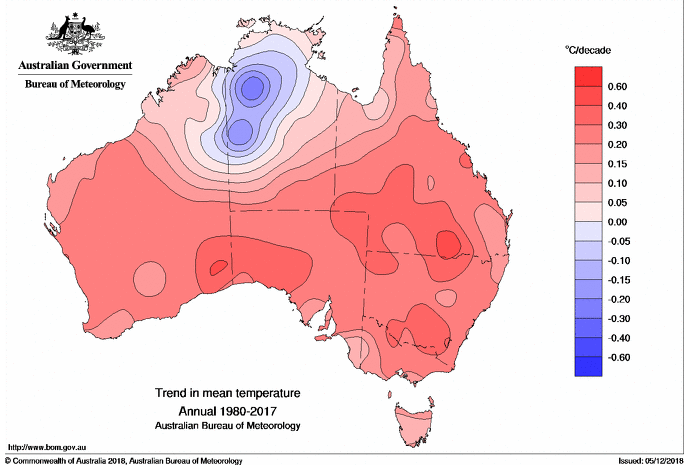
Australia's average temperature in 2018 was 1.14 °C above the 1961–1990 average, making it slightly warmer than 2017 said the Bureau of Meteorology in the 2018 Annual climate statement.
"When we look across all of Australia in 2018, we can see that every single state and territory had above-average day and night-time temperatures," Dr Bettio said.
"The average maximum temperature for the country as a whole was particularly warm, sitting 1.55 °C above the 1961–1990 average, making 2018 Australia's second warmest year on record for daily high temperatures.
"Average minimum temperatures for 2018 were 0.73 °C above average, the eleventh-warmest on record.
"The only part of the country to buck the trend for above average temperatures was the Kimberley region, which had cooler than average nights for the year."
On temperatures 2018 was Australia's third-warmest year on record; a year of protracted drought and persistent warmth.
Meanwhile, Australia still has no effective climate or energy policy, no consistent plan to phase out coal or gas fossil fuels, no plan to reduce transport emissions, a problem with increased vegetation clearing in Queensland and New South Wales. Australia's emissions are rising over the last 4 years and Environment department Data shows that Australia is unlikely to meet it's low 26 percent emissions reduction target by 2030.
The Is it hot right now? website provides a daily view on daily average temperatures for Australian capital cities, comparing the average temperature to it's history for that day, to see where it sits in the distribution of temperatures typical for the time of year.
The site was developed by climate researchers Mathew Lipson, Steefan Contractor and James Goldie. The data comes from the Bureau of Meteorology's ACORN-SAT.
Mat Lipson provided the Yearly average temperature charts and the 2018 heat maps for each city. The trend in rising temperatures is clearly visible in each. I have added details for each city of future projections done by CSIRO in 2015.
In the year heat maps for each city you can still see the fluctuations in temperature due to weather events, but the cold days (blue) are getting rarer, and the hot days (red) are getting more common, a telling sign of the long term climate temperature trend affecting all regions of Australia.
I have been very concerned about rising temperatures and the urban heat island effect on the people in our cities, particularly Melbourne and the City of Moreland where I live. See Climate change and heatwaves in Melbourne - a Review. Moreland Council have been one of the more pro-active local governments in reducing emissions, ameliorating the urban heat island effect through an urban forest strategy, and in working towards adaptive changes by the population of Moreland in dealing with impacts of extreme heat. Liz Hanna puts this together in the dilemmas we will face in future years as temperatures continue to rise.
The reality of living with 50℃ temperatures in our major cities
Sydney is facing 50℃ summer days by 2040, new research says. Andy/Flickr/Wikimedia Commons, CC BY-SA
Australia is hot. But future extreme hot weather will be worse still, with new research predicting that Sydney and Melbourne are on course for 50℃ summer days by the 2040s if high greenhouse emissions continue. That means that places such as Perth, Adelaide and various regional towns could conceivably hit that mark even sooner.
This trend is worrying, but not particularly surprising given the fact that Australia is setting hot weather records at 12 times the pace of cold ones. But it does call for an urgent response.
Most of us are used to hot weather, but temperatures of 50℃ present unprecedented challenges to our health, work, transport habits, leisure and exercise.
Humans have an upper limit to heat tolerance, beyond which we suffer heat stress and even death. Death rates do climb on extremely cold days, but increase much more steeply on extremely hot ones. While cold weather can be tackled with warm clothes, avoiding heat stress requires access to fans or air conditioning, which is not always available.
The death rate in heat ramps up more rapidly than in cold. Data from Li et al., Sci. Rep. (2016); Baccini et al., Epidemiol. (2008); McMichael et al., Int. J. Epidemiol. (2008), Author provided
Even with air conditioning, simply staying indoors is not necessarily an option. People must venture outside to commute and shop. Many essential services have to be done in the open air, such as essential services and maintaining public infrastructure.
Roughly 80% of the energy produced during muscular activity is heat, which must be dissipated to the environment, largely through perspiration. This process is far less effective in hot and humid conditions, and as a result the body’s core temperature begins to climb.
We can cope with increased temperatures for short periods – up to about half an hour – particularly those people who are fit, well hydrated and used to hot conditions. But if body temperature breaches 40-42℃ for an extended time, heat stress and death are likely. In hot enough weather, even going for a walk can be deadly.
Air conditioning may not save lives
We expect air conditioning to take the strain, but may not realise just how much strain is involved. Shade temperatures of 50℃ mean that direct sunlight can raise the temperature to 60℃ or 70℃. Bringing that back to a comfortable 22℃ or even a warm 27℃ is not always possible and requires a lot of energy – putting serious strain on the electricity grid.
Electricity transmission systems are inherently vulnerable to extreme heat. This means they can potentially fail simply due to the weather, let alone the increased demand on the grid from power consumers.
Power cuts can cause chaos, including the disruption to traffic signals on roads that may already be made less safe as their surfaces soften in the heat. Interruptions to essential services such as power and transport hamper access to lifesaving health care.
Myopic planning
It’s a dangerous game to use past extremes as a benchmark when planning for the future. The new research shows that our climate future will be very different from the past.
Melbourne’s 2014 heatwave triggered a surge in demand for ambulances that greatly exceeded the number available. Many of those in distress waited hours for help, and the death toll was estimated at 203.
The health sector is concerned about Australia’s slow progress and is responding with the launch of a national strategy for climate, health and well-being. Reinstating climate and health research, health workforce training and health promotion are key recommendations.
There is much more to be done, and the prospect of major cities sweltering through 50℃ days escalates the urgency.
Two key messages arise from this. The first is that Australia urgently needs to adapt to the extra warming. Heat-wise communities (or “heat-safe communities” in some states) – where people understand the risks, protect themselves and look after each other – are vital to limit harm from heat exposure. The health sector must have the resources to respond to those who succumb. Research, training and health promotion are central.
"This developing heatwave is nothing short of horrifying" said climate scientist Sarah Perkin-Kirkpatrick.
"Much of eastern Australia has seen heatwave after heatwave this summer, with some seasonal records already broken by the start of February. Night-time temperatures have been too hot for adequate sleep and daytime temperatures have been searing."
Sarah Perkin-Kirkpatrick is a climate scientist who has specialised in studying the causes and dynamics of heatwaves. She is an Australian Research Council DECRA fellow at the Climate Change Research Centre, University of NSW. At the annual Australian Meteorological and Oceanographic Organisation conference meeting in Canberra this week she was awarded the Early Career Researcher (ECR) award.
"What is particularly concerning about the developing event is the intensity, where many regions will see a string of extremely hot days with little relief. Much of NSW, QLD and northern VIC will suffer the most, where temperatures will be the hottest, and follow little reprieve from the previous heatwaves." she said.
Averaged across the state, Queensland had its 6th warmest January on record. Mean minimum temperatures were the second-warmest on record for January. (see above deciles average map for January)
But the City of Brisbane in the south east just experienced it's warmist January on record. Back to back heatwaves have brought persistent heat to south east Australia, and especially to southern Queensland and New South Wales. The town of Moree has had 36 consecutive days of temperatures over 35C, doubling the previous record of 17 days in 1982.
This article by John Englart was first published at Climate Action Moreland.
The official reports are in. 2016 was the hottest year on record according to the European Copernicus Climate Change Service (C3S). In Australia the Bureau of Meteorology declared 2016 the 4th warmest on record, but with record sea surface temperatures around the continent.
Last week Kuwait and the city of Basra in Iraq sweltered in 54C heat reported Dr Jeff Masters on the Weather Underground blog. At these temperatures, a major heat hazard is posed to human health.
From April 2015 to May 2016 each month has been a new record for global average temperatures, according to the National Oceanic and Atmospheric Administration. It is an unprecedented series of broken global temperature records. And scientists are warning now that we are in unprecedented territory facing the start of a climate emergency.
May 2016 was 0.87°C above the 20th century average according to NOAA. Each month from December to April was at least 1°C or more over the 20th Century average.
According to Climate Central, The average global temperature change for the first three months of 2016 was 1.48°C, essentially equaling the 1.5°C warming threshold agreed to by COP 21 negotiators in Paris last December.
The researchers argue that aerosols from air pollution are likely to have a substantial cooling impact at the moment, even as India experiences record temperatures. With roll out of renewables and the push to electrify vehicle transport, air pollution will likely be reduced increasing health outcomes. But it may be at the expense of a spike in temperatures at this time of year which will have a large heat health impact on the population, especially poorer people who cannot afford technological adaptation measures such as air-conditioning. It is another reason why recently implemented adaptation plans in India for heat health are so important, as well as taking effective and rapid emissions reduction on a global level in accordance with the UNFCCC Paris Agreement.