Sorry Kids... latest research shows that increasing temperatures adding to extreme heat due to burning fossil fuels has a disproportionate impact in killing young people under 35 years. While this research is based on Mexico, it is highly likely it applies more widely, although there will be some caveats.
One of the authors of the study, Danny Bressler, said: "The concentration of heat-related mortality among younger people is quite disproportionate compared to other causes of death. Although just 16% of overall deaths from all causes are among under 35 year olds, 75% of heat-related deaths are among under 35 year olds. When we consider lost life years, the age-specific inequality is more extreme: 87% of heat-related lost life years occur among under-35-year-olds."
Meanwhile Australia's Environment Minister is set to approve another 3 coal mines pushing up the temperature and endangering our children's future.
Heat disproportionately kills young people: Evidence from wet-bulb temperature in Mexico (December 2024)
The European Copernicus Agency early this week identified that Sunday, Monday and Tuesday set new global daily average temperature records. This Thursday UN Secretary General highlighted Extreme Heat with a call to action, including an end to new fossil fuel extraction. He highlighted a new International Labor Organisation report on extreme heat safety and health for workers.
22 July 2024 was confirmed as warmest day globally in recent history. July 23 and July 21 also broke the record set in July 2023.
Yet Australia is still approving new coal and gas projects, allowing offshore #Fossilfuel exploration exacerbating the #ClimateCrisis. We need a #ClimateTrigger in National Environment laws
Sunday Monday and Tuesday this week all exceeded Global Daily Average Temperature Record set in July 2023. Welcome to the Anthropocene.
The World Meteorological Organisation report on climate services this year focusses on health. It argues the need for tailored climate information and services to support the health sector in the face of more extreme weather and poor air quality, shifting infectious disease patterns and food and water insecurity.
If climate information is not used by the health sector for adaptation, population health can easily move backwards.
“Practically the whole planet has experienced heatwaves this year. The onset of El Niño in 2023 will greatly increase the likelihood of breaking temperature records further, triggering more extreme heat in many parts of the world and in the ocean – and making the challenge even greater,” says WMO Secretary-General, Prof. Petteri Taalas.
“It is clear that by channelling investment and boosting collaboration, there is huge potential to go further and faster by enhancing the impact of climate science and services so that health partners get the support they need at a time when unprecedented changes to our climate are having an increasing impact,” says Prof. Taalas.
The report shows that integrated climate and health action makes a very real difference in people’s daily life. This includes early warning systems for extreme heat, pollen monitoring to help allergy sufferers and satellite surveillance for climate-sensitive diseases.
New research estimates over 61,000 heat related deaths in Europe in 2022. And that comes after heat alerts and other climate adaptation measures implemented after the massive death toll of 73,000 from the 2003 heatwave.
What will the summer bring for Australia? With record temperatures being set around the world (see June climate signals and records), and ElNino formation boosting temperatures.
Meanwhile Australia is approving new thermal coal and gas, and continues fossil fuel subsidiaries to the tune of $11billion per year with no public plan to phase these subsidies out.
Will heat related deaths be at a similar level in 2023 in Europe?
Will we see a similar number of heat related deaths in the southern hemisphere summer?
What should also be noted is that climate impacts are not gender neutral. Research has found that older women died at higher rates than men.
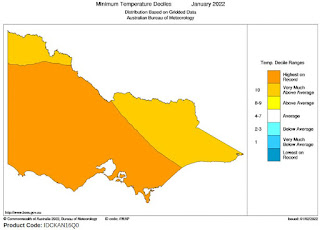
Sleepless in Melbourne? January was a warm one for Melbourne despite presence of La Nina (ENSO) which usually cools global temperatures marginally.
The trend was particularly noteable with record mean minimum temperatures for Melbourne and most of Victoria this year. Victoria's January mean minimum temperatures are rising faster than mean maximum temperatures.
There was also record humidity for January for most of Victoria. Record rainfall was also recorded in north east Victoria.
It seems there will be lots more sleepless January nights in store for us all in Melbourne in future years.
A few years ago climate scientists announced that in coming decades Melbourne and Sydney will experience 50C days.
Those temperatures are also coming to the Mediterranean with Middle East and North Africa temperatures in heatwaves up to 56 degress Celsius according to the latest research.
This is a media release from the Italian based CMCC Foundation:
I've done some tracking on twitter across the political divide on climate and the heatwave events, going back to 22 December 2018 (the start of Christmas/New Year 1st heatwave event). December and January were record hot for Australia.
While Sydney's eastern suburbs temperatures will be in the low 30s in the coming week, residents of Penrith and Richmond in Western #Sydney will swelter through four or five days above 40C says Dean Narramore a meteorologist with the Bureau of Meteorology.
The heatwave will impact large regions of inland Australia with lesser impact of perhaps some extreme heat days for coastal cities and towns. Major international sporting events such as the Australian Tennis Open in Melbourne and the Tour Down Under cycling event in South Australia will see their extreme heat policies implemented.
“Particularly northern South Australia, they’re looking at maybe five days in a row above 45 and normally they might only get five or 10 a year,” meteorologist Dean Narramore said on Sunday, according to The Guardian report.
It is well past time to take rapid action on climate, to reduce emissions and set ambituous targets that are our fair share of the Paris Agreement climate goals to keep global temperatures well below 2 degrees celcius and strive to meet a 1.5C target.
Queensland: Catastrophic fire conditions, a week long extreme heatwave with record breaking temperatures, mass bushfire evacuations at Gracemere near Rochhampton, State and Commonwealth disaster response plans triggered.
But no mention of climate change intensifying heat and bushfires.
I have been very concerned about rising temperatures and the urban heat island effect on the people in our cities, particularly Melbourne and the City of Moreland where I live. See Climate change and heatwaves in Melbourne - a Review. Moreland Council have been one of the more pro-active local governments in reducing emissions, ameliorating the urban heat island effect through an urban forest strategy, and in working towards adaptive changes by the population of Moreland in dealing with impacts of extreme heat. Liz Hanna puts this together in the dilemmas we will face in future years as temperatures continue to rise.
The reality of living with 50℃ temperatures in our major cities
Sydney is facing 50℃ summer days by 2040, new research says. Andy/Flickr/Wikimedia Commons, CC BY-SA
Australia is hot. But future extreme hot weather will be worse still, with new research predicting that Sydney and Melbourne are on course for 50℃ summer days by the 2040s if high greenhouse emissions continue. That means that places such as Perth, Adelaide and various regional towns could conceivably hit that mark even sooner.
This trend is worrying, but not particularly surprising given the fact that Australia is setting hot weather records at 12 times the pace of cold ones. But it does call for an urgent response.
Most of us are used to hot weather, but temperatures of 50℃ present unprecedented challenges to our health, work, transport habits, leisure and exercise.
Humans have an upper limit to heat tolerance, beyond which we suffer heat stress and even death. Death rates do climb on extremely cold days, but increase much more steeply on extremely hot ones. While cold weather can be tackled with warm clothes, avoiding heat stress requires access to fans or air conditioning, which is not always available.
The death rate in heat ramps up more rapidly than in cold. Data from Li et al., Sci. Rep. (2016); Baccini et al., Epidemiol. (2008); McMichael et al., Int. J. Epidemiol. (2008), Author provided
Even with air conditioning, simply staying indoors is not necessarily an option. People must venture outside to commute and shop. Many essential services have to be done in the open air, such as essential services and maintaining public infrastructure.
Roughly 80% of the energy produced during muscular activity is heat, which must be dissipated to the environment, largely through perspiration. This process is far less effective in hot and humid conditions, and as a result the body’s core temperature begins to climb.
We can cope with increased temperatures for short periods – up to about half an hour – particularly those people who are fit, well hydrated and used to hot conditions. But if body temperature breaches 40-42℃ for an extended time, heat stress and death are likely. In hot enough weather, even going for a walk can be deadly.
Air conditioning may not save lives
We expect air conditioning to take the strain, but may not realise just how much strain is involved. Shade temperatures of 50℃ mean that direct sunlight can raise the temperature to 60℃ or 70℃. Bringing that back to a comfortable 22℃ or even a warm 27℃ is not always possible and requires a lot of energy – putting serious strain on the electricity grid.
Electricity transmission systems are inherently vulnerable to extreme heat. This means they can potentially fail simply due to the weather, let alone the increased demand on the grid from power consumers.
Power cuts can cause chaos, including the disruption to traffic signals on roads that may already be made less safe as their surfaces soften in the heat. Interruptions to essential services such as power and transport hamper access to lifesaving health care.
Myopic planning
It’s a dangerous game to use past extremes as a benchmark when planning for the future. The new research shows that our climate future will be very different from the past.
Melbourne’s 2014 heatwave triggered a surge in demand for ambulances that greatly exceeded the number available. Many of those in distress waited hours for help, and the death toll was estimated at 203.
The health sector is concerned about Australia’s slow progress and is responding with the launch of a national strategy for climate, health and well-being. Reinstating climate and health research, health workforce training and health promotion are key recommendations.
There is much more to be done, and the prospect of major cities sweltering through 50℃ days escalates the urgency.
Two key messages arise from this. The first is that Australia urgently needs to adapt to the extra warming. Heat-wise communities (or “heat-safe communities” in some states) – where people understand the risks, protect themselves and look after each other – are vital to limit harm from heat exposure. The health sector must have the resources to respond to those who succumb. Research, training and health promotion are central.
Professor Kristie L. Ebi, from University of Washington, presented a plenary talk at the Australian Meteorological and Oceanographic Society (AMOS) conference in Canberra on Climate and health. An interesting talk even via twitter and speaks to the need for a national climate and health policy in Australia.
Cyclists in the Santos Tour Down Under UCI Professional cycling race in South Australia today faced the challenge of riding in temperatures over 40 degrees. Local temperatures on the road are likely to be even higher for the cyclists riding on hot road surfaces. Indeed, Jérémy Maison with the FDJ team measured a local temperature of 50C with their Garmin cycling computer, according to a tweet.
The stage was from the Adelaide suburb of Unley, through the Adelaide Hills to Lyndoch, in the Barossa Valley.
The race length was revised down from 145km to 118km, a reduction of 26.5km, with the finishing circuit reduced from two laps to just one, after cyclists in the peloton complained about the searing conditions.
The real irony though, is the fact that the major race sponsor is the South Australian based Gas and fracking company Santos, whose whole business revolves around fossil fuel extraction which causes climate change and more extreme temperatures.
Last week Kuwait and the city of Basra in Iraq sweltered in 54C heat reported Dr Jeff Masters on the Weather Underground blog. At these temperatures, a major heat hazard is posed to human health.
The researchers argue that aerosols from air pollution are likely to have a substantial cooling impact at the moment, even as India experiences record temperatures. With roll out of renewables and the push to electrify vehicle transport, air pollution will likely be reduced increasing health outcomes. But it may be at the expense of a spike in temperatures at this time of year which will have a large heat health impact on the population, especially poorer people who cannot afford technological adaptation measures such as air-conditioning. It is another reason why recently implemented adaptation plans in India for heat health are so important, as well as taking effective and rapid emissions reduction on a global level in accordance with the UNFCCC Paris Agreement.