Mastodon Climate Citizen --> Mastodon
Showing posts with label Canberra. Show all posts

Friday, October 8, 2021

Australian Aviation CO2 emissions equivalent to 5 coal power stations


A new website uncovers the aviation emissions associated with 1300 airports globally, covering 99 per cent of passenger flights. Twenty four of those airports are located in Australia producing carbon emissions equivalent to five coal fired power stations.

The aviation sector would have been the sixth-largest emitter of CO₂ in 2018 if it were a country, responsible for 2.5 per cent of global emissions. Up until the pandemic aviation was growing 5 per cent annually since 2013. Despite the disruption caused by the pandemic, the sector remains off-track for limiting global heating to 1.5ºC.

Aviation emissions for the website is based on data from 1300 airports from 2013, 2018, 2019. The website was a joint project by the International Council on Clean Transportation (ICCT), International Think Tank ODI, and Transport and Environment (T&E).

This is the first global attempt to focus on the infrastructure that enables and induces air travel and leads to more CO₂ emissions in future decades.

Wednesday, January 9, 2019

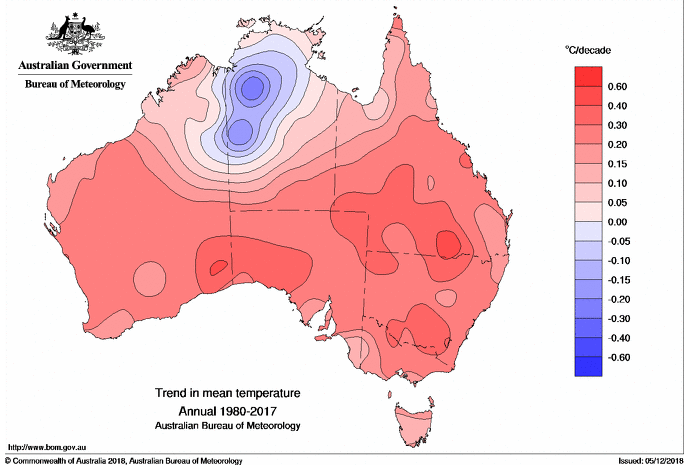
Mapping the heat trend in Australia's capital cities for 2018 and future projections


The Is it hot right now? website provides a daily view on daily average temperatures for Australian capital cities, comparing the average temperature to it's history for that day, to see where it sits in the distribution of temperatures typical for the time of year.

The site was developed by climate researchers Mathew Lipson, Steefan Contractor and James Goldie. The data comes from the Bureau of Meteorology's ACORN-SAT.

Mat Lipson provided the Yearly average temperature charts and the 2018 heat maps for each city. The trend in rising temperatures is clearly visible in each. I have added details for each city of future projections done by CSIRO in 2015.

In the year heat maps for each city you can still see the fluctuations in temperature due to weather events, but the cold days (blue) are getting rarer, and the hot days (red) are getting more common, a telling sign of the long term climate temperature trend affecting all regions of Australia.

Wednesday, December 5, 2018

School kids occupy Australian parliament foyer demanding 100% renewables, #stopAdani

Students involved in the National School Strike for Climate Actionjoined First Nations leaders from Seedmob, youth leaders from AYCC and climate experts to hold a peaceful occupation of approximately 100 people in the foyer of Federal Parliament House in Canberra on Wednesday 5 December.

This follows a climate strike involving over 15,000 students and supporters on Friday 30 November in all capital cites and some 20 regional cities and towns.

The students are demanding:
  • 1. Stop the Adani coal mine
  • 2. No new coal or gas
  • 3. 100% renewable energy by 2030


and requesting:
  • 1. Host a climate change forum for school students in your electorate before the Federal Election
  • 2. Take a photo with us and a StopAdani sign to demonstrate your opposition to the mine and support for our future.

Sunday, May 25, 2014

Autumn heatwave across south-east Australia sets new records

While there are few complaints about the super mild autumn temperatures, new temperature duration records are being set across large parts of south eastern Australia.

Professor Will Steffen has now written a report - Climate Council Seasonal Update: Abnormal Autumn 2014 - in which he details that the 24 months to April 2014 were the hottest two year period on record, and due to the abnormally warm weather in May, the 24 months to May 2014 is likely to eclipse this record. With an El Nino brewing in the Pacific we are likely to have elevated temperatures through winter and spring which will influence soil moisture and other factors involved in increasing the number of extreme fire weather days with a longer fire season in southern regions later this year.

Weather Bureau releases special climate statement - 30 May 2014

The Bureau of Meteorology has released special climate statement 49 (PDF) summarising the autumn May warmspell. A persistent blocking high in the Tasman brought the warm period, but comes on top of a trend for hotter than usual periods:

The current warm event is the latest in a sequence of prolonged or intense warm spells that have affected a large part of the continent roughly every six weeks since the end of 2012. This coincides with record-breaking or well-above-average temperatures that have persisted across Australia for the past 22 months. The 12 months ending January 2014, February 2014, March 2014 and April 2014 have all been record-warm for Australia. It is virtually certain that the 12 months ending May 2014 will also set a new high record.

The year-to-date (January to May) temperature anomaly for Australia at 31 May 2014 is expected to be near +0.95 °C. This will mean that 2014 ranks in the top five warmest starts to a year on record behind 2005 (+1.17 °C), 1998 (+1.05 °C), 2013 (+1.04 °C) and 2007 (+0.96 °C).


The continental averaged daily maximum temperature was 27.35 °C or above on each of the five days from 21 to 25 May. The previous area record after this date was 27.23 °C on 23 May 1958. Daytime average temperatures were 4 to 6 degrees above average over over a large area encompassing most of South Australia, the western half of New South Wales, northwestern Victoria, southwestern Queensland and the southern Northern Territory.

Usually with warm spells of this type in Autumn night time temperatures remain average or are cooler than normal due to cloud free nights radiating the day's energy.

Minimum temperatures for this period (Figure 2) were also above average over most of the continent, except for parts of the New South Wales tablelands and the Kimberley region in the north of Western Australia. The largest anomalies, 4 to 6 °C above average, occurred in the South Australian outback and adjacent border areas of Western Australia and the Northern Territory.


Indeed, special mention is made for one night in Melbourne where the temperature climbed to 22C at 4.30am before falling:

A particularly unusual occurrence was the abnormal warmth in the Melbourne area in the early hours of the morning of 27 May, as northerly winds strengthened ahead of an approaching front. The Melbourne temperature rose to 22.1 °C around 4.30 am, which was only 0.3 °C short of the highest maximum temperature ever observed so late in the season. (It subsequently cooled below 18 °C after 6.30 am, preventing any records being set for high overnight minimum temperatures.)

With the blocking high in place bringing warmth to much of central and eastern Australia, the south west saw more cold fronts bringing rain resulting in southwestern Western Australia having its wettest May since 2005. "Pemberton experienced 23 consecutive days with rainfall from 7 to 29 May, a May record, and numerous other sites in the region had 20 to 22 days with rainfall during this period." said the BOM statement.

Some of the records broken

  • Sydney - 19 consecutive days of 22 °C or above from 10 to 28 May (previous record of 9 days from 1 to 9 May 1978 and 1 to 9 May 2007).
  • Sydney - 25 days for most consecutive days of 20 °C or above.
  • Adelaide - 16 days for most consecutive days of 20 °C or above.
  • Melbourne - 13 days for most consecutive days of 20 °C or above.
  • Wilsons Promontory - 6 consecutive days of 20 °C or above. (No previous instance in May of a spell of more than 3 consecutive days of 20 °C or above, and only one 7 day spell in April in 1970)
  • Victoria - 9 consecutive days from 14 to 22 May with a statewide mean maximum above 20 °C, matching the record set from 1 to 9 May 1972.
  • Campania (Tas) - 24.1 °C observed on 15 May, highest maximum temperature so late in the season for any Tasmania site.
  • Ouyen (Vic) - 27.4 °C on 26 May, highest maximum temperature so late in the season for Victoria.
  • Birdsville (Qld) reached 34.7 °C highest maximum temperature of the event outside the tropics.
  • Hobart - 23.9 on 15 May highest maximum temp on same or later day (previous 22.6 16/5/1947)
  • Hobart - 14.9 on 19 May highest minimum on same or later day (previous 14.5 (24/5/2000,
    31/5/1976)
  • Canberra - 21.7 on 26 May highest maximum temp on same or later day (previous 20.1 (29/5/1954, 3 and 4/6/1957)

25 May 2014:

Sydney has just posted its longest Autumn warm spell for May going back to records which started in 1910. Saturday was the 14th day in May where the maximum temperature exceeded 22 degrees smashing the old record of 6 days. Average maximum temperatures will also beat the existing record for May - 22.7 degrees set in 1958 - according to Ben Domensino, a senior meteorologist at Weatherzone as reported by the Sydney Morning Herald. Melbourne also has experienced abnormally mild temperatures with May 2014 exceeding May 1972 for the most days with temperatures over 20 degrees.

Canberra has also exceeded a 67-year-old record for a late-autumn heatwave last Thursday, when temperatures passed 17 degrees for the 11th consecutive day. Weatherzone meteorologist Max Gonzalez said the city had been experiencing above average day time temperatures and cooler than average nocturnal temperatures, "The average overnight temperature in Canberra this month has been 1.5 degrees which is 1.6 below the usual average," he said. "But during the day we’re averaging temperatures of 16.8 which is 1.2 degrees warmer than the monthly average." reported the Sydney Morning Herald.

The warmer than usual weather has also caused algae blooms in Lake Burley Griffin and Lake Tuggeranong forcing there closure for swimming. Adelaide's top of 27.4 degrees was that city's warmest on record this late in the season, while Hobart's 23.9 degrees on Thursday was that city's warmest so deep into autumn. Both cities' records go back more than a century, said Blair Trewin, a senior climatologist at the Bureau of Meteorology as reported by the Age.

See Scorcher.org.au for Australian heatwave distribution and data for recent and past heatwaves events for individual observation sites. Dr Sarah Perkins explains in detail on her blog about heatwaves, and finding the human signal in them.

The Snowy Mountains skifields are also decidedly still green even though the start of the ski season is fast approaching on the June Queens birthday weekend. Temperatures at most ski resorts are still above zero, still too warm to even start the snowmaking machines. Australia’s alpine zones have been identified as one of six key regions that are highly vulnerable to climate change. There has already been a substantial reduction in snow, and by the end of this century it is projected most snow will be gone. This will have a large affect on the shrinking size of the alpine ecosystems, not to mention ski resort tourism.

Increased temperatures during this Autumn heatwave may have implications for later in the year according to Climate scientist Dr Sarah perkins, as reported in the Sydney Morning Herald. Raised temperatures increase plant growth adding to fuel loads, but also help to dry out soils raising the prospect for more intense fires and droughts later in the year if dry conditions persist. Signs of an impending El Nino may also contribute to drought and a more intense and lengthy bushfire season in the later part of 2014. There are several signs the El Nino may match the strenth and intensity of the 1997/1998 El Nino.

NOAA: April tied with 2010 as hottest on record

This comes as NOAA announced that April 2014 tied with 2010 as the hottest April on record. According to NOAA:

The globally-averaged temperature across land and ocean surfaces tied with 2010 as the highest on record for the month, at 0.77°C (1.39°F) higher than the 20th century average. This also ties with April 2010 as the seventh highest departure from average among all months in the period of record, which dates back to January 1880. The record highest departure is 0.86°C (1.55°F) above average, set in February 1998, a month when El Niño conditions had been present for nearly a year. Neither El Niño nor La Niña have been present in the east central equatorial Pacific Ocean for the past two years; however, according to NOAA's Climate Prediction Center, the chance of El Niño emerging increases for the remainder of 2014, exceeding 65 percent during the Northern Hemisphere summer 2014.

The NOAA report also noted that average temperatures for Australia in April were high:

Australia observed its seventh highest average April temperature since records began in 1910, at 1.12°C (2.02°F) higher than the 1961–90 average. The average minimum temperature was fourth highest for April, at 1.32°C (2.38°F) above average, with Queensland setting a new record high monthly minimum for the state.

Sunday, November 17, 2013

Tens of Thousands rally for Climate Action across Australia

More than 60,000 people are estimated to have rallied or marched for climate action across Australia in a demonstration that a significant number of people view climate change as a serious issue requiring substantive action from all levels of Government, including the Federal Government lead by cinservative Prime Minister Tony Abbott.

The rallies were organised by GetUp, the Australian Youth Climate Coalition and the Australian Conservation Foundation.

The protest comes as the bills to dismantle Australia's carbon price and funding subsidies for renewable energy are introduced into Federal parliament on Monday. If successful, Australia would become the first country to rill back a functioning carbon pricing mechanism.

Thursday, October 13, 2011

Passage of Australian Carbon Pricing legislation may influence UN Climate talks

Julia Gillard don't cave in to pressure from big polluters - Melbourne World Environment Day 2011

Could our carbon pricing package be a "game changer" at the next UN climate talks to be held in Durban, South Africa from 28 November - 9 December 2011? Australia's climate change ambassador, Louise Hand thinks it is possible. But first a look at the passage of the legislation through the House of Representatives and some community reactions.

Yesterday the House of Representatives passed the Government's carbon pricing and clean energy legislation with the support of Independent members Tony Windsor, Rob Oakeshott, Andrew Wilkie, and Greens member Adam Bandt: the vote was 74-72. The legislation passed despite a vociferous campaign against climate change science well orchestrated by right wing talk back radio identities like Alan Jones and supported by the Liberal and National opposition parties led by Tony Abbott, who in the past has denied climate change and also advocated a carbon tax.

Sunday, June 5, 2011

Thousands rally to price carbon on World Environment Day


An estimated 10,000 people packed the lawns of the State Library on Swanston street Melbourne on World Environment Day to Say yes to a safe climate and support the introduction of a carbon price by the Gillard Federal Labor Government. About 8000 people also gathered in Sydney, 5000 people rallied in Adelaide's Victoria Square, 5000 in Brisbane, 3000 in Perth, 3000 in Hobart, and 2000 in Canberra. Organisors estimate up to 45000 may have attended rallies across Australia today to support climate action and pricing carbon.

Flickr photos: Melbourne | Adelaide | Canberra | Sydney

Wednesday, March 23, 2011

Action for Climate change petition delivered as conservatives rally against Carbon Tax

Canberra was the focus of action today over climate change and the Government's proposed carbon tax, with an action for climate change petition presented, youth climate activists in town to meet politicians, and the No Tax on Carbon rally attended by climate deniers and conservatives and actively promoted on shock-jock talk back radio.

Ged Kearney from the ACTU and Kellie Caught from the WWF-Australia delivered a petition with 12,500 names supporting action on climate change to Greg Combet, Minister for Climate Change and Energy Efficiency, at Parliament house in the morning.

Climate Deniers Rally against carbon tax in Canberra


People opposed to a carbon tax rallied at noon in Canberra, Melbourne and Brisbane. The protest in Canberra was organised by the Consumers and Taxpayers Assoc Inc. and 2GB broadcaster Chris Smith.

Friday, August 27, 2010

ACT Government takes the lead in climate action emission reduction targets

The ACT Government has announced cuts to greenhouse gas emissions by 40 per cent by 2020, and 80 per cent by 2050, based on 1990 levels. The targets were announced by Minister for the Environment Climate Change and Water, Simon Corbell when tabling the Climate Change and Greenhouse Gas Reduction Bill 2010 in the ACT legislative assembly.

"The ACT Government has consulted widely on potential targets for greenhouse gas reduction in the Territory, and has analysed evidence based arguments on human caused global warming." siad Simon Corbell, "Governments have a responsibility to act on this issue, and the ACT Labor Government is leading Australia on reducing our carbon footprint by increasing the uptake of renewable energy and increasing energy efficiency in Canberra homes and businesses."

Monday, November 23, 2009

Climate civil disobedience action in Canberra for 40% carbon reduction target

Two hundred people blockaded Parliament House in Canberra today calling on Prime Minister Kevin Rudd to secure a strong, legally binding treaty at the upcoming international climate negotiations in Copenhagen. Police arrested 130 people, although it is believed none were charged.

Related: Scientists: Climate Treaty more urgent with Global carbon emissions still increasing | Rising Tide Media Release | Coal protesters appealing damages order over Brisbane Climate Direct Action | 21 world leaders, including president Obama, have said they don't expect Copenhagen to produce a binding treaty

Friday, November 20, 2009

Firefighters turn climate heat on Canberra

Sydney IMC: Firefighters demanded action on climate change from politicians in Canberra on November 19 while much of south eastern Australia sweltered and suffered with temperatures well above 30 degrees. Many regions were declared severe, extreme or catastrophic fire danger. The Firefighters carried a banner "Firefighters for climate change action now" demanded that the Government's Carbon Pollution Reduction Scheme be passed by the Senate.

Scientists have reported this week that the Climate Treaty is more urgent with Global carbon emissions still increasing. with Australia the worst emitter on a per capita basis. Scientists have also called for Emissions need to be slashed to save Great Barrier Reef. | Read ACTU media release | Climate Institute Media Release

Saturday, May 16, 2009

Climate protest highlights environment funding in the Australian Budget

Eight people were arrested in a dramatic climate protest at Canberra during the 2009 Government budget session over the Government's inadequate response to climate change. So, how did the Environment fare in the budget?

"This is a historic level of Commonwealth investment in solar energy and public transport and we warmly welcome it. The money for solar gives a good kick start to this crucial industry of the future. In contrast, the $2 billion of new funds over nine years for carbon capture and storage research is public money not well spent. The companies that make huge profits from mining and burning coal should fund the research into technologies that may – or may not – help reduce Australia’s carbon emissions in ten, fifteen or twenty years." summed up Australian Conservation Foundation (ACF) executive director Don Henry.

While the Australian coal industry continues to be annually subsidised to the tune of $7 billion, for the first time a significant amount of money - $1.5 billion - has been allocated to the development of solar power projects, which is a significant breakthrough in funding renewable energy.

Renewable Energy Projects

Wasim Saman, Professor of sustainable energy engineering and Director of the Sustainable Energy Centre at the University of South Australia was enthused by the "exciting initiatives to help the mainstreaming of solar energy use and other sustainable energy measures."

"The biggest item is the support being provided for building solar thermal and photovoltaic generation capacity equivalent to that of a conventional power station. This can build on a current solar thermal demonstration project being constructed in Whyalla. The establishment of 'Renewables Australia' to support research in renewable energy technology is also welcome as it may accelerate the development of new technologies for utilising wave/tidal, geothermal and other renewable resources." said Saman.

Energy efficiency has also received a boost. About $160 million has been allocated for programs to reduce energy demand, such as smart grids and energy efficient appliances. According to Saman "the funding announced for trialling smart metering and energy networks and for tightening minimum energy performance standards of both buildings and appliances and for establishing a mandatory disclosure program of energy use in housing and commercial buildings will support more efficient energy use in our homes and other buildings."

"The additional funding of over $1 billion for four demonstration solar power stations is of course welcome. So is the expansion of the nascent Solar Institute into Renewables Australia." said Dr Mark Diesendorf, Deputy Director of the Institute of Environmental Studies at the University of New South Wales.

However, Diesendorf is critical that there is no provision in the budget for essential infrastructure for renewable energy, such as new and strengthened transmission links. "If the federal government upgraded the transmission lines linking South Australia to NSW and Victoria, Australia’s wind power capacity could be greatly augmented. Commitment to a new high-capacity transmission line linking the geothermal region in north-east S.A. to the main grid would also be valuable." he said.

Greenpeace welcomed the allocation of $1.5 billion to build four solar power stations up to a total of 1000 megawatts (equates to renewable energy to power 400,000 homes).

"The multi-billion dollar Clean Energy Initiative, with existing funds and commitments, adds up to a smart cost and risk effective investment strategy in solar, wind, geothermal and potentially significantly reducing pollution from coal," said John Connor, CEO of the Climate Institute. "It’s vital we aim to hit 2020 with a mix of industrial scale clean energy options so we know which technology works best, or at all, as we shift to near zero emission, and better, supplies of energy."

Carbon Capture and Storage

Carbon capture and storage (CCS - so called Clean Coal) has been allocated $2.4 billion under the Green Energy Initiative, and it will still be at the pilot stage of development. Professor Jerry Vanclay is Professor of Sustainable Forestry and Head of the School of Environmental Science and Management at Southern Cross University said that the "technology is yet to be proven at an operational scale. Technically it is possible, but it is not clear if CO2 can be separated from flue gasses in an economic way. Suitable sites for underground storage are limited, and may not occur in proximity to coal-fired power stations. Finally, a relatively short distance from the CCS trial in Victoria is a enterprise pumping CO2 gas up from underground for industrial use, further illustrating that we cannot economically capture CO2.

Vanclay was disappointed that less than half of the Green Energy Initiative is devoted to Solar energy, and only a tiny fraction for Renewables Australia.

Caring for our Country and Water for the Future

Two previously anounced important programs were unchanged - ‘Caring for our Country’ ($2 billion over 5 years; includes LandCare and Reef Rescue) was announced last year, and remains unaltered – and ‘Water for the Future’ ($13 billion over 10 years).

Green Car Fund

The Green car Innovation fund was allocated $1.3 billion over ten years and was previously announced. Vanclay said that this money "misses the target – most of our car needs can be satisfied with imported vehicles, and our special needs relate to our large distances without services – likely to be better served by fuel-efficient turbo-diesel cars rather than hybrid cars – especially if they are fuelled with biodiesel manufactured from biomass residues – and that’s not what the fund is aimed at."

Public Transport

On the positive side, 55 per cent of the money from the "Nation Building Infrastructure" funds for transport was allocated to public transport projects - $4.6 billion is for metropolitan rail projects, while $3.4 billion goes to roads and $389 million to ports.

"The first time that a federal government has made such a significant investment in urban public transport, tipping the investment balance away from roads for the first time. Like renewables, public transport is jobs rich and low carbon compared with the alternatives, so this investment is warmly welcomed." said Cam Walker from Friends of the Earth.

Land and Water Australia Centre axed

The Land and Water Australia Centre, a vital resource for drought and other climate-related information, has been axed for a saving of just $16 million. Professor Snow Barlow, Associate Dean (Strategic Relations) Melbourne School of Land and Environment, University of Melbourne said "While the closure of Land and Water Australia is regrettable the increased expenditure in climate and marine sciences to match initiatives in climate change adaptation last year is necessary and very welcome."

According to the Australian Conservation Foundtion research funding has also been cut for the Rural Industries Research & Development Corporation ( – 12 million) and the Commonwealth Environmental Research Facilities Program ( – $10 million).

Carbon Pollution Reduction Scheme

The Governments Carbon Pollution Reduction Scheme has been heavily criticied. Professor Vanclay said "Many environmentalists would have welcomed a greater commitment to greenhouse mitigation in the budget. The Government is committed to the Carbon Pollution Reduction Scheme (CPRS), which is fraught with several difficulties and limitations (as well as very modest targets), and which is yet to be passed by the Senate. I’d welcome a carbon tax, either in place of, or in conjunction with the CPRS. A carbon tax could help add certainty for industry, funds for the government, and a sure carbon signal for all consumers to help reduce emissions. But predictably, there is no carbon tax in the budget."

"The Carbon Pollution Reduction Scheme is unlikely to help renewable energy for the first decade of its existence, if it ever gets through parliament. Its design and tiny target will see to that. What we really need is implementation of the long-awaited Expanded Renewable Energy Target (promised in 2007), to assist wind power and bioelectricity, and a national feed-in tariff to drive the roll-out large solar power stations on a commercial basis. These policies will cost the government nothing, since they will be paid for by a slight increase in the price of electricity." said Diesndorf.

Nuclear Power and waste

According to the Australian Conservation Foundation money continues to pour into the problem area of nuclear power, nuclear waste and cleaning up old uranium mines:

  • Nuclear waste dump: $4.4 million to continue with the previous government's plans to site a radioactive waste dump somewhere in remote Australia. This money should be used to fund an independent public inquiry to work out what is the best way to deal with Australia’s nuclear waste problem.
  • Nuclear research: the Australian Nuclear Science & Technology Organisation, operator of the under-performing Opal reactor in Sydney, will receive $68.4 million over four years for additional facilities and management of existing facilities.
  • Rum Jungle: $8.3 million over four years to clean up the site of an old uranium mine in the Northern Territory, which operated from 1954 to 1971.

Foreign Aid and Climate Adaption

This is a real increase of 5.6% in the Foreign Aid (ODA) budget. The total Aid Budget for 2009/10 is around $3.8 billion, up from $3.7 billion last year. While Friends of the Earth welcomed this increase, they were critical of the amount set aside for climate adaption.

"We are very disappointed to see that expenditure on environment and climate change programs in 2009/10 is estimated to be $170 million, which is only 5% of total Australian ODA. Estimates of a 'fair share' of adaptation costs to help the developing world cope with climate change impacts is between $1.5 and 1.75 billion a year for Australia. Clearly we have a very long way to go in terms of meeting our obligations as such a large per capita greenhouse gas emitter." said FOE national liason officer Cam Walker.

"We also need to consider the implications of climate change displacement – just today climate scientists warned that up to 100 million people may be displaced in our region by climate change. This reality needs to be acknowledged in future funding priorities and legislation to begin to support and resettle at least some of these people". said Cam Walker

Other Items

  • Green skills development: $26.9 million over four years as part of the ‘Skills for the Carbon Challenge’ program.
  • Indigenous rangers: $69 million over five years for 210 new environmental jobs for Indigenous rangers.
  • National parks: $33 million of new funding, including more funds for Kakadu.
  • Nuclear disarmament commission: $9.2 million over two years to advance nuclear disarmament and non-proliferation efforts internationally.

Conclusion

While there are glimmers of environmental hope in the budget, Professor Vanclay summed up the feeling "I think that most environmentalists will be quite disappointed by tonight’s budget, and can justifiably feel that the environment (including climate change) has been overlooked in the drama of the recession."

Sources: