Mastodon Climate Citizen --> Mastodon
Showing posts with label synthetic turf. Show all posts

Thursday, June 15, 2023

Major Scientific review of Synthetic Turf environmental and health impacts released by NSW Chief Scientist

NSW CSE synthetic turf report a lot to chew over
A major review and report on current scientific assessment of synthetic turf was published by the NSW Office of the Chief Scientist and Engineer. This is of global significance. 

The NSW government released the NSW Office of the Chief Scientist and Engineer Review report on synthetic turf on Friday 9 June 2023. The actual report is 77 pages but includes 19 appendices, bringing the document up to 539 pages. The Review final Report was ready for publication on 13 October 2022, but release was delayed as the document was made Cabinet-in-Confidence and its release delayed due to the NSW election and change of government

The Review’s analysis and insights focussed on four key questions:

  •  What do we know about synthetic turf materials and their use in NSW?

  •  What are the trends and initiatives and their applicability to NSW?

  •  What are the potential health impacts of synthetic turf?

  •  What are the potential environmental and ecological impacts of synthetic turf?


Embedded within the report are 19 appendices containing science based assessments of synthetic turf issues, including: health issues, air pollution and exposure, Odorant monitoring, heat impacts and thermal comfort, heat related health risks, Contaminants and the environment, environmental plastics and microplastics, hydrology, PFAS, soil health, Impact of artificial lights at night, bushfire risk, and Life cycle analysis, and natural turf sporting surfaces.


Much of the report and the science assessments, the key findings and recommendations, have great relevance for Victoria and other states, both for the State Governments and Municipal Councils.


Many of the commissioned experts, from diverse research areas, identified a singular major knowledge gap - that chemical constituents of synthetic turf components, and their associated human and environmental health impacts, are not fully known. (9.1 page 73)


Key insight in the report executive summary questioned the long term sustainability of synthetic turf sporting surfaces given changing climatic conditions due to global warming::


"Overall, it is not clear whether expectations about the longevity and carrying capacity of synthetic fields can be met under Australian climatic conditions, potentially influencing decisions about installation and cost-benefit considerations"


The review also proposed that increased performance of natural turf surfaces may be able to meet the demand for use:

"Best practice guidelines for improving the performance of natural turf have been developed in NSW.  If applied to installation and ongoing management of natural turf sporting fields, these practices may allow increased performance of natural turf fields to meet demand"


Tuesday, May 23, 2023

Submission on Synthetic Turf to Moonee Valley Council for JH Allan Reserve


The following submission to Moonee Valley Council was made 22 March 2023 regarding a plan to redevelop JH Allan Reserve, including a proposal to turn open space natural grass sports field to a synthetic turf soccer pitch. 

I followed my original submission with an addendum on 4th April due to new information before the consultation closed.

Even during that short time period a new scientific review and new research had become known regarding the threat of airborne microplastics, with synthetic turf implicated as one source for airborne microplastics. 

The redevelopment of JH Allan Reserve in Keilor East  was identified in the Moonee Valley Soccer Strategy presented to Council meeting in September 2022. The strategy identified opportunities to improve sports infrastructure at J H Allan Reserve. 

Upgrade to lighting using new energy efficient LED sports lights to the eastern sports field is under consideration to improve evening use and minimise light spill and glare.

Repurposing of the western sports field natural grass currently used as a cricket oval and open space to a synthetic turf soccer pitch is under active consideration. 

Once again we see Soccer driving the push for synthetic turf, without a consideration of possible alternatives, including new research on improved natural turf surfaces providing increased capacity.

"At this stage, no scoping or design work in relation to this potential development has commenced." said Moonee Valley Council. "initial estimates based on similar recent projects indicate this development would cost between $4-$5 million."

After 7-10 years the synthetic turf matting and infill will need to be replaced. Current cost for a soccer pitch synthetic surface replacement is $750,000 (Estimate for Clifton Park 2023/24 Merribek Council Capital Works Budget)

In Mid-2023 there will be a Report back to Moonee Valley Council following the completion of the community consultation process.

Having Milleara Gardens Kindergarten located next to the Western oval where the Synthetic turf conversion is proposed should also raise concerns in particular about possible urban heat impacts on learning and airborne microplastics pollution and childrens health. This was not included in my submission or addendum.

Friday, September 16, 2022

Microplastics pollution threat fails to be included in Hockey Feasibility study for Moreland Council

On Wednesday night I made a statement to Moreland Council meeting on Agenda item 7.9 Hockey Feasibility Study for a second Field Hockey pitch in Moreland.

My concerns were that Council needs to consider all the information on health and environmental impacts of synthetic turf, as well as the well argued social benefits, as part of good governance for making an informed  decision. This includes assessing carbon footprint, greenhouse gas emissions climate impact, urban heat, microplastics pollution and reduction in biodiversity, and disposal at end-of-life.

The Feasibility Report had a number of errors which I tried to highlight in my statement, the major one being the complete absence of the microplastics pollution threat. 

A Swiss/German study published October 2021 found that between 50 kilograms to over 1 metric ton per year was the average fibre loss from a synthetic pitch. (Bertling et al 2021) This is separate from infill loss assessed at 2.98 tonnes average per year from the same study (which would mainly apply to soccer artificial turf rather than hockey). 

There are several more errors in the Feasibility study I did not go into.

The health and environmental impacts that were mentioned, were not adequately detailed or quantified which was in sharp comparison to data provided to justify the social benefits. 

My Literature Review: Synthetic Turf carbon footprint, environmental, health, microplastics and biodiversity impacts, published April 2021, highlighted numerous impacts including in the areas of urban heat, microplastics and carbon footprint. The Literature review also explored how use of synthetic turf is an aspect of the Plastics crisis, is concurrent with and related to the climate crisis.

Wednesday, September 7, 2022

PFAS, synthetic turf and a new planetary boundary proposed and being exceeded


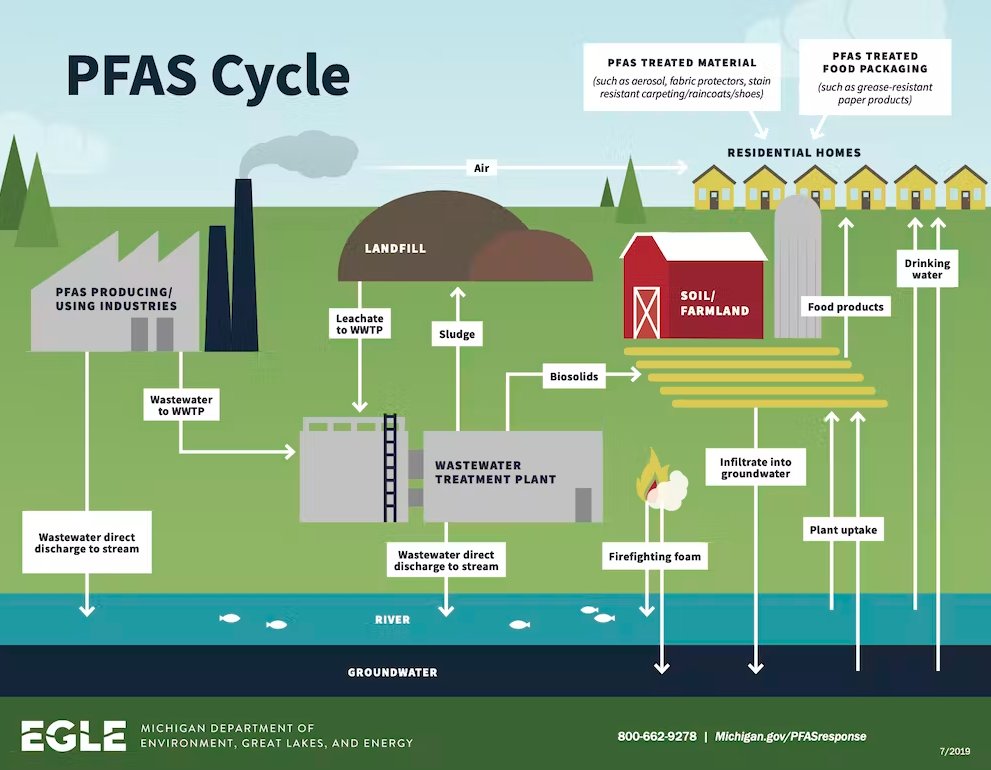
Very concerning. Increasing production and use of Forever chemicals, that is, the thousands of chemicals in the PFAS class: Per- and Polyfluoroalkyl Substances. These are not natural chemicals, and they do not break down in the environment. The chemicals are widely used. According to the Department of Health they are not manufactured in Australia, although plenty of products that use PFAS are imported.

PFAS is spread widely through water pollution and oceans and as aerosols in the atmosphere contaminating soils. PFAS chemicals are found very widely across the earth in rainfall. So, our water resources  are now contaminated.

My attention was drawn to this Euronews article. It sums up the recent scientific findings and outlines the issues: Rainwater everywhere on Earth unsafe to drink due to ‘forever chemicals’, study finds. 

Fluorine signatures and PFAS chemicals have been found in synthetic turf matting and fibers in the USA and in Sweden. With the study in Sweden the researchers say the presence of PFAS chemicals "we believe these results to be broadly translatable to Artificial turfs globally".

Friday, August 26, 2022

Synthetic turf and microplastics under investigation by NSW Chief Scientist

The Office of the Chief Scientist in New South Wales is currently investigating the use of synthetic turf and its environmental impacts, including the generation of microplastics. 

Professor HUGH DURRANT-WHYTE, Commissioner, Natural Resources Commission, and NSW Chief Scientist & Engineer answered questions at the NSW Budget estimates on Tuesday 23 August, 2022.

Durrant-Whyte explained: "It is about suitability for purpose in general, and the Office of the Chief Scientist, in general, doesn't make policy recommendations; it will make science recommendations. There is a lot to do with, as you say, not just microplastics but a whole range of other things, like local temperatures and things like that which impact significantly, but also there is a useability element which is important, so communities actually having access to playing fields and things like that. A lot of things have to be balanced out. Our role in this is to collect the evidence, collect the views, and to genuinely provide the scientific recommendation on which Government can make a policy decision."

The collection of information has been ocurring since the start of 2022 explained Durrant-Whyte. This has included involvement of a number of university groups plus collection of international data.

Wednesday, March 9, 2022

Update on Synthetic turf: risk and impacts associated with floods and bushfires

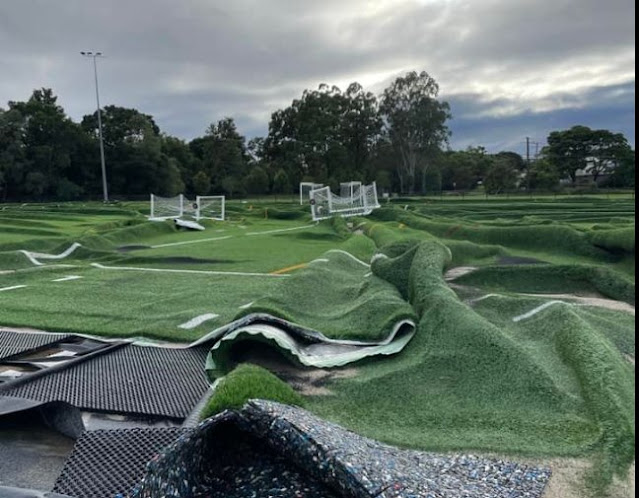
Mitchelton Football club synthetic turf field damaged by flooding of Kedron Brook (Brisbane)

The Queensland and NSW Flood disasters in February and March 2022 highlighted other risks and impacts that were not included in my Literature Review on Synthetic Turf (2021).

The Guardian reported on a football club in north-west Brisbane seeing its $1.5m synthetic playing field damaged and equipment washed away as flood waters inundated the sports fields beside the creek. (Favazzo 2022)

“In one word, it’s devastating,” said Mitchelton football club technical director Joe Fenech, described the damages. 

I don't think Mr Fenech was thinking of the microplastic pollution the synthetic turf caused due to the floodwaters. Much of the field's rubber infill and any loose plastic fibres would be washed away becoming microplastics pollution, adding to this pollution in the world's oceans.

One of the Football Club shipping containers containing sports equipment was washed down Kedron Brook an estimated seven kilometres from Mitchelton to The Grange, according to a Facebook report by the Club.

My literature review focussed on all the environmental problems, but it also focussed in particular on one proposed natural grass sports field conversion to synthetic turf at Hosken Reserve in North Coburg. It looked only at siting issues within that context. But siting of synthetic turf is a general problem to consider especially with regards to flood and bushfire events.

In terms of extreme weather events, both flooding and bushfire risk should be important determinants for contributing to triple bottom line assessments for Synthetic Field siting.

Friday, June 25, 2021

Federal Government called to investigate environmental impacts of artificial turf and more environmentally appropriate alternatives for sporting surfaces

Conversion of grass sporting fields to Synthetic Turf... The Australian Local Government Association (ALGA) National Conference was held in Canberra last weekend 20-23 June 2021, and passed a motion unanimously "to investigate the environmental impacts of artificial turf and more environmentally appropriate alternatives for sporting surfaces."

Issue 24 submitted by Mitcham Council, SA

That the National General Assembly calls on the Federal Government to investigate the environmental impacts of artificial turf and more environmentally appropriate alternatives for sporting surfaces.

The resolution was passed unanimously, including by the Moreland Councillors in attendance: Cr Adam Pulford, Cr Lambros Tapinos, Cr Oscar Yildiz, Cr Helen Pavlidis and Cr Angelica Pandopolous.

Tuesday, April 27, 2021

Sustainable sports fields are natural turf not synthetic in a time of climate emergency

Moreland Council intends rolling out synthetic turf when evidence points to it being a highly problematic environmental and climate issue and at a substantially greater lifecycle cost even when factoring in a higher usage ratio.


So it seems the ratepayers of Moreland are going to be hit with expensive replacement costs of synthetic fields every 7-10 years, an increase in urban heat island which will result in health impacts to residents especially during extreme heat events which are becoming more common, an increase in microplastics pollution to local waterways and Port Philip Bay, 274 tonnes of landfill every 7-10 years, reduced abundance of birdlife, and extra greenhouse gas emissions (lifecycle emissions range from 500-1505 tonnes CO2e for synthetic turf) that will need mitigation. (See the Literature Review: Synthetic Turf carbon footprint, environmental, health, microplastics and biodiversity impacts)

So what is the alternative to Plastic Grass?

Well constructed natural turf field with a carefully chosen grass cultivar to suit the usage and climate.

I have just read a study that was presented at Australian Water Assocation conference last June - Ozwater20 - by Dr Mick Battam (a soil scientist) and Dr Paul Lambie (an irrigation specialist). The study was on building natural turf fields using industrial grade compost. This improves player carrying capacity to about 35-37 hours per week with minimal wear. Their study is titled: Creating Sustainable Open Spaces - Using Compost to Deliver Liveability, Sustainability, Recreation and Economic Outcomes, and is available from Australian Water Assocation website. The study paper concludes:
"Using compost to amend the soils on sports fields has been shown to improve soil fertility. The amendment of soils also reduces irrigation demand, with benefits to the water industry from water savings and increased resilience to drought. A natural turf field built with a wear tolerant turf cultivar and compost amended soil provides for more liveable cities and gives a superior economic outcome to synthetic turf alternatives."

Use of compost for sporting fields to increase their fertility, usage capacity and drought resilience is part of the circular economy. It could provide an outlet for Moreland's green bin food and organic waste collection after it has been through the industrial scale composting process. This is a no-brainer. Moreland Council should embrace this possible reuse of green waste for improving municipal sporting fields.

Friday, April 16, 2021

Statement by John Englart on Synthetic Turf to Moreland Council


John Englart addressing Moreland Council on Synthetic Turf 14 April 2021
(Image courtesy Moreland Council)

I made the following statement to Moreland Council on 14 April 2021 on Synthetic turf and its climate and environmental impact, although a few sections had to be skimmed over for brevity and meeting the 2 minute time limit. I also note problems with the audio feed during my speech on the video recording.

The vote to defeat this motion indicates that some Councillors may have already made their mind up prior to the public engagement being reported back to them and in listening to scientific advice on the subject. I identified clear flaws in the previous consultants report (February 2018) content and its presentation to Council in April 2018 that should indicate the need for a more transparent and in-depth independant assessment of current science on synthetic turf and artificial surfaces for proper triple bottom line decision making and governance.

Literature Review: Synthetic Turf carbon footprint, environmental, health, microplastics and biodiversity impacts


Hosken Reserve: grass oval used for soccer training, informal recreation, off-lead dog exercise
Hosken Reserve: grass oval used for soccer training, informal reacreation, off-lead dog exercise
(Photo by John Englart)

Abstract: 

The conversion of a grass oval to synthetic turf at Hosken Reserve, Coburg North, is about a failure in transparency and consultation with the local community, and poorly framed triple bottom line decision making by Moreland Council. There are questions about the integrity of the triple bottom line decision making embracing the social, environmental and economic impacts, costs and benefits, that was used in the process in the past decade for this site. And there are questions how triple bottom line decision making and weighting of factors will be applied for the current process. 

This literature review provides numerous reasons why conversion of a natural grass oval and open space to a fenced synthetic soccer pitch should not take place. It finds that there are two primary reasons against synthetic turf at Hosken Reserve, and that either reason is significant in itself for the primary project not to go ahead. These two essential reasons are - synthetic turf carbon footprint (up to 1500 CO2e tonnes) in total life cycle greenhouse gas emissions, and synthetic turf increasing waste to landfill contributing to toxic leachates pollution and microplastics pollution. On both these grounds conversion of a shared use natural grass oval to synthetic turf would appear to conflict with existing Council policy and frameworks related to climate change and the climate emergency, and Council’s zero waste to landfill by 2030 target. 

On the triple bottom line factors we found the social factors weighed up with some positive and some negative, the environmental factors were mostly against, and the economics didn’t stack up, even after factoring in 2 to 1 equivalence usage factor for synthetic turf. This review investigated peer reviewed science, grey literature and relevant policy documents to ascertain the following issues with synthetic turf::

  1. Derived from fossil fuel petrochemical industry
  2. Produces greenhouse gas emissions during manufacturing and as it degrades
  3. Increases landfill at end of life
  4. Produces microplastics pollution
  5. Increases urban heat island effect on local residents
  6. Replaces natural grass which allows soil organic carbon sequestration, provides oxygen
  7. Reduces soil biota, grass seeds and insects with a trophic impact on local biodiversity primarily birdlife.
  8. Compacts the soil increasing stormwater runoff
  9. Toxic Chemical leachates from rubber infill pollute waterways
  10. Results in increased lower extremity injuries in elite players
  11. Long term human health impacts uncertain, but vertebrate model confirms toxicity to human health of rubber infill leachates
  12. Enhances infection transmission risk. Encourages a microbial community structure primarily defined by anthropic contamination
  13. Appears to improve water conservation, but the situation is far more complex when life-cycle assessment and irrigation to reduce heat for playability is taken into account
  14. Other issues: increased fire risk, increase in traffic, parking on quiet residential streets
  15. Alternative Solutions

The Climate Action Moreland full submission to Moreland Councillors and Hosken Refresh Consultation can be downloaded in PDF format (27 March 2021). This contained extra information regarding Hosken Reserve and Moreland Couuncil.  The version below has extra references and minor updates but focuses on the science.

This document was researched and prepared by John Englart, Convenor of Climate Action Moreland and was subject to peer review by group members and other active members in the Moreland climate community.

Publication Date: 15 April 2021 

DOI: 10.13140/RG.2.2.28126.56646

Supplementary: Annotated Bibliography on Synthetic Turf and Climate, health, biodiversity and microplastics pollution issues, https://takvera.blogspot.com/2021/04/annotated-bibliography-synthetic-turf.html 


Suggested Citation: Englart, J (2021), Literature Review on environmental and health impacts of synthetic turf., Climate Action Moreland, DOI: 10.13140/RG.2.2.28126.56646

Thursday, April 15, 2021

Annotated Bibliography: Synthetic Turf and Climate, health, biodiversity and microplastics pollution issues


Increasing use of synthetic surfaces and synthetic turf is problematic for Several reasons. 

Synthetic turf is:


  1. Derived from fossil fuel petrochemical industry

  2. Produces greenhouse gas emissions during manufacturing and as it degrades

  3. Increases landfill at end of life

  4. Produces micro-plastic pollution as synthetic turf breaks down

  5. increases urban heat island effect on local residents.

  6. replaces natural grass which allows soil organic carbon sequestration, provides oxygen

  7. reduces soil biota, grass seeds and insects with a trophic impact on local biodiversity primarily birdlife.

  8. compacts the soil increasing stormwater runoff

  9. Toxic Chemical leachates from rubber infill pollute waterways

  10. results in increased lower extremity injuries in elite players 

  11. long term human health impacts uncertain, but vertebrate model confirms toxicity to human health of rubber infill leachates

  12. encourages a microbial community structure primarily defined by anthropic contamination

  13. appears to improve water conservation, but the situation is far more complex when life-cycle assessment and irrigation to reduce heat for playability is taken into account

  14. Other issues: increased fire risk, alternative infills, traffic, parking and cycling


This annotated bibliography was developed for the issue of conversion of an existing grass sports fields to synthetic turf in Moreland Municipality, and includes specific policy documents relating to the issue in Moreland. Most of the articles are peer reviewed science studies plus some relevant grey literature on climate. Most articles I have personally read, although for a small number I only had access to the scientific abstract to review. Google Scholar was used for researching this subject, as well as following reference trails from some science papers.


Moreland Council needs to reassess current recommended plans to rollout synthetic surfaces in the municipality with regard to Council policies developed in recent years. These policies include, but are not limited to, the Climate Emergency Framework including the Zero Carbon Moreland 2040 Framework, Waste and Litter Policy (aiming for zero waste to landfill by 2030 and a circular economy), and the Urban Heat Island Action Plan.


I have cast my scientific reading wide to encompass: total life-cycle assessment analysis related to synthetic fields and natural turf; water use and conservation; energy; soil carbon sequestration; greenhouse gas emissions; heat retention and urban heat island effect; microplastics and pollution; impact on biodiversity and plant health; health impacts and sports injuries. 


This annotated bibliography was prepared for Climate Action Moreland and is current as at 15 April 2021. Climate Action Moreland has published a submission and reference list as: Synthetic Turf and the Tragedy of the Commons in Moreland. Two other related articles were also published recently on carbon footprint and greenhouse gas emissions, and synthetic turf increasing urban heat island impact:

John Englart Convenor Climate Action Moreland.