Mastodon Climate Citizen --> Mastodon
Showing posts with label biodiversity. Show all posts

Sunday, November 3, 2024

Australia at Biological Diversity COP16 in Columbia

UN Convention on Biological Diversity (CBD) COP16 meets from October 20 - 27 in Cali, Columbia. This is a Live article actively updated during October.

Participants will review the state of implementation of the Kunming-Montreal Global Biodiversity Framework, including through alignment with national biodiversity strategies and action plans as well as resource mobilization. At the previous summit, COP15, which was held in Montreal in December 2022, countries agreed to the Kunming-Montreal Global Biodiversity Framework (GBF). The GBF is a set of four goals to 2050 and 23 targets to 2030 with the overarching mission of reversing the decline of biodiversity around the world by 2030. (Read the goals and targets here: The Montreal Moment for Biodiversity: Kunming-Montreal Global Biodiversity Framework adopted)

Australia submitted its 6th national report to the CBD in 2020, and is due this year to submit a new national report.

COP16 Meeting documents | Carbon Brief INtereactive: who wants what | DCCEEW on CBD
CBD Youtube | CBD-Live YoutubeIISD Earth Negotiation Bulletin on COP16

Friday, October 18, 2024

Inaugural Global Nature Positive Summit more financial greenwash than tackling decline in nature and biodiversity

Australia committed two years ago in 2022 at the landmark Convention on Biodiversity COP15 meeting in Montreal to hold an inaugural Global Nature Positive Summit. This occurred in Sydney 8-10 October. 

Unlike the Kunming-Montreal Global Biodiversity Framework adopted at Biodiversity COP15,  the Nature Positive Summit proved to have substantial  greenwash from the Australian and NSW state Governments, as they continue to approve and subsidise new coal and gas or logging of native forests.

The Federal Labor Government had been elected in May 2022 with a commitment to take strong climate action and to revamp and overhaul Australia's ineffective national environment laws. 

A report on State of the Australian Environment had its publication delayed by the previous Coalition Government. This report showed most ecosystems are declining or in a dire state which needs to be addressed, and is already impacting human society and economics. This expert report summaried at The Conversation, argued that:

  • Australia’s environment is generally deteriorating
  • Climate change threatens every ecosystem
  • The importance of Indigenous knowledge and management to deliver on-ground change
  • Environmental management isn’t well coordinated
  • Environmental decline and destruction is harming our well-being

Since Labor came to power in May 2022 we have seen some changes made such as a Water Trigger and Nature Repair Market, further changes to establish an Environment Protection Agency and Data Information Agency at a standstill in the Senate with the Government unwilling to compromise with the Greens and crossbench. Most substantive changes to the Environment Protection and Biodiversity Conservation (EPBC) Act have now been pushed out to beyond the next election. A fundamental fail by this Labor Government.

The Coalition has refused to bargain on a bipartisan basis and has signaled its support for business as usual regarding land clearing, forestry and mining. They too refused to act on the Samuel Review to upgrade ther EPBC Act. Ambition to address biodiversity crisis and species extinction is failing from both major parties.

The Nature Positive Summit seems to be more talkfest as Government policy ambition fails to address the nature negative policies already in place and driving biodiversity loss. The conference was held a week after three new thermal coal mine projects approved by the Federal Government that will result in up to 1.5 billion tonnes of lifecycle greenhouse gas emissions. 

The Labor NSW government can't stand high either as Forests NSW is about to log native forests 400km north of Sydney in the Bulga State Forest, which includes habitat for ther endangered Greater Glider. The Federal Government Regional Forestry Agreements with the states exclude application of the present ineffective national environment laws to protect endangered species.

Tuesday, December 20, 2022

The Montreal Moment for Biodiversity: Kunming-Montreal Global Biodiversity Framework adopted

Final COP15 Decision Plenary at Montreal

The  Kunming-Montreal Global Biodiversity Framework, due to the pandemic, has been four years in the making, was finally adopted in Montreal in the early hours of the morning on the 19th December 2022. 

This is the 'Montreal moment' for the Biodiversity crisis and the Convention on Biological Diversity, the equivalent of the 'Paris moment' for the UNFCCC and the climate crisis. 

Like the Paris Agreement, it is far from being perfect. The consensus process means that much compromise is entailed in reaching a global agreement. 

It sets mission goals for 2030 and 2050 to arrest loss of ecosystems and conserve species numbers. It includes an ambitious 30 per cent of land and 30 per cent of ocean for conservation by 2030. This is a step in the right direction, although recent science says that between 44 per cent (1) or 50 percent of land (2) may be necessary to protect to meet the mission statement.

The Package also includes reform of $500bn (£410bn) of environmentally damaging subsidies, and halt pollution that damages ecosystems by the end of the decade. Countries from the global north would contribute $30bn a year for conservation by the end of the decade. 

Strong language for the protection of indigenous rights and territories emphasised throughout the 23 specific targets and four goals that make up the main agreement, known as the post-2020 global biodiversity framework. 

While a separate Biodiversity Fund was not agreed, there was a compromise plan to create a new financing mechanism for biodiversity housed under the UN’s Global Environment Facility (GEF).

Monday, December 19, 2022

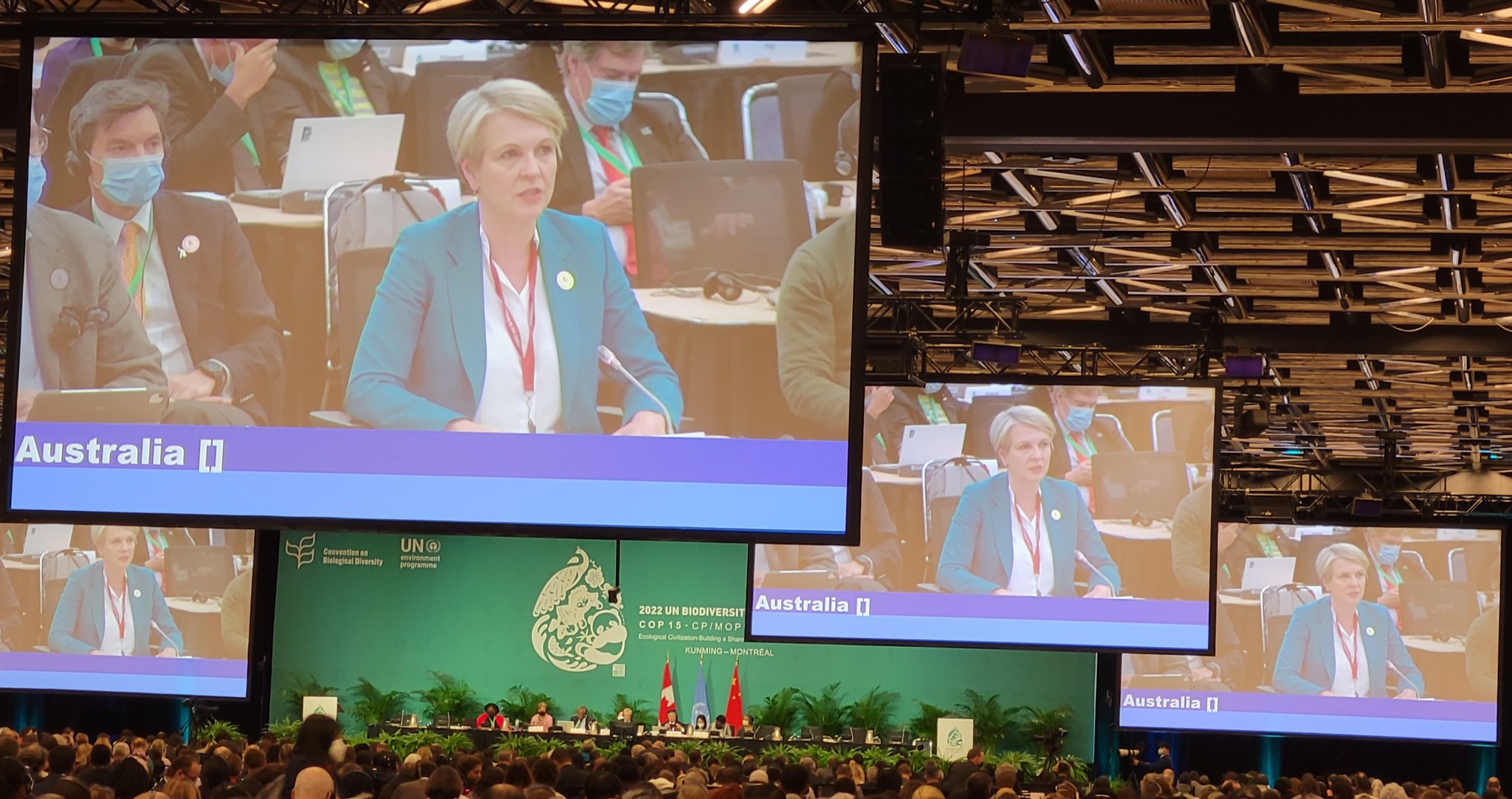
Australia and the UN Biodiversity Conference COP15

Tanya Plibersek in Plenary Photo: Nat Pelle (ACF)


The United Nations Biodiversity Conference (COP15 / CP-MOP10 / NP-MOP4) is meeting in Montreal, Canada, 7-19 December 2022. This is part of the UN Convention on Biological Diversity (CBD).

The Biodiversity conference is important as countries will set the 2030 targets. Parties will seek to finalise the 10-year post-2020 global biodiversity framework (GBF). (read my blog on Global framework on Biodiversity - Australian statement on the Convention on Biodiversity 2030 target)

Environment Minister Tanya Plibersek has confirmed she will attend COP15 in Montreal.

| COP15 Day Summaries | Australian Pledges | Tracking Minister Plibersek | Resources |

Breaking: Kunming-Montreal Global Biodiversity Framework adopted, although not without some controversy over objection of DRC. See The Montreal Moment for Biodiversity: Kunming-Montreal Global Biodiversity Framework adopted

Thursday, December 8, 2022

Minister outlines major update to Australian environmental laws and the EPBC Act by end of 2023

Photo: Tanya Plibesek speech
Australia: Environment Minister Tanya Plibersek announces formal response to the Independent Review of Australia’s Environment Protection and Biodiversity Conservation Act.
 
"At the heart of our reform is a conceptual shift. When we reform our environmental laws, we will take them from being nature negative, where we just manage an overall decline in our environment, to nature positive, where we protect our land and leave it in a better state than we found it." said Plibersek at a Queensland Conservation Council event. 

Major Reforms include: 
  • introduction of National Environmental Standards, 
  • new system of regional planning, 
  • overhaul of environmental offsets, and 
  • establishment of an independent Environment Protection Agency. 

New National Environmental Standards will apply to Regional Forestry Agreements, which were previously exempt from EPBC Act regulation. This means threatened species and ecosystems will come back under Federal government regulation.

Climate will be a consideration, but no climate trigger for the amended legislation: 
"proponents of large projects be required to publish their lifetime, domestic carbon dioxide emissions. Proponents will also be required to disclose what they will do to manage or offset their emissions, in line with Australia’s climate targets."

"Time to forge a Peace Pact with Nature" says UN Secretary General Antonio Guterres at COP15 Biodiversity conference:

Antonio Guterres, the UN Secretary General, again stepped up the rhetoric at the openning plenary of the Biodiversity conference in Montreal, calling for a "Peace Pact with Nature".

He articulated the rapid species and ecosystems decline and the costs to humanity of cost measured in lost jobs, hunger, diseases and deaths, and higher prices for water, food and energy.

He focussed on three concrete actions:

  • Governments should develop bold national action plans across all ministries, from finance and food, to energy and infrastructure. This includes "plans that re-purpose subsidies and tax breaks away from nature-destroying activities towards green solutions like renewable energy, plastic reduction, nature-friendly food production and sustainable resource extraction. Plans that recognize and protect the rights of Indigenous peoples and local communities, who have always been the most effective guardians of biodiversity. And National Biodiversity Finance Plans to help close the finance gap."
  • The private sector and business must recognize that profit and protection must go hand-in-hand. That means the food and agricultural industry moving towards sustainable production and natural means of pollination, pest control and fertilization. It means the timber, chemicals, building and construction industries taking their impacts on nature into account in their business plans. It means the biotech, pharmaceutical and other industries that use biodiversity sharing the benefits fairly and equitably. It means tough regulatory frameworks and disclosure measures that end greenwashing, and hold the private sector accountable for their actions across every link of their supply chains. And it means challenging the relentless concentration of wealth and power by few that is working against nature and the real interests of the majority.  
  • Dveloped countries must provide bold financial support for the countries of the Global South as custodians of our world’s natural wealth.

Friday, September 23, 2022

Australia commits to Global Nature Pledge to reverse biodiversity loss by 2030 during UN General Assembly

More than 93 countries have signed the Global Leaders Pledge for Nature for Sustainable Development to reverse biodiversity loss by 2030. Prime Minister Anthony Albanese just committed Australia to this pladge. The previous government of Scott Morrison refused to act on this pledge.

The pledge was developed by the Alliance of Small Island States (AOSIS), Belize, Bhutan, Colombia, Costa Rica, the EU, Finland, Kenya, Seychelles, the UK and an alliance of organisations.

It is part of the UN convention on Biological Diversity which is considering a new global draft agreement (PDF) for adoption at Montreal, Canada, from 7 - 19 December 2022  Conference of the Parties meeting (COP15). This is a landmark agreement addressing the biodiversity crisis, an equivalent for what the Paris Agreement did for climate change.

Thursday, September 2, 2021

Global framework on Biodiversity - Australian statement on the Convention on Biodiversity 2030 target


Australia's statement on the Convention on Biodiversity Plenary 24 Aug - Open-ended Working Group 3 on Post-2020 Global Biodiversity Framework. The Conference of the Parties (COP15) for the Convention on Biodiversity is coming up early next year. I haven't seen any local news on this...

I'd like to highlight this part of the statement in particular:
"Australia welcomes a global target for the protection of 30 per cent of land and 30 per cent of sea by 2030. We support the focus in this target on areas important for biodiversity and through a combination of protected areas and other effective area-based conservation measures. Australia also recognises that Indigenous Peoples and Local Communities (IPLCs) must be full partners in the implementation of this target."

You can read the draft global framework on Biodiversity to be put for adoption.

The draft framework includes 21 targets for 2030 that call for, among other things:

• At least 30% of land and sea areas global (especially areas of particular importance for biodiversity and its contributions to people) conserved through effective, equitably managed, ecologically representative and well-connected systems of protected areas (and other effective area-based conservation measures) 
• A 50% of greater reduction in the rate of introduction of invasive alien species, and controls or eradication of such species to eliminate or reduce their impacts 
• Reducing nutrients lost to the environment by at least half, and pesticides by at least two thirds, and eliminating the discharge of plastic waste 
• Nature-based contributions to global climate change mitigation efforts of least 10 GtCO2e per year, and that all mitigation and adaptation efforts avoid negative impacts on biodiversity 
• Redirecting, repurposing, reforming or eliminating incentives harmful for biodiversity, in a just and equitable way, reducing them by at least $US 500 billion per year 
• A $US 200 billion increase in international financial flows from all sources to developing countries.

Friday, April 16, 2021

Literature Review: Synthetic Turf carbon footprint, environmental, health, microplastics and biodiversity impacts


Hosken Reserve: grass oval used for soccer training, informal recreation, off-lead dog exercise
Hosken Reserve: grass oval used for soccer training, informal reacreation, off-lead dog exercise
(Photo by John Englart)

Abstract: 

The conversion of a grass oval to synthetic turf at Hosken Reserve, Coburg North, is about a failure in transparency and consultation with the local community, and poorly framed triple bottom line decision making by Moreland Council. There are questions about the integrity of the triple bottom line decision making embracing the social, environmental and economic impacts, costs and benefits, that was used in the process in the past decade for this site. And there are questions how triple bottom line decision making and weighting of factors will be applied for the current process. 

This literature review provides numerous reasons why conversion of a natural grass oval and open space to a fenced synthetic soccer pitch should not take place. It finds that there are two primary reasons against synthetic turf at Hosken Reserve, and that either reason is significant in itself for the primary project not to go ahead. These two essential reasons are - synthetic turf carbon footprint (up to 1500 CO2e tonnes) in total life cycle greenhouse gas emissions, and synthetic turf increasing waste to landfill contributing to toxic leachates pollution and microplastics pollution. On both these grounds conversion of a shared use natural grass oval to synthetic turf would appear to conflict with existing Council policy and frameworks related to climate change and the climate emergency, and Council’s zero waste to landfill by 2030 target. 

On the triple bottom line factors we found the social factors weighed up with some positive and some negative, the environmental factors were mostly against, and the economics didn’t stack up, even after factoring in 2 to 1 equivalence usage factor for synthetic turf. This review investigated peer reviewed science, grey literature and relevant policy documents to ascertain the following issues with synthetic turf::

  1. Derived from fossil fuel petrochemical industry
  2. Produces greenhouse gas emissions during manufacturing and as it degrades
  3. Increases landfill at end of life
  4. Produces microplastics pollution
  5. Increases urban heat island effect on local residents
  6. Replaces natural grass which allows soil organic carbon sequestration, provides oxygen
  7. Reduces soil biota, grass seeds and insects with a trophic impact on local biodiversity primarily birdlife.
  8. Compacts the soil increasing stormwater runoff
  9. Toxic Chemical leachates from rubber infill pollute waterways
  10. Results in increased lower extremity injuries in elite players
  11. Long term human health impacts uncertain, but vertebrate model confirms toxicity to human health of rubber infill leachates
  12. Enhances infection transmission risk. Encourages a microbial community structure primarily defined by anthropic contamination
  13. Appears to improve water conservation, but the situation is far more complex when life-cycle assessment and irrigation to reduce heat for playability is taken into account
  14. Other issues: increased fire risk, increase in traffic, parking on quiet residential streets
  15. Alternative Solutions

The Climate Action Moreland full submission to Moreland Councillors and Hosken Refresh Consultation can be downloaded in PDF format (27 March 2021). This contained extra information regarding Hosken Reserve and Moreland Couuncil.  The version below has extra references and minor updates but focuses on the science.

This document was researched and prepared by John Englart, Convenor of Climate Action Moreland and was subject to peer review by group members and other active members in the Moreland climate community.

Publication Date: 15 April 2021 

DOI: 10.13140/RG.2.2.28126.56646

Supplementary: Annotated Bibliography on Synthetic Turf and Climate, health, biodiversity and microplastics pollution issues, https://takvera.blogspot.com/2021/04/annotated-bibliography-synthetic-turf.html 


Suggested Citation: Englart, J (2021), Literature Review on environmental and health impacts of synthetic turf., Climate Action Moreland, DOI: 10.13140/RG.2.2.28126.56646

Thursday, April 15, 2021

Annotated Bibliography: Synthetic Turf and Climate, health, biodiversity and microplastics pollution issues


Increasing use of synthetic surfaces and synthetic turf is problematic for Several reasons. 

Synthetic turf is:


  1. Derived from fossil fuel petrochemical industry

  2. Produces greenhouse gas emissions during manufacturing and as it degrades

  3. Increases landfill at end of life

  4. Produces micro-plastic pollution as synthetic turf breaks down

  5. increases urban heat island effect on local residents.

  6. replaces natural grass which allows soil organic carbon sequestration, provides oxygen

  7. reduces soil biota, grass seeds and insects with a trophic impact on local biodiversity primarily birdlife.

  8. compacts the soil increasing stormwater runoff

  9. Toxic Chemical leachates from rubber infill pollute waterways

  10. results in increased lower extremity injuries in elite players 

  11. long term human health impacts uncertain, but vertebrate model confirms toxicity to human health of rubber infill leachates

  12. encourages a microbial community structure primarily defined by anthropic contamination

  13. appears to improve water conservation, but the situation is far more complex when life-cycle assessment and irrigation to reduce heat for playability is taken into account

  14. Other issues: increased fire risk, alternative infills, traffic, parking and cycling


This annotated bibliography was developed for the issue of conversion of an existing grass sports fields to synthetic turf in Moreland Municipality, and includes specific policy documents relating to the issue in Moreland. Most of the articles are peer reviewed science studies plus some relevant grey literature on climate. Most articles I have personally read, although for a small number I only had access to the scientific abstract to review. Google Scholar was used for researching this subject, as well as following reference trails from some science papers.


Moreland Council needs to reassess current recommended plans to rollout synthetic surfaces in the municipality with regard to Council policies developed in recent years. These policies include, but are not limited to, the Climate Emergency Framework including the Zero Carbon Moreland 2040 Framework, Waste and Litter Policy (aiming for zero waste to landfill by 2030 and a circular economy), and the Urban Heat Island Action Plan.


I have cast my scientific reading wide to encompass: total life-cycle assessment analysis related to synthetic fields and natural turf; water use and conservation; energy; soil carbon sequestration; greenhouse gas emissions; heat retention and urban heat island effect; microplastics and pollution; impact on biodiversity and plant health; health impacts and sports injuries. 


This annotated bibliography was prepared for Climate Action Moreland and is current as at 15 April 2021. Climate Action Moreland has published a submission and reference list as: Synthetic Turf and the Tragedy of the Commons in Moreland. Two other related articles were also published recently on carbon footprint and greenhouse gas emissions, and synthetic turf increasing urban heat island impact:

John Englart Convenor Climate Action Moreland.

Wednesday, February 8, 2017

Great Forest National Park and Port Philip Bay: communicating conservation research at #vicbiocon17


Sarah Rees and Sheree Maris gave two inspiring presentations on science communication in conservation and biodiversity in an afternoon plenary at the Victorian Biodiversity Conference in Melbourne.

Its always nice to discover new natural wonders in our local area. It enhances our sense of place and pride in nature, and is an important motivation for conservation.

Sarah Rees and Sheree Maris bring us the wonders of the ancient Central Highland forests and the extraordinary ecosystems hiding just under the surface of Port Philip. Both of these environments are just on the edge of Melbourne, yet are largely unknown and unexplored by most Melburnians.

Friday, October 16, 2015

Europe Diary: London Natural History Museum misses Anthropocene climate education opportunity


Original article published at nofibs.com.au
Like many visitors and tourists to London I took the opportunity to visit the London Natural History Museum. I visited this museum 19 years ago and spent a whole day there with my older step children when they were 11 and 9 years old.

So I was keen to go back and share a new experience at the museum with my 15 year old daughter. Many interactive exhibits had changed, but many case exhibits looked pretty much exactly as I remembered them.

I remember my visit to the Mammals room with the Blue Whale as the centre piece hanging from the ceiling. The blue whale was still there but surrounded by scaffolding being restored. I guess you expect some continual maintenance in a museum, but I was a little disappointed.

Wednesday, July 15, 2015

Bumblebee populations in steep decline due to climate change in North America and Europe


Bumblebee populations in North America and in Europe are in steep decline and shrinking their ranges due to human caused climate change says new research. The study was conducted across two continents based on over 110 years of data and observations.

This has enormous implications for pollination and eco-system health, as well as for human agricultural productivity. Many trees and plants are dependant to varying extents for reproduction and fruit on pollination by insects including bumble bees.

What was thought to be just one of several factors affecting wild and domesticated bee populations, is now seen to be far more important. Factors affecting the decline of bee populations include Colony Collpase disorder, use of pesticides including neonicotinoids, habitat loss, low genetic diversity and high infection rates with the parasite pathogens, and climate-driven mismatch between the times when flowers open and when bees emerge. (See my 2011 article: A dangerous sting for agriculture: climate change implicated in bee decline)

Saturday, February 22, 2014

Whitehaven coal mine offsets not compatible with threatened ecosystems being destroyed

The Whitehaven coal mine at Maule's Creek near Boggabri in north Western NSW involves the destruction of a substantial part of the Leard Forest. One of the requirements for approval was the provision of environmental offsets to balance 'like for like' against the destruction of high biodiversity habitat. But the latest environmental report by Dr John Hunter advises the offsets for critically endangered ecological communities are "vastly overstated".

This shows that the approval under the EPBC Act by former Environment Minister Tony Burke and the continued support given by current Environment minister Greg Hunt are a travesty and likely a dereliction of duty of care for the environment, threatened species and biodiversity.

Related: Front Line Action on Coal | Leard State Forest | Maule's Creek Community | No Fibs Leard Blockade reports

Tuesday, October 15, 2013

Climate Departure: Oceans already outside historical variability as cities and ecosystems follow


Researchers from the University of Hawaii have estimated the year when we depart the climate variability we have historically known for cities around the globe. But the study also identifies that the planet's oceans have already passed their climate departure point, and that the greatest impact of global warming will be felt in biodiversity and ecosystems in the tropics.

In a study published in Nature - The projected timing of climate departure from recent variability (abstract) - researchers lead by Camilo Mora from the Geography Department at the University of Hawaii sought to identify the point at which the climate at 54,000 locations on Earth will exceed the bounds of historical variability. They used a baseline period of 1860 to 2005 to determine natural temperature variability. Using results averaged from 39 different climate models, they then determined for each location measured the year point in which the coldest years are likely to be consistently hotter than any of the past 150 years.

Friday, August 23, 2013

If threatened species could vote...Wills candidates discuss biodiversity

From my election 2013 series - see my Wills 2013 seat reports at Nofibs.com.au


Leadbeaters Possum is on the endangered list, presently being assessed for upgrading to critically endangered Photo: John Englart
Environment and biodiversity have hardly rated a mention by the mainstream media in this Federal election campaign. Bread and butter issues of economic stability and national leadership predominate. But the election is being held on September 7, threatened species day, with the World Wildlife Fund Australia launching a series of television ads on the impact of climate change on the environment.

Even many Common plants and animals are facing dramatic biodiversity decline from climate change. But as environmentalist Margaret Blakers argues in The Guardian, we do have time to turn it around if there is political will.

Wednesday, August 7, 2013

Election 2013 called on Threatened Species Day – September 7

From my election 2013 series - original at Fawkner.org

The election has been called by Kevin Rudd at last for September 7th, one week before Julia Gillard's announced date. The campaign is on. September 7 also happens to be Threatened Species Day. It is perhaps significant as action on climate change, the future of clean energy programs and investment, and conservation and biodiversity programs are at risk.

Matted Flax lilly
Photo: Matted Flax lilly at Bababi Djinanang
One tends to think in the city that biodiversity is not a great concern, but here in Fawkner we have the Matted Flax-lily (Dianella amoena) at Bababi Djinanang native grassland. The species is nationally endangered although only listed as vulnerable in Victoria. We sometimes have platypus in Merri Creek and kangaroos that follow the creek down into the Fawkner grasslands.

These are wondrous sights to see in our urban environment along our creek nature reserves. Once degraded and used as little more than drains, many people have put incredible effort into re-vegetation and restoration of our creek environments, including Friends of Merri Creek and Merri Creek Management Committee.

Thursday, July 25, 2013

Prime Minister Rudd axes Biodiversity Fund in carbon pricing shakeup

Elimination of the $1 billion Biodiversity Fund is a major impact of Prime Minister Rudd's shake-up of Australia's carbon pricing policy and bringing forward the introduction of the Emissions Trading Scheme (ETS) by one year to 1st July 2014. This relegates Australia's funding of biodiversity programs to the same level as many third world countries like the Congo and Iraq. Well done Prime Minister. A real race to the bottom on conservation.

There is a global Biodiversity crisis with habitat and climate change causing a 6th mass extinction. Species biodiversity under threat from the velocity of climate change. Even many Common plants and animals facing dramatic biodiversity decline from climate change.

Wednesday, June 12, 2013

Climate change driving California native Freshwater fish species to extinction

Eighty two percent of native freshwater fish species in California, including salmon, are likely to become extinct on present trends within the next century due to climate change, reports a study lead by Professor Peter Moyle from University of California Davis.

The study - Climate Change Vulnerability of Native and Alien Freshwater Fishes of California: A Systematic Assessment Approach - found that, of 121 native fish species, 82 percent are likely to be driven to extinction or very low numbers as climate change speeds the decline of already depleted populations. In contrast, the study reported that 19 percent of the 50 non-native fish species in the state face a similar risk of extinction. Many non-native fish are likely to thrive in changed aquatic conditions, mostly at the expense of native species.

"If present trends continue, much of the unique California fish fauna will disappear and be replaced by alien fishes, such as carp, largemouth bass, fathead minnows and green sunfish," said Peter Moyle, a professor of fish biology at UC Davis who has been documenting the biology and status of California fish for the past 40 years.

"Disappearing fish will include not only obscure species of minnows, suckers and pupfishes, but also coho salmon, most runs of steelhead trout and Chinook salmon, and Sacramento perch," Moyle said.

Sunday, June 9, 2013

Frogs, Salamanders, turtles declining rapidly in US due to climate change and habitat loss

A recent study revealed amphibian declines are occurring much more rapidly and more widespread than expected in species populations across the United States, even in protected national parks and wildlife refuges.

"This new study confirms that our country's amphibians are facing an extinction crisis that demands aggressive action to tackle threats like habitat destruction and climate change," said Collette Adkins Giese, a Center for Biological Diversity biologist and attorney focusing on protection of amphibians and reptiles. "Scientists have known for a long time that frogs, toads and salamanders are in big trouble, but the declines this study documents are surprising and disturbing."