Mastodon Climate Citizen --> Mastodon
Showing posts with label PFAS. Show all posts

Monday, July 10, 2023

Ozone layer in Recovery, Montreal Protocol reducing Greenhouse gases set to avoid global warming by about 0.5–1°C by 2050

Photo: IISD/ENB OEWG contact group meeting
The Montreal Protocol, the little international treaty that reduces ozone depleting substances but also assists greatly with reducing greenhouse gases causing global warming.

The 45th Meeting of the Open-ended Working Group of the Parties to the Montreal Protocol met in Thailand between 2 to 7 July 2023.

The IISD/ENB summary report of the meeting notes:

"The success of the Montreal Protocol was again highlighted and further specified by the Scientific Assessment Panel (SAP): stratospheric ozone is on the way to full recovery, expected by around 2040 for the near-global average, around 2045 in the Arctic, and around 2066 in the Antarctic. At the same time, the decline in ozone depleting substance (ODS) emissions due to compliance with the Protocol is set to avoid global warming by about 0.5–1°C by 2050, compared to an uncontrolled increase in ODS. Another 0.3–0.5°C of avoided warming by 2100 is estimated due to the phase-down of HFCs, the ozone-friendly but climate-warming greenhouse gases controlled under the Kigali Amendment to the Montreal Protocol."

Tuesday, May 23, 2023

Submission on Synthetic Turf to Moonee Valley Council for JH Allan Reserve


The following submission to Moonee Valley Council was made 22 March 2023 regarding a plan to redevelop JH Allan Reserve, including a proposal to turn open space natural grass sports field to a synthetic turf soccer pitch. 

I followed my original submission with an addendum on 4th April due to new information before the consultation closed.

Even during that short time period a new scientific review and new research had become known regarding the threat of airborne microplastics, with synthetic turf implicated as one source for airborne microplastics. 

The redevelopment of JH Allan Reserve in Keilor East  was identified in the Moonee Valley Soccer Strategy presented to Council meeting in September 2022. The strategy identified opportunities to improve sports infrastructure at J H Allan Reserve. 

Upgrade to lighting using new energy efficient LED sports lights to the eastern sports field is under consideration to improve evening use and minimise light spill and glare.

Repurposing of the western sports field natural grass currently used as a cricket oval and open space to a synthetic turf soccer pitch is under active consideration. 

Once again we see Soccer driving the push for synthetic turf, without a consideration of possible alternatives, including new research on improved natural turf surfaces providing increased capacity.

"At this stage, no scoping or design work in relation to this potential development has commenced." said Moonee Valley Council. "initial estimates based on similar recent projects indicate this development would cost between $4-$5 million."

After 7-10 years the synthetic turf matting and infill will need to be replaced. Current cost for a soccer pitch synthetic surface replacement is $750,000 (Estimate for Clifton Park 2023/24 Merribek Council Capital Works Budget)

In Mid-2023 there will be a Report back to Moonee Valley Council following the completion of the community consultation process.

Having Milleara Gardens Kindergarten located next to the Western oval where the Synthetic turf conversion is proposed should also raise concerns in particular about possible urban heat impacts on learning and airborne microplastics pollution and childrens health. This was not included in my submission or addendum.

Friday, September 16, 2022

Microplastics pollution threat fails to be included in Hockey Feasibility study for Moreland Council

On Wednesday night I made a statement to Moreland Council meeting on Agenda item 7.9 Hockey Feasibility Study for a second Field Hockey pitch in Moreland.

My concerns were that Council needs to consider all the information on health and environmental impacts of synthetic turf, as well as the well argued social benefits, as part of good governance for making an informed  decision. This includes assessing carbon footprint, greenhouse gas emissions climate impact, urban heat, microplastics pollution and reduction in biodiversity, and disposal at end-of-life.

The Feasibility Report had a number of errors which I tried to highlight in my statement, the major one being the complete absence of the microplastics pollution threat. 

A Swiss/German study published October 2021 found that between 50 kilograms to over 1 metric ton per year was the average fibre loss from a synthetic pitch. (Bertling et al 2021) This is separate from infill loss assessed at 2.98 tonnes average per year from the same study (which would mainly apply to soccer artificial turf rather than hockey). 

There are several more errors in the Feasibility study I did not go into.

The health and environmental impacts that were mentioned, were not adequately detailed or quantified which was in sharp comparison to data provided to justify the social benefits. 

My Literature Review: Synthetic Turf carbon footprint, environmental, health, microplastics and biodiversity impacts, published April 2021, highlighted numerous impacts including in the areas of urban heat, microplastics and carbon footprint. The Literature review also explored how use of synthetic turf is an aspect of the Plastics crisis, is concurrent with and related to the climate crisis.

Wednesday, September 7, 2022

PFAS, synthetic turf and a new planetary boundary proposed and being exceeded


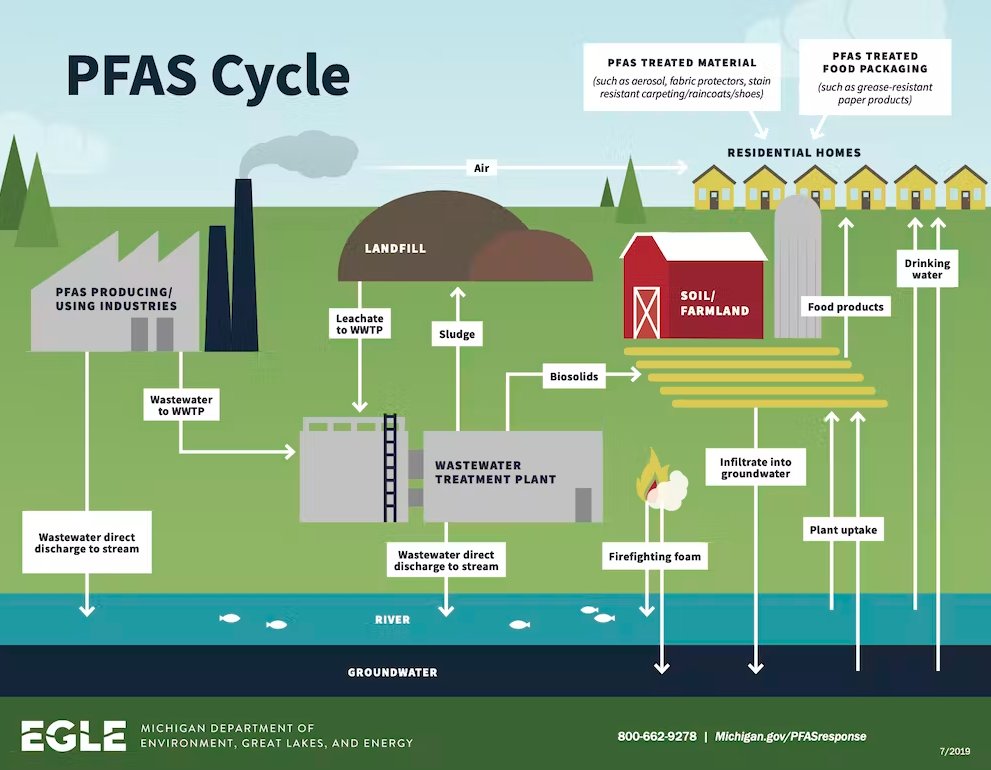
Very concerning. Increasing production and use of Forever chemicals, that is, the thousands of chemicals in the PFAS class: Per- and Polyfluoroalkyl Substances. These are not natural chemicals, and they do not break down in the environment. The chemicals are widely used. According to the Department of Health they are not manufactured in Australia, although plenty of products that use PFAS are imported.

PFAS is spread widely through water pollution and oceans and as aerosols in the atmosphere contaminating soils. PFAS chemicals are found very widely across the earth in rainfall. So, our water resources  are now contaminated.

My attention was drawn to this Euronews article. It sums up the recent scientific findings and outlines the issues: Rainwater everywhere on Earth unsafe to drink due to ‘forever chemicals’, study finds

Fluorine signatures and PFAS chemicals have been found in synthetic turf matting and fibers in the USA and in Sweden. With the study in Sweden the researchers say the presence of PFAS chemicals "we believe these results to be broadly translatable to Artificial turfs globally".