Mastodon Climate Citizen --> Mastodon

Monday, January 13, 2014

Extreme Heatwave hits Southeast Australia

This page may be updated further in coming days
Last week we saw record temperatures in a heatwave in Queensland and Western New South Wales with 34 maximum temperatures broken and mass deaths of flying foxes. The heat has been building over the last week in Western Australia and central Australia with an extreme heatwave across much of south east Australia forecast for this week.

Alasdair Hainsworth, Assistant Director for Weather Services at the Bureau of Meteorology said “What is unusual about this event, which the pilot heatwave forecast shows, is that when high maximum temperatures and above average minimum temperatures are sustained over a number of days, there is a build-up of ‘excess’ heat. Extreme heatwave conditions can be seen in southern NSW, Victoria and Tasmania."

Tess Parker from Monash University explains the dynamics of the heatwave at the Conversation: What’s cranking up the heat across south-eastern Australia?

Saturday, January 11, 2014

Climate Geo-engineering study on sulphate injection shows Hydrological disruption to rain and severe drought

While politicians have effectively dithered on robust action to reduce greenhouse gas emissions over the last 20 years we are hearing more about geo-engineering proposals to moderate rising temperatures. But the latest study from the University of Reading scientists modelling solar radiation management, and in particular atmospheric aerosol injection - one of the easiest geo-engineering proposals to do at large scale - says such a project would result in a major decrease in tropical rainfall and an increase in drought in many regional areas.

The Reading University study concentrated on the consequences on geo-engineering methods to change the solar radiation reaching the earth: through mirrors above the atmosphere; and injecting sulfate aerosols into the atmosphere to reflect solar radiation. The first could prove hideously expensive and is at the moment impractical, but the second method is quite achieveable at reasonable cost.

The study - Weakened tropical circulation and reduced precipitation in response to geoengineering (Full paper) - looks at aerosol injection in particular and the projected impacts. It was published in Environmental Research Letters.

Related: Yale Environment360: Solar Geoengineering: Weighing Costs of Blocking the Sun’s Rays (9 Jan 2014)

Thursday, January 9, 2014

Guest Post: Climate change may cut cloud cover and increase temperatures - higher climate sensitivity likely

It seems there is no silver lining in clouds as a moderating influence for a warming climate. In fact, indications are the latest research reduces some uncertainty in a crucial area, which means that climate sensitivity will be towards the higher end of the range at about 3 to 5 degrees Celsius for a doubling of atmospheric carbon dioxide. This means we are well on track to realising 4 degrees world by the end of the century. In this article from the Conversation Professor Steve Sherwood explains the importance of this research for climate sensitivity.

Related: Peter Sinclair: Happy New Year. It's worse than we thought, Climate Code Red: Warming climate may cut cloud cover, push temperatures even higher See also comments by Michael E. Mann and Gavin Schmidt at Real climate Blog: A Bit More Sensitive....

Wednesday, January 8, 2014

Risk attribution Study: Record Australian 2013 temperatures caused by climate change

Professor David Karoly and Post-doctoral researcher Sophie lewis have been undertaking analysis on the temperature record for Australia in 2013. Their article published at The Conversation - Australia’s hottest year was no freak event: humans caused it - is an attribution of risk study of the extreme Australian heat in 2013 involving statistical probability analysis. This is cutting edge climate science research using Global Climate modelling, simulations and probability analysis to determine likely cause.

Last year Lewis and Karoly examined the temperatures for the 2012-2013 Australian summer using Fractional Attribution of Risk (FAR) analysis, publishing a study - Anthropogenic contributions to Australia's record summer temperatures of 2013 (open access) - that "found that it was very likely (with 90% confidence) that human influences increased the odds of extreme summers such as 2012-13 by at least five times."

Fractional Attribution of Risk (FAR) methodologies were originally developed in epidemiology, health and population studies, and over the last few years have been applied to extreme weather events to determine the statistical likelihood of these events being substantially caused or contributed to by human caused greenhouse gas emissions and climate change. You can read background on Why bother trying to attribute extreme events? at the Real climate Blog.

2013 temperatures for Australia were off the charts claims Climate Council


The Climate Council has released it's latest report written by Professor Will Steffen: Off the Charts: 2013 was Australia's hottest year.

It draws heavily on the detail in the Bureau of Meteorology Annual Climate Statement for 2013 which I reported on, but also puts the information in context with the global trend and other scientific papers and reviews such as the IPCC Fifth Assessment Report, IPCC Working Group 1: the Physcical Science released in late September 2013.

If follows the Climate Council's first major report published at the end of 2013 on by Professor Lesley Hughes: Be Prepared: Climate Change and the Australian Bushfire Threat.

Tuesday, January 7, 2014

Mass bat deaths in record setting Queensland heatwave

Flying Foxes are dropping to earth and dying in their thousands from heat exhaustion. The extreme heat in Queensland from the 29 December to 5 January has taken a massive toll of flying fox colonies, warns a wildlife conservation organisation. It is estimated that perhaps hundreds of thousands of native flying foxes have died as a direct result of the record setting high temperatures in the heatwave event across Queensland and north western NSW.

Last year Australia suffered it's hottest year on record, with scientists claiming that extensive fractional risk attribution modelling of 2013 temperatures that this was clearly caused by human greenhouse gas emissions and climate change.

A wildlife conservation organisation, the Bat Conservation and Rescue Queensland Ltd, said that "many colonies across South-East Queensland have been severely affected including those at Camira, Mt. Ommaney, Pan Pacific Gardens, Regents Park, Boonah, Bellmere, Pine Rivers and Palmwoods. Reports indicate all Western Suburbs colonies and inland, and colonies from Gympie down to Yamanto have been devastated."

We tend to think of our own comfort and safety in extreme weather events, but animals and plants can also suffer. Heat related stress is a major cause of increased human mortality during heatwaves. But these events also impact populations of many species such as flying foxes and birds. They can't seek shelter in air-conditioned lounge rooms or shopping centres (except maybe the odd few sparrows). Instead, they fall from their tree roosts suffering heat exhaustion and dehydration.

Monday, January 6, 2014

Australian Heatwave temperatures climb towards 50C at start of 2014

With substantial heat in the continental centre, the first days of 2014 saw temperatures climb towards 50C in western Queensland, western NSW, South Australia and parts of Western Australia and the Northern Territory.

See this video report from the Guardian (3 January 2013) of bushfires on North Stradbroke Island in south east Queensland, and temperatures hitting 54C at Oodnadatta in South Australia.

Related: 2013 hottest year on record for Australia | Sea surface temperatures unusually warm around Australia in 2013

Sunday, January 5, 2014

2013 hottest year on record for Australia

Australia's Bureau of Meteorology (BOM) confirmed on 3 January 2014 in the annual climate statement that 2013 was the hottest year on record for Australia. This was all the more concerning considering the neutral ENSO conditions. 2013 also ranks as the sixth-warmest year since global records commenced in 1880, according to the WMO.

Related: Sea surface temperatures unusually warm around Australia in 2013 | 2013 was Australia's hottest year, warm for much of the world say Bureau of Meteorology scientists | SMH: Climate change: It's hot - and not just in the kitchens of bickering MPs | Alex White (Guardian): Australia swelters under a sham climate change policy after hottest year on record

Sea surface temperatures unusually warm around Australia in 2013

Sea surface temperatures around Australia in 2013 were unusually warm reported the Australian Bureau of Meteorology in it's annual climate statement. Record ocean temperatures were recorded for January and February, with November the second-highest on record. This continues a long term trend for increasing sea surface temperatures around Australia and globally.

Updates:

Friday, January 3, 2014

Volcanic activity adds further to instability of West Antarctic Ice Sheet

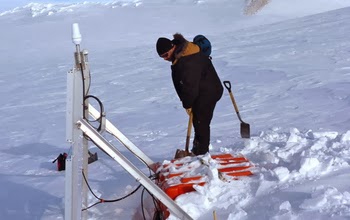
Volcanic activity detected near the Executive Committee range in Marie Byrd Land in West Antarctica adds another factor to the instability of the West Antarctic Ice Sheet (WAIS). A small eruption under the ice could result in melt water adding substantial lubrication to the bottom of a portion of the ice sheet, speeding up the ice stream discharge into the Ross Sea.

The West Antarctic Ice sheet is buttressed by huge ice shelves at it's edges which hold back the ice streams. Warming Southern ocean currents are melting ice shelves, causing them to retreat, allowing faster discharge of ice flows from the interior. Much of the ice sheet is grounded on a sub-glacial basin below sea level, so as the ice shelf grounding line retreats, more warm water can interact with the ice to speed the discharge and collapse of the ice sheet. Volcanic activity adds further potential instability to this process.