Back-to-back La Niña events has produced the wettest two year period on record for Australia according to the Bureau of Meteorology (BOM). The two year rainfall total for 2010-2011 of 1409 mm, eclipsed the old record of 1407 mm set during the big wet of 1973-1974. But underlying this wet record is a strong drying trend in the southeast and southwest of the continent with a consistent reduction in Autumn and winter rainfall and streamflow which are important for both agriculture and water storage.

Monday, February 13, 2012
Drying trend in Australia still evident despite wettest two year period on record

Friday, February 10, 2012
Tropical insects face catastrophic reduction in reproduction with climate change
It looks like cold blooded species (ectotherms) in the tropics could be at an extreme risk of extinction with just moderate increases in temperature according to scientific studies. The latest study looked at the effects of increased temperature on the entire life cycle of one tropical ectotherm species, suggesting reproduction may suffer a catastrophic reduction as the climate warms with just moderate increases in tropical temperatures. The research has possible ramifications for all tropical ectotherms - Insects, spiders, frogs, snakes, turtles and other reptiles.
This is not the first indication that global warming impact on tropical species is greater than expected. Small increases in temperature in tropical ecosystems can have large impacts as many species are already near their thermal physiological maximum. Many species also have small dispersal ranges which increases their risk of extinction through small changes in habitat or environment.
This is not the first indication that global warming impact on tropical species is greater than expected. Small increases in temperature in tropical ecosystems can have large impacts as many species are already near their thermal physiological maximum. Many species also have small dispersal ranges which increases their risk of extinction through small changes in habitat or environment.
Thursday, February 9, 2012
Alcoa to review Point Henry smelter at Anglesea
Alcoa have announced a review of the future of Point Henry Smelter near Anglesea in a press release to the Australian Stock Exchange. The smelter at Point Henry has been operating for 49 years and employs about 600 people. Maybe the government subsidies that prop up an inefficient industrial plant need to be redirected into reskilling, retraining and relocating the 600 odd workers that face losing their jobs. This could provide the perfect opportunity for job creation in the renewable sector with the right range of government incentives. Sadly, the Baillieu track record on wind farms is beholden to the anti-wind farm lobby with Future wind power development in Victoria stifled by draconian planning regulations.
Monday, February 6, 2012
No coal mine in Bacchus Marsh - locals and activists halt exploratory drilling

Two people locked themselves to the Mantle Mining exploratory drilling rig this morning: Paul Connor climbed to the top of the rig and unfurled a banner which read ‘No New Coal Bacchus Marsh’. Bacchus Marsh mother Natasha Mills, who is pregnant with her second child, locked herself to the bottom of the rig and told reporters "I felt a responsibility to stop drilling today because I’m determined to protect my family from a dangerous coal mine, and I don’t want my children’s future to be marked by run-away climate change."
Background: Our neighbour the coal mine? Bacchus Marsh | Quit Coal | Quit Coal Flickr Photostream | Moorabool Environment Group | Sourcewatch: Bacchus Marsh coal project
Sunday, February 5, 2012
Sea Cucumber poo moderates impact of ocean acidification on coral reefs

It is a vital marine process that provides some buffer to corals with the impacts of ocean acidification. "We have found that sea cucumbers play a vital role in reducing the harmful impact of ocean acidification on coral growth," said Professor Maria Byrne, the director of One Tree Island Research Station.
Saturday, February 4, 2012
Climate change predicted to escalate Tropical Cyclone damage costs for US and China
A new study looking at the economic costs of tropical cyclone damage taking into account climate change, forecasts that tropical cyclones will cause $109 billion in damages by 2100. Increased vulnerability of populations and growing economic wealth is expected to double the costs from $26 billion per year to $56 billion by 2100. Climate change is predicted to add some $53 Billion in damages. Two countries are responsible for incurring 75% of the extra damage from climate change associated with tropical cyclones: the United States and China. But tropical island nations will incurr the highest damage per GDP - up to 37%.
The study - The impact of climate change on global tropical cyclone damage - is by Robert Mendelsohn, Kerry Emanuel, Shun Chonabayashi & Laura Bakkensen from Yale and MIT and was published in Nature Climate Change on January 15, 2012.
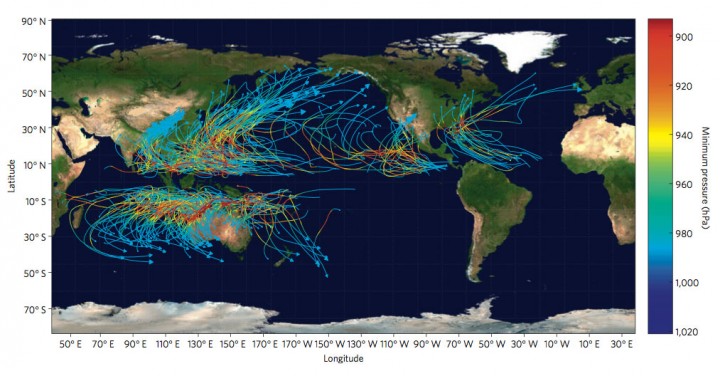
Caption: Storm tracks and minimum pressure for a sample of synthetic storms. The tracks show that storms are more frequent in the western Pacific. The minimum pressure (hpa) or storm intensity is measured by their color. Storm intensity is higher over the warm waters near the Equator and lower over the cooler waters towards the poles.
Extreme weather: Heavy rain and flooding in Fiji tests climate disaster preparedness
Fiji is experiencing heavy rain and major flooding with a 15-day state of emergency being declared in Fiji’s west coast areas. At least 8 people have died so far in the Fiji January-February 2012 floods with up to 51 reported cases of water-related diseases, thousands in evacuation centres and $30million in damages reported so far.
The Government’s Provincial Development and Multi Ethnic Affairs Ministry Permanent Secretary, Colonel Inia Seruiratu, declared the emergency on January 25 to apply to Ba, Lautoka, Nadi, Nadroga, Ra, and Tavua.
A 2009 publication produced by UNISDR and the UN Development Programme (UNDP) warned that in western Fiji, high-intensity floods would become more frequent. In the Nadi area, for example, these type of floods used to occur every 190 years, but with the influence of climate change by 2100 it is projected that they will occur every 25 years. (Institutional and policy analysis of disaster risk reduction and climate change adaptation in Pacific Island Countries: final report (PDF))
Wednesday, February 1, 2012
Rally says no to HRL coal power station in Victoria
About 400 people gathered in the sun, on the steps of the Victorian parliament for a weekday lunchtime protest to say no new coal fired power stations. The Rally was against the propoed HRL coal fired power station for Victoria. Speakers included Adam Bandt, Greens MP for Melbourne, Kelvin Thomson, Labor MP for Wills, Victoria McKenzie-McHarg, Safe Climate Campaigner for Environment Victoria, Greenpeace Energy Campaigner Julien Vincent, and Gem from AYCC.
Climate change increasing Canada's boreal forest mortality reducing carbon sink capacity

Climate change induced drought and water stress is increasing tree mortality in Canada's boreal forests, particularly in western Canada, resulting in a reduction in biomass which reduces it's capacity as a carbon sink. As tree mortality increases, there is reduced capacity to absorb carbon dioxide, resulting in a feedback loop where conditions become warmer and drier increasing the stress on the boreal forest ecosystem and ability to absorb carbon dioxide that humans keep on pumping into the atmosphere at increasing rates.
Monday, January 30, 2012
Critical time for stopping the HRL Coal fired power station in Victoria
Victorian residents are fighting to stop the construction of a new 600MW coal fired power station at Morwell in the La Trobe valley. The HRL coal gasification plant proposes to turn brown coal into a synthetic gas which is mixed with natural gas to fire steam turbines to generate electricity. The pollution generated will be the equivalent of a black coal fired powered station, around 4 million tonnes of CO2 pollution each and every year.
John Howard awarded HRL $100 million, a low emissions technology 'clean coal' grant contingent on it meeting certain project deliverables including raising commercial finance by 31st December 2011. These conditions have not been met. Victorians will rally on Wednesday 1st February 2012 at Parliament House in Spring Street at 12.30pm for the Federal Government to withdraw this grant money and redirect it to renewable energy projects. And to ensure that Julia Gillard keeps her 2010 promise "that there will be no more dirty coal powered stations built in this country".
Related: July 2011 - Victorian Government needs to come clean on plan to achieve 20 percent emissions cut by 2020 | June 2011 - Ferguson and Gillard feeding HRL's coal gasification technology in Melbourne | April 2011 - Government foyer occupied to stop new Victorian coal power station | Campaign sites: Stop HRL, Quit Coal
Subscribe to:
Posts (Atom)