Mastodon Climate Citizen --> Mastodon
Showing posts with label Arctic. Show all posts

Thursday, January 4, 2024

Dr Jennifer Francis on weather whiplash, 2024 and beyond "Expect surprises, destruction, suffering..."

New research has investigated abrupt swings in extreme weather in the Northern Hemisphere. This is being driven by Arctic amplified warming and slowing of the Northern Hemisphere Jet stream.

Changes to the Jet Stream is one of the areas that Dr Jennifer Francis has been focussed on. Francis is Senior Climate Scientist with the Woods Hole Institute in the US. Her recent research has been in weather whiplash, abrupt changes in extreme weather as it applies to North America and Europe.

This interview below is with Nick Breeze and she says for 2024 expect surprises, more broken weather records, and extreme weather will get even worse.

Thursday, February 18, 2016

Storify: January 2016 smashes monthly temperature anomaly by 1.13C

NASA and NOAA and JMA all agree that January 2016 set a new high temperature anomaly over 1 degree C, the ninth consecutive month to set a new monthly record. The strong El Nino likely added about 0.2C to this anomaly.

Monday, September 28, 2015

Shell abandons Arctic oil exploration for foreseeable future


Activists reacted positively to Shell's announcement of an end to Arctic oil exploration in the Chukchi sea.

In a media release today Royal Dutch Shell announced it was discontinuing it's Arctic oil drilling program in the Chukchi Sea, off Alaska, blaming the treacherous conditions and the regulatory environment.

Exploratory drilling to 6800 feet was undertaken with some indications of oil and gas in the Burger J well, but not in sufficient quantities to warrant further exploration in this part of the basin.

Tuesday, August 11, 2015

Professor Wadhams: If we take really serious action we can survive


Professor Peter Wadhams has spent the last 40 years working on sea-ice research, polar oceanography and how the changes in Arctic and Antarctic ice are affecting climate. He has particularly warned about the impacts of the retreat and loss of Arctic sea-ice and the threat from an Arctic methane breakout to give a substantial acceleration to global warming.

In this May 2015 interview with Judy Sole, founder of the Green Party of South Africa, he outlines the reduction of Arctic sea ice, the loss of most of the multi-year ice, where he thinks more research should be devoted and what we should do for a best chance of survival for our children.

Wadhams is professor of Ocean Physics, and Head of the Polar Ocean Physics Group in the Department of Applied Mathematics and Theoretical Physics, University of Cambridge. He is also president of the International Association for the Physical Sciences of the Oceans Commission on Sea Ice and Coordinator for the International Programme for Antarctic Buoys.

He is one of the few scientists who has been prepared to publicly speak out on major climate risks associated with loss of sea-ice and the dangers in massive methane release from methane hydrates contained in the shallow continental shelves of the Arctic, and what this means for human survival. His warnings, along with those of James Hansen and Kevin Anderson should not be ignored.

Friday, July 31, 2015

Portland bridge danglers delay Shell ice-breaker leaving for Arctic oil drilling #ShellNo


Note: this article is updating with developments

Portland, Oregon: Climate protestors with Greenpeace and Rising Tide have set up a blockade to stop the Finnish ice-breaker Fennica, hired by Shell, to leave port with needed parts for their Arctic oil drilling program in the Chukchi Sea.

13 Greenpeace protestors dangled across the river below the St John's bridge with linked lines to prevent passage of the ship.

They were supported by a crew of 13 on the bridge roadway, a flotilla of kayaktivists, and people gathered in the riverside park.

The same day as the Fennica icebreaker was being blockaded in Portland, news was published that Shell is sacking 6500 workers globally due to the downturn in oil prices. Shell joined oil giants BP and Chevron in cutting costs due to a 50 per cent slump in crude prices in the past year. The company's share price rose 4.7 per cent, but the stock has still dropped 17 per cent this year, reported Bloomberg.

Tuesday, May 19, 2015

Shell Arctic oil drilling rigs unwelcome in Seattle


Over the last week Royal Dutch Shell has faced stiff public opposition in Seattle to it's Arctic oil exploration program with the arrival of the Noble Explorer and Polar Pioneer drill rigs for maintenance and provisioning in Seattle.

Related: Shell Polar Pioneer Arctic drilling rig blockaded at Port Terminal 5 in Seattle | 2013: Grounding of Shell drilling platform highlights dangers of Arctic Oil Drilling ShellNO.org | Rising Tide Seattle

The Noble Discoverer arrived in the Port of Everett last Tuesday (12 May). It was met by half a dozen kayaktivists with a sign that said "Shell No".

Last week protesters at the Port of Seattle setup a tripod at Terminal 5 to voice their opposition to the Polar Pioneer drill ship, which had been parked at Port Angeles but arrived in Seattle on Thursday. A handful of kayaktivists met the Polar Pioneer on the waters of Elliot Bay on Thursday when it arrived.

On May 12 Rising Tide Seattle said in a tweet that "This morning work stopped at Shell's Seattle Operations for nearly 3 hours - more coming this week!" A tripod was setup at the main entrance during the morning and a statement read out. Watch on Youtube

Shell wants to use the Port of Seattle as it's base to refuel, re-provision and carry out maintenance on it's Arctic drill rigs. But even the Seattle City Council has declared it's opposition to Shell's plans.

Shell Polar Pioneer Arctic drilling rig blockaded at Port Terminal 5 in Seattle


On Monday 18 May 2015, over five hundred people blockaded Port of Seattle Terminal 5 where Royal Dutch Shell's Polar Pioneer oil rig is docked.

Shell is planning to do exploratory oil drilling in the Chukchi Sea in the Arctic off the Alaska coast despite climate scientists saying we cannot afford to drill for oil in the Arctic for a safe climate and the environmental risks dangers if a major oil spill were to occurr in the Arctic.

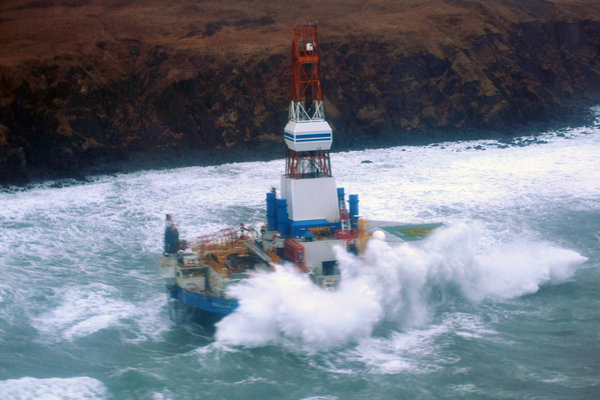
In December 2012 it's oil drilling rig Kulluk ran aground off Kodiak Island while it was being moved from Alaska to Washington State to avoid paying $6 million in taxes.

Protestors started gathering before 7am before marching to blockade the terminal front gate. Here is how the day unfolded. There is a great live ustream video report from KPFA community powered radio from Berkeley California.

Thursday, January 22, 2015

Age profile of Arctic Sea Ice Change: 1987 to 2014


Arctic sea ice has been on a long downwards trend and this is projected to continue.

There are various ways to measure sea ice.

Sea Ice extent gives you the area of ice that varies between Summer and winter peaks. It is on a long downward trend. It is relatively easy to measure by satellite remote sensing.


Ice volume is a much better measure of sea ice, but it is notoriously difficult to estimate with accuracy, involving people doing actual thickness measurements which involves travel by helicopter or submarine and then estimation.


The relative age of sea ice in the Arctic, and the extent of different aged sea ice, provides an intermediary method for gauging the state of sea ice. This can be done through remote sensing, although it is not without it's own measurement problems and level of inaccuracy.

NASA has now produced this 1 minute video showing that old ice is now exceedingly rare. This affects the thickness of ice and the susceptibility to melting with summer. The animation tracks the various levels of different aged ice from 1987 to November 2014.

Each winter most of the Arctic sea freezes over and forms new ice. As winter recedes, sea ice melts and some gets pushed through the Fram Strait. This ice loss used to be replaced by new sea ice formed in the Beaufort Gyre, northeast of Alaska. But this century with warmer waters near Alaska less ice has been able to form to replace that lost through the Fram Strait. Old ice 9 years or more is now exceedingly rare.

"While perennial ice increased between 2013 and 2014, the long-term trend continues to be downward, the Report Card authors stated. In 1980s, the oldest ice (fourth-year ice and older) comprised 26 percent of the ice pack; as of March 2014, it was 10%. And as the animation above shows, very old ice (say, 7-8 years or older) has become even more rare." says the NASA article.


Source:

Tuesday, April 9, 2013

Arctic Sea Ice Death Spiral - Lord Monckton revealed as bad joke


Peter Sinclair has put together another educative video gem on the decline of Arctic Sea Ice, and indeed global sea ice. The video mixes together video footage of Lord Monckton from 2009, 2011, and 2013 to show his inconsistency, with the facts and observations from climate scientists on sea ice decline.

Climate scientists interviewed include Dr Walt Meier from the National Snow and Ice Data center, Dr Ken Dunton from University of Texas, Dr Jennifer Francis from Rutgers University, Dr Jeff Masters from the WeatherUnderground, Dr Claire Parkinson from the Goddard Space Flight Center NASA,

The video covers the recent and unusually extensive ice fractures seen in the Beaufort Sea from the beginning of February through March. This highlights that most of this sea ice is seasonal or first year ice. Sea ice extent continues to track well below model predictions for the disintegration of summer sea ice. Sea Ice volume trend is even more stark with a projection of a possible ice free summer as early as 2016.

Sunday, March 3, 2013

Permafrost climate tipping point threshold at 1.5 degrees - Siberian caves reveal


At what point might we trigger a permafrost tipping point? New research from the caves of Siberia points to a threshold temperature of just 1.5 degrees celsius. At that temperature we could see large swathes of permafrost across Siberia melting resulting in the release of more than 1,000 gigatons of carbon and methane. This would be a substantial climate feedback resulting in even greater global warming. There would also be substantial damage to natural and human environments and structures.

And we are already halfway there to warming the world by 1.5C, with an estimated global temperature rise since the Nineteenth century of between 0.7 and 0.8 degrees C. There is already enough inertia in the climate system to carry us over this threshold. Which makes every attempt to reduce carbon emissions, and the use of fossil fuels, as worthwhile to limit the permafrost thaw.

Related: Methane and CO2 in thawing Arctic permafrost a climate tipping point | "We do have an emergency" - Arctic Methane Feedback amplifying warming | Arctic Permafrost thawing raising CO2 levels

Arctic amplification, the Jet stream and Extreme weather in Northern Hemisphere

A series of major extreme weather events in the Northern hemisphere including the heatwave in the United States in 2011, the Russian heatwave of 2010, the Pakistani floods of 2010 have now been attributed to a common physical cause. The scientists suggest in a new scientific study that man-made climate change repeatedly disturbs the patterns of atmospheric flow - the atmospheric Rossby waves of the jet stream - around the globe's Northern hemisphere through a subtle resonance mechanism.

"An important part of the global air motion in the mid-latitudes of the Earth normally takes the form of waves wandering around the planet, oscillating between the tropical and the Arctic regions. So when they swing up, these waves suck warm air from the tropics to Europe, Russia, or the US, and when they swing down, they do the same thing with cold air from the Arctic," explains lead author Vladimir Petoukhov.

"What we found is that during several recent extreme weather events these planetary waves almost freeze in their tracks for weeks. So instead of bringing in cool air after having brought warm air in before, the heat just stays. In fact, we observe a strong amplification of the usually weak, slowly moving component of these waves," says Petoukhov.

Sunday, February 24, 2013

Sea ice reduction disturbs Arctic greenhouse gas balance

The diminishing Arctic sea-ice extent is resulting in changes in how greenhouse gases interact between the land, ocean and atmosphere according to a new study.

"Changes in the balance of greenhouse gases can have major consequences because, globally, plants and the oceans absorb around half of the carbon dioxide that humans release into the air through the use of fossil fuels. If the Arctic component of this buffer changes, so will the amount of greenhouse gases in the atmosphere", says Dr Frans-Jan Parmentier, a researcher at Lund University, Sweden, and lead author of the study..

Reduced white sea ice and expanded dark ocean surface results in a change to the surface albedo feedback or reflectivity, resulting in increased light absorption and ocean warming which then warms the atmosphere affecting the rate of interchange of CO2.

The decline of summer sea ice has been dramatic with the Arctic Summer Sea Ice Extent Minimum record smashed in 2012.

Wednesday, February 20, 2013

Greenland Melting detected during Winter a climate change concern

Satellite data for the first several weeks of 2013 is showing that melting is occurring in south east Greenland. In summer this would be expected, but January-February is the dead of winter. Some portions of Greenland have experienced more than 30 days of melting since the start of this year, a worrying trend.

According to email correspondence with Ted Scambos from National Snow and Ice Data Centre (NSIDC) sent to Tom Yulsman, all of Greenland has been 2 to 6 degrees C warmer than the 30 year mean. Tom quotes Ted Scambos on his blog: "Air temperatures along the southeastern coast for the period Feb 10 – 15 are running 2 to 6 C above normal. Nuuk, the capital, on the very southern west coast, is currently just a couple of degrees below freezing."

Related: Is Climate Change causing an exponential rate of Ice sheet Mass Loss, sea level rise? | Global Warming threshold for Greenland Ice Sheet collapse reduced to 1.6 degrees C

Thursday, January 3, 2013

Grounding of Shell drilling platform highlights dangers of Arctic Oil Drilling

Shell has plans for drilling several exploratory wells in the Chukchi and Beaufort seas area off the north coast of Alaska. The grounding of the Kulluk circular oil drilling ship while being towed in heavy seas must call into question whether safety measures by Shell and Coast Guard response capabilities are adequate to allow Arctic drilling to proceed.

Initial approval for oil drilling by Shell Oil was given by the Obama administration in August 2012 despite opposition by numerous conservation groups and a petition of over a million US citizens. To preserve a safe climate based upon the simple climate maths of how much fossil fuels we can afford to burn, we need to Go Fossil Free through divestment, start taxing carbon and leave the oil reserves beneath the Arctic alone.

Related: Greenpeace - Save The Arctic | Sierra Club - Chill the Drills: Protect America's Arctic! | Center for Biological Diversity - Arctic Oil Development | Alaska Despatch - U.S.: Shell’s grounded drilling rig raises questions | July 2011 - Smears on integrity of Polar wildlife scientist a prelude to Arctic Oil Drilling

Tuesday, January 1, 2013

Climate Feedback: Arctic sea ice changes increase light absorption and ocean warming

A new study has examined the impact of changing sea ice and light absorption in the Arctic to reveal another climate feedback mechanism.

As multi-year sea ice is replaced with thinner first year sea ice, the properties of the sea ice change to allow more light through to the water beneath increasing ocean warming and more melting of sea ice.

Saturday, December 22, 2012

"We do have an emergency" - Arctic Methane Feedback amplifying warming


As James Hansen in this video says "We DO have an emergency". He talks about climate tipping points such as the loss of summer Arctic sea ice amplifying the release of methane in permafrost on tundra landscapes and methane hydrates in the shallow East Siberian and Alaskan continental shelves. These tipping points have catastrophic consequences for our climate.

Climate tipping points are processes we don't want to launch. They are climate feedback mechanisms which take any sort of control over global warming out of our hands and threaten widespread species extinction and threaten the viability of civilisation and perhaps even human survival.

They could act either as slowly accelerating feedback mechanisms which keep increasing global temperatures by several degrees or a relatively sudden 'methane bomb' in which a large abrupt release of methane occurs. In either case, it would be disastrous for human civilisation, although in the first instance we would be like the frog in a pot of water being brought slowly to the boil, not having the where-with-all to notice the incremental changes before it is way too late.

Related: The United Nations Environment Program released a scientific report - Policy Implications of Warming Permafrost - at the Doha climate talks highlighting the threat from methane from melting permafrost. See Methane and CO2 in thawing Arctic permafrost a climate tipping point | Radio Ecoshock: Climate: Arctic Thermostat Blows Up , particularly the Interview with Paul Beckwith (MP3) from the Arctic Emergency Methane Group

2 Arctic seal species listed as Endangered due to Climate Change

The Centre for Biological Diversity reports that as a result of their 2008 petition, the US Federal Government has added Ringed seals and Bearded seals, found in the waters off Alaska, to the list of endangered species.

Both seal species are dependent on the existence of sea ice which is rapidly declining during summer, with some scientists saying the Arctic could be largely ice free as early as 2016. These are the first species since polar bears to be protected primarily because of climate change threats.

“Arctic animals face a clear danger of extinction from climate change,” said Shaye Wolf, the Center’s climate science director. “The Endangered Species Act offers strong protections for these seals, but we can’t save the Arctic ecosystem without confronting the broader climate crisis. The Obama administration has to take decisive action, right now, against greenhouse gas pollution to preserve a world filled with ice seals, walruses and polar bears.”

Related: Centre for Biological Diversity: Saving the Bearded, Ringed and Spotted Seals

Saturday, December 8, 2012

Global warming breaking records in Arctic says 2012 Report card

Records were broken in the Arctic during 2012 with rapid changes occurring in sea ice extent and surface melt of Greenland Ice sheet according to the latest Arctic Report Card. These changes happened despite air temperatures being fairly unremarkable. It was the warmest summer in the last 170 years on Greenland.

“The Arctic is changing in both predictable and unpredictable ways, so we must expect surprises,” said Jane Lubchenco, Ph.D., under secretary of commerce for oceans and atmosphere and NOAA administrator, during a press briefing at the American Geophysical Union annual meeting in San Francisco, Calif. “The Arctic is an extremely sensitive part of the world and with the warming scientists have observed, we see the results with less snow and sea ice, greater ice sheet melt and changing vegetation.”

Saturday, December 1, 2012

Methane and CO2 in thawing Arctic permafrost a climate tipping point

A new report on permafrost slowly thawing in the Arctic creating methane and carbon dioxide emissions highlights an approaching dangerous climate tipping point. There is a huge amount of organic matter frozen in permafrost, estimated to contain 1,700 gigatonnes of carbon, twice the amount of carbon currently in the atmosphere. And it is starting to melt. With no way to stop it except indirectly through us reducing the rate of global warming by reducing our own emissions.

"The release of carbon dioxide and methane from warming permafrost is irreversible: once the organic matter thaws and decays away, there is no way to put it back into the permafrost," said lead author Kevin Schaefer, from the University of Colorado's National Snow and Ice Data Center.

"Anthropogenic emissions' targets in the climate change treaty need to account for these emissions or we risk overshooting the 2°C maximum warming target," he added.

Watch this youtube interview with Lead author Professor Kevin Schaefer, Research Scientist at the University of Colorado being interviewed at the climate talks in Doha:


The report - Policy Implications of Warming Permafrost (PDF) - was published by the United Nations Environment Program (UNEP) and launched at the United Nations Framework Convention on Climate Change (UNFCCC) at Doha on November 27. (See media release)

Wednesday, November 28, 2012

Chasing Ice: James Balog sounding the alarm on Glacier retreat and global warming


A new documentary film on extreme ice loss from glaciers - one of the impacts of global warming - is doing the rounds. Chasing Ice documents the work of National Geographic photographer James Balog in documenting the massive changes to glaciers in the Arctic region where global warming is having a much higher impact than in the mid latutudes or the tropics. Film maker Jeff Orlowski follows Balog on expeditions to the glaciers and tells Balog's story of the rapid and profound changes happening to glaciers.

The film Chasing Ice is the result. In september 2012 it won the Best Documentary at the 22nd Annual Awards of the Environmental Media Association, Excellence in Cinematography Award: US Documentary at the Sundance Film festival and some 21 other awards.