Mastodon Climate Citizen --> Mastodon
Showing posts with label economics. Show all posts

Sunday, March 11, 2012

Paul Gilding at TED: Choosing life over fear - The coming war for a sustainable civilisation


This talk by sustainability campaigner Paul Gilding is both pessimistic and optimistic about the future of human civilisation facing numerous planetary crises including human overpopulation, overuse of resources, anthropogenic climate change, and biodiversity loss. The earth is now full. Human civilisation is facing a great disruption this century, within our lifetimes.

Economic growth as we know it is dead, the planet can no longer sustain infinite growth, without degradation of our working capital, the earth and it's resources. We are now spending the future of our children.

Paul stresses that where we have a great crisis, humans have the capability to act with great resourcefulness. We have an opportunity for change. We can make the preparations in transitioning our lives, our communities through the great disruption.

Saturday, February 4, 2012

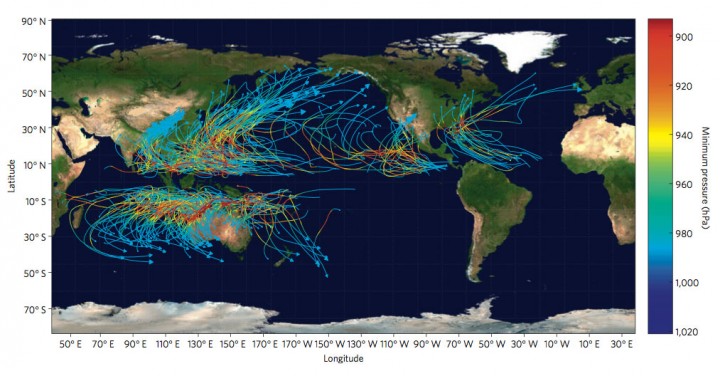
Climate change predicted to escalate Tropical Cyclone damage costs for US and China

A new study looking at the economic costs of tropical cyclone damage taking into account climate change, forecasts that tropical cyclones will cause $109 billion in damages by 2100. Increased vulnerability of populations and growing economic wealth is expected to double the costs from $26 billion per year to $56 billion by 2100. Climate change is predicted to add some $53 Billion in damages. Two countries are responsible for incurring 75% of the extra damage from climate change associated with tropical cyclones: the United States and China. But tropical island nations will incurr the highest damage per GDP - up to 37%.

The study - The impact of climate change on global tropical cyclone damage - is by Robert Mendelsohn, Kerry Emanuel, Shun Chonabayashi & Laura Bakkensen from Yale and MIT and was published in Nature Climate Change on January 15, 2012.

Caption: Storm tracks and minimum pressure for a sample of synthetic storms. The tracks show that storms are more frequent in the western Pacific. The minimum pressure (hpa) or storm intensity is measured by their color. Storm intensity is higher over the warm waters near the Equator and lower over the cooler waters towards the poles.

Friday, December 16, 2011

Is it possible to decouple economic wealth from carbon dioxide emission rates?

Is it possible to decouple economic wealth from carbon dioxide emission rates? Dr Tim Garrett applies basic thermodynamic physics principles to the economics of wealth, carbon emission rates and civilization and comes up with some very disturbing results.

I came across this randomly chasing youtube links. This talk captured in a 3 part video was given at the Pacific Institute for Climate Studies Seminar May 31st, 2010, University of Victoria in Canada, but only recently uploaded to youtube in December 2011. Dr. Tim Garrett is an Associate Professor of Physics in the Department of Atmospheric Sciences, University of Utah, whose main academic work is in cloud physics.

Friday, November 18, 2011

The carbon economy of logging native forests and CO2 reduction

An interesting seminar was held at the Australian National University on November 10, 2011 on logging of native forests and the timeframe for dealing with CO2 emissions for climate policy. The seminar was given by Dr Judith Ajani, an economist at the ANU Fenner School of Environment and Society and the author of The Forest Wars (MUP 2007). She examines both sides of the debate regarding logging of native forests and whether native forests should be used for bioenergy or biodiversity.