Mastodon Climate Citizen --> Mastodon

Saturday, January 12, 2013

Mangrove forests threatened by Climate Change in the Sundarbans of Bangladesh and India

A new study has found the Sundarban coast retreating up to 200 metres in a single year due to rapidly deteriorating health of the world's largest Mangrove forest in the Sundarbans, the Ganges delta region of India and Bangladesh.

Zoological Society of London (ZSL) researcher Dr Nathalie Pettorelli, senior author of the paper says: "Our results indicate a rapidly retreating coastline that cannot be accounted for by the regular dynamics of the Sundarbans. Degradation is happening fast, weakening this natural shield for India and Bangladesh."

In the Bengali language 'Sundarban' can be literally translated as 'beautiful forest'. The area is the largest block of continuous mangrove forest in the world, being home to almost 500 species of reptile, fish, bird and mammals, including the endangered Bengal tiger.

See Also: Mangrove Alliance | Mangrove Action Project | Mangrove Watch Australia | Planners need to allow for Coastal wetlands migration due to sea level rise, climate change

Thursday, January 10, 2013

Greens Leader says 'Look at the damage to humanity being caused by people who bankroll coalmines'

Jonathon Moylan's ANZ Bank hoax letter over the Maule's Creek Project open cut coalmine continues to produce reverberations. Greens Leader Christine Milne has now come out in his support arguing that we are in a climate emergency and we need to have a very serious 'Look at the damage to humanity being caused by people who bankroll coalmines'. Independent Economist Rod Campbell implies that the real hoax being perpetrated on small and institutional investors in Whitehaven coal is by Gillespie Economics and NSW Planning Department who massively overestimated the benefits and underestimated the social, environmental, health and climate costs of the project.

Jonathon Moylan may become Australia's first high profile climate civil disobedience activist jailed as a result of an ASIC investigation. A somewhat similar case ocurred in the USA in 2011 when climate activist Tim DeChristopher was jailed for two years and fined $10,000 for climate civil disobedience for exposing the rorts in an auction of public lands for mineral exploration. Clive Hamilton on The Conversation website article - ANZ imposter takes up new climate tactic - also draws our attention to the parallels with the Tim DeChristopher case.

Take Action: Sign the ANZ Stop the Loan e-petition

Wednesday, January 9, 2013

Total Fire Ban exemption for Santos CSG plant riles Pilliga residents

While firefighters were battling over 137 fires across NSW, over 40 uncontrolled, and with a total fire ban in place on Tuesday and Wednesday in record temperatures, Santos Gas at it's Pillaga CSG processing plant were able to vent and burn gas as usual in the middle of a tinder dry forest. Local residents have complained about this exemption saying it poses an unacceptable fire risk for the local community and for the Pilliga forest.

Background: The Global Mail - Pillaging the Pilliga (October 2012)

Tuesday, January 8, 2013

Records tumble in heatwave as Julia Gillard links bushfire to climate change

On Tuesday January 8 the Bureau of Meteorology released an interim special climate statement on the Extreme January heat Australia is currently experiencing. Record temperatures both day-time maximum and night-time minimums continue to be broken. The extraordinary heatwave has also been the scene for catastrophic fires, especially in Tasmania. The Prime Minister Julia Gillard saw the devastation in Dunalley and amoung her many interviews and press conferences made a brief statement connecting the intensity of bushfires with climate change.

The Extreme Heatwave had its origins in late December, but seriously started on January 3. It covers an extensive part of the continent mainly affecting inland areas but occasionally impacting the coast. Dr Braganza described it has "It's just an extensive dome of heat over the continent," in a Sydney Morning Herald report. Dr Karl Braganza is Manager of Climate Modelling at the Bureau of Meteorology.

The Bureau statement says the spatial extent of the heatwave is highly unusual resulting in many individual station temperatures and national average temperature records being broken, "To date (data up to the 6 January 2013) the national area-average for each of the first 6 days of 2013 has been in the top 20 hottest days on record, with 6 January the fifth hottest on record and the first time 5 consecutive days over 39 °C has ever been recorded for Australia." says the statement.

Read Previous article: Extreme Heatwave for Australia January 2013 - bushfire strikes.

Listen to Alasdair Hainsworth from the Bureau of Meteorology being interviewed on the ABC 7.30pm on 8 January 2013 (Youtube)


Here is the text of the BoM statement in full as updated by BOM on 14 January:

Monday, January 7, 2013

Uncovering the real hoax: ANZ Bank greenwash while financing coal and climate change

For a moment farmers, conservationists and climate campaigners in the north west of New South Wales thought one of the big four banks - the ANZ Bank - was living up to it's sustainability charter and taking a lead: acting ethically with regard to not destroying agricultural land, maintaining biodiversity and preventing climate change.

A media release purportedly from the bank said it was withdrawing it's $1.2 billion loan for Whitehaven for development of a new coal mine at Maules Creek on agricultural and forrested land near Narrabri, New South Wales. Further, the letter said that "ANZ is currently undertaking a review of coal and gas investments on productive agricultural lands and areas of high biodiversity."

But it was not to be.

Saturday, January 5, 2013

England experiences wettest year on record, second wettest for UK

According to provisional data by the UK Met office 2012 was the second wettest year in the UK national record dating back to 1910, and just a few millimetres short of the record set in 2000. Four of the top five wettest years have now occurred since 2000. The year was the wettest year on record for England, and third wettest for Wales.

2012 saw Britain come out of one of the severest droughts on record in 2011. March was the driest for more than half a century leading to activation of hosepipe bans across much of England. While the year started dry it then set new rainfall records for the wettest April, and the wettest June for the UK causing widespread flooding.

The persistent wet weather resulted in total 2012 rainfall for the UK of 1330.7 mm, which is just 6.6 mm short of the record set in 2000.

Thursday, January 3, 2013

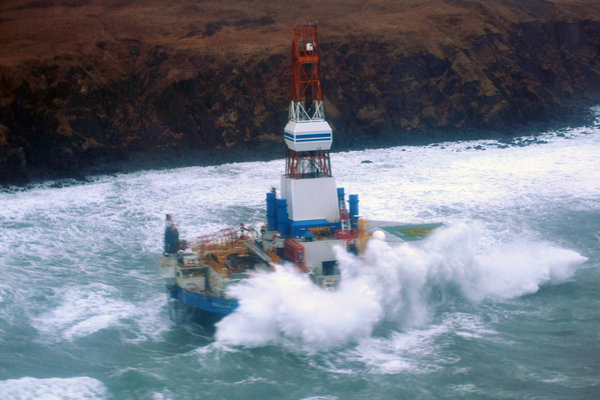
Grounding of Shell drilling platform highlights dangers of Arctic Oil Drilling

Shell has plans for drilling several exploratory wells in the Chukchi and Beaufort seas area off the north coast of Alaska. The grounding of the Kulluk circular oil drilling ship while being towed in heavy seas must call into question whether safety measures by Shell and Coast Guard response capabilities are adequate to allow Arctic drilling to proceed.

Initial approval for oil drilling by Shell Oil was given by the Obama administration in August 2012 despite opposition by numerous conservation groups and a petition of over a million US citizens. To preserve a safe climate based upon the simple climate maths of how much fossil fuels we can afford to burn, we need to Go Fossil Free through divestment, start taxing carbon and leave the oil reserves beneath the Arctic alone.

Related: Greenpeace - Save The Arctic | Sierra Club - Chill the Drills: Protect America's Arctic! | Center for Biological Diversity - Arctic Oil Development | Alaska Despatch - U.S.: Shell’s grounded drilling rig raises questions | July 2011 - Smears on integrity of Polar wildlife scientist a prelude to Arctic Oil Drilling

Extreme Heatwave for Australia January 2013 - bushfires strike

Note: article may be updated over coming days.

Jan 18: Sydney swelters setting new record temperature of 45.8C Friday 18 January while fires across southern states continue to burn out of control.

Jan 5: A heatwave covering 70 per cent of Australia that started on January 3 has sparked catastrophic bushfires. Tasmania has so far been the most devastated by fire with more than 100 houses and businesses razed, the Tasman peninsula cutoff, without power, and thousands evacuated by boat to Hobart. The Temperature soared in Hobart setting new records for highest daily minimum overnight temperature of 23.4C and a new maximum temperature of 41.3C.

Other states are also experiencing bushfires, but have so far brought the fires mostly under control. The heatwave is expected to last over a week with elevated temperatures particularly in inland areas. It is very unusual that a heat wave covers such a large area of the continent at one time, according to Karl Braganza, manager of climate monitoring at the Australian Bureau of Meteorology.

Australia's weather has switched to hot and dry after one of the wettest two year periods in Australia's history influenced by an extremely strong La Nina event.

Related: Scientists outline health limits of heat stress with Climate Change (May 2010) | Flooding rains now burning plains - Bushfire risk and climate change (Oct 2011) | Logging of Victorian mountain ash forests increases bushfire risk (Oct 2011) | Intact native Forests mitigate bushfire in a warming climate (Nov 2011) | CSIRO - Climate change impacts on fire weather

Tuesday, January 1, 2013

Climate Feedback: Arctic sea ice changes increase light absorption and ocean warming

A new study has examined the impact of changing sea ice and light absorption in the Arctic to reveal another climate feedback mechanism.

As multi-year sea ice is replaced with thinner first year sea ice, the properties of the sea ice change to allow more light through to the water beneath increasing ocean warming and more melting of sea ice.

Monday, December 31, 2012

Is Climate Change causing an exponential rate of Ice sheet Mass Loss, sea level rise?

Climate scientist James Hansen and his colleague Makiko Sato have released a new discussion paper with updated data on ice sheet mass loss from Greenland and Antarctica, with implications for possible multi-metre sea level rise this century. It makes for some interesting reading - there is a link to Hansen's website and the paper at the end.

The thesis that Hansen has put forward for several years is that Ice Sheet collapse is a non-linear process: that with the inclusion of amplifying climate feedbacks it is likely to follow an exponential rate of acceleration - a doubling rate. It might be a 10 year doubling time, or less. This will lead to extensive sea level rise, perhaps in the order of 5 metres this century.

But accurate data measurements of ice mass loss via laboriously estimating mass input and output has only been available since the early 1990s, and accurate satellite measurements (Gravimetry) via the GRACE satellites since 2000.

What these measurements show is that ice mass loss from both Greenland and Antarctica are accelerating, but the data for the time period is still too short to determine whether ice sheet mass loss will follow a somewhat linear path, or an exponential path doubling every 10 years or shorter time period.

Caption: Figure 2: Greenland (a) and Antarctic (b) mass change deduced from gravitational field measurements by Velicogna (2009) and best-fits with 5-year and 10-year mass loss doubling times. From NASA: Earth's Climate History: Implications for Tomorrow Hansen and Sato July 2011

Update 14 Jan 2013: Matt Owens from Fairfax Climate Watch had a similar idea in reviewing Hansen's discussion paper. Read his initial analysis: Sea level rise could crimp GDP; US direct losses could top 1/4 trillion per year during 2040-2050. On 11 January 2013 he updated his analysis with a new article: Surprising negative feedback could mean epic disaster. Both are worthwhile reading.