Mastodon Climate Citizen --> Mastodon
Showing posts with label transport. Show all posts

Wednesday, August 21, 2024

Cruise ships are getting larger and emissions are growing says new report

There is a new report on Cruise ship emissions. Cruise ships are getting larger and more numerous. This is a problem for the environment, according to Transport NGO Transport and Environment.

They argue that the cruise ship sector:

  • The world’s biggest cruise ships are now twice as big as they were in 2000
  • At the current rate of growth, the biggest cruise ships in 2050 could become almost eight times bigger than the Titanic and carry nearly 11,000 passengers
  • Twentyfold increase in the number of cruise ships from only 21 in 1970 to 515 today
  • Cruise ship CO2 emissions were already nearly 20% higher in 2022 than in 2019 before the pandemic
  • Cruise ships are currently exempt from fuel duties as well as most corporate and consumer taxes. A €50 tax on a typical cruise journey ticket would bring in €1.6 billion globally, €410 million of which would be raised in Europe.

Friday, November 17, 2023

State of Climate Action Report 2023 finds World behind on almost every policy required to cut carbon emissions


This is a major science based assessment of global efforts for climate action to reduce emissions. It found that Coal must be phased out seven times faster, Deforestation must be reduced four times faster, public transport around the world built out six times faster than at present, to avoid the worst impacts of climate breakdown. Altogether it found that 41 of 42 indicators assessed were not on track to achieve their 2030 targets. 

Progress for more than half of these indicators remains well off track, such that recent efforts must accelerate at least twofold this decade. Worse still, another six indicators are heading in the wrong direction entirely.

Thursday, October 26, 2023

Freight Decarbonisation for Australia addresses transport emissions says new ClimateWorks report


Decarbonising freight is critical to decarbonising the transport sector and meeting Australia's climate targets. ClimateWorks has just published a report on Delivering freight decarbonisation: Strategies for reducing Australia’s transport emissions.

In 2021, the transport sector contributed approximately 20 per cent of Australia’s domestic emissions and is likely to become the largest contributor by 2030. Freight makes up a considerable share of transport emissions, estimated by Climateworks to be just under 40 per cent of the transport total. This represents approximately 7 per cent of Australia’s total emissions.

Passenger transport emissions can be addressed through uptake of Electric Vehicles, Fuel Efficiency standards, policies that encourage active transport (walking and cycling) and micro-mobility and use of public transport. This report does not focus on passenger transport emissions.

Tuesday, May 30, 2023

Importance of funding active transport infrastructure in Merri-bek budget to 2027

Separated Upfield Bike Path past Moreland Station
On behalf of Climate Action Merribek I sent in a submission to Merri-bek Council on their draft budget 2023-2027 on May 19. You can read the CAMerribek submission in full: Major backtrack on active transport projects in Draft Merri-bek Council Budget jeopardizes Climate Targets.  

Tonight, 29 May 2023, I fronted before Council Budget committee to speak to this presentation. There were a substantial number of submissions on Council Budget, evidently more than half focussed on the need for funding for more active transport infrastructure as a priority with many people opting to speak in person or online to Council on their submission.

My speech is below. As I only had 2 minutes to deliver, I excised a few paragraphs as marked with brackets, and still went slightly over..

There were some excellent presentations from citizens from Glenroy, Fawkner, Coburg North, Coburg, Brunswick West and Brunswick highlighting different facets of the problem, often with personal stories.

I have also included key findings of a new Climate Council report on Decarbonising Transport which support my presentation arguments and that of the CAMerribek submission.

Thursday, March 17, 2022

Aviation exhaust pollution, air quality, and impacts on Human Health - Melbourne Airport 3rd runway expansion

Melbourne Airport with 3 runways 2026 Option 1, Night 11pm-6am Flight Paths


Melbourne Airport is planning a third runway.

So I'm doing a science literature dive into reading the air pollution health impacts of aviation emissions...

You know, that coating you find over your car or house if you live under a flight path...this is soot, black carbon (BC), particulate pollution emissions from aircraft landing and taking off. But it's the particles you don't see that are problematic: Ultra Fine Particles (UFP) sometimes referred to as particulate matter with a size designation often classified as PM2.5, but often even smaller which can reach the furthest alveoli of your lungs..

These pollution particulates are not good for your health. UFPs have a high surface area and a capacity to adsorb a substantial amount of toxic organic compounds.

Studies indicate that the "exposure to aircraft emissions induce pulmonary and systemic inflammation, which potentially contributes to cancer, asthma, respiratory and coronary heart disease." (Bendtsen 2021)

In fact it is calculated that aviation emissions on a global basis cause about 16,000 people to die prematurely every year, and of this number about 5,000 people who live within 20 km of airports are estimated to die prematurely each year.

As Steve H L Yim et al (2015) study says: " primary PM2.5 emissions from aviation are a significant contributor to health risk when airport vicinity exposure is captured."

The study also highlights that the health cost of aviation emissions is actually at a magnitude larger than global aviation fatal accident costs, and on par with aviation's climate costs.

I wonder if Melbourne Airport have done their sums on the extra costs to health of people in the 20km radius of the airport with the extra aviation emissions a third runway will induce?


The No Third Tulla Runway campaign has articulated reasons to oppose development of the third runway. These include:
These are all relevant reasons to oppose the airport. The missing piece in this analysis is the aviation pollution impacts on air quality and human health at all scales: local, regional and global.

This article seeks to draw attention to some of the science on aviation exhaust emissions, air quality and human health.

Friday, November 12, 2021

Methane, coal transition, transport and forest pledges at COP26 still leave substantial emissions gap - Climate Action Tracker


I'd like to say the various pledges made these last two weeks have eliminated the emissions gap, but they haven't. If they are implemented and garner more signatories they will shrink the gap. New analysis by Climate Action Tracker shows that for the countries that have signed the pledges, they have closed the 2030 emissions gap between a 1.5°C path and government targets by around 9% - or 2.2 GtCO2e.

The UN Environment Program Emissions Gap report published late October showed that the planet heading to 2.7C climate catastrophe without needed 2030 ambition at COP26

"Even with all new pledges and such sectoral initiatives for 2030, global emissions are still
expected to be almost twice as high in 2030 as necessary to for a 1.5°C compatible pathway.
Therefore, all governments need to reconsider their targets towards COP27 in 2022 to jointly
enhance mitigation ambition." says Climate Action Tracker.

The final decision of the conference is presently being worked through. There is a draft clause which  give nations that have not submitted “new or updated” 2030 targets another 12 months to “revisit and strengthen” their emissions reduction effort in their Nationally Determined contributions. 

Thursday, November 11, 2021

Transport Day at COP26: aviation, shipping, EVs but don't mention cycling, micro-mobility or public transport


Wednesday 10 November was designated transport day at the UN Climate conference COP26. After the energy sector, the transport sector needs to be decarbonised. Decarbonisation of electricity grids will substantially contribute and assist in reducing transport emissions.

The UK Government used their position as COP26 Presidency for 3 specific declarations, all areas that need to be addressed. But on public transport, e-mobility, cycling, and walking infrastructure and change in mobility behaviours very little.

UN Secretary General on Sustainable Transport (14 October)

The UN Secretary General Antonio Guterres slammed the IMO for its slow progress on shipping emissions at the Second Global Sustainable Transport conference on 14 October 2021:

“We must accelerate the decarbonization of the entire transport sector.

“Let’s be honest. While member states have made some initial steps through the International Civil Aviation Organization and the International Maritime Organization to address emissions from shipping and aviation, current commitments are not aligned with the 1.5-degree goal of the Paris Agreement.

“In fact, they are more consistent with warming way above 3 degrees. 

“Adopting a new set of more ambitious and credible targets that are truly consistent with the goals of the Paris Agreement must be an urgent priority for both these bodies in the months and years ahead.

The priorities are clear:

  • Phase out the production of internal combustion engine vehicles by 2035 for leading manufacturing countries, and by 2040 for developing countries.
  • Zero emission ships must be the default choice, and commercially available for all by 2030, in order to achieve zero emissions in the shipping sector by 2050.
  • Companies must start using sustainable aviation fuels now, in order to cut carbon emissions per passenger by 65 per cent by 2050.
  • All stakeholders have a role to play, from individuals changing their travel habits, to businesses transforming their carbon footprint.
  • Governments must incentivize clean transport options, including through standards and taxation, and impose stricter regulation of infrastructure and procurement.

“In developed countries, transport policies that encourage cycling and walking in urban areas, rather than driving short distances, can contribute to progress across the SDGs: on climate, health, pollution and more.

“Sustainable railway systems should be upgraded and expanded for medium and long-distance travel for people and goods, to increase efficiency and encourage shifts in behaviour.

“Second, we must close access and safety gaps.

“This means helping more than one billion people to access paved roads, with designated space for pedestrians and bicycles, and providing convenient public transit options.

“It means providing safe conditions for all on public transport by ending harassment and violence against women and girls, and reducing deaths and injuries from road traffic accidents.”

Cycling and related organisations have written an open letter: COP26: Government leaders must commit to boosting cycling levels to reduce carbon emissions and reach global climate goals quickly and effectively. We have seen many cities already doing this, especially in Europe, but also North America.

The declaration calls for all governments and leaders at COP26 to:

  • Declare commitments to significantly boost cycling levels at home. This can be done by:
  • Promoting cycling in all its forms, including cycling tourism, sports cycling, bike sharing, riding to work or school and for exercising
  • Recognising cycling as a climate solution, establishing a clear link between how an increase in bicycle trips and a decrease in private car trips reduce CO₂ emissions
  • Creating and financing national cycling strategies and collecting data on cycling to know where improvements in infrastructure and usage can be made
  • Focusing investments on building safe and high-quality cycling infrastructure and in incentives for communities historically marginalised from cycling
  • Providing direct incentives for people and businesses to switch from automobiles to bicycles for more of their daily trips
  • Building synergies with public transport and foster combined mobility solutions for a multimodal ecosystem capable of covering all user needs without relying on a private car
  • Collectively commit to achieving a global target of higher cycling levels. More cycling in a handful of countries will not be enough to reduce global CO₂ emissions. All countries must contribute, and these efforts must be tracked at the UN level.


Climate Home news also pickup on this silence on public transport and active transport: As Cop26 car pledge underwhelms, delegates ask: where are the bikes?

COP26 declaration: zero emission cars and vans

The COP26 declaration on zero emission cars and vans is a landmark global agreement launched by the UK COP presidency to signal the end of polluting vehicles.

The declaration aims for all sales of new cars and vans being zero emission globally by 2040, and by no later than 2035 in leading markets

A. As governments, we will work towards all sales of new cars and vans being zero emission by 2040 or earlier, or by no later than 2035 in leading markets.

B. As governments in emerging markets and developing economies, we will work intensely towards accelerated proliferation and adoption of zero emission vehicles. We call on all developed countries to strengthen the collaboration and international support offer to facilitate a global, equitable and just transition.

C. As cities, states, and regional governments, we will work towards converting our owned or leased car and van fleets to zero emission vehicles by 2035 at the latest, as well as putting in place policies that will enable, accelerate, or otherwise incentivise the transition to zero emission vehicles as soon as possible, to the extent possible given our jurisdictional powers.

D. As automotive manufacturers, we will work towards reaching 100% zero emission new car and van sales in leading markets by 2035 or earlier, supported by a business strategy that is in line with achieving this ambition, as we help build customer demand.

E. As business fleet owners and operators, or shared mobility platforms, we will work towards 100% of our car and van fleets being zero emission vehicles by 2030, or earlier where markets allow.

F. As investors with significant shareholdings in automotive manufacturers, we will support an accelerated transition to zero emission vehicles in line with achieving 100% new car and van sales being zero emission in leading markets by 2035. We will provide proactive engagement and escalation of these issues with investees, coupled with encouraging all our holdings to decarbonise their fleets in line with science-based targets.

G. As financial institutions, we confirm our support for an accelerated transition to zero emission vehicles in line with achieving 100% new car and van sales being zero emission in leading markets by 2035, supported by making capital and financial products available to enable this transition for consumers, businesses, charging infrastructure and manufacturers.

H. As other signatories, we support an accelerated transition to zero emission vehicles in line with achieving 100% of new car and van sales being zero emission in leading markets by 2035.

Almost as a footnote, other forms of travel are included in this declaration:

We recognise that alongside the shift to zero emission vehicles, a sustainable future for road transport will require wider system transformation, including support for active travel, public and shared transport, as well as addressing the full value chain impacts from vehicle production, use and disposal.

 Signatories

A. Governments

Austria, Azerbaijan, Cambodia, Canada, Cape Verde, Chile, Croatia, Cyprus, Denmark, El Salvador, Finland, Iceland, Ireland, Israel, Lithuania, Luxembourg, Netherlands, New Zealand, Norway, Poland, Slovenia, Sweden, United Kingdom

B. Governments in emerging markets and developing economies

Dominican Republic, Ghana, India, Kenya, Secretariat of Economy, Mexico, Morocco, Paraguay, Rwanda, Turkey, Uruguay

C. Cities, states and regional governments

Akureyri, Ann Arbor, Atlanta, Australian Capital Territory, Barcelona, Bologna, Bristol, British Columbia, Buenos Aires, California, Catalonia, Catamarca Province, Charleston, Dallas, Florence, Gangwon Province, Jeju Province, La Paz, Lagos, Los Angeles, New York, New York City, Northern Ireland, Quebec, Reykjavik, Rome, San Diego, San Francisco, Santa Monica, Sao Paolo, Scotland, Seattle, Sejong City, Seoul Metropolitan Government, Government of Sikkim, South Chungcheong Province, Ulsan Metropolitan City, Victoria, Wales, Washington (state)
NSW has also signed according to this SMH report

D. Automotive manufacturers

Avera Electric Vehicles, BYD Auto, Etrio Automobiles Private Limited, Ford Motor Company, Gayam Motor Works, General Motors, Jaguar Land Rover, Mercedes-Benz, MOBI, Quantum Motors, Volvo Cars


COP 26: Clydebank Declaration for green shipping corridors

States will support the establishment of green shipping corridors globally under the Clydebank Declaration launched at COP26. The central tenets of the Declaration are:

  • support the establishment of green shipping corridors – zero-emission maritime routes between 2 (or more) ports.
  • support the establishment of at least 6 green corridors by the middle of this decade
  • aspiration to see many more corridors in operation by 2030
  • facilitate the establishment of partnerships, with participation from ports, operators and others along the value chain, to accelerate the decarbonisation of the shipping sector and its fuel supply through green shipping corridor projects

Signatories: Australia, Belgium, Canada, Chile, Costa Rica, Denmark, Fiji, Finland, France, Germany, Republic of Ireland, Italy, Japan, Republic of the Marshall Islands, Morocco, Netherlands, New Zealand, Norway, Spain, Sweden, The United Kingdom of Great Britain and Northern Ireland, The United States of America

Urgent need to start decarbonising shipping

Latest research on urgent need to reduce shipping emissions by Simon Bullock, James Mason &Alice Larkin of the Tyndall Centre for Climate research, published 27 October in the Climate Policy journal, shows the gap between present IMO actions and what is required to meet Paris Agreement targets for shipping.

The declaration failed to call on greater ambition in shipping.

Shipping emissions are globally equivalent to a mid sized developed nation such as Germany.

Because of long ship life lead times, we can't afford to wait.

The article concludes that significantly stronger short- and longer-term targets need to be set for the sector to be compatible with the Paris Agreement’s goals: 34% reductions on 2008 emissions levels by 2030, and zero emissions before 2050, compared with the sector’s existing target of a 50% cut in CO2 by 2050. Crucially, strengthening the target by the IMO’s strategy revision date of 2023 is imperative. The long asset lifetimes of ships and shipping infrastructure limit the speed of transition such that a delay of even a few years will dictate an untenable rate of decarbonization and increased risk of pushing the already challenging Paris goals out of reach.

A decade of no progress at @IMO_HQ  in cutting shipping emissions means the only feasible pathway remaining is the green one - with linear reductions to zero from 2023.

Key policy insights

  • There is a gap between targets set out in the IMO’s Initial Strategy and what is needed by the shipping sector to be Paris-compliant.
  • Paris-compliant targets require a 34% reduction in emissions by 2030, with zero emissions before 2050. Existing targets imply no absolute reduction in emissions to 2030, and only a 50% reduction by 2050.
  • The longer the delay in setting new targets, the steeper subsequent decarbonization trajectories become. Delay beyond 2023 would necessitate an untenably rapid transition, given long shipping asset lifetimes and global requirements for new land-side infrastructures, increasing the mitigation burden on other sectors.

COP26 in November 2021 is an opportunity for the shipping sector to signal its intent to strengthen its targets, and to implement this in its 2023 strategy revision process, at the latest.


COP 26 declaration: International Aviation Climate Ambition Coalition

Countries commit to ambitious action on international aviation emissions, including through a new global goal and promotion of cleaner fuels and technologies.

There has been much criticism of this declaration, that it fails to bring the ambition necessary for addressing aviation emissions and climate impact. Read the critiques at Blog: Civil aviation High Ambition emissions reduction at COP26? yeah nah just more greenwashing, blah, blah , blah - back to you ICAO

Stay Grounded has a Petition to the UN climate convention, the International Civil Aviation Organisation, the EU Commission, EU Parliament, and national governments: to Stop Greenwashing — Reduce Air Traffic Now!

Signatories to the declaration included: Burkina Faso, Canada, Costa Rica, Finland, France, Ireland, Japan, Kenya, Maldives, Morocco, Netherlands, New Zealand, Norway, Republic of Korea, Spain, Turkey, United Kingdom, United States of America.


References:


Wednesday, November 10, 2021

Underwhelming 'Future Fuels Strategy' earns Australia's 4th Fossil award of COP26 on poor transport emissions policy

Where Australia stands on road transport climate policy Via Australia Institute
The release of the Australian Government's 'Future Fuels Strategy' on the eve of Transport Day of the UN Climate Conference, with little substance to increase Electric Vehicles takeup ensured Australia of a Fossil of the Day. This is Australia's 4th Fossil award of COP26.

The United States received the first Fossil award of the day for failing to take basic steps to halt fossil fuel production. Serbia received a third place award for giving grace to big polluters.

Friday, April 9, 2021

Community Panel recommends 21 actions for EV transition for Victoria to reduce Transport Emissions

Community Panel for Infrastructure Victoria on Transport Emissions. I was on this panel which had 211 Victorians (most age groups, Metro and Regional) and met online during late January to mid February 2021.

The 'Tackling Transport Emissions' Community Panel successfully worked together in a virtual environment to deliver 21 recommendations to Infrastructure Victoria using principles of a Just Transition, Equitable Access, and Shared Knowledge.

These recommendations have now been taken forward by Infrastructure Victoria to undertake a detailed technical review. This may include seeking out additional evidence or undertaking further analysis where required.

The reviewed recommendations will inform Infrastructure Victoria’s advice - to support the broader community to take up zero or low emissions vehicles sooner - to government in Victoria’s 30-year infrastructure strategy. This Strategy is planned to be released in mid-2021.

The community panel was titled 'Tackling transport emissions'. Some members felt the need to broaden the remit question's scope to include public and active transport. I was one of those people. Clearly the panel was misnamed and should have been titled 'Tackling the transition to net zero emissions by 2050 through zero emission vehicles' Of course transition to EVs is needed, but we also need to look at mode share change in behaviour for more public and active transport journeys, and urban and transport planning to change transport behaviours. Sadly this wasn't part of the remit.

Thursday, October 18, 2018

IPCC 1.5C report needs to inform Moreland's transport strategy


I attended the Brunswick Town Hall, for a special hearing by Moreland Council considering oral presentations to submissions on the Moreland Integrated Transport Strategy and the Moreland Parking Policy.

I was number 19 on the list of presenters as I had made a submission on behalf of Climate Action Moreland (Read it here).

Many of the presenters spoke on the personal circumstances of traffic, parking, cycling and walking in Moreland, and concerns how the strategy and policy might affect employment or business.

Thursday, October 2, 2014

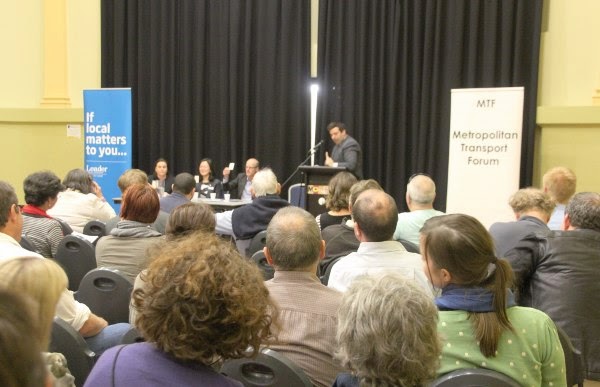
Transport Forum question on Climate change and heatwaves


Originally Published at Climate Action Moreland.

The Moreland Transport Forum was held on Monday, just a few hours after Premier Denis Napthine signed the East West Link contracts. A few of us from Climate Action Moreland attended handing out our leaflet on East West Link being Climate Madness, and a climate postcard.

Andrea Bunting from our group submitted the following question to be asked at the forum. It was the most highly rated question.

With climate change, we are facing a hotter, carbon-constrained world. Currently during heatwaves we can experience power failures for public transport, unbearable heat in trams and trains, and buckling of train tracks. Dark roads also amplify the urban heat island effect; hence temperatures in our urban areas are much hotter, leading to increased deaths and illness. What will you to do (a) reduce dependency on fossil fuel usage in transport; (b) ensure that all transport infrastructure can deal with heat waves; and (c) reduce urban heat island effect from dark roads?

The question was asked slightly differently in person at the forum to all three candidates - sitting member for Brunswick Jane Garrett MP, Greens candidate for Brunswick Tim Read, and Liberal Party no 2 on the ticket for Northern metro region (Upper house) Gladys Liu.

Saturday, December 15, 2007

Melbourne now Freeway capital of Australia - a Disaster for Climate and Sustainability

A new report from University of Melbourne on travelling to work says that car travel in Melbourne is the "worst performing city over the three decades. It has the biggest increase in car driving and the biggest declines in public transport, car pooling and walking. More cars are driven to work each day in Melbourne than in Sydney, despite Sydney’s much bigger workforce. The share of workers who drive is now higher in Melbourne than in Sydney, Brisbane, Hobart and even Canberra. This appears to be a result of Melbourne having constructed more urban freeways and tollways over the last 30 years than any other capital."
,
Related: Travel to work in Australian capital cities, 1976-2006 |

Victoria Envirowatch: one year in

The report’s principal author, Dr Paul Mees, said that despite the recent focus on climate change and the push towards more sustainable living, city based workers remain unconvinced with many driving to work. "There has been a dramatic increase in the number of cars driven to work each day in Australia capital city – a 70.1% rise over the past 30 years. That’s more than 1.4 million cars on the road each day since census data began recording work travel information. The result has been a huge increase in greenhouse emissions."

According to the report just over 78% of Melbourne workers drive each day, while just 13.9% use public transport. Cycling accounts for just one per cent of trips everywhere, though the figure is higher in Canberra (2.5%) and in the innercity suburbs of capital cities. Although increasing its profile as sustainable transport for urban workers, cycling is growing from a very low base.

The report says that "The census data show that treating traffic problems by building more roads is an ineffective response. The main result has been to shift travellers out of environmentally friendly modes and into cars. By contrast, the performance of public transport and walking can be improved more cheaply and would produce superior environmental outcomes."

The federal government comes in for criticism over its funding priorities: "The Auslink scheme is exacerbating urban transport problems, because it is biased in favour of new roads and against urban rail infrastructure. Investment needs to be redirected away from urban motorways towards more environmentally friendly modes, particularly public transport and walking. This is the only way Australia can meet its international environmental obligations in the transport arena."

The report recommends that "State governments also need to change their transport policies, which remain dominated by motorway-building. In addition, they need to reform the governance and management of public transport, especially in Sydney and Melbourne, both of which lack competent, dynamic regional public transport agencies."

Big Carbon emissions Projects in the Pipeline


Victorian Premier John Brumby has just come back from the Climate Change talks in Bali and undoubtedly we will see pronouncements about his Governments green credentials and projects to reduce emissions by 60 per cent by 2050. But Kenneth Davidson has just written a scathing column in the Age titled Big projects taking us all for a ride.

Davidson points out that:

* Melburnians are growing more dependent on cars to get to work, and going backwards in terms of comparative trends in other Australian cities. (See Melbourne now Freeway capital of Australia - a disaster for climate and sustainability)
* In 2005 the State Labor Government extended the life of the Hazelwood power station from 2009 to 2031, even though it is the dirtiest power station in the country.
* Building a highly energy intensive desalination plant under a public-private partnership, thus ensuring that we will get and pay for deslinated water and profits for the plant operator even when there is sufficient natural supply in our water reservoirs. In other words profits from selling water will take priority over CO2 emissions and climate change.
* The Government is considering an east-west tunnel connecting the Eastern Freeway to EastLink, running under the Melbourne Cemetery at a time of rising oil prices with the onset of Peak Oil which will make "tollways redundant long before their economic life ends."
* There has been no significant heavy rail extensions since the opening of the Glen Waverley line in 1930. According to Davidson Melbourne's public transport system has been mismanaged since its privatisation in 1999 with subsidies to Melbourne's public transport operators having doubled in real terms since 1999.

According to Environment Victoria half of the Victorian Government’s environment election promises are at risk of not being delivered or have already been broken. The report says that the State Government has broken three of its 68 pre-election environment promises, while another 31 show little or no signs of progress. It has so far kept seven of its pre-election promises, while another 27 are on target to be delivered. The broken promises relate to the decision to raid rivers of their legal water entitlements to provide water for urban use and agriculture. Over 50 per cent of the Government’s climate change promises are at risk of not being delivered.

Ms O’Shanassy from Environment Victoria said the Government would need to significantly boost energy efficiency and renewable energy programs over the next three years to meet their election promises. "Unfortunately, even if all these promises are met, they are unlikely to ensure Victoria’s greenhouse gas emissions actually fall," she said. "What we’re really missing is a short-term target to reduce pollution that informs all government decisions."

Don't hold your breathe. Our politicians are stuffing up in not funding major public transport infrastructure building in reversing car dependence. This particularly affects outer suburban areas. The crunch will come with Peak Oil as petrol prices increase as demand soars. Transport is second to Electricity production in its contribution to greenhouse gas emissions. The greater the intransigence now the greater the social cost downstream to our children and grandchildren.

Reports:

* Travel to work in Australian capital cities, 1976-2006: an analysis of census data | Press Release
* Envirowatch: one year in


Originally published at Melbourne Cyclist by Takver