Mastodon Climate Citizen --> Mastodon

Wednesday, October 8, 2014

Tokelau and Pacific warriors fighting climate change and western intransigence


Island nations are very aware of the threat to their culture and heritage and very lives from the perils of climate change, ocean acidification and sea level rise. Tokelau has chosen to lead by example converting their electricity to 100 per cent renewables in 2012 and now sending climate warriors to Australia to close down the largest coal port in the world for a day.

While we sit and ponder the hand of climate change setting new temperature records in Australia or the most severe drought on record in California, the people of the Carribean, the Indian Ocean and Pacific small Island states suffer the effects of rising sea levels, rising ocean ocidification and increasing intensity of storms.

Although Pacific Island countries only contribute 0.03% of the world's greenhouse gas emissions they will be the first to go under if the business as usual scenarios of the IPCC come to pass.

The leader of tiny Tokelau in the South Pacific knows this too well. The Ulu o Tokelau, Aliki Faipule Kuresa Nasau, made this statement at the 25th South Pacific Regional Environment Programm (SPREP) Meeting in Majuro in the Marshall Islands on 3 October 2014. The meeting called for less talk and more action on climate change financing such as the Green Climate Fund. Other important themes discussed included the importance of building island resilience, developing the blue-green economy and the growing the co-operation for meaningful and durable partnerships to achieve common goals.

Tuesday, October 7, 2014

Divestment: Local Government Super add negative filter for coal


Local Government Super, an industry superannuation fund covering local government workers in NSW, has announced increased negative screening for high carbon assets such as coal mining and coal power generators, specifically citing the impact of climate change for this decision.

The additional negative screening will exclude companies from its portfolio with a material exposure to ‘high carbon sensitive’ activities such as coal and tar sands mining, as well as coal-fired electricity generators. The threshold for this screening has been set at a minimum of one third of company revenue.

The Super fund has used negative screening since 2000 regularly reviewing this policy and it's application. The policy has limited investment with companies involved with tobacco, gambling, armaments and old growth forests, as well as excluding companies with poor management of environment, social and governance (ESG) risks.

Local Government Super has about $8 billion in investments. The policy will mean about $25 million will be divested from various mining and energy companies, including $15 million in shares of AGL Energy and Whitehaven Coal.

Sunday, October 5, 2014

Moreland Council plan to cut community emissions 22 per cent by 2020


Original article published at Climate Action Moreland.

At the Coburg Carnivale, the Zero Carbon Evolution strategy plan was launched by Moreland Council Mayor Cr Lambros Tapinos, Wills Federal MP Kelvin Thomson and Brunswick State MP Jane Garrett. The strategy aims for community greenhouse gas emissions to be reduced by 22 per cent by 2020.

Friday, October 3, 2014

Australian National University divests from 7 fossil fuel and mining companies


The Australian National University has announced divestment of $16 million in shares in seven Australian fossil fuel and mining companies.

The Council of the University has agreed to a proposal by Vice-Chancellor Professor Ian Young AO to divest following an independent review of equity investments under its Socially Responsible Investment Policy conducted by the Centre for Australian Ethical Research (CAER).

The companies the university will be divesting from are Iluka Resources, Independence Group, Newcrest Mining, Sandfire Resources, Oil Search, Santos and Sirius Resources. The investments amount to around 5.1 per cent of the University’s Australian equity holdings and approximately one per cent of its total investment holdings.

Thursday, October 2, 2014

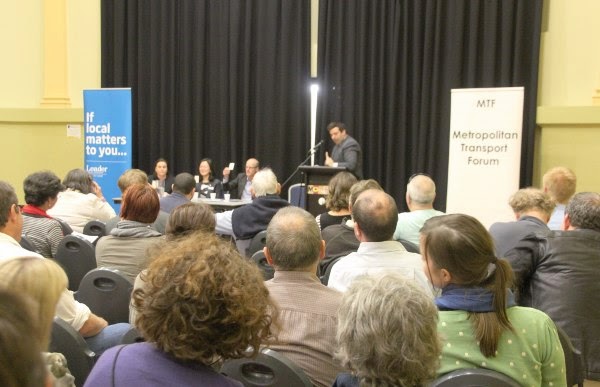
Transport Forum question on Climate change and heatwaves


Originally Published at Climate Action Moreland.

The Moreland Transport Forum was held on Monday, just a few hours after Premier Denis Napthine signed the East West Link contracts. A few of us from Climate Action Moreland attended handing out our leaflet on East West Link being Climate Madness, and a climate postcard.

Andrea Bunting from our group submitted the following question to be asked at the forum. It was the most highly rated question.

With climate change, we are facing a hotter, carbon-constrained world. Currently during heatwaves we can experience power failures for public transport, unbearable heat in trams and trains, and buckling of train tracks. Dark roads also amplify the urban heat island effect; hence temperatures in our urban areas are much hotter, leading to increased deaths and illness. What will you to do (a) reduce dependency on fossil fuel usage in transport; (b) ensure that all transport infrastructure can deal with heat waves; and (c) reduce urban heat island effect from dark roads?

The question was asked slightly differently in person at the forum to all three candidates - sitting member for Brunswick Jane Garrett MP, Greens candidate for Brunswick Tim Read, and Liberal Party no 2 on the ticket for Northern metro region (Upper house) Gladys Liu.

Tuesday, September 30, 2014

Guest Post: Human hands are all over Australia's hottest ever year in 2013


New research by multiple separate research groups shows that extreme heat events are increasing and can be clearly attributable to global warming. The research draws upon modelling and Fractional Attribution of Risk (FAR) of extreme weather events including from Australian scientists who have shown that extreme heatwaves and hot spells are caused by the increase in greenhouse gases in the atmosphere. It confirms earlier published research by Karoly and Lewis that the Record Australian 2013 temperatures caused by climate change.

Australia is already feeling the heat of global warming and Spending wisely now will make heatwaves less costly later. Our cities in particular are becoming hothouses in summer as global warming amplifies the urban heat island effect which along with increasing urbanisation like in Sydney, provides major climate impacts. There are already major challenges for adaptation for cities like Melbourne with Municipal Councils often on the front line.

Monday, September 29, 2014

Australia's Foreign minister Julie Bishop shunned at UN climate summit


The original article was published at nofibs.com.au.

Australia's Foreign Affairs minister Julie Bishop took the podium at the United Nations Climate Summit to an almost empty plenary to announce that Australia was balancing economic growth with climate action, with a 5 per cent cut based on 2000 levels by 2020 using $2.55 billion to fund emission reductions under the Government's Direct Action Plan. (Read speech) Two photos tell the story of her address to this climate summit, of the vast gap between the government's rhetoric and actual action.

The first is the more flattering image the Abbott Government would prefer you to see tweeted by Australia's ambassador and permanent representative to the United Nations Gary Quinlan:


The second photo is a wide angle shot encompassing much of the plenary room and shows that most delegates and ministers were not present when Ms Bishop delivered her statement. While this does not in itself mean much, it is symptomatic of Australia being diplomatically shunned for it's retrograde steps on climate policy, including being the first country to abolish a carbon pricing scheme, and the snubbing of the summit by Prime Minister Tony Abbott who attended UN sessions discussing on terrorism the following day.


Sunday, September 28, 2014

South Australia sets 50 per cent renewables target for 2025


Congratulations to South Australian Premier Jay Wetherall who announced this past week that the state was about to reach it's 2020 target of 33 per cent renewables in the electricity sector and had chosen to increase this target to 50 per cent by 2020.

“This new target of half of the States power to be generated by renewable sources will create jobs and drive capital investment and advanced manufacturing industries." he said in a statement. (statement PDF)

The Federal Renewable Energy Target (RET) has been a significant factor in attracting $5.5 billion in investment and was likely to support a further $4.4 billion by 2025, creating much needed jobs in solar installation and advanced manufacturing.

“This new target of half of the States power to be generated by renewable sources will create
jobs and drive capital investment and advanced manufacturing industries." Wetherall said, “But we will only be successful with both of these targets if the Federal Government maintains the current Renewable Energy Target Scheme arrangements."

The Abbott Government Warburton review of the RET has recommended either closing the scheme to new investors or by setting targets based on the growth of electricity demand. Both of these options would throw a spanner in the works of investment in renewable energy in Australia.

Thursday, September 25, 2014

Oxfam: Green Climate Fund pledges still far below target for funding adaptation by developing countries


The UN Climate Change Summit in New York brought many new pledges and commitments on emissions reduction targets, reduced deforestation, and in financing the Green Climate Fund, and many more.

It was hailed by by UN Secretary General Ban Ki-Moon as a successful start for negotiating a global climate agreement in Paris in December 2015 at COP21.

But Graça Machel, the widow of Nelsen Mandela, who followed Ban Ki-moon in the closing speeches of the summit, identified that there is still "a huge mismatch between the magnitude and of the challenge and the response that we heard here today". Machel is a member of the elders, an independent group of global leaders foundered by Nelson Mandela.

Take the Green Climate Fund as an example.

Graça Machel: Are pledges enough to avoid the climate change precipice?


The widow of Nelson Mandela, Graça Machel, addressed the UN Climate summit in the closing ceremony directly after UN General Secretary Ban Ki-moon's closing statement and questioned whether the pledges made so far meet the challenge that we face.

Because our very survival may depend upon these decisions.

"We have reached a tipping point" she said, "So our commitments must be ambitious enough to stop us falling over the precipice. And personally I have mixed feelings. I acknowledge that there is the beginning of understanding of the gravity of the challenge that we face. But at the same time I have the impression that there is a huge mismatch between the magnitude and of the challenge and the response that we heard here today. The scale is much more than what we have achieved."

Machel highlighted the huge marches on Sunday in New York, Melbourne and around the world demanding action on climate justice, which brought applause from those in the chamber.

"So the obligation in my view is to step up the ambition, is to maximise fairness, to increase the momentum, and to make sure that from now to Paris, each one of us has made their homework of matching the magnitude of the problem with the response we are prepared to do. We, citizens of the world, will be watching." Machel told the 120 world leaders and other representatives gathered.