Mastodon Climate Citizen --> Mastodon
Showing posts with label CBD. Show all posts

Sunday, November 3, 2024

Australia at Biological Diversity COP16 in Columbia

UN Convention on Biological Diversity (CBD) COP16 meets from October 20 - 27 in Cali, Columbia. This is a Live article actively updated during October.

Participants will review the state of implementation of the Kunming-Montreal Global Biodiversity Framework, including through alignment with national biodiversity strategies and action plans as well as resource mobilization. At the previous summit, COP15, which was held in Montreal in December 2022, countries agreed to the Kunming-Montreal Global Biodiversity Framework (GBF). The GBF is a set of four goals to 2050 and 23 targets to 2030 with the overarching mission of reversing the decline of biodiversity around the world by 2030. (Read the goals and targets here: The Montreal Moment for Biodiversity: Kunming-Montreal Global Biodiversity Framework adopted)

Australia submitted its 6th national report to the CBD in 2020, and is due this year to submit a new national report.

COP16 Meeting documents | Carbon Brief INtereactive: who wants what | DCCEEW on CBD
CBD Youtube | CBD-Live YoutubeIISD Earth Negotiation Bulletin on COP16

Tuesday, December 20, 2022

The Montreal Moment for Biodiversity: Kunming-Montreal Global Biodiversity Framework adopted

Final COP15 Decision Plenary at Montreal

The  Kunming-Montreal Global Biodiversity Framework, due to the pandemic, has been four years in the making, was finally adopted in Montreal in the early hours of the morning on the 19th December 2022. 

This is the 'Montreal moment' for the Biodiversity crisis and the Convention on Biological Diversity, the equivalent of the 'Paris moment' for the UNFCCC and the climate crisis. 

Like the Paris Agreement, it is far from being perfect. The consensus process means that much compromise is entailed in reaching a global agreement. 

It sets mission goals for 2030 and 2050 to arrest loss of ecosystems and conserve species numbers. It includes an ambitious 30 per cent of land and 30 per cent of ocean for conservation by 2030. This is a step in the right direction, although recent science says that between 44 per cent (1) or 50 percent of land (2) may be necessary to protect to meet the mission statement.

The Package also includes reform of $500bn (£410bn) of environmentally damaging subsidies, and halt pollution that damages ecosystems by the end of the decade. Countries from the global north would contribute $30bn a year for conservation by the end of the decade. 

Strong language for the protection of indigenous rights and territories emphasised throughout the 23 specific targets and four goals that make up the main agreement, known as the post-2020 global biodiversity framework. 

While a separate Biodiversity Fund was not agreed, there was a compromise plan to create a new financing mechanism for biodiversity housed under the UN’s Global Environment Facility (GEF).

Monday, December 19, 2022

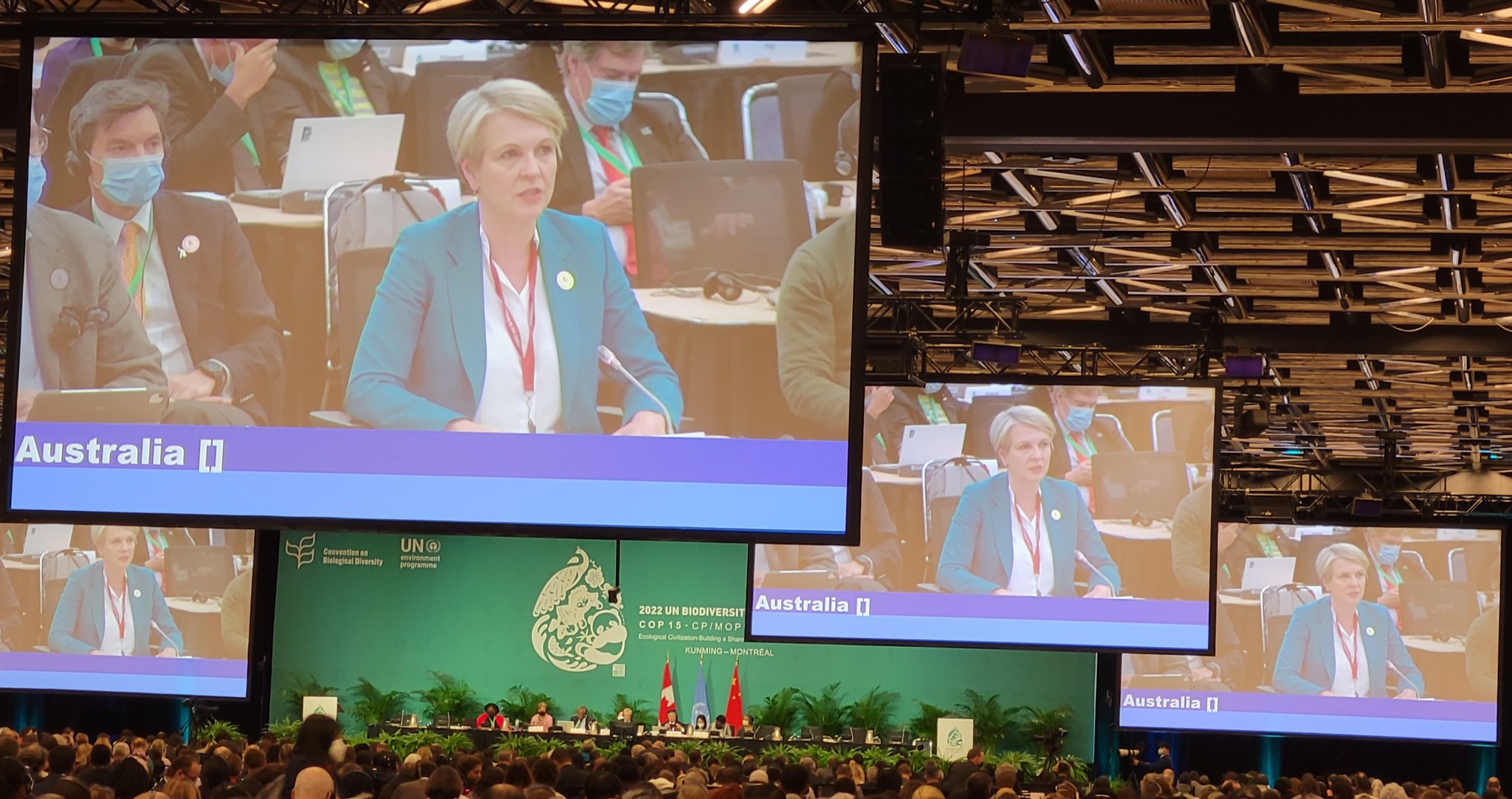
Australia and the UN Biodiversity Conference COP15

Tanya Plibersek in Plenary Photo: Nat Pelle (ACF)


The United Nations Biodiversity Conference (COP15 / CP-MOP10 / NP-MOP4) is meeting in Montreal, Canada, 7-19 December 2022. This is part of the UN Convention on Biological Diversity (CBD).

The Biodiversity conference is important as countries will set the 2030 targets. Parties will seek to finalise the 10-year post-2020 global biodiversity framework (GBF). (read my blog on Global framework on Biodiversity - Australian statement on the Convention on Biodiversity 2030 target)

Environment Minister Tanya Plibersek has confirmed she will attend COP15 in Montreal.

| COP15 Day Summaries | Australian Pledges | Tracking Minister Plibersek | Resources |

Breaking: Kunming-Montreal Global Biodiversity Framework adopted, although not without some controversy over objection of DRC. See The Montreal Moment for Biodiversity: Kunming-Montreal Global Biodiversity Framework adopted

Thursday, December 8, 2022

"Time to forge a Peace Pact with Nature" says UN Secretary General Antonio Guterres at COP15 Biodiversity conference:

Antonio Guterres, the UN Secretary General, again stepped up the rhetoric at the openning plenary of the Biodiversity conference in Montreal, calling for a "Peace Pact with Nature".

He articulated the rapid species and ecosystems decline and the costs to humanity of cost measured in lost jobs, hunger, diseases and deaths, and higher prices for water, food and energy.

He focussed on three concrete actions:

  • Governments should develop bold national action plans across all ministries, from finance and food, to energy and infrastructure. This includes "plans that re-purpose subsidies and tax breaks away from nature-destroying activities towards green solutions like renewable energy, plastic reduction, nature-friendly food production and sustainable resource extraction. Plans that recognize and protect the rights of Indigenous peoples and local communities, who have always been the most effective guardians of biodiversity. And National Biodiversity Finance Plans to help close the finance gap."
  • The private sector and business must recognize that profit and protection must go hand-in-hand. That means the food and agricultural industry moving towards sustainable production and natural means of pollination, pest control and fertilization. It means the timber, chemicals, building and construction industries taking their impacts on nature into account in their business plans. It means the biotech, pharmaceutical and other industries that use biodiversity sharing the benefits fairly and equitably. It means tough regulatory frameworks and disclosure measures that end greenwashing, and hold the private sector accountable for their actions across every link of their supply chains. And it means challenging the relentless concentration of wealth and power by few that is working against nature and the real interests of the majority.  
  • Dveloped countries must provide bold financial support for the countries of the Global South as custodians of our world’s natural wealth.

Friday, September 23, 2022

Australia commits to Global Nature Pledge to reverse biodiversity loss by 2030 during UN General Assembly

More than 93 countries have signed the Global Leaders Pledge for Nature for Sustainable Development to reverse biodiversity loss by 2030. Prime Minister Anthony Albanese just committed Australia to this pladge. The previous government of Scott Morrison refused to act on this pledge.

The pledge was developed by the Alliance of Small Island States (AOSIS), Belize, Bhutan, Colombia, Costa Rica, the EU, Finland, Kenya, Seychelles, the UK and an alliance of organisations.

It is part of the UN convention on Biological Diversity which is considering a new global draft agreement (PDF) for adoption at Montreal, Canada, from 7 - 19 December 2022  Conference of the Parties meeting (COP15). This is a landmark agreement addressing the biodiversity crisis, an equivalent for what the Paris Agreement did for climate change.

Thursday, September 2, 2021

Global framework on Biodiversity - Australian statement on the Convention on Biodiversity 2030 target


Australia's statement on the Convention on Biodiversity Plenary 24 Aug - Open-ended Working Group 3 on Post-2020 Global Biodiversity Framework. The Conference of the Parties (COP15) for the Convention on Biodiversity is coming up early next year. I haven't seen any local news on this...

I'd like to highlight this part of the statement in particular:
"Australia welcomes a global target for the protection of 30 per cent of land and 30 per cent of sea by 2030. We support the focus in this target on areas important for biodiversity and through a combination of protected areas and other effective area-based conservation measures. Australia also recognises that Indigenous Peoples and Local Communities (IPLCs) must be full partners in the implementation of this target."

You can read the draft global framework on Biodiversity to be put for adoption.

The draft framework includes 21 targets for 2030 that call for, among other things:

• At least 30% of land and sea areas global (especially areas of particular importance for biodiversity and its contributions to people) conserved through effective, equitably managed, ecologically representative and well-connected systems of protected areas (and other effective area-based conservation measures) 
• A 50% of greater reduction in the rate of introduction of invasive alien species, and controls or eradication of such species to eliminate or reduce their impacts 
• Reducing nutrients lost to the environment by at least half, and pesticides by at least two thirds, and eliminating the discharge of plastic waste 
• Nature-based contributions to global climate change mitigation efforts of least 10 GtCO2e per year, and that all mitigation and adaptation efforts avoid negative impacts on biodiversity 
• Redirecting, repurposing, reforming or eliminating incentives harmful for biodiversity, in a just and equitable way, reducing them by at least $US 500 billion per year 
• A $US 200 billion increase in international financial flows from all sources to developing countries.