Mastodon Climate Citizen --> Mastodon

Wednesday, May 3, 2023

Australia talking renewables at Petersberg Climate Dialogue 2023 while new gas projects launch

Senator Jenny McAllister at
Petersberg Climate Dialogue

The Petersberg Climate dialogue is ocurring in Berlin, Germany over 2-3 May 2023. About 40 countries are represented. Australia is represented by Senator the Hon Jenny McAllister, Assistant Minister for Climate Change and Energy.

The Dialogue is co-hosted by Germany and the incoming UNFCCC Conference of the Parties (COP) President, which for 2023 is the United Arab Emirates.

Actions under discussion include on climate change mitigation, energy transition, adaptation and loss and damage, and climate finance.

According to the press release Minister McAllister will participate in high-level political discussions on global energy transitions and adaptation action and co-facilitate discussions on new funding arrangements to address loss and damage arising from climate change impacts.

Tuesday, May 2, 2023

Email to the Treasurer for Budget 2023: stop subsidising fossil fuels

Dear Treasurer, Jim Chalmers
I know this is a late request and that the major decisions for Budget 2023 have already been made and signed off.

Yet as an Australian citizen who takes a strong interest in politics and Federal Government decisions, I feel it is important to register my suggestions for the budget. 

Addressing the climate, biodiversity and pollution crises are uppermost in my mind. But I am also aware of cost of living pressures, the housing crisis, the health crisis and level of poverty that low jobseeker, single parent and other government allowances engender,and the extent of the government deficit. And the change in global geopolitics has meant increased defence spending. 

Addressing all these issues requires hard choices. I'd like you firstly to reconsider the Stage 3 tax cuts, which addresses the revenue side. These were legislated prior to the pandemic. I don't think they were good taxation policy even when formulated, now they are disastrous.They greatly increase inequality while reducing government revenue at a t8ime of large deficits.

I know that tax subsidies to Fossil fuel companies are running at about $11 billion per year. We need to stop offering carrots to fossil fuels. I know it is difficult cutting a program of subsidies, but perhaps there can be staged phaseout over a the forward estimates? Now would be the time to start such a phaseout as part of addressing budget repair.

I would also like to see  the Petroleum resource rent tax (PRRT) legislation updated to better capture windfall profits of fossil fuel companies. It is a disgrace that Australia does not have a sovereign weath fund that shares the huge profits that have been made in mining and export of our fossil fuel and mineral resources.

Minister, I know the Regional development Fund , CEFC and ARENA are helping to fund renewables expansion, renewable hydrogen, green steel. This investment is vital to develop a renewable-powered export industry.. Green steel and aluminium made by us is natural value adding supporting Australian jobs and industry.

My last request is that the Budget establish a National Energy Transition Authority to effectively manage the impacts for workers and communities of phase-out of coal and gas in our electricity sector as we ramp up renewable energy solutions supported by pumped hydro and grid level batteries, and micro-grids.

Treasurer, I know your government is already acting on climate change, but the speed of action in multiple sectors is also important. I have read the latest IPCC 6th assessment Synthesis report and understand the climate crisis we are in. Given this, I think my suggestions above are moderate and sensible.

Yours sincerely,
John Englart

Tuesday, January 10, 2023

Guest Post: Labor’s scheme to cut industrial emissions is worryingly flexible


BHP steelworks at Port Kembla Phto: John Englart

Rebecca Pearse, Australian National University

The federal government today proposed new rules to regulate greenhouse gas emissions from Australia’s polluting industrial sector. The rule changes apply to a measure known as the “safeguard mechanism”, and are supposed to stop Australia’s top 215 emitters, such as new coal, oil and gas projects, from emitting over certain thresholds, or “baselines”.

The safeguard mechanism was established by the Abbott Coalition government in 2016. It’s been widely criticised for lacking teeth – indeed, industrial emissions have actually increased since the mechanism began.

The safeguard mechanism was reviewed last year and Labor had promised a revamp. The fine detail of the changes is crucial, because it will determine how well Australia brings down its emissions on the path to net zero.

So would Labor’s proposed reforms, if implemented, be effective and equitable? Unfortunately, it appears no. They involve only very modest changes to a very flexible regime, and many issues plaguing the safeguard mechanism under the previous government continue.

Ozone action on track, helping avoid 0.5C of global warming by 2100 says UNEP

Ozone recovery is back on track says the latest UNEP assessment report on ozone depletion and recovery.

Rogue emissions from China of ozone-depleting chemicals had threatened to delay recovery by a decade. But the emissions were stopped, says the New York Times.

“That ozone recovery is on track according to the latest quadrennial report is fantastic news. The impact the Montreal Protocol has had on climate change mitigation cannot be overstressed. Over the last 35 years, the Protocol has become a true champion for the environment,” said Meg Seki, Executive Secretary of the United Nations Environment Programme’s Ozone Secretariat. “The assessments and reviews undertaken by the Scientific Assessment Panel remain a vital component of the work of the Protocol that helps inform policy and decision makers.”

Monday, January 9, 2023

Chubb Review into the integrity of Australian Carbon Offsets sends mixed messages

Chubb review into the integrity of carbon offsets ignores the elephant in the room argues the Climate Council: too many major emitters are buying ACCUs so that they can continue to pollute as usual.

“The Chubb Review has provided some positive recommendations for improving the integrity and transparency of carbon credits. But the most important question is: where and how will carbon credits be used?" says Climate Council Head of Advocacy Dr Jennifer Rayner

“Big polluters shouldn’t be able to keep polluting as usual by offsetting much or all of their emissions under the Safeguard Mechanism."

The Chubb Review found the carbon offsets scheme was "fundamentally" well designed when it was first introduced, but called for more data transparency which would improve integrity, recommending that "the default should be that data be made public, including carbon estimation areas" and the government should consider a national platform to share this information.

Tuesday, January 3, 2023

2002 Cabinet Documents: Climate change impacts acknowledged by Foreign Minister Downer and Environment Minister Kemp as Australia refuses to sign Kyoto Protocol

Howard Cabinet in 2002

Cabinet documents released by the National Archives from 2002 shine a light on the conservative Liberal-National Party Coalition Government of Prime Minister John Howard in refusing to sign on to the UNFCCC Kyoto Protocol, and also the decision not to proceed with a High Speed East Coast Train network linking Melbourne, Canberra, Sydney and Brisbane.

The Cabinet documents highlight that Cabinet Ministers Alexander Downer (Foreign Minister) and David Kemp (Environment and Heritage Minister) acknowledged that climate impacts would be felt by Australians, no matter what measures were taken. Rather than planning for the future as suggested by a Treasury Department submission, little action was taken regarding expansion of the fossil fuel sector, or long term inter-capital transport planning.

Tuesday, December 20, 2022

The Montreal Moment for Biodiversity: Kunming-Montreal Global Biodiversity Framework adopted

Final COP15 Decision Plenary at Montreal

The  Kunming-Montreal Global Biodiversity Framework, due to the pandemic, has been four years in the making, was finally adopted in Montreal in the early hours of the morning on the 19th December 2022. 

This is the 'Montreal moment' for the Biodiversity crisis and the Convention on Biological Diversity, the equivalent of the 'Paris moment' for the UNFCCC and the climate crisis. 

Like the Paris Agreement, it is far from being perfect. The consensus process means that much compromise is entailed in reaching a global agreement. 

It sets mission goals for 2030 and 2050 to arrest loss of ecosystems and conserve species numbers. It includes an ambitious 30 per cent of land and 30 per cent of ocean for conservation by 2030. This is a step in the right direction, although recent science says that between 44 per cent (1) or 50 percent of land (2) may be necessary to protect to meet the mission statement.

The Package also includes reform of $500bn (£410bn) of environmentally damaging subsidies, and halt pollution that damages ecosystems by the end of the decade. Countries from the global north would contribute $30bn a year for conservation by the end of the decade. 

Strong language for the protection of indigenous rights and territories emphasised throughout the 23 specific targets and four goals that make up the main agreement, known as the post-2020 global biodiversity framework. 

While a separate Biodiversity Fund was not agreed, there was a compromise plan to create a new financing mechanism for biodiversity housed under the UN’s Global Environment Facility (GEF).

Monday, December 19, 2022

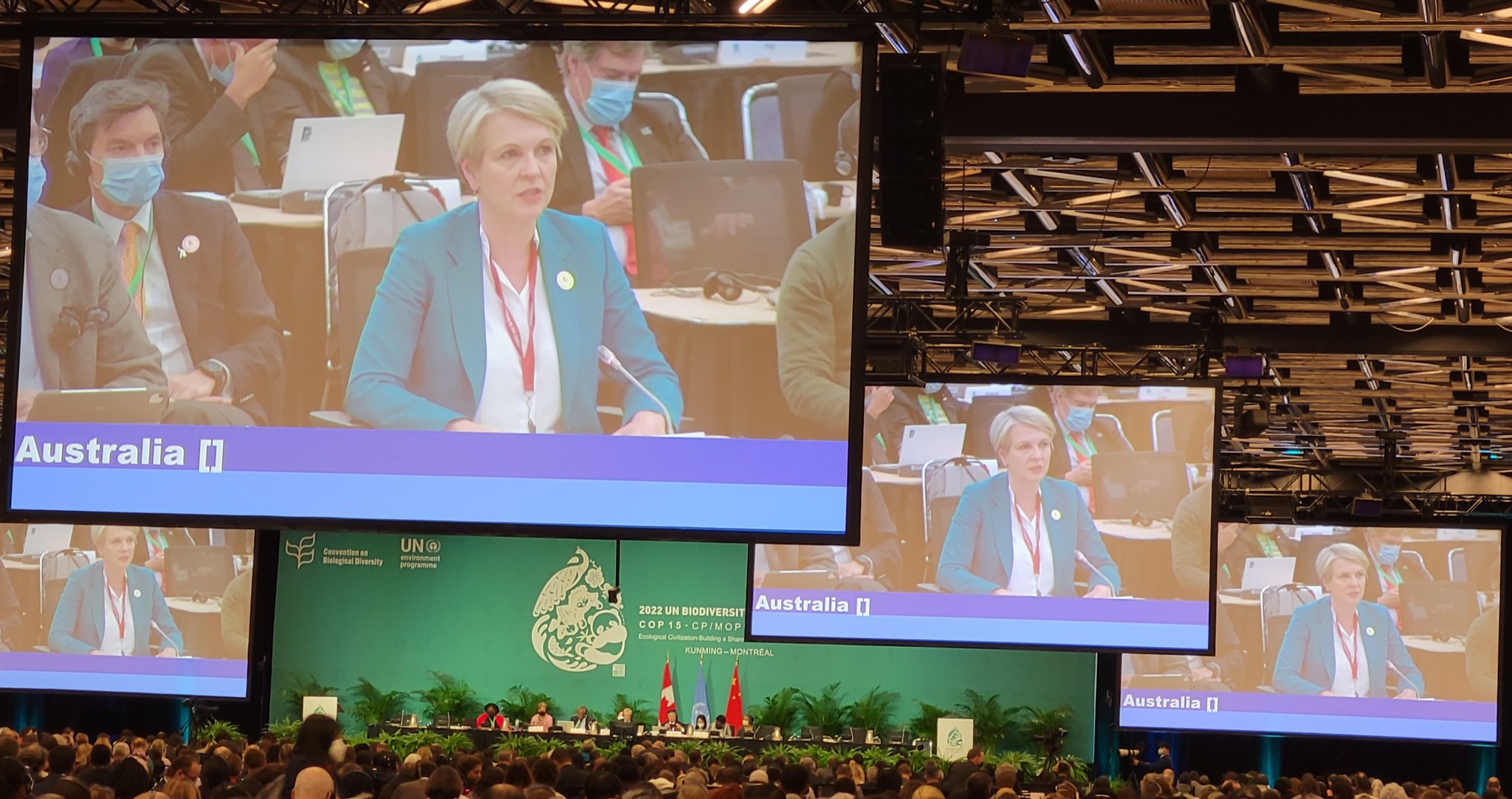
Australia and the UN Biodiversity Conference COP15

Tanya Plibersek in Plenary Photo: Nat Pelle (ACF)


The United Nations Biodiversity Conference (COP15 / CP-MOP10 / NP-MOP4) is meeting in Montreal, Canada, 7-19 December 2022. This is part of the UN Convention on Biological Diversity (CBD).

The Biodiversity conference is important as countries will set the 2030 targets. Parties will seek to finalise the 10-year post-2020 global biodiversity framework (GBF). (read my blog on Global framework on Biodiversity - Australian statement on the Convention on Biodiversity 2030 target)

Environment Minister Tanya Plibersek has confirmed she will attend COP15 in Montreal.

| COP15 Day Summaries | Australian Pledges | Tracking Minister Plibersek | Resources |

Breaking: Kunming-Montreal Global Biodiversity Framework adopted, although not without some controversy over objection of DRC. See The Montreal Moment for Biodiversity: Kunming-Montreal Global Biodiversity Framework adopted

Thursday, December 8, 2022

Capacity Investment Scheme for Energy Storage agreed by Federal and State Energy ministers

State Energy Ministers met with Chris Bowen, Federal Minister for Climate and Energy, and agreed on a new scheme that would boost energy storage, both batteries and long duration storage.

The Labor Government has set a renewables target of 82 per cent by 2030. Along with more solar and wind  energy storage is needed to make dispatchable power for the grid.

“The Capacity Investment Scheme is essentially a ‘keep the lights on’ mechanism,” Bowen said.

“Australian households, industry and the energy market are all moving with their feet towards more affordable renewable energy. The Capacity Investment Scheme will ensure the reliable power we need is delivered as this transition continues.”

Minister outlines major update to Australian environmental laws and the EPBC Act by end of 2023

Photo: Tanya Plibesek speech
Australia: Environment Minister Tanya Plibersek announces formal response to the Independent Review of Australia’s Environment Protection and Biodiversity Conservation Act.
 
"At the heart of our reform is a conceptual shift. When we reform our environmental laws, we will take them from being nature negative, where we just manage an overall decline in our environment, to nature positive, where we protect our land and leave it in a better state than we found it." said Plibersek at a Queensland Conservation Council event. 

Major Reforms include: 
  • introduction of National Environmental Standards, 
  • new system of regional planning, 
  • overhaul of environmental offsets, and 
  • establishment of an independent Environment Protection Agency. 

New National Environmental Standards will apply to Regional Forestry Agreements, which were previously exempt from EPBC Act regulation. This means threatened species and ecosystems will come back under Federal government regulation.

Climate will be a consideration, but no climate trigger for the amended legislation: 
"proponents of large projects be required to publish their lifetime, domestic carbon dioxide emissions. Proponents will also be required to disclose what they will do to manage or offset their emissions, in line with Australia’s climate targets."